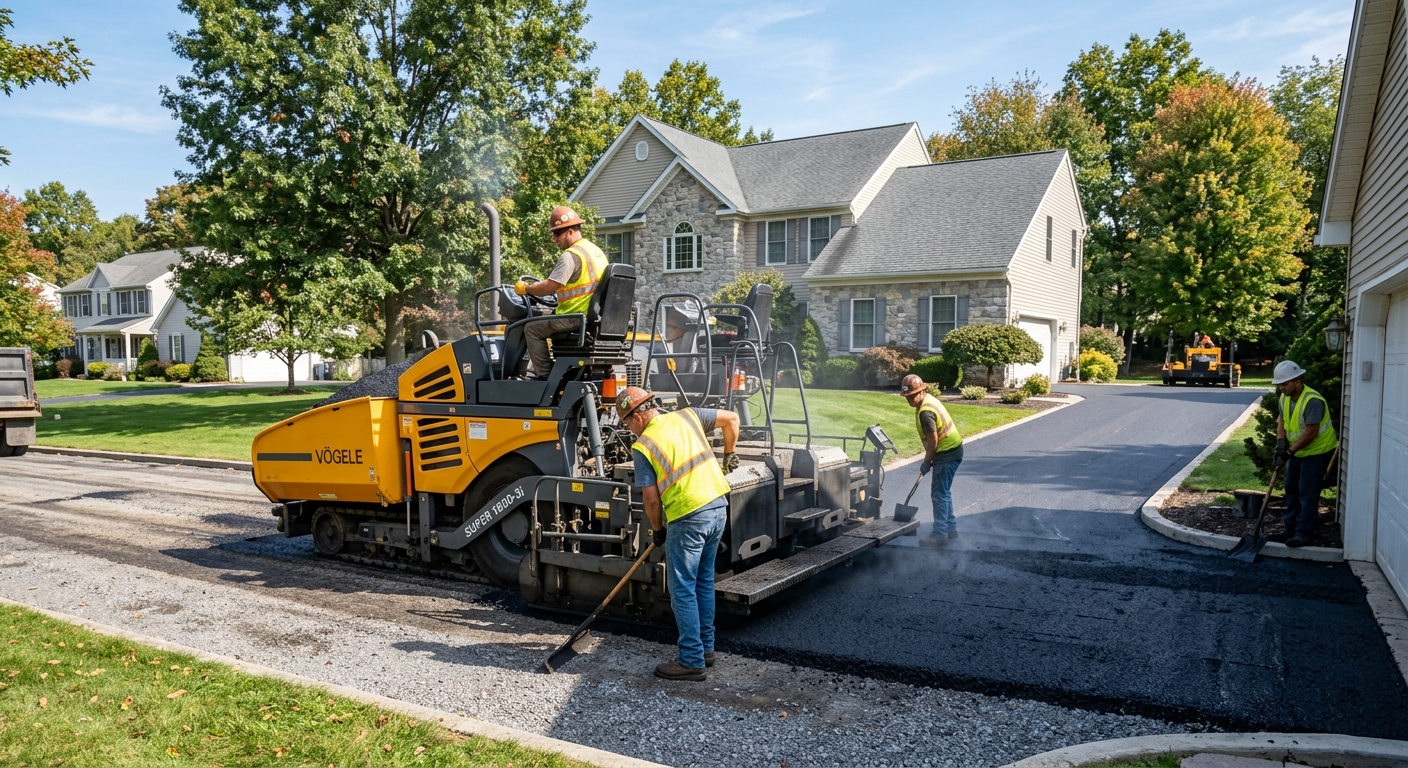
What a new driveway costs in Norwood
Most driveways in Norwood are at least 60 years old—nearly nine out of ten homes here were built before 1980 (U.S. Census Bureau, ACS 2024). Nearly 68% are owner-occupied, and just over a third are single-family homes. That means most driveways aren’t shared, but they often date from a time when cars were smaller and drainage was an afterthought. Paving is one of the most expensive detached-home upkeep projects you’ll face, and price differences between contractors rarely come down to just material or labor. The biggest driver is what happens under the surface: the thickness and compaction of the new stone base, the handling of the old subgrade (mostly glacial till or compacted fill here), and whether proper drainage is built in.
Norwood’s freeze-thaw cycle—where water penetrates and freezes in the base—can cut a driveway life in half if the sub-base is shortchanged. Most of what determines performance and final price is buried, not visible. Any quote that seems “cheap for new asphalt” should prompt questions about how much new aggregate they’re actually bringing and whether they’re prepping for local soil conditions. Here’s what you can expect for typical Norwood driveway projects:
| Service |
Best for |
Lifespan |
Price range |
| Asphalt — full replacement with new base |
failed base, structural cracking |
20–30 yrs |
$3,500–$9,100 |
| Asphalt overlay / resurfacing |
sound base, surface cracking only |
8–15 yrs |
$1,500–$4,500 |
| Sealcoating — single application |
preventive maintenance on sound asphalt |
2–4 yrs |
$200–$700 |
| Concrete — new installation |
long service life, low maintenance |
30–50 yrs |
$5,100–$12,000 |
| Crack filling and patching |
isolated cracks under a quarter inch |
1–3 yrs |
$200–$800 |
| Gravel driveway |
rural, budget, long runs |
5–10 yrs with upkeep |
$900–$3,500 |
Estimates for a typical Norwood driveway. Square footage and base condition drive these figures more than material choice.
Choosing a paving company
Vetting an asphalt contractor in Norwood goes far beyond checking for a low price. Good work comes down to experience, established presence, and proper insurance. In Pennsylvania, all paving contractors are required to hold a Home Improvement Contractor (HIC) registration for jobs over $500—verify this for yourself at hic.attorneygeneral.gov. Workers’ compensation coverage is mandatory for every employer; check their insurance status on WCAIS (wcais.pa.gov). But paperwork is just the start.
Paving is capital-intensive—you want a contractor with a local yard, their own equipment, and a trail of work, not a fly-by-night with rented rollers and no track record. Ask for references from jobs three or more years old, since a new driveway always looks good at first. Locally in Norwood, most reputable contractors buy their asphalt from Eddystone or South Philadelphia plants; anyone who can’t name their supplier is likely brokering the job out or worse.
- Check HIC registration at hic.attorneygeneral.gov
- Verify workers' comp at wcais.pa.gov
- Insist on a verifiable local business address, not just a cell number
- Ask for references from jobs done at least three years ago
- Visit at least one finished project in Norwood
- Ask what local plant supplies their asphalt
- Confirm they own (not rent) most of their paving equipment
- Request a written contract—required over $500 by state law
- Never pay more than a modest deposit upfront
- Make sure their proposal details base thickness and drainage plan
- Ask directly about warranty, and if it covers poor drainage or base failure
Red flags: out-of-state plates, unmarked trucks, no permanent business address, and “I can do it right now for cash” offers. A bit of skepticism here saves far more than shopping on price alone.
Widening, extending or adding a parking pad
When you widen a driveway for a second car, add a turnaround, or put in a gravel run to a detached garage, the project moves from repaving into new construction rules. You’re now working with undisturbed ground—usually compacted fill or glacial till in Norwood—which demands a new stone base built up from scratch. The seam where new paving meets old is always a weak point; even perfectly constructed, it can develop a crack over time because of freeze-thaw movement.
Any time you add to your driveway’s footprint, most Norwood-area municipalities (including Norwood itself) may trigger plan review for stormwater management. Widening or adding a pad increases impervious area—a big concern since Delaware County’s inner suburbs control runoff tightly to prevent flooding. In addition, local zoning setback rules may restrict how close you can pave to a property line. If you’re connecting to a street, remember the driveway approach—the patch from driveway to curb—needs a permit, sometimes from PennDOT for state roads, and other times from the township.
If you’re trying to decide between overlaying and expanding at the same time, know that a true expansion costs more per square foot because of excavation, base prep, and approvals. Even on a modest Norwood lot, these items can add weeks, not days, to the project schedule—and the largest risk factor is always the sub-base and drainage under your expansion.
Grading and water management on a Norwood driveway
Water is the underlying reason nearly every driveway in Norwood fails early. Good grading is not just cosmetic—it is what keeps your investment from breaking apart within a few years. The minimum pitch for a driveway should be at least 2% (about a quarter inch per foot) to ensure surface water drains off quickly. On narrow Norwood lots, driveways are often crowned (sloped slightly away from the center) or set with a mild cross-slope to direct water away from garage doors or foundations. If your drive slopes toward the house or has settled to make a low spot, water will pool, soak into the base, and—thanks to our regular freeze-thaw cycles—heave the pavement until it cracks and crumbles.
Channel or trench drains are solutions where you can’t achieve the right surface pitch—say, where the driveway runs uphill from the street or is boxed in by other pavement. Surface water management options include daylighting (directing water to spill out to a yard or street) and dry wells, though the latter involve excavation and regular maintenance.
The local subsoil (compacted fill and sometimes heavy clay) can drain poorly, which keeps water sitting in the stone base. That means extra attention is needed to base thickness, separation fabric, and possibly French drains. Always remember: whether or not your permit is approved, you can be held liable if you direct runoff onto a neighbor’s property. Norwood’s compact lots make this a common—and avoidable—point of dispute. Do not let surface grading be an afterthought when reviewing paving proposals.
Permits and approvals for paving in Norwood
For most homeowners in Norwood, simply repaving an existing residential driveway—without making it any larger—does not require a building permit. This saves time and expense, but it’s true only because the footprint stays the same and you’re not changing the impervious area. If you want to widen, extend, or add an apron, you will likely need municipal approval due to stormwater runoff requirements and setback limits.
Where many are caught off guard is the driveway approach: if you are replacing or rebuilding where the driveway meets the public road, this typically requires a permit—not from the borough, but from PennDOT District 6 if it connects to a state route, or from the township if it’s a local street. These permits focus on sightlines, drainage, and public safety at the curb cut. Lacking the correct permit can lead to costly corrections or removal orders.
When hiring a contractor, verify their Home Improvement Contractor (HIC) registration at hic.attorneygeneral.gov, and confirm their workers’ compensation status at WCAIS (wcais.pa.gov). Both are required by law for jobs over $500. Skipping these checks puts you at risk if a worker is hurt during your job.
Asphalt or concrete for a Norwood driveway?
In Norwood’s climate, with its moderate but stubborn freeze-thaw cycles and humid Pennsylvania summers, most homeowners lean toward asphalt for its ability to flex and recover instead of cracking under pressure. Asphalt moves with the expansion and contraction of the ground, handling the 30-inch frost depth common here without splitting open. Concrete, meanwhile, performs best where winter salts are rare—here, winter road crews lay down plenty, and salt is the number-one cause of concrete driveway spalling and scaling. That means concrete can last 30–50 years in theory, but only if you never use salt-based de-icers and keep water out of expansion joints.
Asphalt is less expensive up front—full replacement runs $3,500–$9,100—and the trade-off is slightly higher maintenance: expect to sealcoat every 3–4 years for best results. Concrete costs more—$5,100–$12,000—but aside from avoiding salt and handling the occasional pressure wash, there’s not much upkeep. It’s worth noting that concrete simply doesn’t forgive mistakes in grading or drainage: freeze-thaw cycles and chemical de-icers can cause visible damage within just a few years if poorly built.
Driveway pavers are an option—costlier than both but easy to repair one unit at a time and forgiving to ground movement. Gravel is a practical solution for long, low-traffic runs that don’t justify the cost of hard surfacing, draining well and costing least to install but needing regular top-dressing. Here’s how your options compare in Norwood:
| Option |
Installed cost |
Maintenance |
Freeze-thaw performance |
Lifespan |
| Asphalt — new install |
$3,500–$9,100 |
sealcoat every 3–4 yrs |
excellent, flexes |
20–30 yrs |
| Asphalt — overlay |
$1,500–$4,500 |
same |
good if base is sound |
+8–15 yrs |
| Concrete |
$5,100–$12,000 |
low, avoid de-icing salt |
fair, spalls with salt |
30–50 yrs |
| Pavers |
$8,100–$12,000 |
individual units replaceable |
good, settles gradually |
25–50 yrs |
| Gravel |
$900–$3,500 |
top-dress every 2–3 yrs |
excellent drainage |
indefinite with upkeep |
When paving can actually be done in Norwood
Paving in Norwood is absolutely seasonal—this is not just preference, it’s physics. Hot-mix asphalt must go down and get compacted before it cools below a certain temperature, otherwise it turns brittle and doesn’t bond. Local asphalt plants in Eddystone and South Philadelphia supply our area and close for the winter: they shut down in late November and won’t open again until the weather is reliably above 40 °F. Concrete has its own season. While it can technically be poured in the cold, it needs above-freezing days and nights for at least a week to cure properly. Trying to pour or pave when it’s too cold is a shortcut that always leads to shortened lifespan and trouble.
Here, the region’s winter design temperature drops to 14 °F, so practical paving starts up around late March or early April and winds down before Thanksgiving. Late spring and early fall are the shoulder seasons, when crews have space in the schedule and prices are most favorable. Summer is usually booked up. If a crew is pushing to do your job after mid-November, you’re not getting a deal—you’re risking failure. Material supply here is short-haul, so weather, not transport, is your only real scheduling factor. Plan ahead, because a reputable Norwood contractor will not pave outside the April–November window.
Frequently asked questions — driveway paving in Norwood
When is the best time of year to pave in Norwood?
The best time for new driveway paving in Norwood is between April and early November. Asphalt plants serving Norwood shut down for the winter, so material simply isn't available during the coldest months. The sweet spot is late spring and early fall—the weather is reliably above 40 °F, crews aren't fully booked, and conditions let the asphalt or concrete cure correctly. Paving outside this window risks early cracking and poor compaction, shortening the lifespan of your driveway. Expect prices for a full asphalt replacement to run $3,500–$9,100 during any season, but there's less flexibility or last-minute availability outside of peak months.
What slope does a driveway need for drainage?
In Norwood, a driveway should have a minimum slope of 2% (about 1/4 inch per foot) away from any structures for good drainage. This is especially important locally because old driveways often slope toward garages or homes, letting water pool and eventually seep into the base—accelerating damage during freeze-thaw cycles. In this region's climate, inadequate pitch is the number one cause of frost heaves and early surface cracking. Most new installations in Norwood include a plan for crowning or adding a cross-slope to direct water to a safe outlet. Addressing grading when you invest in even a resurfacing job (typically $1,500–$4,500) is often money well spent.
Are pavers worth the cost in southeastern Pennsylvania?
Pavers can be a worthwhile choice in Norwood, especially for homeowners who want long service life paired with easy repairs. They handle southeastern Pennsylvania's freeze-thaw cycles much better than poured concrete because they flex and settle gradually; if one cracks or heaves, it’s simple to swap out. This makes them popular for decorative aprons and walkways. The main downside is upfront cost—expect to pay $8,100–$12,000 for a standard-size drive. Maintenance is minimal, but weeds and ants can become an issue if joints aren’t maintained. For heavy traffic or plowing, pavers require a robust base, just like asphalt or concrete.
Why are paving quotes in Norwood so different from each other?
The price spread for driveway paving in Norwood mostly comes down to what’s below the surface. Some contractors skip on excavation and bring barely enough new stone base, especially when dealing with old fills under our 60–100 year-old homes. Unscrupulous outfits sometimes just put a thin layer of new blacktop on bad soil and call it a day—that job will not last. The regional average for a full asphalt replacement is $3,500–$9,100, but quotes near the bottom of that range nearly always mean less prep, no drainage correction, or cut corners on base thickness. Always ask what’s included—cheap up front means expensive in the long run.
Do I need an approach permit where my driveway meets the road?
Yes—replacing or modifying the driveway approach, where your drive meets the street, almost always requires a separate permit in Norwood. If your drive ties into a state-maintained road, PennDOT District 6 issues the Highway Occupancy Permit; if it's a local street, the township usually handles it. This is separate from any borough permit for the rest of the driveway. Even if you are told you don't need a permit for repaving, always check—failure to get an approach permit can mean fines or your new apron being ripped out. Expect the approach to add at least $1,500–$4,500 to your overall cost if curb or sidewalk work is involved.
What causes driveway cracks in Norwood?
Most driveway cracks in Norwood start from water infiltration followed by freeze-thaw cycles. Delaware County’s ground is a mix of glacial till and compacted fill; neither drains well without help. When water sits in or under your driveway and the temperature drops, it expands and heaves, forcing the pavement to crack. Additional causes include poor base compaction, underbuilt stone layers, tree roots, and (in concrete) aggressive use of de-icing salt in winter. Even with proper construction, you should expect to see minor surface cracks after 8–15 years; overlay resurfacing, which costs $1,500–$4,500, can fix those if the base is sound.
Does Norwood have local asphalt plants?
Norwood itself doesn’t have an asphalt plant, but it’s served by plants in Eddystone and South Philadelphia—meaning fast delivery, minimal trucking surcharge, and no real supply bottleneck during the paving season. This benefits Norwood homeowners because you’re not paying extra for materials to be hauled long distance, making the price for full replacement competitive with the regional average of $3,500–$9,100. If a contractor can't say which plant supplies their mix, be wary—they might be brokering it instead of handling the job themselves, which rarely turns out well.
How often should I sealcoat my driveway in Norwood?
For Norwood’s climate, with humid summers and freeze-thaw winters, sealcoating is best done every 3–4 years on a sound asphalt driveway. This helps prevent oxidation, moisture intrusion, and small cracks from growing into major issues. If your drive sees a lot of sun or heavy vehicle traffic, you might consider every two years, but more frequent jobs usually aren’t needed unless the surface is already failing. The typical price for a single sealcoat application in Norwood is $200–$700. Maintenance spreads out the costs and extends your driveway’s usable life.
How much does it cost to widen a driveway?
Widening a driveway in Norwood—whether for a second car or to add a parking pad—means excavation, new aggregate base, and usually some level of permit and stormwater review. The price depends heavily on how much new area you’re adding, but minimums start around $3,500–$9,100 for full-depth asphalt built to match the existing drive. Smaller extensions or parking pads may cost less, especially if no curb or approach work is needed. Always remember: seams between old and new are permanent weak points, so expect some future movement or cracking there sooner than in a fully rebuilt surface.