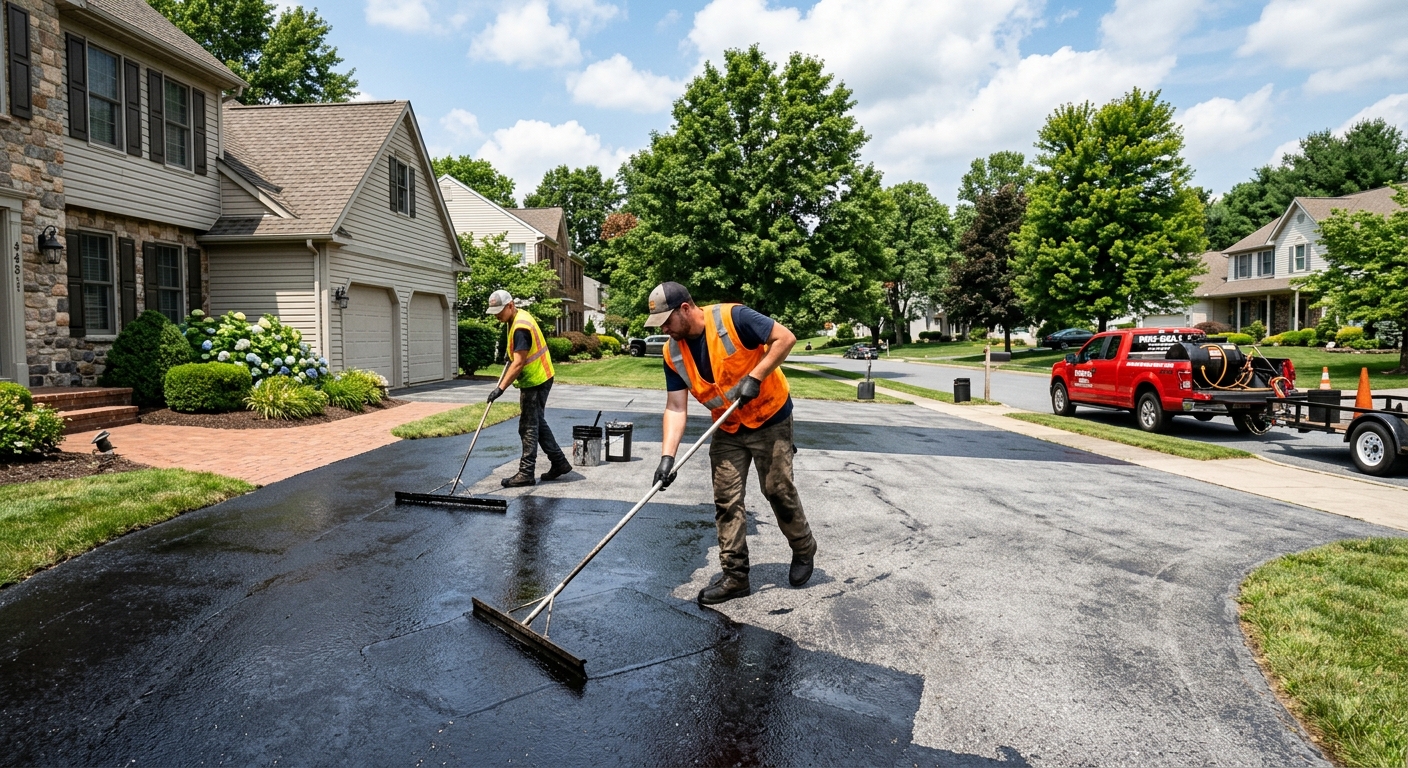
Driveway paving costs in Canton — 2026
Canton’s housing stock is overwhelmingly single-family (71.5%), and most homes are owner-occupied (86.7%) (U.S. Census Bureau, ACS 2024), so driveway paving is a necessary and common investment here—not just a cosmetic upgrade. With southwest Pennsylvania’s pronounced freeze-thaw cycles and the county’s natural subgrade of heavy clay and shale, installation methods truly matter: the life of any driveway here is determined as much by what goes beneath the surface as what you can see on top.
Few homeowners realize that for asphalt or concrete, most of the price difference between contractors is due to what you do not see: excavation depth, base thickness, drainage allowances, and the time spent compacting every layer. Skimping here means a pretty drive that fails after a few winters. A driveway that lasts 20 or 30 years is rarely the cheapest up-front bid, but it’s nearly always the best value in the long run—especially with haul distances to asphalt plants rarely a cost constraint in the local market.
| Service |
Best for |
Lifespan |
Price range |
| Asphalt — full replacement with new base |
failed base, structural cracking |
20–30 yrs |
$3,400–$8,700 |
| Asphalt overlay / resurfacing |
sound base, surface cracking only |
8–15 yrs |
$1,450–$4,300 |
| Sealcoating — single application |
preventive maintenance on sound asphalt |
2–4 yrs |
$200–$700 |
| Concrete — new installation |
long service life, low maintenance |
30–50 yrs |
$4,800–$11,500 |
| Crack filling and patching |
isolated cracks under a quarter inch |
1–3 yrs |
$200–$800 |
| Gravel driveway |
rural, budget, long runs |
5–10 yrs with upkeep |
$900–$3,500 |
Estimates for a typical Canton driveway. Square footage and base condition drive these figures more than material choice.
Grading and water management on a Canton driveway
In Canton and all of Washington County, water is the number one enemy of driveways. It isn’t just about avoiding puddles: improper grading is the main cause of driveway failure in our area, because surface water works its way into the base, then freezes and heaves the entire structure. This region’s frequent freeze-thaw cycles magnify even small grading mistakes, and the heavy clay soils common in Washington County make matters worse by holding water against the base instead of letting it drain away naturally.
Your driveway needs enough slope—at least 2% (about a quarter inch per foot)—to shed water efficiently. This can be achieved by crowning the center or running a consistent cross-slope toward one side, but a driveway that slopes toward your garage or home is a code red: expect water in your foundation or garage sooner or later. When slope correction is impossible due to site conditions, trench drains or channel drains are installed across the driveway to intercept and redirect flow. That water needs to be daylighted—emptied onto a suitable area where it won’t cause problems—or, if that’s not possible, sent to a dry well built specifically for infiltration.
It’s not enough to solve your drainage by sending runoff onto a neighbor’s property—doing so creates a serious liability whether or not local code enforcement flags it. Thoughtful grading at installation time protects your investment from the start, especially with soils that hold moisture.
Choosing a paving company
The right contractor is what separates a driveway that lasts decades from one that cracks in a few winters. In Canton and the rest of Washington County, verifying a paving company starts with more than just a handshake or a flashy truck. Require a Pennsylvania Home Improvement Contractor (HIC) registration for any job over $500—verify it directly at hic.attorneygeneral.gov. Confirm they carry workers’ compensation insurance in Pennsylvania through the WCAIS system. No insurance means liability risk for you, plain and simple.
Insist on a business with a physical address in Washington County, not just a cell phone number. If a contractor doesn’t own their paving and compaction equipment, be cautious—they may be reselling the job or running a “traveling” crew from out of town. Ask for references from three or more years ago to find out how their work is truly holding up in Pennsylvania’s climate. If they can’t say which Pittsburgh-Washington area asphalt plant they buy from—when local aggregate supply is no obstacle—they’re probably just brokering or worse.
- Verify HIC registration at hic.attorneygeneral.gov
- Check workers’ compensation at wcais.pa.gov
- Require a local business address, not just a phone
- Ask for jobs older than three years for references
- Insist they name their asphalt supplier
- Confirm they own their paving and compaction equipment
- Get a detailed, written estimate that breaks out base prep, asphalt, and grading
- Ask about who actually performs the work (crews, not subs)
- Check for warranty terms in writing
- Look for membership in trade organizations or local endorsements
- Demand clear payment terms—never pay in full up front
- Insist on a written contract for jobs over $500
Red flags: contractors who want cash up front, lack traceable business identity, or cannot answer technical questions about materials or local drainage problems. Skip anyone knocking door-to-door in the spring or summer.
Sealcoating: what it does and what it doesn't
Sealcoating is the most advertised but least understood aspect of driveway maintenance in Canton. What sealcoating actually does: it protects the asphalt binder from oxidation due to air and sunlight, blocks the penetration of oil and gasoline, and gives a smooth, uniform black finish. This helps asphalt look fresher and resist surface wear, especially under the region’s heavy freeze-thaw conditions.
But sealcoating is not magic. It does not fix cracks, cannot restore a badly aged or structurally failed driveway, and doesn’t provide any real strength. If your base is soft or the driveway is already showing alligator cracking, sealcoating is just paint on a rotten board. Too many applications, especially annually, do more harm than good—the build-up can peel and crack, inviting further water entry. It’s also a mistake to sealcoat new asphalt before it’s cured: volatile compounds need time to escape, or you trap moisture and weaken the driveway over time. In this climate, wait a full season before the first seal, then apply no more often than every 2–4 years.
Crack filling is a higher priority than sealcoating. A proper, hot-applied crack fill keeps water out of the base and extends life; a spray-over sealant does not. If a price comes in at the very bottom of the local range—say, $200–$700 for the job—ask what’s included. Hand-applied squeegee coats and thoughtful prep cost a bit more, but actually help. Cheap “spray and go” jobs often peel within a season and may mask trouble instead of solving it.
What you need before paving in Canton
In most of Canton, repaving or resurfacing an existing driveway does not require a building permit if you’re keeping to the same footprint, particularly for homes on PennDOT-maintained state routes; these projects often don’t trigger a new Highway Occupancy Permit. However, any change to the driveway approach—where your drive meets the public road—does require permitting, and the right authority depends on the road. For state routes, PennDOT’s district office handles these permits; your municipality covers local streets. Don’t leave this step out or you could face issues when selling or with future municipal work.
If you are expanding the paved area (adding width or length), expect a review for stormwater runoff. Regionally, more impervious surface can trigger site drainage requirements—especially with our local clay and shale soils that already hold water. Even where the township lets a project slide on paperwork, sending runoff onto a neighbor’s property can make you legally liable for any damage.
Before signing, confirm your contractor holds current Pennsylvania Home Improvement Contractor registration—look this up yourself at hic.attorneygeneral.gov. Pennsylvania also requires workers’ compensation insurance for all employers; make sure your contractor carries it and verify through the WCAIS registry, not just a certificate. These checks are non-negotiable for jobs over $500 in Pennsylvania.
Caring for a new Canton driveway
The first rule for a long-lived driveway in Canton is to keep water from getting below the surface. Crack filling comes first: sealing small cracks quickly, before freeze-thaw cycles pump water into the base, is the single best way to avoid early failures. Next, support the driveway edges—without lateral support, heavy vehicles or mowers will cause crumbling along the sides. Keep gutters clear and direct runoff away from paved surfaces so water can’t pool or saturate the subgrade.
Avoid heavy point loads—don’t set block piers, dumpsters, or jack stands on asphalt or concrete. For new asphalt, allow at least 3–7 days of warm, dry weather before parking. Don’t spin steering wheels in place or park heavy vehicles until the surface has fully cured (usually 30 days in this region’s climate).
De-icing is nuanced here. On concrete, salt will corrode and pit the surface quickly; stick with sand or calcium magnesium acetate if traction is needed, but be careful with products even labeled “concrete safe.” On asphalt, salt won’t hurt the material itself, but melting snow and refreezing overnight causes the very freeze-thaw cycling that ruins surfaces. Use de-icers sparingly, sweep sand after, and focus on removing snow before ice forms.
Numbers, not adjectives
Ask ten contractors how thick they’ll make your driveway and you’ll hear “three inches” — but that can mean almost anything. In Canton, where freeze-thaw swings are harsh and clay or shale base soils hold water, what’s written in your contract matters more than any sales pitch. Pennsylvania’s ground conditions demand deeper, better-compacted bases—and for driveways to last, those numbers need to be on paper.
A real quote will break down: excavation depth, exact type and thickness of the crushed stone base, method and number of passes for compaction, both the binder and surface course asphalt depths as compacted (not “as laid”), the precise asphalt mix code from the local Pittsburgh-Washington batch plant, and how the driveway edges will be treated. Compacted thickness is key—a 3-inch loose asphalt lift compacts to 2.25 inches, and that hidden inch means everything for longevity. Edge treatment—whether with concrete, stone, or just rolled edges—prevents creeping and cracking where you don’t see it on day one.
When “three inches” isn’t spelled out as “two-inch base, 1.5-inch surface, compacted,” you’re likely getting less than you’re paying for. Spec insistence is your only real insurance.
- Total excavation depth, including removal of any soft soil
- Aggregate base depth (inches, compacted) and type
- Compaction method for each layer (roller tonnage and number of passes)
- Asphalt binder course depth (inches, compacted)
- Asphalt surface course depth (inches, compacted)
- Asphalt mix designation from plant
- Edge treatment method (e.g., rolled, concrete, stone border)
- Driveway slope and drainage direction in percent or inches per foot
- Type and location of any drains or gravel trenches
- Transition to street: sawcut, apron, or overlap?
Frequently asked questions — driveway paving in Canton
Are door-to-door pavers a problem in Canton?
Yes, door-to-door pavers—especially those offering “leftover asphalt” jobs or demanding cash on the spot—are a recurring issue in Canton and surrounding Washington County neighborhoods. They often lack a verifiable business address and usually aren’t registered through Pennsylvania’s Home Improvement Contractor registry. These crews may disappear before addressing warranty issues, and jobs done this way rarely last a full season given our tough winter freeze-thaw cycle. Even if the offer sounds like a bargain at $1,450–$4,300 for an “overlay,” the tradeoff is poor quality with little recourse if problems arise. Reliable local contractors never pressure you at the door or ask for an immediate commitment.
Can asphalt be laid in cold weather?
Asphalt paving shouldn’t be done in cold weather—especially in Canton, where low temperatures and ground freeze are common for much of the year. The minimum recommended air and surface temperature for paving is usually around 50°F and rising. When installed in colder conditions, asphalt cools too quickly for proper compaction, leading to weak spots and premature cracking, particularly with our local freeze-thaw cycles and clay soil. Rushed jobs late in the season may look fine for a few weeks but often require early repairs or even replacement, wasting your initial investment of $3,400–$8,700 for a full replacement. The best local contractors won’t schedule these jobs during questionable weather.
Is gravel a cheaper option in Canton?
Gravel is often the least expensive way to surface a drive in Canton, with initial cost bands running $900–$3,500 depending on length and prep. For longer rural drives or when budget is key, gravel makes sense, especially since local plants keep material costs reasonable. Maintenance matters more than installation: you’ll need regular regrading and fresh stone to patch washouts, especially in clay-heavy soils where drainage is slow. Gravel suits rural or secondary homes but isn’t for everyone—it requires ongoing upkeep that might offset the upfront savings for busy households.
What is the difference between binder and surface course?
In Canton’s climate, an asphalt driveway that lasts is built in at least two compacted layers. The binder course is the lower, thicker layer—usually made from coarser aggregate for strength and flexibility on our challenging clay and shale subgrades. The surface course is the finer, top layer designed to provide a smooth finish and resist wear. Some cheaper bids may skip the binder layer entirely, but that’s a shortcut that causes early failure in our region. Spending $3,400–$8,700 on full replacement without proper layer breakdown is risking your money.
What is the difference between crack filling and sealcoating?
Crack filling and sealcoating are completely different maintenance steps, though they’re often advertised together in Canton. Crack filling involves applying a flexible sealant—usually hot-applied—directly into cracks to block water. This is critical maintenance, because water getting below the surface is the root cause of failure here. Sealcoating is a topcoat that shields against UV, oil, and air—improving the look and slowing oxidation. Crack filling usually needs attention every couple of years at $200–$800, while sealcoating is best on a multi-year schedule. One never substitutes for the other.
Asphalt or concrete for a Canton driveway?
Both materials perform in Canton, but your choice depends on budget and maintenance. Asphalt is less expensive up front—$3,400–$8,700 for a replacement—and handles freeze-thaw cycles by flexing without cracking, but it requires periodic sealing and crack filling. Concrete, at $4,800–$11,500, is much less prone to rutting or softening in summer and requires little upkeep, but our winter salt and clay soils can cause spalling and pops. For sloped drives, asphalt can be slippery in ice, while concrete offers more traction. The blend of hilly terrain and local climate can tip the choice either way, so consider site conditions.
Can I cancel a paving contract I signed at my door?
Yes. Under the Pennsylvania Home Improvement Consumer Protection Act, anyone who signs a paving contract valued over $500 at home—including “special deals” offered at your door in Canton—has three business days to cancel in writing, no questions asked. The contractor must give you clear notice of this right. If you feel pressured, don’t hesitate to use it. Don’t let a pushy sales pitch for a $2,900 “special” force you into a bad decision—the law is there for precisely this kind of circumstance.
How much does driveway paving cost in Canton?
Paving costs in Canton depend on your site’s size and base condition as much as the surface material. A full asphalt replacement with new base runs $3,400–$8,700, with overlays for sound bases at $1,450–$4,300. Concrete costs more: $4,800–$11,500 for a typical drive. Check whether drainage work or grading will add cost, particularly if poor clay soils or slope issues are present—these factors drive pricing more than square footage alone.
What causes concrete to spall or flake in Canton?
Concrete spalling—flaking or chipping from the surface—is usually the result of freeze-thaw damage, aggressive de-icing salts, or poor curing practices. In Canton, frequent freeze-thaw swings and heavy clay subgrades mean water is slow to drain, heightening the risk. If water sits on the surface and freezes, pressure builds under the finish and pops the top off. Using road salt on new concrete in the first winter, or using too much in later years, practically guarantees spalling here. Concrete costs at $4,800–$11,500 are too high to risk by skipping proper drainage or by cutting corners on curing.