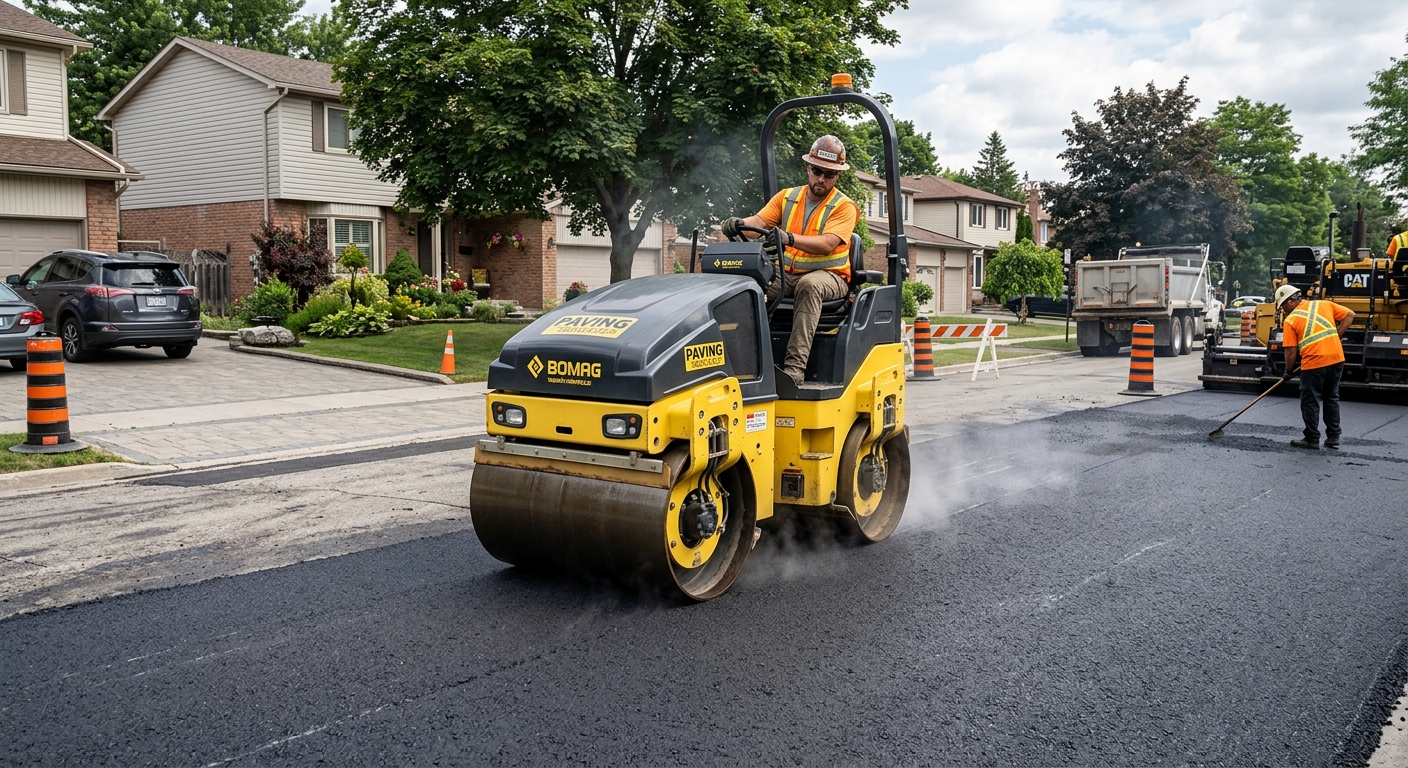
What a new driveway costs in Rostraver
In Rostraver, where 79.1% of homes are single-family and the homeownership rate stands at 82.4% (U.S. Census Bureau, ACS 2024), driveway replacement is a common expense—and a substantial one. Homeowners here are right to ask not just the cost but what is hiding beneath the surface. With Pennsylvania’s heavy freeze-thaw cycles and a local subgrade of clay and shale, much of your bill goes toward what you can’t see: excavation, base materials, and compaction.
The difference between a cheap and a lasting job in Rostraver isn’t always visible from the street. Two quotes might seem worlds apart, but it’s rarely the asphalt mix or concrete alone—it’s whether proper sub-base depth is installed, how water is managed, and how every layer is compacted. Most of Rostraver’s driveways were poured after 1960, but prior construction standards and decades of weather mean resurfacing is often possible, though a failed base means you’ll need a full-depth replacement.
Here is what homeowners can expect for common services:
| Service |
Best for |
Lifespan |
Price range |
| Asphalt — full replacement with new base |
failed base, structural cracking |
20–30 yrs |
$3,400–$8,800 |
| Asphalt overlay / resurfacing |
sound base, surface cracking only |
8–15 yrs |
$1,450–$4,400 |
| Sealcoating — single application |
preventive maintenance on sound asphalt |
2–4 yrs |
$200–$700 |
| Concrete — new installation |
long service life, low maintenance |
30–50 yrs |
$4,900–$11,500 |
| Crack filling and patching |
isolated cracks under a quarter inch |
1–3 yrs |
$200–$800 |
| Gravel driveway |
rural, budget, long runs |
5–10 yrs with upkeep |
$900–$3,500 |
Estimates for a typical Rostraver driveway. Square footage and base condition drive these figures more than material choice.
The honest case for and against sealcoating
Sealcoating your driveway in Rostraver does have clear benefits, but it is not the one-size-fits-all cure often sold door-to-door. A proper sealcoat protects the asphalt’s binder from oxygen, sunlight, and chemical spills, keeping it flexible. It freshens up faded driveways and, when applied to a solid surface, can prolong the useful life for a modest price—typically $200–$700 for a single application.
However, sealcoating will not fix structural issues or add true strength. If your driveway’s base is failing or you have growing cracks, a sealer won’t reverse the damage. Worse still, building up coat after coat every year (a common local upsell) can actually shorten its life: multiple layers peel and crack, letting water in. Sealing asphalt too soon after installation—before it’s fully cured—traps oils and can weaken the surface, so your new driveway should usually cure for 90 days or through one full summer before its first seal.
Crack filling is actually the higher priority. Water intrusion in freeze-thaw Rostraver will accelerate heaving and potholes far faster than surface oxidation. Seek out a hot-applied rubberized crack fill for anything wider than a hairline; cold pour is for minor gaps only.
A properly applied sealcoat is squeegeed—not just sprayed—so it bonds and fills pores. If a price sounds too cheap or the crew is in and out in minutes, it’s almost always a thin, watered-down spray that won’t survive the first winter.
The driveway scams that work in Rostraver
Paving is a ripe field for scams in places like Rostraver. With the county’s mix of suburban lots and rural homes spread out, less visibility and longer distances between neighbors make it easier for transient crews to operate. Here’s how the scam typically goes: a truck—usually unmarked, often with plates from another state—knocks, claiming “leftover material” from a job down the road. They offer a today-only discount, pressure you for cash, and insist on a verbal agreement, skipping the paperwork entirely.
Sealcoating scams are especially common: they’ll spray a shiny, oil-laden liquid and promise your driveway will look new for years, when in fact it’ll peel in one season because it isn’t true sealer or it’s cut with diesel. If you hear there’s only enough for your project “if you act right now,” or there’s a supposed urgent need for upfront cash to “lock in the deal,” that’s another red flag.
Rostraver’s moderate market density—suburban near Hempfield, rural elsewhere—means you can’t always knock on a neighbor’s door to check out a contractor’s last job, and scam crews know this. But protection is built into Pennsylvania law: for any paving job over $500, you are entitled to a written contract and a three business-day right of cancellation under the Home Improvement Consumer Protection Act. Never accept a handshake deal or excuse for skipping paperwork.
Stop bad actors with quick, simple checks: verify Home Improvement Contractor registration at hic.attorneygeneral.gov, demand workers’ compensation proof via WCAIS, confirm a written scope of work, get the vehicle’s full business ID, and never pay in cash up front. These basics stop nearly every fast-talking scam in its tracks.
Permits and approvals for paving in Rostraver
In most of Rostraver, repaving your existing driveway in the same footprint does not require a building permit, saving you both cost and paperwork. But if you plan to change the size, add a curb cut, or alter how your driveway meets the road, a different set of rules comes into play. The approach—where your driveway ties into a state road—requires a permit from PennDOT District 12, managed by the Westmoreland County maintenance office, not the local building department as many expect.
Adding or expanding a driveway—especially in hilly terrain—may increase impervious surface, triggering stormwater rules. This matters because directing water off your property or onto a neighbor’s can create legal problems, with or without a permit. If your project expands the paved footprint, check if local zoning or runoff rules apply before work starts.
For contractor verification, Pennsylvania requires Home Improvement Contractor registration through the Office of Attorney General for any job over $500 (verify at hic.attorneygeneral.gov). Employers must provide workers’ compensation; proof is available via WCAIS (wcais.pa.gov). These steps only take minutes online and could save you considerable hassle down the road.
Rostraver's ground and what it means for paving
Rostraver and greater Westmoreland County sit mostly on clay and shale subgrade, and both materials have serious impact on driveway performance. Clay holds water and expands and contracts with each freeze-thaw, while shale may break down over time, especially if it’s not compacted tightly below the base. These soil types require a thicker, fully compacted stone base than you’d use in level, sandy ground.
Combine that with a frost depth of 36 inches and a winter design temperature of 8 °F: what’s under your surface decides whether your driveway survives a Rostraver winter or heaves and cracks by spring. Decades-old driveways may never have received an engineered base—especially those poured before rigorous standards became typical in post-1960 subdivisions—so replacement often means correcting undersized stone and poor drainage, even in neighborhoods where resurfacing is common.
If you only resurface cracked asphalt on top of bad subgrade, you’re likely paying to do it again after two or three harsh cycles. For Rostraver soils, don’t accept a minimal base: it isn’t saving you money, just deferring the problem.
The specifications to demand in writing
If you’re comparing driveway quotes in Rostraver, stop looking at just the bottom line—focus on what goes in beneath your tires. The way to get a driveway that lasts through Pennsylvania’s freeze-thaw cycles, tough winters, and shifting clay and shale is to pin your contractor to real, written numbers instead of vague promises.
Every quote should specify the depth of excavation (in inches), the type and thickness of aggregate base, and how it’s compacted—preferably with a plate or roller, and in multiple “lifts” (layers), not just rolled once at the end. Asphalt thickness must be stated as compacted depth, since hot mix shrinks by about 25% when rolled. The type of mix and binder content should be called out in clear terms, not left to verbal definitions. Edge treatments and how seams or transitions are handled should never be left out.
If your quote just says “three inches of blacktop,” you don’t know what you’re getting. Here, you should demand more base and compaction than in a mild climate, given the heavy freeze-thaw and clay/shale subgrade.
- Excavation depth (in inches)
- Type/thickness of stone base (e.g., 6"+ compacted 2A limestone)
- Base compaction method and whether installed in lifts
- Asphalt binder course thickness, as compacted
- Asphalt surface (wearing) course thickness, as compacted
- Total asphalt depth after compaction
- Asphalt mix designation (plant spec code or DOT reference)
- Edge treatment (tapered, backfilled, or retained)
- Where water runs off and how that is managed
- Joint/seam detail for overlays or expansions
Beyond replacement: layout changes
Some Rostraver homeowners need more than a straight replacement—a wider drive for a second car, an extension to a detached garage, a parking pad, or paving a gravel stretch. These projects mean everything changes, not just the surface. Expanding or altering layout means you’re dealing with undisturbed subgrade, which will need proper excavation, a full-depth new base, and careful edge tie-ins to avoid future settling.
Where old pavement meets new, that seam stays a lifetime weak spot—careful joint prep is critical. Larger changes can also bring zoning headaches. Adding impervious surface may trigger stormwater review, and, in many parts of Westmoreland County, there are rules about how close to the property line or sidewalk you can pave. These rules may also limit how wide you can go, especially near public right-of-way.
If your new configuration connects to a state road, expect to need an approach permit from PennDOT District 12, not just township permission. Always check runoff and drainage—directing water onto a neighbor or public right-of-way can mean costly fixes down the line.
Frequently asked questions — driveway paving in Rostraver
Do I need a permit to repave a driveway in Rostraver?
For most driveways in Rostraver, simply resurfacing or repaving in the same footprint does not require a building permit. However, there are exceptions if you plan any changes—like expanding the drive, altering the curb, or changing drainage patterns. If your driveway ties into a state road, you will need an approach permit from PennDOT District 12. Failing to get a permit for these changes can result in stop-work orders or penalties. Even if a permit isn’t required, it’s wise to get written confirmation from your municipality before starting any project over $500. This covers you if code officers ever question the work.
What does compaction in lifts mean?
Compaction in lifts is a step that separates a professional job from a short-lived one in Rostraver’s climate. Instead of dumping all your stone base or asphalt at once, the contractor spreads each layer (“lift”) at a set thickness—maybe 3–4 inches for stone or 1.5–2 inches for asphalt—and runs heavy equipment over it to compact that layer before adding the next. This process ensures the base is solid all the way down. Without compaction in lifts, the ground can settle unevenly during Rostraver’s freeze-thaw cycles, leading to dips and cracks. Good contractors will reference this method in your quote and specify the thickness of each lift for quality assurance. The extra time is key for a driveway that lasts 20–30 years, not just a few seasons.
How many freeze-thaw cycles does Rostraver get?
Rostraver, like the rest of Westmoreland County, sees a harsh freeze-thaw season—often 40 to 60 cycles per winter. Every time the surface moisture freezes, expands, thaws, and contracts, your driveway takes another blow. That’s why Pennsylvania specs for asphalt and stone bases demand more depth and better drainage than milder states. The typical driveway overlay here, costing $1,450–$4,400, is only a smart investment if the base is stable enough to handle these cycles. If you skip proper prep, each freeze-thaw just accelerates damage you’ll soon see in the form of cracks and heaves.
Why does my driveway have depressions that hold water?
Depressions and puddling in a Rostraver driveway almost always mean the base has settled or was never properly compacted to begin with. The clay and shale subgrade common in Westmoreland County holds water, so when it wasn’t excavated or drained correctly, freeze-thaw cycles cause shifting and sinking over time. Heavy vehicles parked in the same spots can speed up damage. Sometimes, low spots are due to thin asphalt or overlays applied over cracks instead of fixing the underlying problem. The short-term fix is patching—best for small areas priced around $200–$800—but if the issue is widespread, it may point to a full replacement.
Why are paving quotes in Rostraver so different from each other?
Paving quotes in Rostraver vary dramatically because much of the cost is below the surface—excavation, stone, and prep work. Some contractors cut corners by using less stone, skipping compaction in lifts, or stretching asphalt thin. One quote might offer a quick overlay at $1,450–$4,400 while another includes stripping, new base, and thicker topcoat for over $3,400–$8,800. Always require written specs for excavation depth, stone and asphalt thickness, compaction, mix type, and drainage. In Rostraver’s heavy freeze-thaw climate and with our clay/shale soils, paying less upfront nearly always means paying again later when the cheap job fails.
How much does driveway paving cost in Rostraver?
Typical driveway paving costs in Rostraver range from $1,450–$4,400 for an asphalt overlay (if the base is solid) up to $3,400–$8,800 for a full-depth replacement with new base. Concrete installations start even higher, from $4,900–$11,500. The wide band reflects differences in prep (base excavation and depth), driveway length and width, and difficulty with drainage or grading in our local soils. If your driveway just needs minor patching or crack filling, you’re generally looking at $200–$800. Square footage and what’s lurking beneath the surface drive pricing far more than finishing material.
When can I seal a brand new asphalt driveway?
In Rostraver’s climate, new asphalt should typically “cure” for at least 90 days—and often until the following summer—before you apply a sealcoat. Right after paving, the surface still contains oils and volatiles that need to dissipate so the sealant can bond and not trap moisture. Sealing too soon risks softening the top layer or causing premature peeling. Many Rostraver contractors schedule sealing after your first full season, offering a single application in the $200–$700 range. For best results, schedule before leaves start falling and after a week of dry, warm weather.
Can I pave over my existing driveway?
You can pave over a driveway in Rostraver if the base below is stable and there are no structural cracks, soft spots, or drainage issues. Asphalt overlay or resurfacing saves money—typically $1,450–$4,400—but it’s only a good bet if what’s underneath is solid. If you cover a crumbling or deeply cracked base, the new layer will fail just as quickly, especially in our freeze-thaw-prone soil. A reputable contractor will spot-test the base with core samples or a test pit. Don’t let anyone sell you an overlay unless they’ve verified that the subgrade is up to the task.
How long before I can drive on a new asphalt driveway?
In Rostraver, wait at least 24 to 48 hours before driving on fresh asphalt in the summer—longer if the weather is cool or damp. The surface may look solid after a few hours, but the underlying layers need more time to gain strength, especially given the thick stone base required for our clay and shale soils. Heavy vehicles, like delivery trucks or RVs, should stay off for up to a week to reduce surface depressions. If your installer is finishing with a sealcoat later, factor in drying time again (usually 24–36 hours). For a typical job in the $3,400–$8,800 range, following this guidance ensures you get the longest possible life from your new driveway.