Driveway paving costs in Harrisburg — 2026
In Harrisburg, driveway paving prices reflect more than just the work you see on the surface. With only 13.3% of homes classed as single-family and a homeownership rate of 35.5% (U.S. Census Bureau, ACS 2024), investing in your driveway here is less common than in more suburban parts of Dauphin County—but when it’s needed, the number that matters most is what’s buried underneath. South-central Pennsylvania’s freeze-thaw cycles and underlying limestone karst and shale mean a thicker, well-drained aggregate base is critical. A job may look perfect on day one, but poor prep underneath guarantees early failure here. That’s what drives most of the gap between one quote and the next: base excavation, true compaction, aggregate thickness, and drainage—none of which you can see at a glance.
Material costs in Harrisburg are generally steady thanks to short hauls from local plants near Harrisburg and Middletown, but curbside appearance and square footage matter far less than the work you’ll never see once it’s paved over. A cut-price job is nearly always cutting corners where you cannot check: thinner base, less excavation, shortcuts in compaction, or even paving right over trouble. Ask for every layer in writing. Pricing below shows what you can expect for most homes in the city and surrounding townships.
| Service |
Best for |
Lifespan |
Price range |
| Asphalt — full replacement with new base |
failed base, structural cracking |
20–30 yrs |
$3,300–$8,500 |
| Asphalt overlay / resurfacing |
sound base, surface cracking only |
8–15 yrs |
$1,400–$4,200 |
| Sealcoating — single application |
preventive maintenance on sound asphalt |
2–4 yrs |
$200–$650 |
| Concrete — new installation |
long service life, low maintenance |
30–50 yrs |
$4,700–$11,500 |
| Crack filling and patching |
isolated cracks under a quarter inch |
1–3 yrs |
$200–$800 |
| Gravel driveway |
rural, budget, long runs |
5–10 yrs with upkeep |
$900–$3,500 |
Estimates for a typical Harrisburg driveway. Square footage and base condition drive these figures more than material choice.
The paving season in south-central Pennsylvania
In Harrisburg and across Dauphin County, paving follows the climate’s rules, not anyone’s preference. Our winter design temperature is 12 °F, and pronounced freeze-thaw cycling shapes every part of the work. Hot-mix asphalt, the standard for driveways here, must be installed when air and surface temperatures are high enough for proper compaction—typically above 50 °F. Below that, the mix sets up too quickly, stays porous, and is easy prey for the first few winters. This isn’t negotiable. Asphalt plants around Harrisburg and Middletown simply shut down from late fall through early spring, so getting genuine hot-mix in December or March just isn’t an option.
Concrete has its own constraint: if poured in cold weather, especially below freezing, it will not cure correctly and early surface damage is almost certain. Most years, that shrinks the real paving window to late April through mid-October. May, June, and September are the safest bets—crews have better availability in early spring and late fall, while peak summer is booked solid and prices push toward the top of the range. If someone offers to pave in late November or before the last frost is out of the ground, they’re cutting corners, or worse, laying cold mix you don’t want.
The main takeaway for Harrisburg homeowners is to plan early if you want a spring or summer job, and to be skeptical of any crew promising true hot-mix paving when the aggregate plants are closed for the season. Concrete, if you choose it, also needs above-freezing weather for both pour and cure—never rush it.
How paving fraud actually operates
Paving draws more bad actors than most trades, especially in mixed urban-suburban markets like Harrisburg and the broader Dauphin County area. With urban demand in Harrisburg and moderate suburban work in Lower Paxton, there’s plenty of opportunity to profit from rushed or absent oversight. Here’s how scams typically work here: a crew shows up with an unmarked or out-of-area truck and claims they have leftover material from “a job just down the street,” offering a today-only deal if you pay cash immediately. The price they pitch, and what’s delivered, often diverge fast. Key tells are no written contract, verbal quotes, a push for cash or check up front, and a price that only holds until “the end of the day.” Sometimes they’ll offer a spray-on black, thin layer of oil and sell it as a full sealcoat—this washes away by spring or never bonds at all.
Harrisburg’s density makes door-to-door scams easier for travelers: neighbors may be blocks or streets away, and follow-up is hard if you’re left with a failing drive. Pennsylvania’s Home Improvement Consumer Protection Act steps in here: any job over $500 requires a written contract, and you have a three-business-day right to cancel. No contractor may talk you out of this protection. Never pay a dollar up front without a Pennsylvania Home Improvement Contractor registration (verify at hic.attorneygeneral.gov) and always get the contract in writing with the scope and price spelled out.
Five-minute checks: verify HIC registration, confirm the crew’s business address, ask for written scope and price, demand the contract with your cancellation right, and never pay in cash up front. Refusing any of these is a red flag every single time.
Maintenance that actually works
In Harrisburg’s climate, routine driveway maintenance is focused on stopping water from reaching the base layer—because the repeated freeze-thaw cycles in south-central Pennsylvania are what do the real damage. Start with crack filling: if you catch cracks before water gets through, you dramatically extend the life of any paved drive. Second, keep the edges supported and well back from soft ground—edge crumble invites base loss. Third, keep downspouts, runoff, and snowmelt from draining over your drive, since moving water is enemy number one for every base. Avoid letting dumpsters or jack stands sit for weeks—point loading will dent both asphalt and concrete here. On new asphalt, wait as long as you can (ideally 7–14 days) before parking or turning wheels while stationary.
De-icing is a real question every Dauphin County homeowner faces each winter. Rock salt is harsh on concrete—repeated cycles leave scaling, etching, and pitting—so it's best avoided on concrete drives. On asphalt, salt itself is less damaging, but the key problem is that melting leads to refreezing at night, and that exposes any crack or defect to even more freeze-thaw stress. Alternatives like sand or calcium magnesium acetate are gentler but cost more and don’t clear ice as well. For both surfaces, timely shoveling and keeping water off the drive’s surface are your best bets for long-term durability.
What you need before paving in Harrisburg
In Harrisburg and most nearby Dauphin County townships, you generally do not need a building permit to resurface or replace an existing driveway, provided you aren’t expanding its footprint. This saves homeowners hassle and expense; most repaving jobs, if correctly permitted in the past, proceed with no new approvals. However, the rules change at the approach: if you are constructing, replacing, or widening the part of your driveway that meets the public street—the apron or curb cut—that usually means a separate street opening or access permit from the City of Harrisburg Department of Building and Housing Development. On state roads, driveway approaches are permitted by the PennDOT Engineering District 8‑0 Highway Occupancy Permits office, not the city or township.
If your project adds impervious surface by widening your drive or paving new areas, you may run into municipal stormwater requirements—permission to discharge runoff, barriers against directing water onto neighbors, or a call for retention solutions. Even if no permit is triggered, draining water onto someone else’s property is still a liability, and no code grants the right to ignore it.
Contractor verification is simple: for any contract over $500, Pennsylvania law requires the contractor hold and provide Home Improvement Contractor registration, verifiable at hic.attorneygeneral.gov. Any crew bringing help must maintain workers’ compensation insurance (checkable at wcais.pa.gov). Get proof before work begins.
Overlay, patch or full replacement?
Before you commit to any driveway work in Harrisburg, check the symptoms on your own. Most of the price and all of the longevity is determined by what’s under your tires, not what you see at the surface. If the driveway shows alligator cracking—a pattern like reptile skin spanning wide areas—the base is shot and no overlay will fix it for long. Patching and overlaying in that state is money wasted, no matter how tidy it looks on day one. But if the cracks are few, narrow, and mostly run in straight lines, the trouble is likely just aging of the asphalt and an overlay or crack fill may last. Birdbaths (low spots that hold water) signal subgrade settling, while edges crumbling away usually mean there’s either no edge support or the base runs short. Potholes with loose material underneath mean water has already invaded the base—a warning that a full patch or worse is needed.
A reputable contractor should core or probe the existing driveway and share the findings. If an estimate only looks at the surface, you’re being sold convenience, not a solution. Don’t pay for an overlay over failed base; it won’t last Harrisburg’s winters. Instead, match the fix to the actual problem as below:
| What you see |
Likely cause |
Right fix |
Cost |
| Isolated cracks under 1/4 inch |
surface aging |
crack fill and seal |
$200–$650 |
| Alligator cracking over a wide area |
base failure |
full replacement |
$3,300–$8,500 |
| Depressions holding water |
subgrade movement |
excavate and rebuild that area |
$3,300–$5,200 |
| Crumbling edges |
no edge support |
edge repair, consider curbing |
$400–$1,500 |
| Potholes |
water into the base |
full-depth patch, then assess |
$250–$900 |
| Faded but sound surface |
oxidation only |
sealcoat |
$200–$650 |
Why Harrisburg driveways fail from the bottom up
The real performance of a Harrisburg driveway starts deep beneath the surface. The typical assembly, whether asphalt or concrete, is: native soil (“subgrade”), then several inches of compacted aggregate base, then the paved layer on top. Most homeowners see only the top, but every layer must be right—otherwise, the driveway will not survive the local climate. Our region sits on limestone karst and shale, which means soils can settle unpredictably and drain poorly if not managed. That calls for a base thicker than you’d see in regions with stable, sandy soil.
Freeze-thaw cycling is an even larger enemy. Water in the subgrade freezes each winter, expanding upward and lifting the pavement. The result is uneven lifting (frost heave) and cracks that run from the bottom up. When the thaw comes, the unsupported sections sink and the cycle repeats—cause enough for “birdbaths,” edge cracks, and alligatoring within a few years of shoddy installation. Good base preparation means excavating any organic or wet soil, then installing a true crushed-stone base, compacted in 3–4 inch layers (“lifts”) until solid. Skimping on excavation, using untested fill, or laying only 2–3 inches of base—common tricks in bargain bids—leads to premature failure, guaranteed. You won't see the effects until the third or fourth winter.
In Harrisburg, demand and confirm in your contract: at least 6 inches (often more) of compacted 2A modified crushed stone for asphalt, compacted in lifts, and ask for proof the crew compacted each layer. That’s what distinguishes a drive that lasts 20–30 years from one that’s back in trouble after five.
Frequently asked questions — driveway paving in Harrisburg
How long does a driveway installation take?
For most single-family homes in Harrisburg or throughout Dauphin County, a typical asphalt driveway replacement takes 1–3 days from start to finish once equipment is on site. The first day is spent on demolition and excavation of the old driveway and base, followed by base installation and compaction—critical on our local limestone and shale soils. Paving itself is usually done the next day, provided the base checks out and there are no drainage hold-ups. Concrete driveways take a bit longer: usually 3–5 days, including necessary curing time (especially if temperatures dip). If the project includes a new approach or apron that requires a permit, allow extra time for municipal inspections or approvals, especially in Harrisburg city proper. Remember, costs start at $3,300–$8,500 for full asphalt replacement, and most delays come from weather or extra subgrade work, not from the visible paving itself.
Can I cancel a paving contract I signed at my door?
Yes, under Pennsylvania law—the Home Improvement Consumer Protection Act—any contract over $500 signed for home paving in Harrisburg or anywhere else in the state gives you a three business day “cooling off” right to cancel, no questions asked. If you agreed to work with a contractor who knocked on your door, you have until midnight of the third business day after signing to rescind in writing, and the contractor must honor it, even if they started pressuring you to begin immediately. This rule exists because of door-to-door paving scams, which are unfortunately not uncommon in Harrisburg and Dauphin County. If you’ve paid anything up front and cancel within this window, you’re entitled to a full refund. For any job above $500, demand your written contract and know this right can’t be waived, no matter what the contractor says.
What does sealcoating cost in Harrisburg?
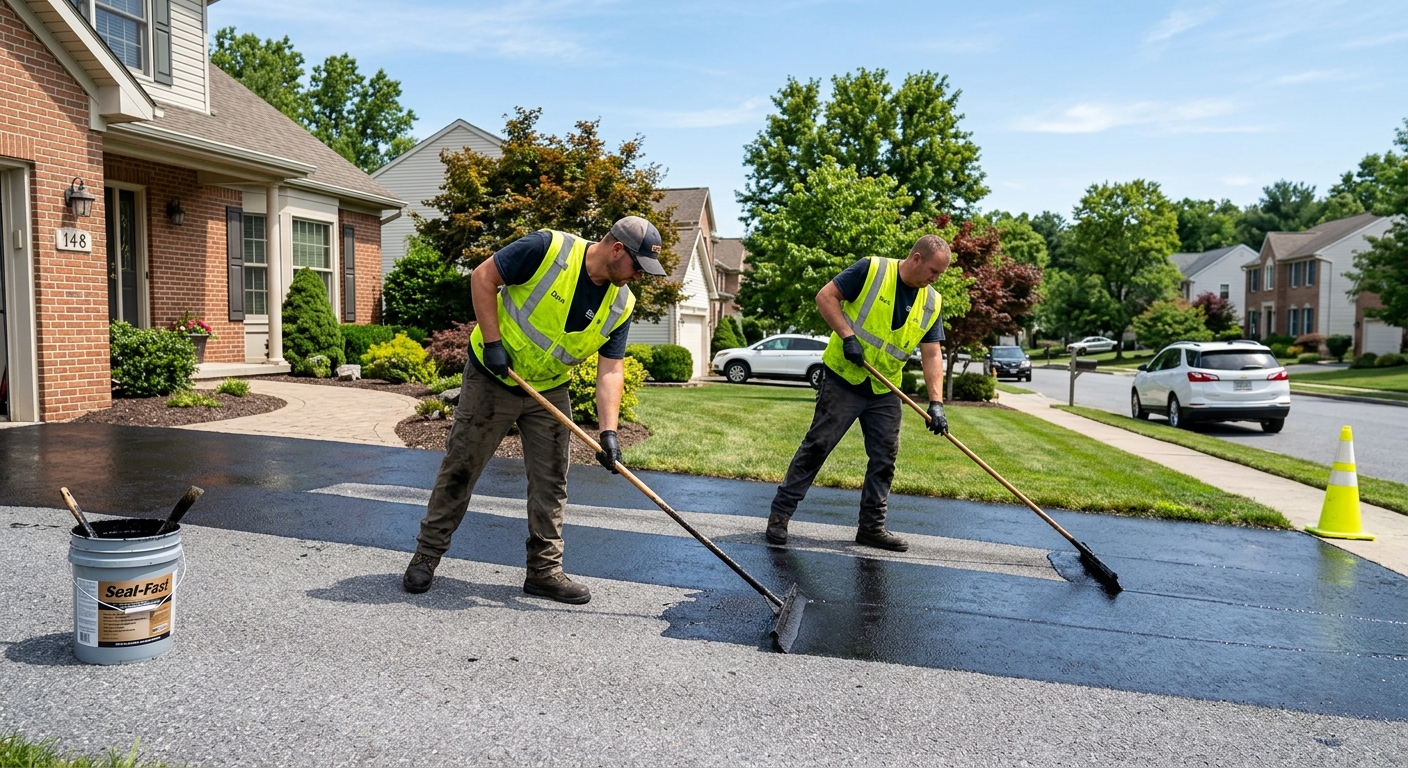
Sealcoating is a practical, preventive step you can take on a sound asphalt driveway in Harrisburg’s climate. Typical cost for a single application ranges from $200–$650, with most jobs for a standard single-family home falling around $375. Prices depend on square footage and how much prep (cleaning, minor crack filling) is needed. Be wary of anyone offering the work for far less: oil-based “spray and go” scams, common in Harrisburg, produce a shiny look that washes away in months or less. For real protection against the region’s freeze-thaw cycling, insist on two coats applied with brushes or squeegees on clean, dry pavement. Cheap applications will not hold up and may actually trap in moisture, making things worse.
Why are paving quotes in Harrisburg so different from each other?
In the Harrisburg market, most of the price difference between two driveway quotes is about the work you cannot see: how deep the crew goes into the old base, what kind of aggregate they use, how much real compaction they perform, and whether they address drainage at all. The region’s limestone and shale subgrade demands a thicker, well-compacted base for longevity, so anyone skipping excavation or using less stone will submit a lower price—but the driveway won’t survive the local freeze-thaw cycles. Labor costs may be similar, but a quote at the bottom end of the range (say, $3,300–$8,500 for full asphalt replacement) often means thin base or poor prep, while a careful contractor will spell out every step in writing. If you get a much lower quote, ask for specifics on base depth, aggregate, and compaction—if they can’t answer, reconsider.
How often should I sealcoat my driveway in Harrisburg?
In Harrisburg, most homeowners will benefit from sealcoating a sound asphalt driveway every 2 to 4 years, but the right interval depends on traffic, exposure, and how well you keep water and debris off the surface. Our climate’s freeze-thaw cycles mean cracks will appear eventually, and sealcoating is your main preventive tool against oxidation and surface water intrusion. Too-early or too-frequent applications can actually hurt by trapping moisture, so stick to quality, not quantity. For most homes, budget $200–$650 per application. Remember, sealcoating won’t cure a failing base or widespread cracks—its job is maintenance, not repair. Cheap “one-day” spray jobs are common in Harrisburg and often do little except darken the surface for a season.
What are the signs of a failing driveway base?
In Harrisburg, signs of a failing driveway base are easy to spot once you know what to look for. Alligator cracking (where the surface looks like reptile skin), depressions that hold water, potholes, and edge crumbling are nearly always the result of water invading and destabilizing the subgrade beneath the asphalt. These issues are made worse by our area’s frequent freeze-thaw cycling, which lifts and breaks unsupported base. Unlike simple surface cracks, which can be easily fixed by crack sealing ($200–$650), base failures will always resurface unless the base is excavated and rebuilt. If you see soft spots below surface cracks or the whole area flexes beneath your step, it’s time for a full replacement, not a patch.
Are door-to-door pavers a problem in Harrisburg?
Yes, door-to-door pavers remain a real problem in Harrisburg and parts of Dauphin County. The dense urban market makes it easy for out-of-area “crews” to approach homeowners with claims of leftover material from “jobs nearby,” offering today-only deals if paid in cash. These operators rarely provide written contracts and often disappear after a poor-quality job, leaving you with little recourse. Pennsylvania law protects you: demand a written Home Improvement Contractor contract for any project over $500, which gives you three days to cancel if you feel pressured. Always verify a contractor’s registration (hic.attorneygeneral.gov) before signing, and do not pay cash up front. Most reputable Harrisburg contractors welcome verification and written scope; those who don’t should be shown the door.
What does compaction in lifts mean?
Compaction in lifts means each layer of the aggregate base below your Harrisburg driveway gets packed down—usually with a plate compactor or roller—one thin layer at a time, typically 3 or 4 inches thick. This process removes air pockets and locks the base material so it can’t settle after paving. In our area, with limestone and shale soils and frequent freeze-thaw cycles, this is especially important: uncompacted layers allow water to flow and bases to shift in spring and fall. If you see “full-depth compaction” on a paving quote, ask if they’ll compact in lifts (not just roll the top once). Skipping this step can mean a $5,200 asphalt replacement fails in five years instead of twenty, so make sure it’s specifically listed in your contract, not just assumed.
Can I pave over my existing driveway?
Sometimes, yes—but only if your Harrisburg driveway’s base remains solid and you’re seeing only minor surface cracks or fading. Overlay or resurfacing, where new asphalt is applied atop old, is best suited for driveways with a sound, unmoving base and no widespread alligator cracking or low spots that hold water. If the surface is firm, overlays cost $1,400–$4,200—far less than full replacement. However, if the base beneath is failing, an overlay will only mask and accelerate the problem, and the new layer will show cracks or dips within a couple winters. Always have a contractor check the base before agreeing to overlay; reputable companies in Harrisburg will probe the surface and offer their inspection results, not just lay new asphalt over unknown trouble.