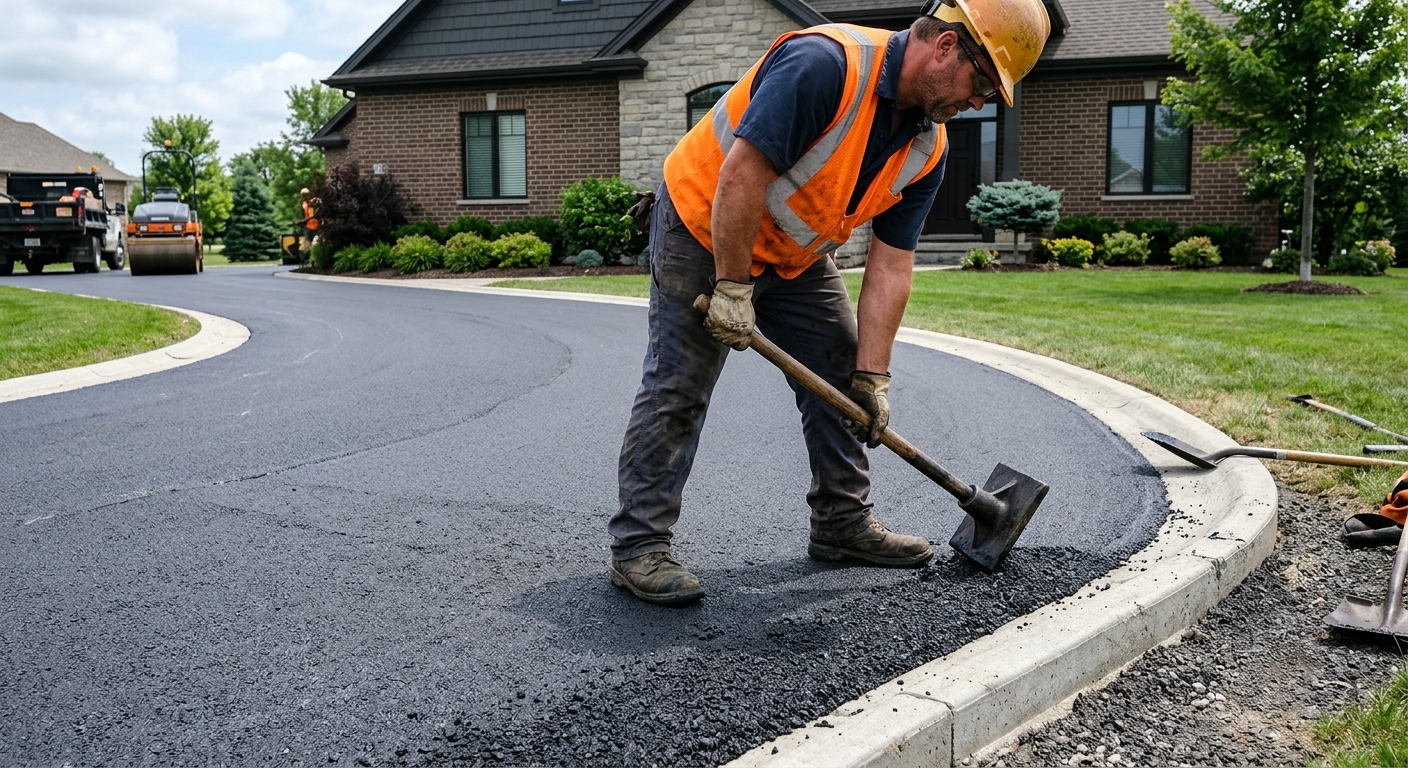
Driveway paving costs in Derry — 2026
In Derry, where about half the homes are single-family properties and the homeownership rate is over 65% (U.S. Census Bureau, ACS 2024), driveway paving is a common investment decision for established homeowners. Paving costs here are shaped by our pronounced freeze-thaw cycle, annual snow, and underlying limestone or shale subgrade. These conditions mean a solid aggregate base matters more than what’s visible on the surface: most of the price difference between two bids is found beneath the asphalt or concrete, where you can’t judge it from the street.
This region’s driveways are reaching full replacement age, especially in post-1950 subdivisions. With frequent ground movement from winter freezing and thawing, thicker bases and proper compaction are mandatory for driveways to hold up over decades. Be aware: the low bid is often achieved by skimping beneath the surface, so a cheap install typically means less base, thinner asphalt, rushed prep, or no drainage work — all invisible until problems appear a few winters later.
| Service |
Best for |
Lifespan |
Price range |
| Asphalt — full replacement with new base |
failed base, structural cracking |
20–30 yrs |
$3,600–$9,300 |
| Asphalt overlay / resurfacing |
sound base, surface cracking only |
8–15 yrs |
$1,550–$4,600 |
| Sealcoating — single application |
preventive maintenance on sound asphalt |
2–4 yrs |
$200–$700 |
| Concrete — new installation |
long service life, low maintenance |
30–50 yrs |
$5,200–$12,500 |
| Crack filling and patching |
isolated cracks under a quarter inch |
1–3 yrs |
$200–$800 |
| Gravel driveway |
rural, budget, long runs |
5–10 yrs with upkeep |
$900–$3,500 |
Estimates for a typical Derry driveway. Square footage and base condition drive these figures more than material choice.
Choosing a paving company
In Derry, the difference between a good paving job and a short-lived one often comes down to the company you hire. The right contractor isn’t just registered — they have a track record on local soils, can name their asphalt plant, own their equipment, and guarantee their work. With active local quarries and asphalt plants around Harrisburg and Middletown, any contractor who can’t quickly say where they get their mix is likely brokering jobs, not building them.
Pennsylvania requires Home Improvement Contractor registration for paving jobs over $500, so verify every contractor’s status at hic.attorneygeneral.gov. Workers’ compensation is mandatory for every employer, and real paving firms can furnish proof via WCAIS. Ask for references on projects three or more years old; new driveways always look great, but longevity comes from the sub-base, compaction, and drainage work you can’t see.
- Verify HIC registration at hic.attorneygeneral.gov
- Ask for proof of workers’ compensation through WCAIS
- Check for a local business address, not just a mobile number
- Confirm equipment is owned, not rented for the day
- Ask for references from driveways at least 3 years old
- Get the name of their regular asphalt or concrete supplier
- See insurance and written contracts (required by law over $500)
- Demand a detailed, itemized quote—not just a lump sum
- Look for clear terms on prep, thickness, and drainage
- Ask to see before/after photos from Dauphin County jobs
- See a warranty for materials and workmanship, not just “labor”
- Confirm who handles approach or street opening permits if needed
Red flags: companies that only operate by cell phone, subcontract all the site work, refuse to specify suppliers, or dodge written contracts. Brokers, door-knockers, and out-of-area firms are a bad fit for Derry driveway work.
Which surface survives Derry winters
Derry’s winters are hard on paved surfaces: pronounced freeze-thaw cycling, plenty of snow, and use of road salts. Asphalt handles this climate better than concrete because it is flexible — it moves with the ground as the base freezes and thaws, absorbing shifts rather than cracking. Properly installed asphalt may last 20–30 years here, provided drainage is correct and maintenance like sealcoating is done every few years.
Concrete, while much longer lasting in theory (30–50 years), struggles in south-central Pennsylvania because de-icing salts cause it to spall and scale. The moment rock salt is used, the risk of early surface failure rises sharply — and even if you avoid salt, tracked-in residue from the roads can do the damage anyway. For a concrete driveway here to last, you need to stick to non-chloride deicers and clean off salt quickly, and most owners do not keep up with that level of care.
Paver driveways can be a solid middle ground: individual units are replaceable if frost heave causes issues, though they do shift and settle slowly. Gravel is still common on rural runs, draining well and never cracking from freeze-thaw, but it needs regular grading and top-dressing.
| Option |
Installed cost |
Maintenance |
Freeze-thaw performance |
Lifespan |
| Asphalt — new install |
$3,600–$9,300 |
sealcoat every 3–4 yrs |
excellent, flexes |
20–30 yrs |
| Asphalt — overlay |
$1,550–$4,600 |
same |
good if base is sound |
+8–15 yrs |
| Concrete |
$5,200–$12,500 |
low, avoid de-icing salt |
fair, spalls with salt |
30–50 yrs |
| Pavers |
$8,200–$12,500 |
individual units replaceable |
good, settles gradually |
25–50 yrs |
| Gravel |
$900–$3,500 |
top-dress every 2–3 yrs |
excellent drainage |
indefinite with upkeep |
Sealcoating: what it does and what it doesn't
Sealcoating is widely promoted in Derry, but its real benefits — and limitations — are simple. A proper sealcoat forms a protective layer on your asphalt, shielding it from sun, air, oil, and gas spills. It also freshens up the look of an older driveway. But sealcoating’s effect is only skin deep: it does not fix cracks, strengthen the surface, or extend the life of a driveway with base problems. If an asphalt drive is already alligatored, holding water, or heaving, a sealcoat is cosmetic and nothing more.
What almost no one mentions: sealing too often causes more harm than good. Buildup of layers leads to peeling and flaky spots, while sealing too soon after new asphalt traps volatiles and can weaken the top layer. In Derry’s climate, every 3–4 years is practical, unless high traffic or chemical exposure says otherwise. Always wait at least a full season (typically spring to late summer) before sealing new asphalt.
Crack filling — using hot rubberized material to fill openings wider than a hairline — is more critical than sealcoating. Proper crack fill, tooled in after cleaning and drying, prevents water from getting into the base, which is what actually drives failure in our freeze-thaw environment.
A good sealcoat job — spray and squeegee applied, with crack prep and edge cleaning — runs $200–$700 for a typical driveway. “Deals” that come in well under this are often nothing more than thin, diluted spray and little or no prep; any benefit is gone within a single winter.
Where the water goes
Water is the root cause behind almost every driveway problem in Derry. It’s not a finishing detail: if your drive doesn’t shed water, everything else fails sooner. The minimum finished slope for surface runoff is 2% (about a quarter inch per foot away from structures), but more is better on long runs. Crowning puts a gentle hump along the center, so water runs off both sides; cross-slope — a steady fall to one side — is easier to build and maintain.
If a driveway slopes toward your garage or entry, water will pond against the house, leading to leaks, frost heave, and sometimes structural damage. Where the yard or site won’t allow you to re-grade the surface, trench or channel drains at the threshold are sometimes needed. From there, drainage should “daylight” downslope, never into a neighbor’s property, or into a properly-sized dry well.
Derry’s limestone and shale subgrade, common around Harrisburg, can create drainage challenges. These soils may hold or funnel water unpredictably, so thicker aggregate bases are necessary to keep the drive from heaving once water gets underneath, especially with our pronounced winter freeze-thaw cycles.
Redirecting runoff onto a neighbor’s lot isn’t just bad practice — it opens you to real liability, whether or not a permit is required. Good grading and drainage aren’t optional extras: they are what let a new driveway last beyond its first decade.
Permits and approvals for paving in Derry
For homeowners in Derry Township and wider Dauphin County, resurfacing or replacing your existing driveway (assuming it’s already properly permitted and you’re not expanding it) normally doesn’t trigger a new permit when you repave on a local, non-state road. This alone saves both time and permit costs. But if your project involves rebuilding the driveway apron — the part in the public right-of-way where your drive meets the street — that’s a different story. Permits for driveway approaches on state roads are handled by the PennDOT Engineering District 8‑0 Highway Occupancy Permits office, not your county or township.
Additions to your driveway can create more impervious surface, which often means stormwater management rules come into play. Even if the municipality doesn’t require a permit for plain repaving, never direct runoff onto a neighbor’s lot: you’re liable for any damage caused.
Any paving contractor working in Pennsylvania must be registered as a Home Improvement Contractor for projects over $500. You can check current status and any complaints at hic.attorneygeneral.gov. Proof of workers’ compensation is mandatory and can be verified in the state’s WCAIS system.
Changing the footprint of a Derry driveway
If you plan on more than just a straight driveway replacement in Derry — such as widening your drive for another car, extending to reach a detached garage, putting in a turnaround pad, or paving over a gravel lane — the rules and risks change. As soon as you go beyond the old footprint, every inch of new area must get a full base preparation. That means properly excavating and compacting a new stone base over untouched subgrade, which is time-consuming but crucial on Dauphin County’s limestone and shale soils. The seam between new and old paving is always a future weak spot, no matter how careful the install, so plan on having it patched or sealed periodically.
Most local municipalities will trigger a permit or review, especially if you’re increasing impervious surface or changing the driveway approach. Stormwater runoff compliance and property line setback rules may apply. If the added section pushes your drive closer to the edge of the lot, you’ll need to check the zoning; set-back or minimum distance rules are enforced to prevent neighbor disputes and runoff problems. If your driveway connects to a state route, a Highway Occupancy Permit from PennDOT Engineering District 8‑0 is required for any changes to the approach.
Frequently asked questions — driveway paving in Derry
How much does it cost to widen a driveway?
In Derry, widening a driveway — whether it is for a second car, to add a parking pad, or to ease entry and exit — means excavating and building a new base where the drive meets yard or lawn. For asphalt, this runs from $3,600–$9,300 if you’re replacing the entire width, or proportionally less if you’re just adding a few feet. Concrete is more: expect $5,200–$12,500 for a full new install. Keep in mind, seams between old and new sections may eventually need attention where freezing and thawing work them open. On top of the paving cost, you may also face extra charges for permits or stormwater controls if you’re changing runoff patterns.
What does compaction in lifts mean?
Compaction in lifts refers to the process of installing your aggregate base and asphalt in several thin layers (or “lifts”), not in one deep pour. In Derry, this step is vital—especially over limestone soils—because it ensures each layer is packed solidly before the next goes on. If a contractor dumps everything at once, the bottom will never compact properly, holding water and leading to frost heave or settlement. For a typical driveway replacement, you should see 4–6 inches of base stone and at least 2 inches of surface asphalt, each compacted in separate passes. Even on a job costing $3,600–$9,300, you can’t skip this step if you want the drive to last through our tough winters.
Does sealcoating fix cracks?
No, sealcoating does not fix cracks—despite what the sales brochures might claim. In Derry’s climate, cracks let water into the base, which is what destroys a driveway over time. Sealcoating is simply a thin surface treatment that protects the asphalt binder from oxidation and chemical spills. Proper crack filling (with a specialty rubberized filler) must be done before sealing, and even then will only hold for small, hairline or quarter-inch cracks. For a driveway already showing deeper cracks or gaps, you are looking at patching or full replacement in the $3,600–$9,300 range, not a cosmetic fix. Always ask your contractor how they plan to prep cracks before applying a sealcoat.
How far ahead should I book a paver in Derry?
In Derry and much of Dauphin County, quality paving companies book up quickly—especially from spring through early fall. For driveway replacement or large repairs, expect lead times of 4–10 weeks in peak season. Sometimes, early scheduling makes a difference in price or lets you negotiate additional prep. If you want a specific start date or have complicated drainage or base work, plan further ahead. Even for smaller sealcoating jobs ($200–$700), a short notice might only get you quick “splash and dash” outfits instead of skilled local crews. Book as soon as you’re serious and have a contract.
Should I repair or replace my Derry driveway?
In Derry, the choice depends on the underlying base and the extent of cracks. Hairline or isolated cracks can be filled and sealed, extending surface life by a couple of years for $200–$800. But if you notice widespread alligator cracking, pot holes, or sagging areas, your base has likely failed. Due to our freeze-thaw cycles and soil movement, patch repairs over a bad base only buy you a brief reprieve. Full replacement with a new base ($3,600–$9,300 for asphalt) is almost always cheaper in the long run if the driveway is past its serviceable lifespan. Reliable contractors will investigate the base before making a recommendation.
Is gravel a cheaper option in Derry?
Yes, gravel is the most budget-friendly option for Derry homeowners—especially where the driveway is long or needs to be extended for additional parking. Installation cost is substantially less: about $900–$3,500 depending on grade and length. Gravel drains much better than asphalt or concrete and never cracks in freeze-thaw cycles. However, it does require annual grading, periodic top-dressing, and can track into garages or roads. On rural and larger suburban properties, gravel is often the only practical solution, but on urban-sized lots, most people prefer the cleaner look and low maintenance of a paved surface in the long run.
How do I verify a paving contractor in Pennsylvania?
To legally work in Derry or anywhere in Pennsylvania, paving contractors must be registered under the Home Improvement Contractor (HIC) Act for jobs over $500. For peace of mind, verify their registration at hic.attorneygeneral.gov—you’ll find their record, business address, and a history of any complaints. Authentic local companies will also provide proof of workers’ compensation insurance, checkable through the WCAIS system. Don’t be shy about asking to see a printed certificate. A reputable crew causes no trouble with these steps, and anyone who hedges, won’t provide it, or only shares a cell number should be passed over—even if their price is tempting ($3,600–$9,300 for a full job).
How long should an asphalt driveway last in Derry?
With proper installation and maintenance—meaning enough compacted stone base, good drainage, and sealcoating every 3–4 years—an asphalt driveway in Derry will last 20–30 years. The pronounced freeze-thaw cycles here are tough on pavement, but most failures trace back to a thin or un-compacted base, not just the weather. Watch for early warning signs like depressions, chronic puddling, or spreading cracks. Many local homeowners are now up for their first full replacement since the tract developments of the 1960s and 70s. Expect to budget $3,600–$9,300 for a proper full-depth replacement job that makes it through several Derry winters.
How many freeze-thaw cycles does Derry get?
Derry typically experiences dozens of freeze-thaw cycles every winter. Temperatures routinely swing above and below freezing from late November through March, which means water in the drive’s base expands then contracts repeatedly. This is what makes driveways in south-central Pennsylvania prone to frost heave and cracking, especially over limestone and shale soils. No material is immune, but a thicker, properly compacted base and good drainage go a long way. That’s why simply sealcoating ($200–$700) isn’t enough once the structure is compromised—the cycles will work their way through any thin patches until a proper rebuild is done.