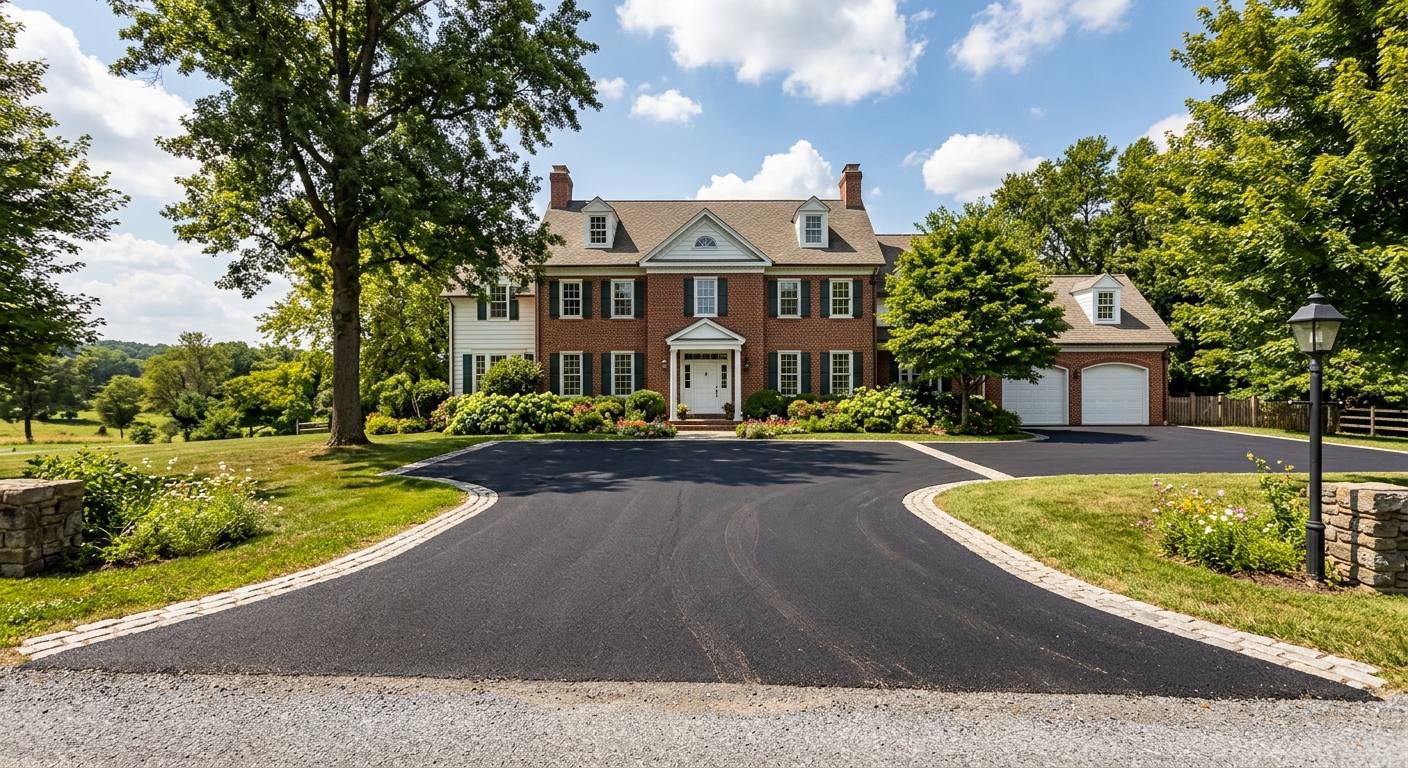
Dingman paving prices by scope — 2026
Dingman homeowners, most of you are living in detached, single-family homes—87.1% according to the latest U.S. Census Bureau report, with a homeownership rate of 88.4%. Driveways here are almost always a homeowner’s responsibility, not something shared or managed by an association. Paving costs in Dingman are shaped by the severe winter climate, heavy snow loads, and the rocky glacial till soils under our lots. That geology means a driveway base in Dingman has to be thicker and better compacted than you might see elsewhere, which raises both material and labor costs.
The table below breaks down Dingman’s real paving options, matched to when each makes sense. Most of the price difference between two quotes is out of sight—buried under the surface in the quality of excavation, subgrade prep, and base layering. It’s what you can’t see that decides how long your driveway will last. A cheap job over untouched or thin base will not hold up here through our freeze-thaw cycles. When you’re comparing estimates, remember this: material cost is just the start, and shortcuts underground cost you much more in the long run.
| Service |
Best for |
Lifespan |
Price range |
| Asphalt — full replacement with new base |
failed base, structural cracking |
20–30 yrs |
$3,700–$9,500 |
| Asphalt overlay / resurfacing |
sound base, surface cracking only |
8–15 yrs |
$1,600–$4,700 |
| Sealcoating — single application |
preventive maintenance on sound asphalt |
2–4 yrs |
$200–$750 |
| Concrete — new installation |
long service life, low maintenance |
30–50 yrs |
$5,300–$12,500 |
| Crack filling and patching |
isolated cracks under a quarter inch |
1–3 yrs |
$200–$800 |
| Gravel driveway |
rural, budget, long runs |
5–10 yrs with upkeep |
$900–$3,500 |
Estimates for a typical Dingman driveway. Square footage and base condition drive these figures more than material choice.
When paving can actually be done in Dingman
Paving in Dingman is strictly seasonal. You cannot lay hot-mix asphalt in cold weather and expect it to last, and our local suppliers know it—the asphalt plants near Scranton shut down every winter, typically from mid-November through March or even April if it's a hard year. In Pike County, temperatures routinely drop well below freezing, with a winter design temperature down to 4°F and ground frost as deep as 36 inches. Trying to pour concrete or lay asphalt in those conditions doesn’t just risk the final appearance—it guarantees a dramatically shorter lifespan because the materials simply cannot cure or compact as designed.
If a crew says they can pave in the off-season or wants to "get you in" after the plants are closed, you should walk away. Even if a warm patch of weather comes through, the base beneath your driveway will still be frozen solid, which prevents proper compaction and bonding. Early spring and late fall are the shoulder seasons, when crews have slots, but in Dingman, contractors are typically booked up by late May through September. Expect the highest quotes and tightest schedules around July and August. With our rural location and aggregate hauled from as far as Lackawanna County, project timing is as much about logistics as it is about weather. If your job isn't urgent, waiting until late spring or early fall can sometimes save you money and get you a more experienced crew.
Asphalt or concrete for a Dingman driveway?
Dingman’s severe freeze-thaw cycle is the deciding factor in material choice. Asphalt is flexible by nature—it can expand and contract as the ground heaves and thaws, absorbing movement instead of cracking. That’s a huge advantage up here, where winter brings heavy snow, brutal cold, and dramatic temperature swings. Concrete offers a longer potential lifespan—30 to 50 years if left intact—but it’s rigid and much more likely to spall or flake when exposed to de-icing salt, which is unavoidable for most Pike County driveways in snowy winters. The minute you use rock salt or any chloride-based de-icer, concrete surface breakdown begins. Most failures I see are from winter salt, not from cracking alone.
Concrete costs a little more up front and rarely needs maintenance, but you have to commit to never using regular salt for ice control. Most owners don’t stick to that, so the added investment is wasted. Asphalt, meanwhile, expects to be resealed every 3–4 years and will eventually need an overlay or replacement, but it takes abuse better and costs less up front. For the steep slopes and rocky soils we see so often in Dingman and surrounding Pike County, asphalt is usually the more forgiving choice.
Pavers and gravel have their place here too. Pavers drain well and can last, though frost can make them uneven over time. Gravel is often the practical move for rural properties and long runs—affordable, good drainage, but expect to top-dress and grade every couple of years.
| Option |
Installed cost |
Maintenance |
Freeze-thaw performance |
Lifespan |
| Asphalt — new install |
$3,700–$9,500 |
sealcoat every 3–4 yrs |
excellent, flexes |
20–30 yrs |
| Asphalt — overlay |
$1,600–$4,700 |
same |
good if base is sound |
+8–15 yrs |
| Concrete |
$5,300–$12,500 |
low, avoid de-icing salt |
fair, spalls with salt |
30–50 yrs |
| Pavers |
$8,400–$12,500 |
individual units replaceable |
good, settles gradually |
25–50 yrs |
| Gravel |
$900–$3,500 |
top-dress every 2–3 yrs |
excellent drainage |
indefinite with upkeep |
Door-knocking crews and leftover material
Dingman (and Pike County in general) is a prime hunting ground for transient door-to-door paving outfits. With homes set back from the road, spread out over rural stretches, and a low population density, it's easy for these crews to operate under the radar and move on before shoddy work is detected. The most common pitches? “We just finished a job down the road and have leftover asphalt,” or “we can give you today-only pricing.” If they’re driving an unmarked truck, insist on full payment in cash, come up with a verbal estimate only, or push a quick spray-seal instead of hot-mix, run the other way. A quality job—especially one that’ll last through our harsh winters—never materializes out of leftover mix.
Pennsylvania’s Home Improvement Consumer Protection Act is built for this: any job over $500 must come with a written contract, and you have a flat-out right to cancel within 3 business days. Do not let a crew rush you. A reputable paver knows you’re protected and has no problem showing documentation, waiting for you to check references, and providing a written scope. Remember, waiving your insurance deductible or “off the books” deals are illegal—never take that risk.
You can defeat all these scams in minutes: ask for their Home Improvement Contractor (HIC) registration number and confirm it at hic.attorneygeneral.gov, and verify their workers' comp coverage at wcais.pa.gov. If they dodge, you’ve saved yourself thousands.
Overlay, patch or full replacement?
Knowing when you need a full replacement, a simple overlay, or just spot repair saves you the most money. Here in Dingman, the real difference is what’s happening under the driveway. Structural “alligator” cracking—spiderweb or block pattern—signals a failed base. Laying new asphalt or an overlay here only hides the problem for a couple years, and then the cracks return, often worse. If you see only a few isolated linear cracks under a quarter inch wide, that’s usually just surface aging, easily handled with crack filling and sealcoating. Depressions or “birdbaths” that hold water after rain mean the subgrade or base has settled. Potholes mean water has soaked deep, eating the base.
Watch for edge crumbling—typical on steep or poorly-supported Dingman driveways—because it means the base didn’t extend far enough or there’s no edge support. To be clear: if your contractor gives you an overlay quote without probing or coring the base, they haven’t actually checked whether your drive can take it. Skipping that step is a red flag. Done right, diagnosis takes a bit of digging, not just a look from the street.
| What you see |
Likely cause |
Right fix |
Cost |
| Isolated cracks under 1/4 inch |
surface aging |
crack fill and seal |
$200–$750 |
| Alligator cracking over a wide area |
base failure |
full replacement |
$3,700–$9,500 |
| Depressions holding water |
subgrade movement |
excavate and rebuild that area |
$3,700–$5,800 |
| Crumbling edges |
no edge support |
edge repair, consider curbing |
$400–$1,500 |
| Potholes |
water into the base |
full-depth patch, then assess |
$250–$900 |
| Faded but sound surface |
oxidation only |
sealcoat |
$200–$750 |
Finding a legitimate paver in Pike County
In Pike County, you can’t rely on word of mouth alone—rural markets attract more out-of-area operators, and past work can be hard to track down. Always ask for a verifiable business address, not just a mobile number or P.O. box. Local contractors should own, not just rent, their equipment, and they should have no problem giving you references from jobs that have been down for at least 3 years. Newer references don’t tell you how their work ages through Dingman’s heavy freeze-thaw cycles. A real local operator will be able to name, without hesitation, which asphalt or aggregate plants near Scranton or Lackawanna County they use. If they can’t, they’re likely not in the trade full time or are simply brokering your job.
- Check their Home Improvement Contractor registration at hic.attorneygeneral.gov
- Verify workers' comp coverage via WCAIS: wcais.pa.gov
- Ask for a business address (not just a cell or post office box)
- Request at least two references for driveways 3+ years old
- Inspect current insurance certificate—no gaps
- See written, detailed scope of work—never accept a verbal estimate
- Ask which asphalt or aggregate plant they buy from
- Look for owned, not only rented, equipment visible at ongoing jobs
- Confirm warranty details in writing
- Check background online—look for a trail longer than three seasons
- Never pay the full price up front—deposit only after contract
- Walk away if pressured to “decide today” or pay cash only
Red flags: unmarked trucks, evasive about insurance or references, push for same-day work, or are vague about materials. These are signs to move on, not to negotiate.
Driveway permits, approaches and stormwater rules
Most driveway patching or basic pothole repairs in Dingman and the rest of Pike County can be done without a building permit—the county does not require permits for these minor repairs. However, if you are building a new asphalt driveway or replacing your entire driveway, especially in Lackawaxen Township, you’ll likely need a local building or zoning permit. For the driveway approach, which is where your drive meets a public or state road, approval almost always comes from outside the township: in Pike County, PennDOT District 4 issues Highway Occupancy permits for any driveway connecting to state routes. That’s a separate review from any local building department.
If you expand the footprint of your driveway or convert a significant area to impervious paving, stormwater runoff becomes your problem whether or not zoning mentions it. Directing water across property lines can land you in civil trouble regardless of permits. Dingman does not have the strictest requirements in the state, but it’s your responsibility to manage runoff and ensure your new drive does not flood neighboring lots or the public road.
Any job over $500 requires a written contract under Pennsylvania law. Before letting any crew dig or pour, verify their Home Improvement Contractor registration at hic.attorneygeneral.gov and check their workers' comp status at wcais.pa.gov.
Frequently asked questions — driveway paving in Dingman
Does road salt damage driveways in Dingman?
Yes, road salt is tough on driveways in Dingman, particularly concrete. Our winters bring heavy snow and icy conditions, so using salt or chloride-based de-icers is nearly unavoidable. On concrete, repeated salt exposure leads to “spalling” and surface breakdown in just a few seasons—the most common failure I see in Pike County. Asphalt holds up better; salt has little effect on the structure, though it can speed minor surface aging. If you’re investing in concrete, you must commit to alternate de-icers like sand or magnesium chloride and clear promptly after storms. For most residents, asphalt is more forgiving, and if you keep it sealcoated every few years—costing around $200–$750 per application—you’ll get a much longer service life.
Asphalt or concrete for a Dingman driveway?
Dingman’s climate—with deep frost, 40-pound snow loads, and plenty of ice—favors asphalt for most homeowners. Asphalt is flexible, absorbs movement from the freeze-thaw cycle, and survives the rougher winters better. Concrete can last longer (up to 50 years), but only if you religiously avoid de-icing salts, which most Pike County residents find unrealistic over our winters. Asphalt costs less up front—typically $3,700–$9,500 for a tear-out and rebuild, much less for an overlay. Unless you’re willing to baby your driveway and never use salt, asphalt is the practical option in Dingman.
Are there stormwater rules on paving in Dingman?
While Pike County is not the most regulated area in Pennsylvania, you cannot ignore stormwater. If your paving project increases the impervious surface—meaning water can’t soak in—it could trigger zoning or runoff requirements. Even where no immediate review is needed, you’re still liable in civil court if your runoff damages a neighbor’s land. For a full replacement or a major width increase (costing $3,700–$9,500 for asphalt), ask your paving contractor about grading and drainage solutions. For new driveways accessing state routes, a separate PennDOT approach permit will often require a drainage plan as part of their review. Don’t let anyone talk you into shortcutting this step.
What does compaction in lifts mean?
Compaction in lifts is the right way to build a stable driveway in Dingman’s soils. Instead of dumping all the gravel or asphalt at once, material is laid out in thin, measured layers—typically 2–4 inches at a time—then compacted with heavy rollers before the next layer goes down. This “builds from the bottom up,” squeezing out air and locking in every layer, crucial in our area where rocky till and deep frost will shift anything not built dense enough. Paying for a real base—part of what makes up the higher end of the $3,700–$9,500 asphalt replacement band—makes the difference between a drive that lasts 30 years and one that cracks within five.
What causes driveway cracks in Dingman?
Seasonal freeze-thaw movement is the main culprit in Dingman. Our 36-inch frost depth and frequent snow/ice cycles mean the ground shifts every winter, especially on driveways built over glacial till. Water seeps into small surface cracks, freezes, then expands, turning little problems into big ones. On older driveways, an unsound base is usually behind widespread crack patterns, especially “alligator” cracks. Poor drainage and lack of edge support also create problems. Maintenance such as crack filling (between $200–$800) and timely sealcoating can extend the surface life, but no repair stops deep base movement once it starts.
What does an asphalt overlay cost in Dingman?
An asphalt overlay in Dingman, where the base is still sound but the top layer is aging or cracked, typically runs $1,600–$4,700. That’s much less than a full tear-out and rebuild, and can add 8–15 years to your driveway’s life. The main condition: your base must be solid with no deep cracks, soft spots, or structural movement—otherwise you’re just putting a Band-Aid over rot. Before signing, ask your contractor how they assessed the base and whether they performed core sampling or test pits, especially in our rocky soils.
Is sealcoating a scam?
Sealcoating isn’t a scam in Dingman—but some contractors sell it that way. Done right, sealcoating (between $200–$750 for a single application) protects your driveway from oxidation, water, and salt, extending its life by sealing surface cracks and slowing damage. The scams happen when outfits spray a thinned, oil-based “sealer” or apply too thin, selling it as a permanent fix for structural problems. If your driveway has deep cracks, potholes, or a failing base, sealcoating won’t help—and any contractor saying otherwise isn’t being honest. Sealcoating is maintenance, not a miracle cure.
How much does a concrete driveway cost in Dingman?
A new concrete driveway installation in Dingman ranges from $5,300–$12,500, depending on the size, slope, and required base prep. The higher cost is partly due to haul distances from concrete plants and also the extra work preparing the glacial till subsoil in Pike County. While concrete can last 30–50 years, it’s important to remember our climate works against it, especially if you use rock salt after winter storms. If you’re thinking about concrete for your drive, factor in the extra maintenance and be realistic about your winter ice control habits—otherwise, you might not get the full lifespan for your investment.
How far ahead should I book a paver in Dingman?
In Dingman, especially between Memorial Day and September, reputable paving crews book up fast—sometimes months out. Most contractors in Pike County have a backlog as soon as the asphalt plants re-open each spring. If you want to be sure of a spot and avoid last-minute scheduling, start scoping your project and collecting quotes at least 2–3 months before you hope to start. For an asphalt full replacement (typically $3,700–$9,500), late spring or early fall not only means better scheduling but often better attention to detail, since crews aren’t overwhelming themselves to get every summer job in before the plant shuts down for the year.