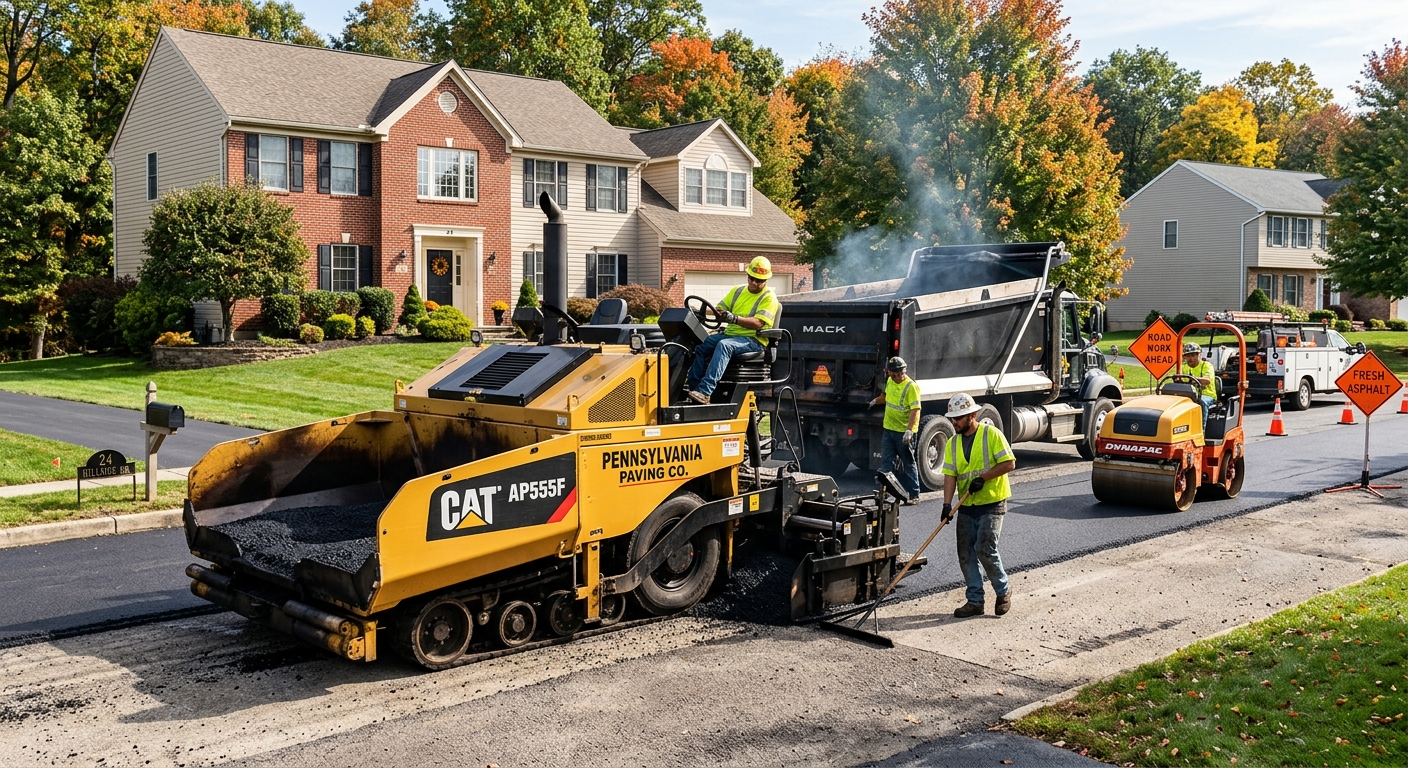
Upper Dublin paving prices by scope — 2026
Upper Dublin’s driveways reflect the higher homeownership rate here — over 84% of households own, and nearly three-quarters live in single-family homes (U.S. Census Bureau, ACS 2024). That means driveway paving and maintenance aren't “nice to have” expenses; they’re part and parcel of home upkeep in a postwar suburb with aging pavement. Whether you’re resurfacing a cracked 1960s drive or replacing a failing base, the numbers you’ll see in estimates come down to much more than just blacktop or concrete on the surface.
Most of the price difference between two quotes hides below ground, where you can’t see it: excavation depth, type and thickness of stone base, and real compaction. Upper Dublin’s moderate freeze-thaw cycles and areas of silty clay or glacial till mean a shortcut below the surface might not show until your third winter, when cracks appear seemingly from nowhere. Outward appearances—fresh asphalt, tidy edges—can mask big differences in how long a driveway will actually last.
Here’s what homeowners in Upper Dublin can expect by project type:
| Service |
Best for |
Lifespan |
Price range |
| Asphalt — full replacement with new base |
failed base, structural cracking |
20–30 yrs |
$4,300–$11,000 |
| Asphalt overlay / resurfacing |
sound base, surface cracking only |
8–15 yrs |
$1,850–$5,500 |
| Sealcoating — single application |
preventive maintenance on sound asphalt |
2–4 yrs |
$250–$850 |
| Concrete — new installation |
long service life, low maintenance |
30–50 yrs |
$6,100–$14,500 |
| Crack filling and patching |
isolated cracks under a quarter inch |
1–3 yrs |
$200–$800 |
| Gravel driveway |
rural, budget, long runs |
5–10 yrs with upkeep |
$900–$3,500 |
Estimates for a typical Upper Dublin driveway. Square footage and base condition drive these figures more than material choice.
The honest case for and against sealcoating
Sealcoating gets pitched as the cure-all for old asphalt — but here’s the honest version for Upper Dublin: it has a purpose, but that purpose is limited. A quality sealcoat shields the asphalt binder from sunlight and from oil or gas drips, which slow down oxidation and prevent brittle surface cracks. It also revives faded gray to a fresh black, which many homeowners like for curb appeal.
But sealcoating will not fix real problems. It does not add any structural integrity. If you have real cracks, rutting, or base failure, no amount of sealing will buy more years. In short: a sealcoat is a little like waxing a car. It protects what’s there, but doesn’t patch rust. If the base is bad, it’s lipstick on a pig — waste of money.
Most important, more is not better. If you apply sealcoat too often — yearly, for instance — you build up layers that become brittle and start to peel off in sheets. Sealing brand-new asphalt too soon is just as bad; it traps solvents and softens the surface. Best practice in Montgomery County? Wait at least six months after new paving for the first seal, and no more often than every two to three years.
Crack filling, with hot-pour rubberized material, is the maintenance that genuinely extends driveway life in Upper Dublin’s climate. It prevents water from seeping into the base — which is the real enemy during freeze-thaw cycles. Beware “sealcoating” for $250–$850 that’s just a thin spray from an unmarked truck; it’s gone after one winter. A proper application is squeegeed for full coverage and uses commercial-grade sealer. If the price seems too good to be true, so is the service.
Base preparation: the part you pay for and never see
What separates a 25-year driveway from a five-year headache in Upper Dublin? Every bit of long-term durability—especially here—comes down to what’s done under the surface before you see a speck of blacktop. The real assembly starts at the bottom: compacting the subgrade, installing the right thickness of stone (aggregate) base, compacting it in lifts, and then laying the asphalt on top.
Upper Dublin and nearby Abington sit on glacial till and pockets of silty clay. Silty clay is notorious for holding water, and that’s what makes this region prone to frost heave. In winter, water expands as it freezes, lifting driveway slabs and asphalt from below and cracking them. Come March, those cracks are wider—and your base has shifted yet again.
This is why you need more than the minimum. For these soils, finished stone base should be at least 6 to 8 inches thick, using clean, well-graded crushed stone (#2A modified aggregate is standard locally), compacted in 2- to 3-inch lifts. The asphalt should go on at a minimum of 3 inches compacted thickness for standard driveways. Drainage — with pitch away from structures and possibly a perimeter drain in poor soils — cannot be shortcut. Skipping these steps, or laying right on top of mud, is where “cheap” jobs go wrong and why one quote can be $4,300–$11,000 while another is suspiciously low.
Ask for these specs in writing: minimum 6-inch compacted stone base, #2A modified aggregate, compacted in lifts, and confirmation that the subgrade was inspected and compacted before stone. If a contractor can’t specify those, look elsewhere.
When paving can actually be done in Upper Dublin
Paving isn’t just about finding an open week on the calendar — Montgomery County’s climate and local supply chain set hard limits. Hot-mix asphalt must be installed and compacted at minimum air and base temperatures, usually above 45–50 °F, because below that it cools before it’s properly compacted and becomes porous, leading to premature failures.
Upper Dublin’s winter design temperature is just 14 °F. Asphalt plants along the I‑276 and US 202 corridors typically shut down from late November through March. If you’re getting quotes to pave during winter, walk away: no reputable contractor here is laying new asphalt then, because the material simply isn’t available locally when the plants close.
Concrete also has temperature rules — it needs to be placed and kept above freezing while it cures. Pouring during a cold snap, or without proper protection, causes surface spalling and shortens lifespan.
Realistically, the paving season runs mid-April through October in Upper Dublin, weather permitting. Crews are busiest from late May through August, when every homeowner wants work done before summer parties or the school year. If a crew says they can pave in December, it means they’re cutting corners. Spring and early fall are shoulder seasons with more capacity and sometimes better pricing, too.
Upper Dublin's ground and what it means for paving
Upper Dublin sits atop a mix of glacial till and silty clay subgrade, quite different from the rocky soils just a township or two away. Silty clay’s biggest problem for driveways? It holds water like a sponge but freezes hard, so when winter hits, the expansion forces the base and surface up and down — the process known as frost heave. Those cycles lead to alligator cracking, potholes, and settled areas, especially when drainage is overlooked.
Because of the local frost depth of 30 inches, any new or replacement driveway here absolutely needs extra attention to base depth and water management. Compared with parts of the county built on gravelly or well-drained soils, Upper Dublin homeowners can’t get away with just a few inches of stone base. A full replacement should include at least 6 to 8 inches of compacted aggregate and a clear plan for moving water off and away from the pavement.
Much of Upper Dublin’s housing was built after 1945, during the postwar suburban boom. In many neighborhoods, original driveways were installed quickly with thin or uninspected bases. That’s why area contractors now see demand for overlays and full reconstruction — the pavement above is failing because the base below never met today’s standards.
Driveway permits, approaches and stormwater rules
In Upper Dublin, just resurfacing your driveway within its existing footprint usually does not require a building permit, saving you a step — unless the work disturbs the curb, apron, or sidewalk, like widening a driveway or replacing part of the apron. For approaches (where your driveway meets a township road), permits generally come from the public works department, not code enforcement. For example, in some Montgomery County townships, approach permits are handled by the Montgomery Township Public Works Department.
Any work that expands your driveway or adds impervious surface — meaning, more area for rainwater to run off instead of soaking in — may trigger stormwater rules. Even if no permit is needed, Pennsylvania standards say you are responsible for where water goes; draining runoff straight onto a neighbor’s lawn or the street opens you to liability, regardless of permits.
By law, any paving contract in Pennsylvania over $500 must be in writing, due to the Home Improvement Consumer Protection Act. Make sure your contractor’s Home Improvement Contractor (HIC) registration is valid at hic.attorneygeneral.gov. Confirm workers’ compensation coverage, as this is mandatory for all employers, and can be checked at wcais.pa.gov. These checks take five minutes and prevent headaches later.
Door-knocking crews and leftover material
Driveway paving brings out more than its share of transient and fly-by-night crews — especially in suburban markets like Montgomery County, where competition is dense and homeowners expect quick service. They show up with these sales pitches: “We have leftover asphalt from a job down the street,” “We can give you a huge discount, but only if you pay cash and decide today,” an unmarked truck with out-of-county plates, and always a verbal price with a handshake instead of any paperwork.
A common summer pitch in Upper Dublin is the oil-based spray sealer for $250–$850 sold as “premium sealcoating.” This is usually thin, dries fast, and washes away by winter — giving real sealcoating a bad name. The “leftover material” scam is just as bad — reputable contractors rarely, if ever, have tons of usable asphalt left at the end of a job, and certainly aren’t selling it door-to-door.
Pennsylvania’s Home Improvement Consumer Protection Act is built for these situations. Any contract over $500 — so nearly every paving job — must be in writing, and you have a three business-day right to cancel, no questions asked. Never pay in full up front, and never accept only a verbal summary of the scope, material, or warranty.
Five-minute checks: Search the contractor at hic.attorneygeneral.gov for HIC registration, check workers’ compensation at wcais.pa.gov, insist on a written contract, and take advantage of your legal right to a three-day cancellation period. No legitimate operator objects to these steps.
Frequently asked questions — driveway paving in Upper Dublin
How often should I sealcoat my driveway in Upper Dublin?
Sealcoating in Upper Dublin is best done every two to three years, not yearly, because our climate sees moderate freeze-thaw cycles and humid summers. Over-sealing is a real problem here — building up too many layers can cause the coating to crack and peel, shortening your driveway’s lifespan and making eventual repairs tougher. The first application should only go down after new asphalt has cured for at least six months. If a crew tells you to sealcoat annually, they’re selling you unneeded service. A proper sealcoating job in Upper Dublin, including hot crack-filling, runs between $250–$850 per application for a typical drive, and the interval between coats is more important than the product itself. Focus on filling cracks as they open rather than overdoing surface sealing.
How much does it cost to widen a driveway?
Widening a driveway in Upper Dublin can range widely in cost, as it depends on whether you’re adding just a few feet of width or creating a double-wide with new base and edges. For most single-family homes in this area, you’re looking at the same cost band as a new installation on a per-square-foot basis, since you’re expanding the base and surface: expect $4,300–$11,000 for asphalt and $6,100–$14,500 for concrete for a full-width install. If you’re only adding a small strip and tying it into an existing base, it may run into the lower half of those bands. Remember, added width can trigger permit or stormwater requirements depending on township code, so check before starting work.
Do I need a permit to repave a driveway in Upper Dublin?
Most Upper Dublin homeowners do not need a building permit to simply repave an existing driveway within the same footprint. If you’re not disturbing curbs, sidewalks, or the apron, the work typically proceeds without township involvement. However, widening your driveway, replacing the apron, or altering drainage may trigger the need for a permit from the township public works or codes department. Always check with your municipal office before starting, especially if you’re increasing impervious surface. Regardless, any paving contract over $500 requires a written agreement by law in Pennsylvania, so avoid any contractor who offers to skip the paperwork.
Why are my driveway edges crumbling?
In Upper Dublin, the most common cause of crumbling driveway edges is insufficient stone base — either too thin when installed or eroded by water over the years. Our area’s glacial till and silty clay soils allow edges to “settle” or break away if not properly supported and compacted. Another frequent factor is mowing right up to the edge, which removes supporting soil. An edge repair with proper base and compaction typically costs $200–$800 for minor patching, and much more if widespread. Long-term, installing a clean edge with adequate stone and pitch for drainage is the real fix.
What slope does a driveway need for drainage?
The minimum recommended slope for driveways in Upper Dublin is 1/4 inch per foot (about 2%), guiding water away from the house and toward an appropriate drainage point. Our region’s silty clay subgrade and moderate freeze-thaw cycles mean letting water collect is a recipe for frost heave and premature failure. When installing or replacing a driveway, make sure this slope is specified in your contract. If you’re resurfacing but have drainage issues, address grading first. Investing $200–$800 in proper regrading or adding a swale up front saves thousands in future repairs.
Is gravel a cheaper option in Upper Dublin?
Gravel driveways are possible in Upper Dublin but rarely seen for front-of-house or suburban settings. That said, it is the lowest-cost option for long, rural drives, with typical installation costs running $900–$3,500 depending on length and base work. The tradeoff: with our local silty clay, you’ll need regular replenishing and grading, as gravel will settle and mix with underlying soils. Gravel is much less forgiving when it comes to mud and ruts, especially in spring. If low up-front spend is priority and you have a secondary drive or access road, gravel makes sense. For most residential situations here, asphalt or concrete is the better long-term value.
Is an overlay worth it or should I start over?
In Upper Dublin, an asphalt overlay (resurfacing) is a good value only if your existing base is solid and you have mostly surface cracking with no major settling or alligator cracks. Overlaying on top of a failed or moving base is throwing away money — you’ll see the same cracks come through fast. A surface overlay runs $1,850–$5,500 and lasts 8–15 years, while a full replacement with new base costs more up front ($4,300–$11,000) but can last 25 years or more if built right. Have a contractor core or probe the base if you’re unsure. If in doubt, spend the money on a new base — overlays can’t fix what’s broken below.
Can asphalt be laid in cold weather?
No — in Upper Dublin, asphalt paving is limited by temperature and local plant operations. Asphalt must be placed and compacted while hot, generally above 45–50 °F. Below that, the mix cools too quickly and won’t compact properly, leading to early cracking and poor durability. Asphalt plants supplying Upper Dublin close during winter, so material is not even available. If a contractor says they can pave for you in December or January, it means they’re either cutting corners or using outdated mix, neither of which will last a single freeze cycle. Wait for spring or summer and plan ahead; you’ll get better results and longer life, well worth the $4,300–$11,000 investment for a full replacement.
Does Upper Dublin have local asphalt plants?
Upper Dublin itself does not have an asphalt plant, but the township is served by plants along the I‑276 and US 202 corridors. These local suppliers keep haul distances short, meaning your asphalt arrives hot and fresh for proper compaction. This is a big advantage over more remote areas — better quality control and fewer excuses for a cold or poorly finished job. The supply line also helps keep prices stable, so you’ll generally see competitive quotes on paving projects in the range of $4,300–$11,000 for full replacement. If a contractor claims they’re trucking in material from counties away, that’s a red flag for quality and cost.