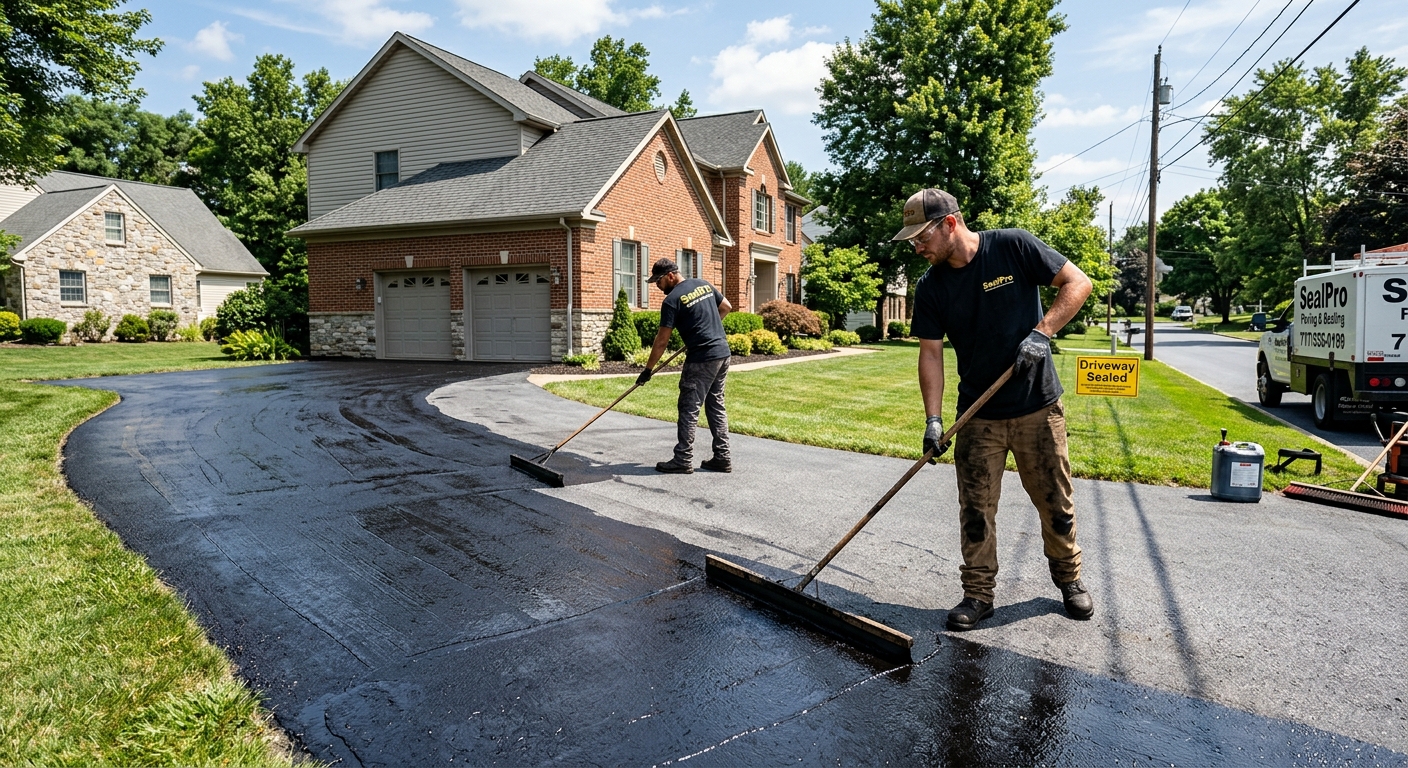
What a new driveway costs in Upper Southampton
Upper Southampton homeowners—over 84% of whom own their homes and 74.9% of whom live in single-family houses—deal with driveway repair and replacement more often than most. In this area, where freeze-thaw cycles and humid summers are the rule, your driveway is working against elements that punish shortcuts and reward proper construction. Underlying soil—silty clay and glacial till, especially in Lower Bucks—makes sub-base prep even more critical.
Don’t be fooled by the looks of an estimate: With paving, most of the difference between two quotes lies under the surface. What you see on top—nice smooth blacktop or crisp white concrete—lasts only as long as the hidden layers beneath it are properly installed and compacted. This sub-base work isn’t visible when the job is done, but it governs how long your driveway stands up to decades of Pennsylvania winters, soggy springs, and the occasional late summer downpour.
Here’s a breakdown of common driveway choices and honest life expectancies. The prices reflect what it costs in Upper Southampton to build right, given local soil and climate:
| Service |
Best for |
Lifespan |
Price range |
| Asphalt — full replacement with new base |
failed base, structural cracking |
20–30 yrs |
$3,800–$9,700 |
| Asphalt overlay / resurfacing |
sound base, surface cracking only |
8–15 yrs |
$1,600–$4,900 |
| Sealcoating — single application |
preventive maintenance on sound asphalt |
2–4 yrs |
$225–$750 |
| Concrete — new installation |
long service life, low maintenance |
30–50 yrs |
$5,400–$13,000 |
| Crack filling and patching |
isolated cracks under a quarter inch |
1–3 yrs |
$200–$800 |
| Gravel driveway |
rural, budget, long runs |
5–10 yrs with upkeep |
$900–$3,500 |
Estimates for a typical Upper Southampton driveway. Square footage and base condition drive these figures more than material choice.
Driveway permits, approaches and stormwater rules
In Upper Southampton, you typically do not need a building permit to resurface or repave a driveway if you are not expanding or changing its footprint. That saves time and paperwork for most regular replacements. However, if you are replacing or modifying the driveway approach—the section where your drive meets the township or state road—that is almost always regulated, and not by the people most expect.
For driveways connecting to state routes in Upper Southampton and across Bucks County, the PennDOT District 6 office issues Highway Occupancy driveway approach permits. If you live on a township or county-maintained road instead, municipal authorities handle the permit, especially if any part of the public right-of-way is touched. In Bensalem Township, both building and zoning reviews are routine for new and expanded driveways.
When expanding a driveway or adding a new hard-surface parking spot, be aware that increasing impervious surface can trigger stormwater management requirements—a growing concern throughout Bucks County. Even if you’re under the permit threshold, you remain responsible for not directing runoff onto a neighbor’s property; doing so can create drainage complaints and legal liabilities regardless of permitting.
Before hiring anyone for work over $500, Pennsylvania law requires a Home Improvement Contractor (HIC) registration—always verify eligibility at hic.attorneygeneral.gov. For any employer, workers’ compensation coverage is mandatory and verifiable through WCAIS; check before work starts to protect yourself from risk.
Which surface survives Upper Southampton winters
Upper Southampton’s winters turn up the worst in driveway materials. Our 14 °F winter design temperature, moderate freeze-thaw cycles, and 30-inch frost depth mean the ground moves—noticeably—between seasons. In these conditions, asphalt is forgiving: it flexes with rising frost and shifting clay, absorbing movement that would crack a rigid material. When installed correctly, asphalt stays serviceable for 20–30 years, provided freeze-thaw cycles don’t attack a poorly prepped base.
Concrete’s biggest draw is longevity: a well-installed slab will outlast asphalt—sometimes by decades—but in Bucks County the reality is tougher. Concrete here tends to spall and scale, especially under frequent salt use. De-icing salt is the number-one cause of concrete failure in this region; it draws moisture into the surface, which then freezes, pops chips, and eventually leads to ugly, flaking patches. Unless you’re prepared to swear off salt-based de-icers for life, the promise of “50 years” is only as good as your resolve and your patience with snow and ice.
Pavers are a high-end, flexible option, and when properly installed over a compacted base, they settle gradually with minimal cracking—an advantage in areas with moving ground. Gravel is still a legitimate budget option on long rural runs, where drainage matters most and surface dressing can be redone as needed.
| Option |
Installed cost |
Maintenance |
Freeze-thaw performance |
Lifespan |
| Asphalt — new install |
$3,800–$9,700 |
sealcoat every 3–4 yrs |
excellent, flexes |
20–30 yrs |
| Asphalt — overlay |
$1,600–$4,900 |
same |
good if base is sound |
+8–15 yrs |
| Concrete |
$5,400–$13,000 |
low, avoid de-icing salt |
fair, spalls with salt |
30–50 yrs |
| Pavers |
$8,700–$13,000 |
individual units replaceable |
good, settles gradually |
25–50 yrs |
| Gravel |
$900–$3,500 |
top-dress every 2–3 yrs |
excellent drainage |
indefinite with upkeep |
Door-knocking crews and leftover material
Paving is notorious for drawing fly-by-night operators—especially in a market like Upper Southampton, surrounded by dense suburbs and with plenty of driveways visible from the road. Here’s the pattern: Someone knocks, says they “just finished a job down the street,” and have “leftover asphalt” to put down for a big discount if you decide on the spot. They offer a today-only price, drive an unmarked truck with out-of-area or missing plates, work on cash or ask for money up front, and provide a handshake “quote” with no written terms. Sometimes, they’ll sell a thin oil-based spray as full sealcoating, which washes away with the first heavy rain.
The reason these scams work is that defective paving isn’t obvious for months or years—by which time the “contractor” is long gone. The high homeownership rate in Upper Southampton helps, but even here, a busy contractor market makes it easier for bad actors to vanish into the suburbs or cross into a new township overnight. If a price sounds hundreds less than what you’ve seen above, there’s a reason—and you’ll pay for it later, in rework or with a broken warranty.
Your legal protection as a Pennsylvania homeowner: for any contract over $500, you are entitled to a written agreement under the Home Improvement Consumer Protection Act (HICPA). You also have a three business-day right to cancel, no matter what the seller claims about urgency. Never accept a verbal quote; if a crew is reluctant to write things down, walk away.
Quick checks that defeat nearly every paving scam: verify their HIC registration at hic.attorneygeneral.gov, ask for a contract in writing, confirm current workers’ comp coverage on WCAIS, and never pay the full amount before work begins.
Diagnosing a failing Upper Southampton driveway
Knowing when to repair and when to replace is all about reading the surface. Most driveways in Upper Southampton are approaching decades of service (with many dating to before 1980), so repairs are common—but a bad base makes any patch a short-term fix.
If you see tight, linear cracks here and there—especially under 1/4 inch wide—you’re looking at normal surface aging, and crack filling plus sealcoat will get you another couple seasons at low cost. But when you see alligator cracking (the classic wrinkled pattern across a broad area), that’s failed base. Water has gotten in, or clay underfoot has shifted, and any overlay or patching is just covering the problem. Depressions or “birdbaths” that hold water mean the subgrade has moved or settled. Edge crumbling often means no edge support was put in. If you have potholes, water is already reaching and weakening the base.
It’s a red flag if a contractor recommends an overlay without probing or cutting into the base to check for movement, depth, and moisture. Overlaying over a failed base is money wasted—expect the same cracks to return beneath the new layer.
| What you see |
Likely cause |
Right fix |
Cost |
| Isolated cracks under 1/4 inch |
surface aging |
crack fill and seal |
$225–$750 |
| Alligator cracking over a wide area |
base failure |
full replacement |
$3,800–$9,700 |
| Depressions holding water |
subgrade movement |
excavate and rebuild that area |
$3,800–$6,000 |
| Crumbling edges |
no edge support |
edge repair, consider curbing |
$400–$1,500 |
| Potholes |
water into the base |
full-depth patch, then assess |
$250–$900 |
| Faded but sound surface |
oxidation only |
sealcoat |
$225–$750 |
Numbers, not adjectives
In Upper Southampton, where frost depth reaches 30 inches and soil is often silty clay, a properly built driveway is about numbers—excavation and compacted thickness—never about vague promises. Too many quotes get away with “three inches of blacktop” without stating whether that’s after compaction (which matters) or before (which sags 20–30%).
Quotes should detail not just total thickness, but how much clean, well-compacted stone goes in, how many lifts of asphalt are laid and compacted, and edge reinforcement (especially for driveways ending at lawns). The freeze-thaw cycles here make proper base depth and compaction a must; shortcutting them means cracks and ruts within a few seasons, no matter how “nice” the top looks on day one.
If a contractor waves off your depth questions or won’t write numbers down, look elsewhere. Here’s what to demand, in writing, on every quote:
- Excavation depth (in inches below finished grade)
- Aggregate (stone) base depth and type (e.g., 2A modified)
- Base compaction method—machine or roller, pass count
- Asphalt binder course compacted thickness (not loose)
- Asphalt surface course compacted thickness
- Mix designations (base vs. surface, appropriate for PA climate)
- Lifts—how many layers, laid and compacted separately
- Edge treatment—tapered, curbed, or backed with soil/stone
- Drainage slope and final grade target (for runoff control)
- Joint treatment method (tack coat or saw-cut as needed)
How often should a Upper Southampton driveway be sealed?
Sealcoating is often oversold in Upper Southampton. What it does is shield the asphalt binder from UV oxidation, water, and chemical spills—important in this region, where hot humid summers and winter plowing wear on driveway surfaces. It makes faded blacktop look new and does buy time against minor weathering. But sealcoating does not fix structural issues, add strength, or solve a failing base; on a cracked or sinking driveway, it’s window dressing at best.
Too many applications can do more harm than good. Most driveways should only be sealed every 2–4 years—certainly not every year. If new asphalt is sealed before it has cured (typically at least 6–12 months in this climate), solvents get trapped, leading to tire marks and early peeling. Let new pavement breathe before the first seal.
Proper crack filling—using hot-applied rubberized material for anything under 1/4 inch wide—matters more than sealing. Ignoring cracks lets water destroy the base, leading to costly patches or replacement. Also, be wary of suspiciously cheap “deals” under $225–$750 for a typical Bucks County driveway; these are usually diluted spray-ons that evaporate fast and provide little protection. A good sealcoat is applied by squeegee or brush at full thickness and should last multiple seasons.
Frequently asked questions — driveway paving in Upper Southampton
Is an overlay worth it or should I start over?
For Upper Southampton driveways, overlays make sense only when the underlying base is sound and cracks are minor—think tight, scattered lines but not widespread alligatoring. If you see structural cracking or feel soft spots underfoot, an overlay is a short-term patch that often fails quickly in our freeze-thaw climate. Since most driveways here were installed before 1980, age and water infiltration tend to make full replacement the longer-lasting value. An overlay typically costs $1,600–$4,900, versus $3,800–$9,700 for full replacement with a new base. A trustworthy contractor should core, probe, or excavate a section to judge the base, not just price what’s visible.
Does Upper Southampton have local asphalt plants?
Upper Southampton is served by multiple local asphalt and aggregate suppliers, with the Delaware Valley quarries and plants only a short distance away. Bucks County benefits from modest haul distances thanks to plants in eastern Montgomery County and nearby regions, which keeps hot mix costs reasonable. If a quote claims “extra” delivery fees for your area, be skeptical—there’s a well-established supply network and plenty of competition. For the average driveway (say, $3,800–$9,700 for full replacement), material comes fresh and typically from within an hour's drive.
What causes concrete to spall or flake in Upper Southampton?
In Upper Southampton, concrete driveways experience spalling and flaking mainly due to de-icing salt use and our climate’s freeze-thaw cycles. Salt draws moisture in, and when water freezes at the surface, it pops off thin chips—called spalls—or leads to more widespread surface loss. The 14 °F winter design temperature and frequent freeze-thaw shifts increase the risk. Add salt sparingly, use calcium chloride (less damaging than sodium chloride), and never seal new concrete until it’s fully cured. Even with best practices, Bucks County’s climate means concrete needs care and that “30–50 yrs” of service life ($5,400–$13,000) is only realistic if you avoid aggressive salt use.
How much does it cost to widen a driveway?
Widening a driveway in Upper Southampton involves excavation, new base prep, and possibly permit review—especially if you’re expanding into a yard or closer to property lines. The cost can run from $1,600–$4,900 for a straightforward asphalt overlay and up to $3,800–$9,700 for a full-width, base-included expansion. Concrete is higher still ($5,400–$13,000). If you are changing the approach near the public road, a PennDOT or township permit is usually required, and stormwater runoff may need to be addressed.
How long does a driveway installation take?
In Upper Southampton, a standard two-car asphalt driveway replacement usually takes 2–3 days: one day for excavation and new stone base, one for compaction and binder layer, and one for the surface course. Add more time if weather intrudes or you need new drainage lines. Concrete needs 1–2 days to install, but you must keep vehicles off it for at least a week while it cures. A good full replacement should never be rushed; for a job priced at $3,800–$9,700, you’re paying as much for proper prep and curing time as you are for the paving itself.
When can I seal a brand new asphalt driveway?
New asphalt in Upper Southampton should not be sealed immediately. Let it cure fully—typically 6–12 months, depending on season—before the first sealcoat. The compounds in fresh asphalt need that time to vent and harden, especially after humid Bucks County summers. Sealing too soon traps oils, leading to scuffs and early peeling. Your best window is late spring or early fall, when weather is mild and the pavement is clean and dry. The price for proper sealcoating is $225–$750 for a typical drive, but a good contractor will advise you to wait until the surface is ready.
Is gravel a cheaper option in Upper Southampton?
Gravel is the most economical surfacing in Upper Southampton, at $900–$3,500 depending on length and prep. It suits rural lots, long runs, and driveways where drainage is tricky. However, gravel requires yearly or biennial re-dressing to keep the surface smooth, as well as regular weed control and minor grading. If you’re after a low-commitment or DIY-maintained surface, gravel is a winner. But in suburban developments, asphalt and concrete remain more common for year-round vehicle access and cleaner entryways.
Are there stormwater rules on paving in Upper Southampton?
Yes, increasing driveway size—especially with asphalt or concrete—can trigger stormwater management review in Upper Southampton and across Bucks County. Permits are more likely if you expand the footprint or build new impervious surfaces, and you are always responsible for not directing runoff to a neighbor’s yard. Directing water into the street or onto someone else’s property can create legal liability even if you hold a permit. For typical repaving (within footprint), the process is simpler, but ask your contractor to confirm drainage is considered—unexpected runoff costs real money down the road, often more than the paving itself ($3,800–$9,700 for major fixes).
How deep should the aggregate base be here?
In Upper Southampton, where the ground freezes to 30 inches and clay or silt is common, a proper driveway base uses at least 6–8 inches of compacted 2A modified stone. Lower Bucks County’s soils absolutely require this, otherwise frost heave and soft spots develop fast. Some contractors, aiming to cut cost (especially on overlays), offer much less—leading to early failure. For any new or replacement driveway, demand a written spec that defines base thickness, material, and compaction method. For reference, a full replacement job done to code, including proper base, starts at $3,800–$9,700.