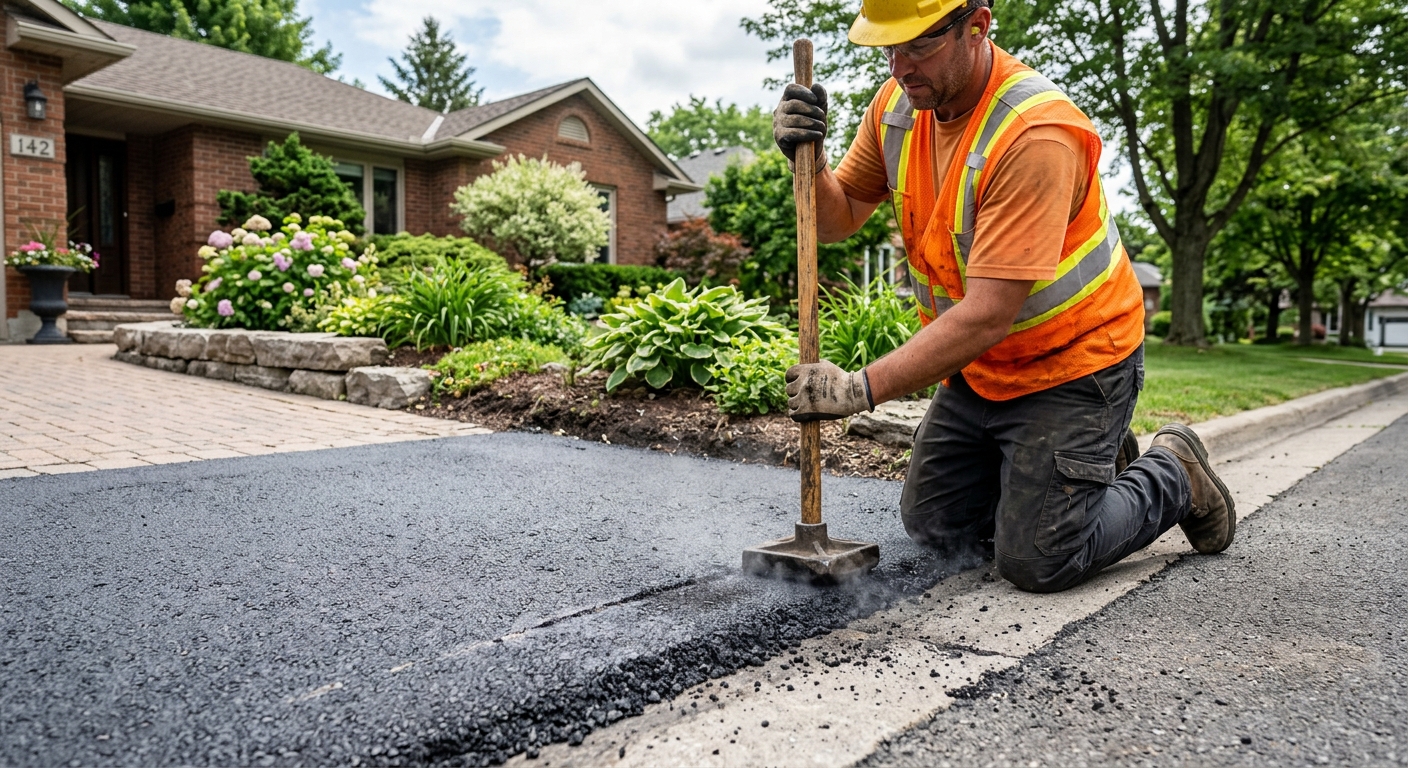
Driveway paving costs in Camp Hill — 2026
Camp Hill’s driveways are overwhelmingly on single-family homes—three out of four houses fit this category, with a homeownership rate above 68%. That tracks with the suburbs running west from Harrisburg, where a private driveway is a basic feature. When someone in Camp Hill looks for a driveway quote, what they see is the top layer. What matters more is what’s under the surface: the stone base, the compaction, and especially whether the limestone or clay soil has been accounted for properly. Freeze-thaw cycles are tough here in south-central Pennsylvania, and the frost line runs to 30 inches. The visible asphalt or concrete costs about the same house-to-house, but what’s hidden—quantity and quality of base stone, drainage work, subgrade corrections—explains nearly all of the price difference. Don’t compare bids based on the square footage price unless you know what each builder is actually repairing or replacing below ground. Older Camp Hill houses, most built before 1980, often have driveways that look fine but have decades-old bases needing full replacement, especially with karst soil or sites with water problems.
| Service |
Best for |
Lifespan |
Price range |
| Asphalt — full replacement with new base |
failed base, structural cracking |
20–30 yrs |
$3,800–$9,700 |
| Asphalt overlay / resurfacing |
sound base, surface cracking only |
8–15 yrs |
$1,600–$4,900 |
| Sealcoating — single application |
preventive maintenance on sound asphalt |
2–4 yrs |
$225–$750 |
| Concrete — new installation |
long service life, low maintenance |
30–50 yrs |
$5,400–$13,000 |
| Crack filling and patching |
isolated cracks under a quarter inch |
1–3 yrs |
$200–$800 |
| Gravel driveway |
rural, budget, long runs |
5–10 yrs with upkeep |
$900–$3,500 |
Estimates for a typical Camp Hill driveway. Square footage and base condition drive these figures more than material choice.
Driveway permits, approaches and stormwater rules
In Camp Hill and across Cumberland County, repaving an existing driveway—meaning no changes in width or layout—usually doesn’t require a building permit, especially in the surrounding townships. This lets you handle basic upkeep without tripping over paperwork. But any work on the driveway approach, where it meets a public street, is a different story. For driveways that exit onto state roads, you’ll need a Highway Occupancy Permit from PennDOT District 8-0. If your driveway fronts a township road, your township office is the permitting authority. In Carlisle Borough, expanding or building a new driveway surface area often means a zoning or building permit from the borough codes office.
Expanding your driveway—whether to add another parking space or widen for easier turning—often means you’re increasing impervious surface. This can trigger stormwater management requirements, since excess runoff can overload local drainage or cause problems for neighbors. Even if it’s technically permitted, Pennsylvania law puts the liability on the homeowner if water is redirected onto another property and causes damage.
For contractor selection, Pennsylvania requires any paving contractor doing jobs over $500 to have a Home Improvement Contractor (HIC) registration, which you can check at hic.attorneygeneral.gov. All employers must carry workers’ compensation insurance, and you can verify coverage through the WCAIS system at wcais.pa.gov. Never accept an excuse or vague answer on registration—those systems exist to protect you, the homeowner.
How to vet a paving contractor in Camp Hill
Choosing a paving contractor in Camp Hill is more about what you can actually check than what’s on a business card. Pennsylvania law requires Home Improvement Contractor registration for any paving job over $500—you can and should verify this at hic.attorneygeneral.gov. Demanding a real, fixed address within the Harrisburg–Carlisle area is step one. Anyone operating out of a PO box or a pickup bed probably won’t stand behind their work. Most real operators in the county own their own rollers and pavers; heavy reliance on rental equipment is a warning sign for cut-and-run work. Always ask for references from driveways paved at least three years ago—what matters is how a surface holds up to freeze-thaw and traffic, not just curb appeal in year one. Lastly, ask where their asphalt and stone come from. With several local limestone quarries and asphalt plants near Carlisle and Mechanicsburg, any established contractor should answer instantly. If they can’t, you’re probably talking to someone who subs out their work, which almost never goes well.
- Verify HIC registration at hic.attorneygeneral.gov
- Check workers’ compensation insurance at wcais.pa.gov
- Request a fixed local business address
- Ask for references for jobs 3+ years old in Camp Hill or nearby
- Confirm the contractor owns their own paving and rolling equipment
- Require a written contract before any work starts
- Insist on a clear, written scope of work—not just “pave driveway”
- Ask for proof that material is sourced from a plant near Carlisle or Mechanicsburg
- Check that the contract includes a 3-day cancellation clause, as legally required
- Make sure no “insurance deductible waiving”—it’s prohibited by state law
- Be wary if they pressure for immediate signature or cash up front
- Require a line-item price for base repair and drainage
Red flags include out-of-area plates, no business address, rented trucks, “today-only” pricing, and unwillingness to specify where their materials come from. If you can’t verify them directly, don’t hire.
Sealcoating: what it does and what it doesn't
Sealcoating is widely sold in Camp Hill as a routine maintenance step, and done right, it does two things: it protects the surface binder in your asphalt from oxidation and chemical spills (especially fuel and oil), and it refreshes old, faded pavement by restoring a rich black finish. For sound asphalt—no structural cracks, potholes or low areas—it buys you a few more years before the top wears away.
But here’s the truth that gets left out: sealcoating is not a cure for deep cracks, heaving, or a failed base. It does not “glue” your driveway together or add any real strength. If the base below is failing, you’re putting a shiny new coat on top of a crumbling floor. Overapplying sealcoat, or doing it more often than every couple years, builds up thick layers that crack and peel, especially in our freeze-thaw climate. Sealing new asphalt too early—before it has cured—can trap oils and actually shorten its life. The right interval for sealcoating in Camp Hill is every two or three years, not every spring.
Crack filling actually matters more. Properly cleaning and hot-sealing cracks under a quarter inch wide holds out water—the primary enemy here. A proper sealcoat job uses squeegees to create a uniform layer and fills hairline cracks; a thin, sprayed-on bargain job (often at the lower end of $225–$750) isn’t worth it. If the price seems too low to cover careful cleaning and decent sealer, it probably is—it’ll look black for a month, then fade rapidly and fail to protect anything.
Why driveways behave differently in Camp Hill
The geology just beneath your feet makes all the difference in Cumberland County. In the Camp Hill and Carlisle areas, limestone karst is common. The ground has natural voids and can settle unpredictably over time. This means new driveways demand a thicker, well-compacted stone base to guard against future settlement or even minor sinkholes. The standard in other places—a thin gravel base or no regrading—simply isn’t enough here. If your contractor ignores the subgrade or suggests cutting corners on draining or base thickness, they’re not building for local conditions.
Freeze-thaw cycling runs every winter, with a frost depth of 30 inches. Any water that gets under the asphalt or concrete will freeze, expand, and lift the pavement—then drop it again when the thaw comes. Camp Hill’s heavy post-1960 subdivisions, especially in Hampden and Silver Spring Townships, have many wide driveways poured on standards that were just “good enough” for the era, rarely to today’s specs. As a result, many are now seeing surface cracking and base failures, making mill-and-overlay or even full replacement necessary. Proper drainage, base compaction, and attention to the specific limestone issues of the region will save you from surprise repairs down the line.
When paving can actually be done in Camp Hill
Paving in Camp Hill is a seasonal business—there’s no getting around it. Hot-mix asphalt must be laid when the air and ground temperatures are high enough to allow it to be worked and compacted before it cools. In this part of south-central Pennsylvania, when the winter design temperature can hit 12 °F and the freeze-thaw cycles kick in on schedule, local asphalt plants simply shut down for winter. As soon as nights regularly dip under 40 °F, not only is supply limited, but the surface you’d be paving onto is too cold for proper bonding. Paving in the wrong conditions here guarantees early failures: a new asphalt drive that feels brittle, develops raveling, or fails as water gets in through imperfections.
Concrete has its own limits—a pour in freezing or near-freezing weather will not cure out to full strength, and surface spalling or early cracking can follow. The main local plants near Carlisle and Mechanicsburg are shut from late fall until spring, so anyone promising “off-season” paving is going to truck in cold mix or cut corners. Best quality work gets done from mid-April through October. Shoulder months, like late April or early November, see crews with more room in their calendars and sometimes better pricing—if the weather cooperates. If someone offers to pave your driveway in late November in Camp Hill, be skeptical: good contractors simply aren’t operating then, and you’re unlikely to get the same materials or crew attention.
Grading and water management on a Camp Hill driveway
Water does more damage to driveways in Camp Hill than any vehicle ever will. Proper grading is what stands between your investment and premature failure. The minimum recommendation for surface drainage is about a 2% slope (a quarter inch per foot) away from structures, whether that’s achieved with a crown in the middle of a two-lane drive or a cross-slope from one side to the other. If your driveway slopes toward your garage or house, you’re inviting water to collect at the foundation, risking not just your drive but your basement too. In tight postwar lots that can’t be regraded, channel drains or trench drains at the garage entry intercept runoff before it causes problems.
The local limestone karst beneath Camp Hill affects drainage design: it percolates water well in places, but pockets and voids mean that excess water can still undermine driveways unexpectedly. Freeze-thaw cycles compound the effect—any puddle that forms will eventually seep into the base and frost-heave the surface in winter. Redirecting runoff onto your neighbor’s lawn is not only bad form but can create legal liability, regardless of permits. If you don’t have enough room for a swale to daylight, a dry well or dedicated infiltration pit can provide relief without shoving the problem downstream. Grading and drainage aren’t optional here—they’re the difference between a driveway that lasts 20 years and one that’s shot in five.
Frequently asked questions — driveway paving in Camp Hill
How many freeze-thaw cycles does Camp Hill get?
Camp Hill gets pronounced freeze-thaw cycling each winter due to its south-central Pennsylvania climate. Typically, you can expect dozens of significant cycles each year—where temperatures rise above and fall below freezing repeatedly from November through March. This is tough on asphalt and concrete because water infiltrates small cracks, then expands when it freezes, breaking apart the surface and base over time. That’s why driveways here built on weak bases or without attention to drainage start showing cracks, potholes, or heaving sooner than in milder areas. A properly constructed driveway, with a solid base and good grading, is going to hold up far better to these conditions, potentially lasting 20–30 years for a full asphalt replacement ($3,800–$9,700), while a poorly built one might need major repairs in less than a decade.
How much does it cost to widen a driveway?
Widening a driveway in Camp Hill means more than just adding asphalt or concrete. You’ll need to factor in additional base stone, excavation, and sometimes new permitting—especially if expansion brings you closer to property lines or increases stormwater runoff beyond code allowances. For an asphalt driveway, expect anywhere from $3,800–$9,700 for a full replacement, but for partial widenings on sound subgrade, prices per extra foot generally fall in the lower half of that range. If your expansion affects the approach onto a state or township road, you’ll also need to budget for a new or modified permit. These costs are extremely sensitive to site conditions—like whether you’re dealing with limestone karst or a sinking edge—so a careful, site-specific estimate is always best.
Is sealcoating a scam?
In Camp Hill, sealcoating isn’t a scam—but it is often oversold. Used reasonably, it extends the appearance of a healthy driveway and slows weathering, especially in our sunlight and freeze-thaw cycle. But sealcoating won’t fix underlying base failure, major cracks, or potholes. Done too often, or by inexperienced hands using thin, watered-down material, it can actually cause more peeling, cracking, and maintenance work. A good sealcoating every two to three years makes sense for your investment, with expected costs of $225–$750 per application on a typical driveway. If a contractor promises sealcoating will “double” your driveway’s lifespan regardless of condition, be skeptical. Focus more on proper crack filling and base repairs to get the best value out of your pavement here.
How deep should the aggregate base be here?
Camp Hill’s limestone karst subgrade means you need a thicker aggregate base than in many other places. For residential driveways, a minimum of 6 to 8 inches of well-compacted, crushed limestone is standard, with some sites requiring up to 12 inches depending on soil stability, drainage, and intended use. Skimping on base depth here leads directly to cracking, depressing, and edge failure—especially given our heavy freeze-thaw cycles. The base is where most of the labor and cost is buried in a full replacement job, which runs $3,800–$9,700 for most homes. If your contractor suggests “resurfacing” a sinking drive without adjusting the base, you’re only kicking the can down the road.
What does sealcoating cost in Camp Hill?
In Camp Hill, a typical sealcoating job will cost between $225–$750, with most homeowners paying around $425 for a standard single-family driveway. The price will swing based on your driveway’s size, surface prep needs, and how many cracks need cleaning and filling before the sealer is applied. Just keep in mind: if you receive a price that seems too good to be true—say, under $200 for a multi-car drive—it usually means the crew is cutting corners with diluted materials or skipping crucial prep steps. Done right, every 2–4 years is enough to keep your asphalt surface in good shape under Camp Hill’s conditions; done too often or too cheaply, it will peel and not protect anything.
Are pavers worth the cost in south-central Pennsylvania?
Interlocking concrete or stone pavers can look stunning and offer real longevity, but they come at a price far above standard asphalt or even poured concrete—typically double or more, well above $5,400–$13,000 for a concrete drive. In Camp Hill, pavers have to be installed with careful attention to base prep because our freeze-thaw cycles and limestone karst subgrade can cause sections to heave or settle if anything beneath shifts. For long-term value, pavers are a good investment on high-end homes or where looks really matter. But for the majority of driveways—a town where 74.9% of homes are single-family—properly built asphalt or concrete offers plenty of value and less maintenance for most homeowners.
Why does my driveway have depressions that hold water?
Depressions or “birdbaths” in Camp Hill driveways are almost always caused by base settling or inadequate compaction, especially where limestone karst creates hidden soft spots. Over years, these dips can collect water, which is a double problem: not only is it inconvenient, but during freeze-thaw cycles, that water expands and contracts, breaking up surface pavement and making the problem worse. Many older local driveways—over 90% of homes here were built before 1980—were paved with thinner bases or on subgrades that weren’t fully prepared. Fixing this properly means cutting out and repairing the base before patching or repaving, which can run as much as a full base repair ($3,800–$9,700) if settlement is widespread.
Are there stormwater rules on paving in Camp Hill?
Yes. Whether you’re in Camp Hill or elsewhere in Cumberland County, expanding a driveway or adding new impervious surface can trigger stormwater review. Most zoning offices want to make sure you aren’t pushing runoff onto roads or neighboring properties—liability remains with you, permit or not. In Carlisle Borough, expanding your drive surface area means a likely zoning or building permit review, with attention to runoff and grading. On township roads, requirements are more variable, but even without a formal permit, improper drainage can mean civil issues if your runoff causes damage. Consider a slightly higher up-front cost for added drainage, proper grading, or even a dry well—often adding just a few hundred to a couple thousand dollars ($900–$3,500 for gravel or supplementary work), to avoid far bigger headaches later.
Can asphalt be laid in cold weather?
Asphalt paving in cold weather doesn’t work in Camp Hill due to how quickly the mix cools—it won’t compact properly and leaves a porous, weak pavement. Air and ground temperatures need to be consistently above 50 °F, which usually limits our local paving season to mid-April through October. Concrete has its own issues, needing above-freezing nights to cure correctly and avoid surface damage. Most asphalt plants in Cumberland County close for the winter, so if you’re offered a “special deal” to pave in late fall or early winter, you’re likely getting leftovers or cold patch—which won’t last. Plan your replacement or resurfacing work in the warm months to ensure your investment, at prices like $3,800–$9,700 for full replacement, goes toward a surface that will actually last.