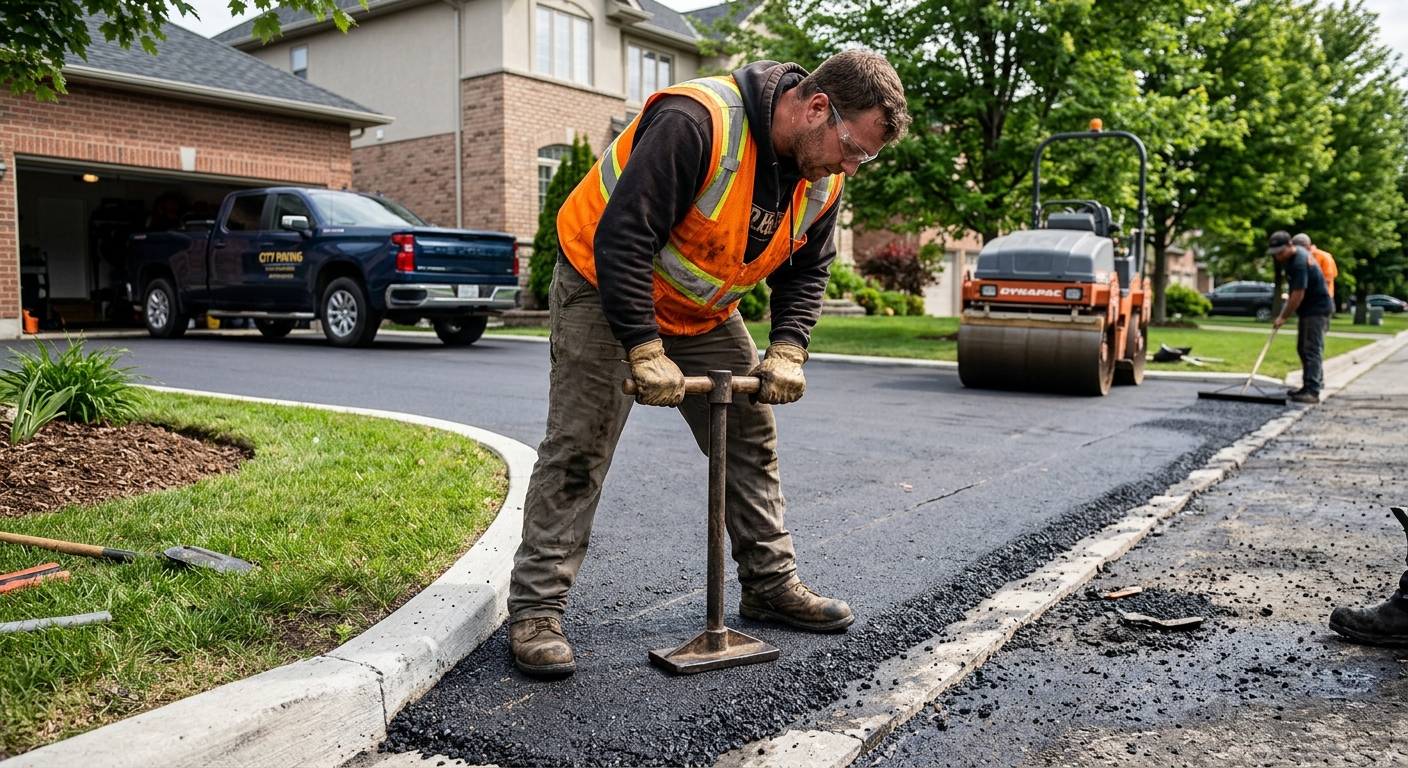
Driveway paving costs in Scott — 2026
In Scott, where nearly three-quarters of homes are single-family houses and the homeownership rate sits at 68.9% (U.S. Census Bureau, ACS 2024), driveways are a core part of the property—not just a luxury. Paving costs here vary more than they do in many parts of Pennsylvania, largely because our region faces the worst freeze-thaw cycles in the state and a soft, silty subgrade common in the Susquehanna River valley. Structural performance and lifespan are determined less by the surface you see and more by the base you’ll never look at—in other words, most of the price difference between two bids comes from what lies below.
Expect higher build costs, especially when deep excavation and more aggregate are needed to offset Scott’s ground conditions. With longer drives and many aging 1940–1970 homes built under older standards, many existing driveways need serious reconstruction for modern vehicles. Below, you’ll find typical project options and their price bands for Scott in 2026. Remember, surface material is only part of the story—the base and prep define both performance and cost.
| Service |
Best for |
Lifespan |
Price range |
| Asphalt — full replacement with new base |
failed base, structural cracking |
20–30 yrs |
$3,400–$8,700 |
| Asphalt overlay / resurfacing |
sound base, surface cracking only |
8–15 yrs |
$1,450–$4,400 |
| Sealcoating — single application |
preventive maintenance on sound asphalt |
2–4 yrs |
$200–$700 |
| Concrete — new installation |
long service life, low maintenance |
30–50 yrs |
$4,900–$11,500 |
| Crack filling and patching |
isolated cracks under a quarter inch |
1–3 yrs |
$200–$800 |
| Gravel driveway |
rural, budget, long runs |
5–10 yrs with upkeep |
$900–$3,500 |
Estimates for a typical Scott driveway. Square footage and base condition drive these figures more than material choice.
What you need before paving in Scott
For most Scott Township homeowners, repaving or resurfacing an existing asphalt or gravel driveway—when not altering the width or length—does not require a township building permit. That’s a relief and saves a phone call. However, if you’re connecting your driveway to a Pennsylvania state route, you’ll need a Highway Occupancy Permit from PennDOT District 3‑0. Expansion projects or driveways tied to new land development, especially near Bloomsburg or Berwick, may involve more municipal scrutiny.
Whenever you expand a driveway, you may trigger stormwater rules—impervious surface adds runoff, and in the Susquehanna valley, drainage mistakes are costly. Even where no formal review is needed, sending water onto a neighbor’s property will eventually bring trouble. If you’re adding pavement, ask about both stormwater compliance and township setback requirements along property lines.
Before signing a contract (which Pennsylvania law requires in writing for jobs over $500), verify your contractor’s Home Improvement Contractor registration through the Pennsylvania Office of Attorney General at hic.attorneygeneral.gov. They must also carry workers’ compensation insurance—check via WCAIS (wcais.pa.gov)—which protects you from liability if someone is injured on your property. These two checks are quick and free, and any hesitation from a contractor here is a reason to keep looking.
Numbers, not adjectives
When comparing bids for paving in Scott, the only real protection you have is asking for every dimension and method in black and white. “We’ll put down three inches of asphalt” sounds specific but means little—three inches before or after compaction? What composition of base? Which asphalt mix? In our freeze-thaw climate, vague promises are a recipe for disappointment. The right depths here are higher than in mild climates—because the ground freezes hard and heaves, and the silty subgrade is weak without sufficient compacted stone.
Never settle for a quote that doesn’t specify all the following in clear numbers. These are the minimum specs you should require in writing for any Scott driveway job:
- Depth of excavation below finished grade (inches)
- Aggregate base thickness and material by type (e.g., 6" compacted 2A modified)
- How and how many times the base is compacted, and with what equipment
- Asphalt binder course depth, compacted
- Asphalt surface course depth, compacted
- Exact asphalt mix for each layer (state DOT or local plant code)
- How many lifts each layer is placed in and compacted separately
- Edge treatments—tapered, butt joint, or with supplemental support
- Drainage plan—pitch/slope toward safe outlet or swale
- Seam treatment for connections to existing surfaces or public road
Scott's ground and what it means for paving
The typical Scott driveway sits over Susquehanna River valley alluvium—a soft, silty soil that holds water and deforms more than shale or glacial till. This means driveways here need a thicker, well-compacted aggregate base to resist rutting and frost heaving. With a required frost depth of 36 inches and long, harsh winters, it’s common for older (1940–1970) driveways—many of which were poured or paved before modern standards—to rest on only minimal stone, if any at all.
What does this mean for you? If you’re replacing or expanding a driveway, expect your contractor to dig deeper for a stable subgrade. Skimping on base depth, or reusing old weak stone, leads to early failure—cracking, settlement, and potholes within a few freeze-thaw cycles. It also means that many Scott driveways that look like “just an overlay” jobs turn out to need full excavation when the base is examined. If you’re facing a shared or narrow driveway, typical of the county’s older housing, that base may be compromised by decades of poor drainage and minimal construction, so repair or widening will almost always involve correcting past shortcuts.
Widening, extending or adding a parking pad
When your project isn’t just a straight replacement—maybe you want to widen for a second car, put in a parking pad for guests, or finally pave that gravel track to your barn—the rules and risks change. Anything that expands your driveway’s footprint means starting from scratch with a new base on undisturbed soil. This is both more expensive, as you’ll need excavation and a thicker stone base, and higher risk if the edge seam isn’t treated properly. The joint where new meets old will always be vulnerable to cracking and water intrusion, so details matter.
Beyond construction, new pavement surface counts against impervious surface totals, and Scott properties near sensitive areas can run into stormwater management requirements—especially if you’re sending water closer to your neighbor’s home or toward a road ditch. If you’re connecting an expanded driveway to a state route, the approach section always requires a Highway Occupancy Permit from PennDOT District 3‑0, regardless of width.
Ask your contractor about setbacks from neighboring properties and the road, which may limit how far you can build even on your own land. Before you start, sort out both stormwater and approach permitting; it’s far less costly up front than after a neighbor calls the township.
Which surface survives Scott winters
Scott sits in one of Pennsylvania’s harshest freeze-thaw bands, regularly dropping below 2°F in winter and racking up over 6,300 heating degree days each season. Asphalt handles these swings by flexing—allowing it to settle, lift, and move with the ground rather than cracking outright. Concrete is much less forgiving: it’s hard and durable but rigid, and as a result is more likely to crack in our climate, especially with a subgrade that holds moisture. The real threat to concrete in Scott, though, isn’t temperature swings—it’s road salt. In Columbia County, heavy winter salt use leads to surface spalling and scaling on concrete driveways, which shortens their life unless you keep salt off entirely.
Honestly, while concrete can last half a century when conditions are perfect and de-icing acids are avoided, very few owners manage to do so for 30 years of winters. Asphalt lasts 20–30 years with consistent sealcoating. If salt isn’t used and you commit to diligent maintenance, concrete pays off—but if you need a hard surface and don’t want to think about it, asphalt is the fit for Scott’s winters.
Paver surfaces shed water, flex locally, and can be repaired in sections, but cost nearly as much as high-end concrete. Gravel works best for long rural runs, draining freely but requiring regular grading and top-dressing to look good and stay smooth.
| Option |
Installed cost |
Maintenance |
Freeze-thaw performance |
Lifespan |
| Asphalt — new install |
$3,400–$8,700 |
sealcoat every 3–4 yrs |
excellent, flexes |
20–30 yrs |
| Asphalt — overlay |
$1,450–$4,400 |
same |
good if base is sound |
+8–15 yrs |
| Concrete |
$4,900–$11,500 |
low, avoid de-icing salt |
fair, spalls with salt |
30–50 yrs |
| Pavers |
$7,800–$11,500 |
individual units replaceable |
good, settles gradually |
25–50 yrs |
| Gravel |
$900–$3,500 |
top-dress every 2–3 yrs |
excellent drainage |
indefinite with upkeep |
Overlay, patch or full replacement?
In Scott, you don’t need to guess about the right approach—you can check it yourself. If your driveway shows widespread “alligator” cracking (a network of small interlocking cracks), that’s almost always base failure: an overlay will last a couple years at best before those cracks reflect through. Isolated cracks (less than a quarter inch wide) and some surface aging? Usually, crack fill and sealcoating are both effective and affordable. If you’re seeing birdbaths or settled areas that hold water, you’ve got subgrade issues—fixing just the surface won’t solve the problem. Crumbling at the edges is a clue there’s no real edge support, and potholes confirm that water has already penetrated the base.
Never accept an overlay bid without a contractor probing the base—if they haven’t, they haven’t really looked, and you’re at risk of burning money on a job that won’t last. Repair recommendations should match what you see on the ground, and price should follow the scope—not just surface area.
| What you see |
Likely cause |
Right fix |
Cost |
| Isolated cracks under 1/4 inch |
surface aging |
crack fill and seal |
$200–$700 |
| Alligator cracking over a wide area |
base failure |
full replacement |
$3,400–$8,700 |
| Depressions holding water |
subgrade movement |
excavate and rebuild that area |
$3,400–$5,300 |
| Crumbling edges |
no edge support |
edge repair, consider curbing |
$400–$1,500 |
| Potholes |
water into the base |
full-depth patch, then assess |
$250–$900 |
| Faded but sound surface |
oxidation only |
sealcoat |
$200–$700 |
Frequently asked questions — driveway paving in Scott
How much does driveway paving cost in Scott?
For a typical single-family home in Scott, a full asphalt driveway replacement including a new base runs from $3,400–$8,700, with most homeowners seeing quotes in the $5,300 range. An asphalt overlay, suitable only when the existing base is solid, comes in lower—$1,450–$4,400. Concrete driveways are higher in both lifespan and price, typically quoted at $4,900–$11,500. Factors moving bids up or down include driveway length, width, excavation depth, and trucking costs for materials, since Scott sits in a rural pocket between the larger plants in Bloomsburg and Berwick. Always insist on precise specs in writing before accepting any quote.
Can I cancel a paving contract I signed at my door?
Yes. In Pennsylvania—including Scott—if you sign a paving contract worth over $500 at your home, the Home Improvement Consumer Protection Act guarantees you three business days to cancel in writing, with no penalty. This protects homeowners from high-pressure door-to-door sales tactics and applies whether the job is asphalt, concrete, sealing, or overlay. Make sure you receive a written contract with the cancellation rights spelled out; if a contractor won’t provide one, that’s a major red flag. For cancellation or disputes, keep all paperwork and consider contacting the Pennsylvania Office of Attorney General for assistance.
When is the best time of year to pave in Scott?
The best paving weather in Scott is late spring through early fall—generally late May through September—when daytime temperatures are consistently above 50°F. In this north-central Pennsylvania region, colder weather means asphalt won’t compact properly, and hot mix plants may shut down as early as November. Trying to rush a job before the first frost often leads to surface defects and shortened lifespan. Reserve winter for minor crack filling or sealcoating, but not for new asphalt or concrete installation. For sealcoating, mid to late summer works well, with costs for a single application in the $200–$700 range.
What causes concrete to spall or flake in Scott?
In Scott and the rest of Columbia County, the main culprit for concrete spalling (surface flaking) is de-icing salt. When road salt or calcium chloride mixes with winter meltwater, it seeps into concrete’s surface and corrodes it internally, especially during frequent freeze-thaw cycles. This region sees high snow loads and aggressive winter maintenance, so damage is common on untreated or improperly sealed slabs. Even high-quality concrete will spall if salt is used regularly. While concrete can last 30–50 years with perfect care, realistic expectations for Scott driveways should plan on some degree of surface wear within the first decade.
What does compaction in lifts mean?
Compaction in lifts is the practice of placing material—usually stone base or hot asphalt—in layers, then thoroughly compacting each layer before adding the next. In Scott, where driveways require deeper bases due to soft, silty soils and a 36-inch frost depth, proper lift compaction prevents settling and frost-related movement. For example, instead of dumping and compressing 6 inches of stone all at once, a contractor spreads two 3-inch layers, compacts each with a vibrating roller, and then moves to the next. This method costs a bit more but ensures long-term performance, which is worth the added investment even on entry-level jobs in the $3,400–$8,700 range.
When can I seal a brand new asphalt driveway?
In Scott, patience pays off. Newly-laid asphalt should cure for a full season—typically 3 to 12 months—before applying a sealcoat. Sealing too early traps oils and solvents, slowing down proper hardening and making the surface prone to tracking and scuffing. Let the new pavement endure at least one winter cycle before its first sealcoating, so any minor shifting or settling takes place. Sealcoating a fresh but cured driveway in its second year extends life and keeps maintenance in the affordable $200–$700 band for the first service.
How much does a concrete driveway cost in Scott?
A new concrete driveway in Scott runs between $4,900–$11,500 installed, with most homes seeing quotes around $7,800, depending on size, thickness, and decorative features. Concrete costs more up front than asphalt and benefits from Scott’s long-term ownership rates. However, keep in mind that our heavy winter salts and repeated freeze-thaw cycles can shorten the surface’s life. If you’re putting in a new parking pad, driveway extension, or complete replacement, always ask your contractor how they’re protecting the finish against salt and freeze damage—heavier mixes and a deeper base are important in this climate.
Is an overlay worth it or should I start over?
In Scott, overlays are worth it only if the existing base is stable—meaning no alligator cracking, sinking, or soft spots. If your driveway has just surface cracks, an overlay can buy you another 8–15 years for $1,450–$4,400. But if there’s base failure, overlays are wasted money: problems will return fast, usually within one or two seasons. A reputable contractor will probe the existing driveway before recommending an overlay. In Scott’s silty soils, don’t take a chance—insist on a base inspection before approving any resurfacing job.
What kind of soil is under Scott driveways?
Most driveways in Scott are over Susquehanna River valley alluvium—a fine, silty soil that holds moisture and is prone to shifting, especially during our 40 psf snow load winters. This matters for both new builds and resurfacing: weak subgrade means you need a thicker compacted stone base for lasting results. Contractors familiar with Scott know to excavate deeper and haul in extra aggregate, raising the cost for typical installs into the $3,400–$8,700 band. Skimping on base or using the wrong stone leads to ruts, cracks, and early failure, no matter what the surface is made of.