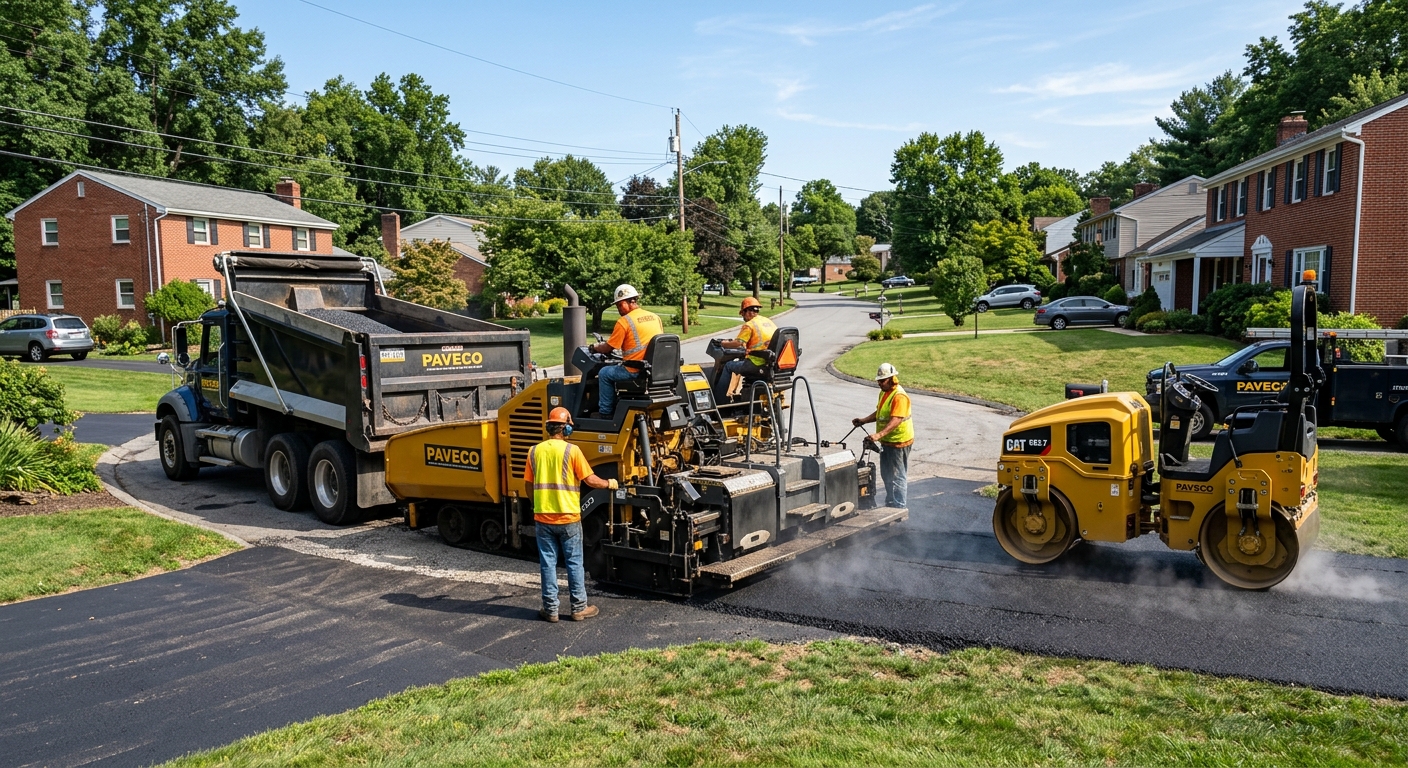
What a new driveway costs in Hazle
Hazle’s high homeownership rate (77.1%) and majority single-family housing (62.9%) mean driveways are a real concern for most households here. If you own in Hazle, your driveway is probably your responsibility, not the landlord’s—and it wasn’t installed all that recently. With cold winters and a 4 °F winter design temp, Luzerne County driveways take a beating from freeze-thaw cycles. The local subgrade—glacial till mixed with shale—demands more prep work than in many other parts of Pennsylvania. A cheap job will look similar to a good one on day one, but you are paying mostly for what is buried: the stone base, how well it was compacted, and whether drainage was addressed. Quotes can vary by thousands because of work you never see. Spend for what’s under the pavement, not on a fancy finish that will crack if the base fails.
| Service |
Best for |
Lifespan |
Price range |
| Asphalt — full replacement with new base |
failed base, structural cracking |
20–30 yrs |
$3,200–$8,100 |
| Asphalt overlay / resurfacing |
sound base, surface cracking only |
8–15 yrs |
$1,350–$4,100 |
| Sealcoating — single application |
preventive maintenance on sound asphalt |
2–4 yrs |
$175–$650 |
| Concrete — new installation |
long service life, low maintenance |
30–50 yrs |
$4,500–$11,000 |
| Crack filling and patching |
isolated cracks under a quarter inch |
1–3 yrs |
$200–$800 |
| Gravel driveway |
rural, budget, long runs |
5–10 yrs with upkeep |
$900–$3,500 |
Estimates for a typical Hazle driveway. Square footage and base condition drive these figures more than material choice.
What a real paving quote contains
The difference between a solid Hazle paving job and a poor one is almost never visible at first glance—it’s in the paperwork. A good quote breaks out the square footage being paved, the depth of excavation, and the type and thickness of the stone base. The right bid will specify how material will be compacted and in how many lifts, plus exactly how thick (compacted) each asphalt course will be. You’ll see details on handling drainage, edge treatment, and any restoration of your yard or sidewalk edges. A real contract will lay out a payment schedule with a modest deposit—not the whole job up front—and clearly state what is and is not under warranty. Beware: very few asphalt warranties in Luzerne County cover any form of cracking, though that’s the failure homeowners expect to be covered. If you receive a one-line bid with only a lump sum and no specs, you cannot compare it to anything else—and that’s the fastest route to overpaying for substandard, short-lived work.
| Line item |
What to look for |
Red flag if… |
| Area |
measured square footage stated |
eyeballed or absent |
| Excavation |
depth and disposal included |
'we'll pave over it' |
| Base |
aggregate type and depth in inches |
'proper base' |
| Compaction |
method, and done in lifts |
not mentioned |
| Asphalt |
courses and compacted depth |
'3 inches' unqualified |
| Drainage |
slope and water direction stated |
silent |
| Warranty |
what is covered and what is excluded |
verbal only |
| Payment |
modest deposit, balance on completion |
full cash up front |
When paving can actually be done in Hazle
Paving is seasonal in Hazle—and not by choice. Both blacktop and concrete installations are regulated by the actual temperature and weather, not just contractor preference. Hot-mix asphalt must be spread and compacted while it’s still above a minimum temperature; if it cools too quickly, as happens below about 50 °F, you end up with a weak, permeable surface that won’t make it through a Luzerne County winter. Asphalt plants in the region shut down when the weather turns cold, and concrete finishing is only safe above freezing—curing fails in cold snaps, leading to spalling and early failure. The typical paving season in Hazle runs from late April to October; crews are booked tight during summer peak, but shoulder seasons in May and September often see more competitive pricing. If someone offers to pave your drive in late November here, they are gambling with your results—or using leftovers from jobs elsewhere. Short hauls from local plants and quarries mean quick service is possible in season, but not off-season.
Asphalt or concrete for a Hazle driveway?
Choosing between asphalt and concrete in Hazle is really a choice about how your driveway will cope with our relentless freeze-thaw cycles. Asphalt is designed to flex as the glacial till and shale subgrade moves each winter, so it’s generally more forgiving—hairline cracks might appear, but widespread heaving or separation is rare if the base was built right. Concrete, while longer-lived—often 30–50 years with care—is rigid. When it fails here, the culprit is almost always de-icing salt eating through the surface, not just random cracks. In Luzerne County’s snow belt, salt use is routine from November through March, so most concrete driveways eventually spall and scale, no matter what the marketing says. The only way to protect concrete is to simply not use salt-based products. That takes discipline most homeowners do not consistently manage. Pavers work if you want individual repairs, but expect settling in these soils. Gravel holds up if you don’t mind annual raking and fresh stone.
| Option |
Installed cost |
Maintenance |
Freeze-thaw performance |
Lifespan |
| Asphalt — new install |
$3,200–$8,100 |
sealcoat every 3–4 yrs |
excellent, flexes |
20–30 yrs |
| Asphalt — overlay |
$1,350–$4,100 |
same |
good if base is sound |
+8–15 yrs |
| Concrete |
$4,500–$11,000 |
low, avoid de-icing salt |
fair, spalls with salt |
30–50 yrs |
| Pavers |
$7,200–$11,000 |
individual units replaceable |
good, settles gradually |
25–50 yrs |
| Gravel |
$900–$3,500 |
top-dress every 2–3 yrs |
excellent drainage |
indefinite with upkeep |
Driveway permits, approaches and stormwater rules
Most repaving work in Hazleton does not require a permit, provided you are patching or resurfacing your existing driveway and not expanding it or changing the way water drains. This saves you paperwork and a fee, but check with your municipal office for any recent rule changes. If you change the size or footprint—increasing impervious surface—you may need a permit, especially in Wilkes-Barre and surrounding municipalities, which routinely enforce zoning and building code related to runoff. Where your driveway meets a state-maintained road (the approach), approval comes from PennDOT District 4 through their Highway Occupancy Permit program, not from the city or borough. Stormwater management matters greatly: expand your driveway and you could be liable for drainage or runoff affecting a neighbor, permit or no permit. Always check that any Hazle area contractor you consider holds a current Home Improvement Contractor registration through the Pennsylvania Office of Attorney General (hic.attorneygeneral.gov), and carries active workers’ compensation insurance (WCAIS system). These are both required by state law for jobs over $500.
The specifications to demand in writing
In Hazle, specs protect you. A “three inch” job without numbers behind it is worthless, because three inches “as laid” often compacts down to just two, and that last inch is everything in a climate this cold. Our glacial till and shale soils hold water and push from beneath; combined with the 36-inch frost depth, that’s a recipe for frost heave if the base isn’t right. Always demand the spec sheet in your paving quote, not just the total cost. Insist on compaction done in lifts, base material and thickness in inches, and both asphalt binder and wearing courses given as final compacted depth. The local trade standard demands a thicker base than you’d get south of Allentown; shortcuts lead to potholes in two winters flat. You must ask for these details and get them in writing—or you have no recourse when the job fails prematurely.
- Excavation depth and any removal specified in inches
- Aggregate base material (e.g., 2A modified stone), depth in inches
- Number of compaction lifts and compaction method (plate or roller)
- Binder course (asphalt base layer) type and compacted depth
- Wearing course (asphalt top layer) type and compacted depth
- Mix design or designation for both asphalt courses
- Edge restraint type—sawcut, trowel, or curb, and if steel/wood forms for concrete
- Grading plan, including slope away from foundation and to street/drain
- Joint details (for concrete)—spacing and type
- Site restoration and lawn repair included
Hazle's ground and what it means for paving
Paving in Hazle means dealing with glacial till and shale subgrades—soils that are tough, uneven, and unpredictable when wet. Glacial till is a mixture of clay, sand, gravel, and rock beneath much of Luzerne County; it can hold water and heaves a surprising amount in freeze-thaw. Shale layers drain poorly and can cause uneven settlement. Here, a typical 1900–1940 Hazle driveway likely sits where the builder found room, not where the base was best. These older small-lot driveways, many sandwiched tightly between houses, often went in with little or no stone base at all. That means replacing an original driveway almost always means full base excavation and start-from-scratch compaction—shortcuts won’t last. Spec for more base stone than you’d need west of the Susquehanna, and push for proper drainage; water trapped in this ground makes for heaved, cracked pavement come January. The upshot: base specs matter more in Hazle than on flatter, better-drained soil, and if an installer dismisses your concerns, get a second quote.
Frequently asked questions — driveway paving in Hazle
What does an asphalt overlay cost in Hazle?
An asphalt overlay in Hazle typically costs from $1,350–$4,100, depending on driveway size and condition. Overlays are only suitable if your existing base is still in good shape but you’re seeing surface cracks or minor wear. It’s a popular choice in Hazle’s older housing stock for keeping costs down, since many driveways here are 30–40 years old but not yet fully failed. Beware anyone pushing an overlay if you have large dips, sunken spots, or drainage issues—it won’t last, and you’ll spend the money again soon. Ask your contractor to confirm the underlying stone base is solid before committing; otherwise, a full replacement is a better investment.
What does compaction in lifts mean?
Compaction in lifts means each layer of material—stone or asphalt—is placed in relatively thin horizontal layers (“lifts”) and compacted separately before the next is added. In Hazle, this matters more than most places, because our glacial till base will settle and move with freeze-thaw. If your installer dumps all the stone or asphalt at once and rolls the top only, you’re left with soft, air-filled gaps underneath, which turn into frost heaves and potholes. The right way (and the way you should insist in your written specs) places four inches of base, compacts, then another four, compacts again, and so on. You want to see that process spelled out in your quote for any driveway project over $3,200–$8,100.
What does sealcoating cost in Hazle?
In Hazle, a single application of asphalt driveway sealcoating generally runs $175–$650 for most single-family drives. Sealcoating every three to four years extends the life of the pavement by protecting against oxidation, minor water intrusion, and damage from salt. The price depends on your driveway’s size and how many cracks need pre-treatment. If someone quotes you much less, ask what prep is included—proper crack filling and edge cleaning should come standard. Keep in mind, sealcoating is for maintenance, not repair; if you have wide cracks or deep holes, fix those before sealing or you’re wasting your money.
Can I cancel a paving contract I signed at my door?
Pennsylvania law protects you here. If you signed a paving contract at your Hazle home for more than $500 (and nearly all legitimate jobs fall above that), you have a three-business-day right to cancel under the Pennsylvania Home Improvement Consumer Protection Act. That’s true no matter what the contractor’s paperwork says, and the contractor must return your deposit if you cancel in writing within the window. You don’t forfeit this right—even if the contractor tells you otherwise. If you feel pressured or change your mind on a contract for $3,200–$8,100, use this cooling-off period—especially if the bid was hurried or from a door-to-door crew.
Does sealcoating fix cracks?
No—sealcoating does not fix structural cracks, and expecting it to will just cost you another $175–$650 with no real improvement. In Hazle, most driveways have some old cracks because of our freeze-thaw cycles, but sealcoating only fills hairline surface marks and helps with protection against weather. Any crack over a quarter inch should be cleaned and filled with a rubberized crack filler before sealcoating. Otherwise, water gets in, freezes, and the crack spreads. Good contractors in Luzerne County always offer crack filling as an add-on; if yours skips it, that’s a warning sign.
How long before I can drive on a new asphalt driveway?
In Hazle, expect to wait 2–3 full days before driving on a freshly paved asphalt driveway, maybe longer if it’s humid or the nights are cool. Asphalt needs time to cure and harden after installation, and driving on it too soon leaves scuffs, depressions, or even tire marks in the surface. For an investment of $3,200–$8,100, patience pays—you want that top layer to bond and last. Keep heavy trucks or equipment off for at least ten days, and don’t park in the same spot for the first week. For concrete, the wait is typically a full week before regular use.
How many freeze-thaw cycles does Hazle get?
Hazle’s driveway surfaces see dozens of freeze-thaw cycles each winter, thanks to our 4 °F winter design temp and steady swings above and below the freezing point. It’s this constant contracting and expanding that challenges all pavement types in Luzerne County. Unlike some areas downstate, you can’t expect a blacktop patch to last through winter unless it’s installed in season and over a properly compacted base—otherwise, cracks will open and water will infiltrate quickly. For this reason, better driveways here are always built heavier, and repairs rarely last more than a few years unless done right, even on overlays costing $1,350–$4,100 or more.
What are the signs of a failing driveway base?
You can often spot base failure on Hazle driveways by repeated potholes, soft spots, and large cracks (especially those with shifting or sinking). If you see water ponding in ruts that keep coming back after patching, that’s a sign the stone base below is pumping or pumping fines—totally common locally with glacial till soil. Widespread “alligator” cracking almost always signals a base needing replacement, not just patching. If a contractor suggests an overlay for a surface showing these signs and quotes under $3,200–$8,100, get a second opinion; overlays over bad base won’t last two winters here.
Should I repair or replace my Hazle driveway?
The answer depends on what’s happening beneath the pavement. If your Hazle driveway has small, scattered cracks or minor edge wear, crack filling and sealcoating—at $175–$650—can buy you more time. But if you see deep cracks, sunken spots, or washouts after rain, repairs are likely a waste: the base is failing and anything you do on top won’t last. With Luzerne County’s soil and freeze-thaw cycle, a fresh install is often smarter, especially considering most local driveways are over 40 years old. A full replacement costs $3,200–$8,100, but it restores drainage and stops recurring problems. Don’t overspend on “band-aid” patches; get a clear assessment first.