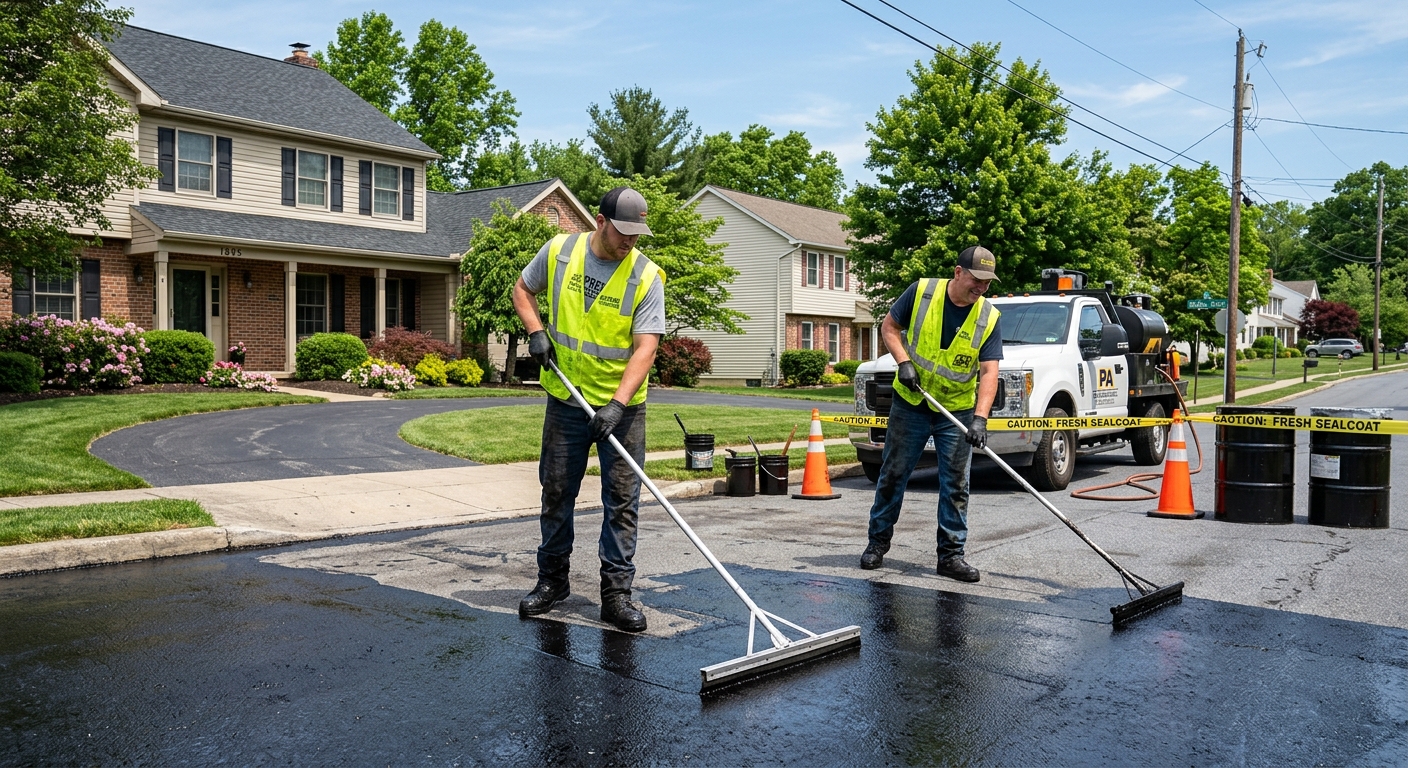
Driveway paving costs in Newberry — 2026
In Newberry, where over 92% of homes are owner-occupied and the majority are single-family (U.S. Census Bureau, ACS 2024), a paved driveway is as much about everyday function as it is curb appeal. Most Newberry homes sit on shale subgrade, which means extra care—and often cost—goes into prepping the base for asphalt or concrete. Our region sees pronounced freeze-thaw cycling every winter, so a driveway that isn’t built right will show it in short order.
What homeowners rarely realize is that the biggest price differences between driveway quotes aren’t about asphalt thickness on top, but about what happens beneath the surface. The base—how deep, how well compacted, and how well drained—determines whether your driveway will last twenty-plus years or start coming apart after two hard winters. Two bids for asphalt may look similar, but unless you know what’s being done under the surface, you’re not comparing apples to apples. That’s particularly true here, where the natural soils demand thicker base correction and careful grading. Below are real market price bands for common driveway projects in Newberry:
| Service |
Best for |
Lifespan |
Price range |
| Asphalt — full replacement with new base |
failed base, structural cracking |
20–30 yrs |
$3,600–$9,300 |
| Asphalt overlay / resurfacing |
sound base, surface cracking only |
8–15 yrs |
$1,550–$4,700 |
| Sealcoating — single application |
preventive maintenance on sound asphalt |
2–4 yrs |
$200–$750 |
| Concrete — new installation |
long service life, low maintenance |
30–50 yrs |
$5,200–$12,500 |
| Crack filling and patching |
isolated cracks under a quarter inch |
1–3 yrs |
$200–$800 |
| Gravel driveway |
rural, budget, long runs |
5–10 yrs with upkeep |
$900–$3,500 |
Estimates for a typical Newberry driveway. Square footage and base condition drive these figures more than material choice.
Getting thirty years out of a driveway
In Newberry’s climate, driveway longevity comes down to a handful of practical habits and construction details. The number one factor is keeping water away from the base. Filling cracks as soon as possible—before you can fit a quarter in—costs little and prevents water from working down to the sub-base, avoiding freeze-thaw heaves common in York County. Edge support matters, too; unsupported edges break down quickly, especially after a few wet winters.
Point loads are another killer. Parking dumpsters, trailers, or using jack stands will punch through almost any driveway in this area, no matter the material. For new asphalt, patience pays off. Avoid parking—even more so turning the wheels in place—for at least a week after installation, and be gentle for the first month when temperatures are hot.
When it comes to de-icing, Newberry’s moderate snowfall mixes with cold snaps that stress driveways. Rock salt damages concrete surfaces, triggering flaking and spalling—calcium magnesium acetate or sand are better, though they cost more and don’t melt ice as quickly. With asphalt, salt won’t eat the surface directly, but every melt/refreeze cycle works to undermine the base through expansion, so mechanical removal and quick clearing make a difference. Investing in regular maintenance—crack filling and sealcoating—pays off here, given how our local freeze-thaw seesaws stress every weakness.
The paving season in south-central Pennsylvania
In south-central Pennsylvania—including Newberry—the paving season is determined by the climate, not contractor preference. Hot-mix asphalt must be installed while ambient and ground temperatures are high enough for proper compaction; if it cools too fast, you’re left with a porous, weak surface that won’t last through our region’s hard freeze-thaw cycles. That winter design temperature of 12 °F marks a real dividing line: from about mid-November through March, asphalt plants in York County are shut down altogether.
Concrete is not much different; it needs above-freezing weather to cure correctly. Pouring concrete when the ground is cold or the air dips below freezing means surface flaking and reduced durability. The local quarries supplying aggregate shut down or work limited hours in winter, which can slow any repairs or construction planned too late in the year.
In practice, this means the best time for driveway projects in Newberry is late spring through early fall. Shoulder months—April, May, late September, early October—are when crews tend to have the most open spots, so you might get a shorter wait or, sometimes, a better price. If someone offers to pave your driveway in December, ask hard questions—either their standards are off, or the work will be. Book early if you want late spring or summer work, as reputable crews fill up fast during peak months.
Diagnosing a failing Newberry driveway
Most Newberry driveways are sitting on postwar base over shale, which shows its age in very specific ways. If your driveway has broad areas of alligator (crocodile skin) cracking, the base is failed—anything short of full replacement will be money burned. On the other hand, if you’re just seeing isolated, narrow cracks, that’s usually plain surface aging and can be fixed with crack filling and a sealcoat.
Check for depressions that hold water after a rain; these “birdbaths” usually mean the subgrade is moving and the water’s working its way under, setting up for potholes later. If the edges are turning to gravel, it means there’s nothing holding them up—no curb or adequate edge—so they’ll keep crumbling unless that’s addressed. One or two potholes don’t mean a full replacement is mandatory, but they do mean water has gotten below and into the base, so at least local patching is needed.
Never accept a suggestion for resurfacing or overlay unless the contractor has actually probed or cored the base. Otherwise, you’re just spending for a new surface that’ll fail with the base underneath. Here’s how typical repairs break down:
| What you see |
Likely cause |
Right fix |
Cost |
| Isolated cracks under 1/4 inch |
surface aging |
crack fill and seal |
$200–$750 |
| Alligator cracking over a wide area |
base failure |
full replacement |
$3,600–$9,300 |
| Depressions holding water |
subgrade movement |
excavate and rebuild that area |
$3,600–$5,700 |
| Crumbling edges |
no edge support |
edge repair, consider curbing |
$400–$1,500 |
| Potholes |
water into the base |
full-depth patch, then assess |
$250–$900 |
| Faded but sound surface |
oxidation only |
sealcoat |
$200–$750 |
What a real paving quote contains
A proper driveway quote in Newberry should spell out every critical detail, especially since base prep is the biggest variable and the easiest to hide. The contractor should state the measured square footage, not just a rough guess. Excavation details matter—how deep do they plan to dig, and where’s the old material going? The base aggregate should be specified by type (crushed stone, not just “stone” or “gravel”) and depth, stated in inches. Compaction isn’t just running a roller over the top; it should be done in lifts, layer by layer.
The asphalt details matter, too: a real quote will say how many courses are going in and the compacted thickness. Edge treatment is often skipped, but without attention there, the driveway will fail at the margins. Drainage should be mentioned—grading and flow are the backbone of longevity in south-central PA. Finally, a real quote breaks out cleanup, payment schedule (with a modest deposit), and a warranty—it won’t usually cover cracks, so read closely. If you get a one-line summary with just a total, you have nothing to compare, and that’s how folks end up overpaying for underbuilt work. Here’s what to watch:
| Line item |
What to look for |
Red flag if… |
| Area |
measured square footage stated |
eyeballed or absent |
| Excavation |
depth and disposal included |
'we'll pave over it' |
| Base |
aggregate type and depth in inches |
'proper base' |
| Compaction |
method, and done in lifts |
not mentioned |
| Asphalt |
courses and compacted depth |
'3 inches' unqualified |
| Drainage |
slope and water direction stated |
silent |
| Warranty |
what is covered and what is excluded |
verbal only |
| Payment |
modest deposit, balance on completion |
full cash up front |
Where the water goes
In Newberry, getting driveway drainage right is a necessity, not a choice. Minimum slope is 2% (about a quarter inch per foot) for surface runoff—a flat driveway will trap water, which will work its way beneath and, after a few freeze-thaw cycles, heave the base and break apart the surface. Crowning—a high point down the center—works for wider driveways, while a cross-slope (tilted to one side) is best for narrow runs.
A driveway that slopes toward the house or a garage is a big problem. In those cases, a trench or channel drain at the base is often needed; if the grade can’t be changed, this is your only reliable defense. Once collected, water shouldn’t just stop at the driveway’s edge—a good design “daylights” (runs water to open ground away from structures), or, if space doesn’t allow, uses a dry well.
Our local shale subgrade demands special attention. Shale won’t let water percolate fast, so driveways without proper drainage will stay wet at the base for long stretches, letting freeze-thaw cycles do their worst. And pushing water onto a neighbor’s property isn’t just bad blood—it creates legal exposure, permit or no. Manage everything onsite and you solve half your lifespan problems before they start.
Driveway permits, approaches and stormwater rules
In York County, the rules on driveway permits depend heavily on exactly what you’re doing and where. If you’re simply resurfacing or repairing an existing driveway in the same footprint, most townships in this area—including Newberry—will not require a building permit, saving you some paperwork and headache. However, if you’re reconstructing, widening, or making significant alterations, many municipalities (like York City) require a building permit—always check directly.
Where your driveway meets the public road—the approach or curb cut—is handled differently. For homes connecting to state roads, the Highway Occupancy Permit comes from PennDOT District 8. Local street approaches are handled by the individual townships. Stormwater: expanding your driveway (more impervious area) can trigger township runoff requirements, and directing runoff onto a neighbor’s property is a liability whether or not your permit says so.
For hiring, any job over $500 must use a written contract under Pennsylvania’s Home Improvement Consumer Protection Act. Contractors must have Home Improvement Contractor (HIC) registration, which you can verify at hic.attorneygeneral.gov. All employers must carry workers’ compensation insurance—check this in the WCAIS system (wcais.pa.gov) before signing a contract.
Frequently asked questions — driveway paving in Newberry
How often should I sealcoat my driveway in Newberry?
Sealing your asphalt driveway in Newberry generally makes sense every two to four years. Our freeze-thaw cycles, paired with moderate snowfall, mean unsealed driveways can crack sooner, as water breaks through the surface. Too-frequent sealcoating isn’t better: it can build up to the point of flaking or tracking. A good rule for south-central Pennsylvania is to sealcoat when the old coat is faded and water stops beading—typically every three years for the average home in York County. For reference, a single sealcoat application runs $200–$750 for most driveways in our area. If your asphalt surface is still black and water beads, you can usually wait another year and save your money.
Does road salt damage driveways in Newberry?
Road salt has different effects depending on your driveway material. In Newberry, where winter is marked by frequent freeze and thaw, salt speeds up surface wear on asphalt mostly by compounding the number of melt-refreeze cycles—water gets into cracks, then freezes, expands, and pops out chunks. On concrete, salt is much worse: it physically attacks the surface, causing flaking and pitting, especially on new installations. If you have concrete, avoid salt and use sand or calcium magnesium acetate, which is gentler but costs more. For asphalt, the main concern is limiting refreezing—keep water off the surface and fill cracks quickly. Whether you go with salt or alternatives, regular maintenance buys you more mileage than any de-icer. For context, a full concrete driveway in Newberry costs $5,200–$12,500 to replace, so protecting that surface is worth some effort.
Are pavers worth the cost in south-central Pennsylvania?
Pavers are attractive, but their value in Newberry depends on your priorities. They offer flexibility and aesthetics, and individual pavers can be replaced if they crack or shift. However, with our shale subgrade and pronounced freeze-thaw cycles, paver driveways require meticulous base prep and regular re-leveling, or you’ll end up with heaving and weed growth in the gaps. Paver material and installation costs far exceed asphalt or plain concrete—expect triple or more per square foot compared to asphalt, which averages $3,600–$9,300 for a full replacement in York County. Unless a specific look or property value boost justifies the expense for you, most homeowners find asphalt or concrete to be a better return on investment here.
Do I need an approach permit where my driveway meets the road?
In Newberry and the rest of York County, approach permits are usually distinct from building permits and handled by a different authority. For driveways connecting to a state-maintained road, PennDOT District 8 handles what’s called a Highway Occupancy Permit. For local or township roads, your individual township issues the driveway approach permit. Even if your project is just a resurfacing, any change that affects the apron or cut (the connection from the driveway to the public road) will put you in permit territory. Fees and processing vary. If you skip this step and alter the approach, you can run into real problems the next time the road is resurfaced or if runoff issues arise.
What does sealcoating cost in Newberry?
For a typical residential driveway in Newberry, sealcoating runs between $200–$750 per application, depending mostly on size and how much edge and handwork is required. The average homeowner spends about $425. DIY sealcoat kits are available at box stores, but professional jobs tend to last longer, as they apply the materials for local climate and get better edge coverage. Remember: on a newer or well-maintained driveway, you only need to seal when the surface loses its dark color or you notice water soaking in rather than beading up.
What does compaction in lifts mean?
“Compaction in lifts” means the aggregate base and asphalt are placed and compacted in separate, thin layers (lifts) instead of all at once. In Newberry, this is a make-or-break detail—our shale soils and freeze-thaw cycles will punish any shortcuts. If your contractor says they’ll put down six inches of base, it needs to be installed in a couple of three-inch layers, compacting each one, or you’ll end up with settling and soft spots. Asphalt, too, is better compacted in two or more lifts—one for the base course, another for the surface. Done right, this produces a finished surface that stands up to our winters and routine loads, avoiding early potholes or rutting. Skipping this is how some quotes come in cheap, but the results don’t last.
How far ahead should I book a paver in Newberry?
In Newberry and throughout York County, it’s wise to plan driveway work at least two to three months in advance if you want your pick of reputable contractors, especially for spring and summer. The true paving season here runs from April into October because of our region’s winter lows, and a lot of jobs are booked right after the ground thaws. Some smaller outfits will squeeze in patching or sealcoating with shorter notice, but for a full replacement—especially if you want a firm date—book in early spring for summer work. Planning ahead also gives you time to compare detailed quotes, not settle for whoever can “do it next week.” And, as a benchmark, a full asphalt replacement for a Newberry home falls in the $3,600–$9,300 range.
How much does it cost to widen a driveway?
Widening a driveway in Newberry involves more than just laying extra asphalt—it requires excavation, new base, potentially changes in grading, and possibly a wider approach permit from your township or PennDOT District 8. Expect to pay the per-square-foot equivalent of a new asphalt driveway, which falls between $3,600–$9,300 depending on site access and how much new width you’re adding. If the project pushes the total impervious area higher, township stormwater review may be triggered. Always get a written quote that spells out excavation, base depth, drainage changes, and permit fees. If you’re widening by just a foot or two for easier parking, the cost will be at the lower end, but for significant changes it approaches full replacement pricing.
What causes driveway cracks in Newberry?
In Newberry, most driveway cracking comes from freeze-thaw cycling—a result of our regional climate. Water works its way into surface cracks, then freezes and expands, prying the asphalt or concrete apart. If the base was laid thinly or on shale without enough correction—a common shortcut given our subgrade—cracking is accelerated. Heavy point loads (from parked dumpsters or trailers) also cause cracks, particularly near edges. For asphalt, neglecting regular maintenance like sealcoating and crack filling breeds further problems. Wide “alligator” cracks almost always point to base failure, while narrow, straight cracks mean shrinkage or surface aging. The right fix depends on which you see—surface cracks are manageable with timely patching and a sealcoat (which costs $200–$750 here), but deep, spreading cracks spell deeper trouble.