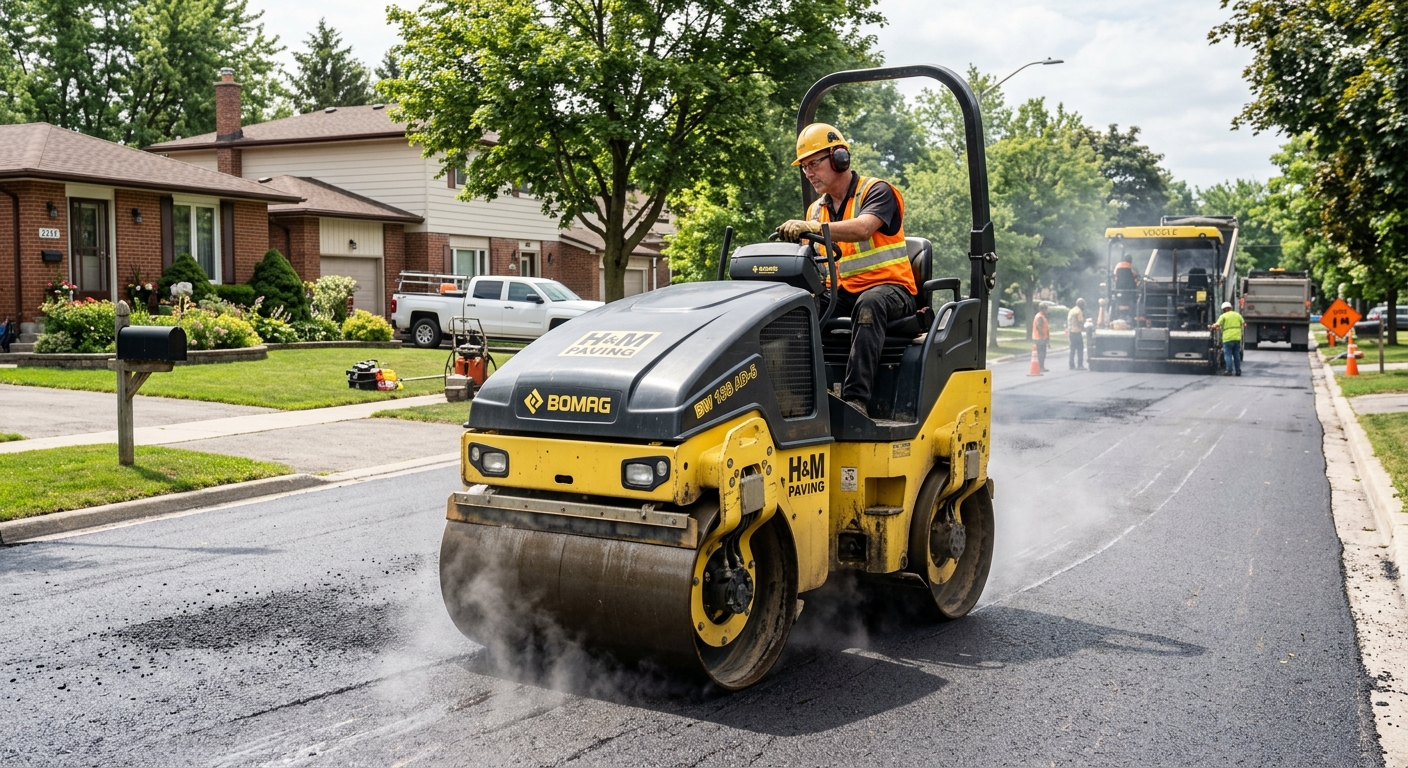
Driveway paving costs in Bethel — 2026
In Bethel, where about 80% of homes are single-family residences and over 96% are owner-occupied (U.S. Census Bureau, ACS 2024), most driveways are the responsibility of the homeowner, not an association or landlord. If you live here, odds are good you’re paying out of pocket for every repair, overlay, or full replacement.
Our region’s freeze-thaw cycle is moderate, but still enough to cause asphalt and concrete to shift and crack over the years, especially if there’s water held by the base or subgrade. Older neighborhoods in Delaware County, especially those built before the 1960s, often have driveways laid over glacial till or compacted filler—what’s buried makes the biggest difference in how long your drive lasts. Most of the price difference between two quotes isn’t in the asphalt or concrete you can see, but in how deep your contractor rebuilds the base and how well they handle drainage. A job with a cut-corner base may look fine for a year, only to fail before it should.
| Service |
Best for |
Lifespan |
Price range |
| Asphalt — full replacement with new base |
failed base, structural cracking |
20–30 yrs |
$4,000–$10,000 |
| Asphalt overlay / resurfacing |
sound base, surface cracking only |
8–15 yrs |
$1,700–$5,100 |
| Sealcoating — single application |
preventive maintenance on sound asphalt |
2–4 yrs |
$225–$800 |
| Concrete — new installation |
long service life, low maintenance |
30–50 yrs |
$5,600–$13,500 |
| Crack filling and patching |
isolated cracks under a quarter inch |
1–3 yrs |
$200–$800 |
| Gravel driveway |
rural, budget, long runs |
5–10 yrs with upkeep |
$900–$3,500 |
Estimates for a typical Bethel driveway. Square footage and base condition drive these figures more than material choice.
How to tell if the base is gone
No decision matters more for a Bethel homeowner than correctly judging the condition of a driveway’s base—the stone and subgrade under the blacktop or concrete. Most patching or overlays fail early if the base underneath isn’t solid. While contractors have an incentive to recommend what suits them, there are some signs you can check yourself.
Alligator cracking—those tight, blocky cracks that spread over a wide surface—usually means the base has failed, and simply resurfacing is a waste of money. Isolated, straight cracks tend to be surface aging or shrinkage, which you can fill and seal. Depressions or “birdbaths” that hold water may mean the subgrade itself is shifting, requiring excavation and base rebuilding in that spot. Crumbling edges are common where the driveway was built without proper edge support and can grow into larger base failures.
Potholes are a clear giveaway: they mean water’s gotten through and damaged the base. A true repair means full-depth patching at minimum—just filling the hole is a short-term fix.
If a contractor quotes an overlay without testing the base, or discourages a proper repair when alligator cracking is present, they either haven’t looked or don’t have your interest in mind. Spend money where it counts—the base. The surface is only as good as what’s under it.
| What you see |
Likely cause |
Right fix |
Cost |
| Isolated cracks under 1/4 inch |
surface aging |
crack fill and seal |
$225–$800 |
| Alligator cracking over a wide area |
base failure |
full replacement |
$4,000–$10,000 |
| Depressions holding water |
subgrade movement |
excavate and rebuild that area |
$4,000–$6,200 |
| Crumbling edges |
no edge support |
edge repair, consider curbing |
$400–$1,500 |
| Potholes |
water into the base |
full-depth patch, then assess |
$250–$900 |
| Faded but sound surface |
oxidation only |
sealcoat |
$225–$800 |
Driveway permits, approaches and stormwater rules
Many Bethel homeowners are surprised to learn a building permit usually isn’t needed to repave a driveway exactly where it sits, as long as you don’t expand its size or change the apron—in line with how it works in much of Delaware County. That said, if you’re widening, extending, or creating a new parking pad, expect to need a permit, since new or enlarged driveways count as added impervious area and can impact runoff.
One place you always need approval is the driveway approach: the section that meets the public road. If your driveway ties into a state highway, it’s PennDOT District 6 that issues the Highway Occupancy Permit—not your township. For local streets, your own township’s code office handles it.
Even if the township doesn’t ask for plans, stormwater still matters. Any project increasing non-absorbing surface can trigger rules about water management, and directing drainage onto a neighbor’s land is your legal liability whether you have a permit or not.
By law, paving contractors must be registered as Home Improvement Contractors for jobs over $500. You can verify at hic.attorneygeneral.gov. Also confirm workers’ compensation is valid using WCAIS at wcais.pa.gov—this is mandatory for any company with employees on site.
Bethel's ground and what it means for paving
Under most Bethel driveways lies glacial till or compacted urban fill. Glacial till is a mixed bag of clay, sand, gravel, and stones left by the retreat of glaciers, and it’s known for holding water in some pockets while draining freely in others. Compacted fill in older neighborhoods can hide buried debris that settles unpredictably. The upshot is our subgrade often calls for a thicker aggregate base—a thin layer is much likelier to shift or rut during our region’s freeze-thaw cycles.
With a regional frost depth of 30 inches, a base that’s too shallow or poorly drained is prone to frost heave, especially in shaded areas or low spots. This is why many driveways in inner-ring suburbs like Upper Darby and Haverford, built pre-1960, are now seeing widespread surface cracking and edge failures—the original builds often skimped on base preparation, counting on short-term cost savings. As a Bethel homeowner, if the asphalt keeps cracking in the same places or puddles get bigger every year, lack of base preparation over poor subgrade is usually the culprit.
Modern standards call for careful base compaction and drainage pitch—repaving over old fill or till without addressing what’s underneath is a path to constant patching.
Widening, extending or adding a parking pad
When you make changes to a Bethel driveway’s shape—widening for a second vehicle, adding a turnaround, extending back to a detached garage, or paving over a gravel strip for a new pad—you’re starting with undisturbed ground. That means fresh excavation and a deliberately built aggregate base, not just adding material over old soil. This is both a blessing, since you can do it right, and a challenge: the seam between new and old driveway is always a future weak spot, so careful base tying and sawcutting are required.
Keep in mind that new or expanded driveways count as added impervious surface, so your township may require details on how you’ll handle runoff. Setback rules generally restrict how close to the property line you can pave, especially for parking pads and turnarounds. If the approach—the entry at the street—also expands, you’ll need a new driveway approach permit from your township for local roads, or from PennDOT District 6 for any driveway connecting to a state-maintained road.
Plan these projects with the long-term in mind. The upfront work on base prep and drainage pays off many times over in fewer call-backs and repairs.
Sealcoating: what it does and what it doesn't
Sealcoating can help extend the life of an asphalt driveway in Bethel, but only if your base and surface are already in good condition. The right sealcoat application puts a protective layer on the surface, blocking UV oxidation and resisting drips of gas or oil. It also tidies up the appearance—nothing makes an older drive pop like a fresh coat of black.
What it won’t do: fix cracks, stop alligatoring, or add structural strength. Sealcoating over a failed or spongy base does nothing but hide the underlying trouble for a season or two. It’s not magic, and anyone promising a sealcoat as a cure-all is being less than honest.
Sealing too often (such as every year) can actually do harm—the layers build up, start to crack and peel, and water works its way underneath. New asphalt should not be sealed until it has cured—usually one full season—so that volatiles are not trapped beneath the sealer. Allowing two to four years between applications is reasonable unless your driveway sees unusually heavy wear.
Crack filling matters much more than sealcoating for longevity. Proper crack repair involves routing and filling, not just blowing sand over a crack before sealing. Sprayed-on, bargain sealcoats don’t last—a realistic price for a quality single application on a typical Bethel driveway is $225–$800. A job that comes in way below that likely means watered-down product and no cleaning or prep.
The paving season in southeastern Pennsylvania
In Bethel and the wider Delaware County area, paving is a seasonal business with hard stops—not just a matter of convenience. Both asphalt and concrete have to go down in warmer weather. Local hot-mix asphalt plants shut down in the winter, usually from late November until March, and concrete pours require daytime temperatures above freezing to cure properly.
The science is simple: hot-mix asphalt needs to be compacted while it’s still hot, so its window is closed by both cold ground and cold air. Once temperatures dip toward the regional winter design low of 14°F, the mix cools too fast to bond, leaving you with porous, crumbly pavement that won’t last. Delaware County’s freeze-thaw pattern means poorly timed jobs fail quickly.
During spring and fall—the “shoulder seasons”—crews tend to have more openings, and the asphalt plants in Eddystone and South Philadelphia keep haul times down. In summer, when temperatures are ideal, most reputable contractors are booked out for weeks. If someone offers to pave a new drive in mid-December, they’re either desperate, using cold patch (short-lived), or not using hot-mix at all.
For the best results and longest life, plan your project for late spring through early fall. It’s worth the wait.
Frequently asked questions — driveway paving in Bethel
How often should I sealcoat my driveway in Bethel?
In Bethel’s climate, sealcoating every 2 to 4 years is typical—sealing too often can cause layers to peel and chip, especially with freeze-thaw cycles. Most driveways here perform best with a single quality coat after a thorough cleaning, which costs $225–$800. The first application should always wait at least one season after new asphalt is installed, allowing the surface to cure and release oils. If you start seeing light gray coloration and mild surface oxidation, that's the right time. More frequent sealing is rarely worth the upcharge and can do more harm than good, especially on drives over glacial till or compacted fill, because trapped moisture accelerates damage. Spend your money on crack filling before appearance.
Asphalt or concrete for a Bethel driveway?
The choice between asphalt and concrete in Bethel depends on what you want out of your driveway. Asphalt is more common here because it’s less costly upfront—figure $4,000–$10,000 for replacement with a new base. It’s flexible, handles freeze-thaw better, and repairs more easily than concrete, but needs routine sealing and patching. Concrete, while more expensive at $5,600–$13,500, lasts longer (30–50 years vs. 20–30 for asphalt) and needs less maintenance. On Bethel’s glacial till, concrete may be more susceptible to frost heave if the base isn’t done right. If low maintenance and long life matter most, and you’re ready for a larger investment, concrete is a good pick. If you want a lower upfront cost and plan for future patching, asphalt is practical.
What does an asphalt overlay cost in Bethel?
Asphalt overlay, or resurfacing, is for driveways where the base is still sound but the surface has cracked or faded. In Bethel, you can expect to pay between $1,700–$5,100 for a typical residential drive. The cost swings with size, drive configuration, and any prep work needed for areas where the base is questionable. An overlay won’t fix deep alligator cracks or sunken spots—if you see those, replacing the base is probably smarter. It’s a good option for driveways 15–20 years old with mostly surface wear, but ask your contractor to prove the base is solid before signing. Saving upfront means nothing if the overlay fails within a few winters.
How much does driveway paving cost in Bethel?
For a full replacement with new base, an asphalt driveway in Bethel runs $4,000–$10,000 in 2026. An overlay, for drives with solid base, is less at $1,700–$5,100. If you’re after concrete, plan on $5,600–$13,500. The range is wide because actual cost depends most on square footage and base preparation—the part you can’t see. Corner-lot sites or long runs cost more, as do add-ons like curbing or drainage correction. Be wary of prices far below these brackets; that usually means thin pavement, weak base, or shortcuts you’ll be repaving sooner than you’d like.
Do I need an approach permit where my driveway meets the road?
Yes—if you modify the section where your Bethel driveway meets a public road (the approach), you will need a permit, and sometimes not from the authority you expect. For driveways opening onto state roads, PennDOT District 6 issues the Highway Occupancy Permit; for driveways onto local township streets, approach permits come from your township code office. Even if you’re just widening or relocating this area, permit rules apply. Costs tied to these permits vary, and while permit fees themselves are modest, failing to get the sign-off can stall your project or lead to penalties. Regular repaving that doesn’t change the approach or size usually does not need a new permit in Bethel.
Does road salt damage driveways in Bethel?
Road salt is common on Bethel streets in the winter, and its runoff can speed up surface wear on both asphalt and concrete driveways. Asphalt will see more rapid oxidation, while concrete can spall or develop surface pitting, especially if installation didn’t account for drainage and base thickness. Sealcoating, which costs $225–$800, helps asphalt resist salt penetration, but concrete is best protected through proper curing and draining meltwater away. Salt by itself won’t destroy a properly built drive, but in combination with freeze-thaw and water intrusion, it accelerates small cracks turning into big ones. In short, salt speeds up what bad water management is already doing.
What are the signs of a failing driveway base?
In Bethel, these are the biggest red flags for base failure: alligator cracking (blocks of interconnected cracks spreading across wide areas), repeated or growing depressions (birdbaths), persistent potholes after patching, and edges crumbling away from the drive. Water pooling along low spots and cracks that keep coming back no matter how often you fill them are also warnings. All of this is more common where driveways were built over glacial till or fill with a thin aggregate layer. If all you see is faded surface without major cracking, sealcoating ($225–$800) might be enough, but the issues above mean it’s time to budget for a full replacement—no amount of patching will fix the base.
When is the best time of year to pave in Bethel?
The ideal paving window in Bethel is from late spring through early fall—roughly April through October. This is when asphalt plants are open locally and both air and ground temperatures are reliably above the minimum required for hot-mix asphalt and concrete. Our freeze-thaw climate, where the winter design temperature hits 14°F, just doesn’t allow for proper compaction or cure in cold months. Quality jobs almost never happen after November, so book early if you want the prime season and to get on a reputable contractor’s calendar. The price for asphalt replacement stays in the $4,000–$10,000 range—off-season deals are rare, and lower bids usually mean cut corners or cold patch, which just doesn’t last in Bethel’s climate.
What slope does a driveway need for drainage?
In Bethel, driveways should slope away from structures by at least one-quarter inch per foot for the first 8–10 feet. This is especially critical over our glacial till and urban fill, which retains water and amplifies frost heave risks. Poor slope means persistent ice, pooled water, and cracks—no material can fix bad pitch after installation. Contractors familiar with Delaware County soils grade surfaces and underlayment to carry water where it can drain or soak harmlessly, not toward your house or neighbor’s yard. It’s worth paying for grading as part of a replacement project (totaling $4,000–$10,000 for asphalt) rather than dealing with repeated repairs from trapped runoff or water damage.