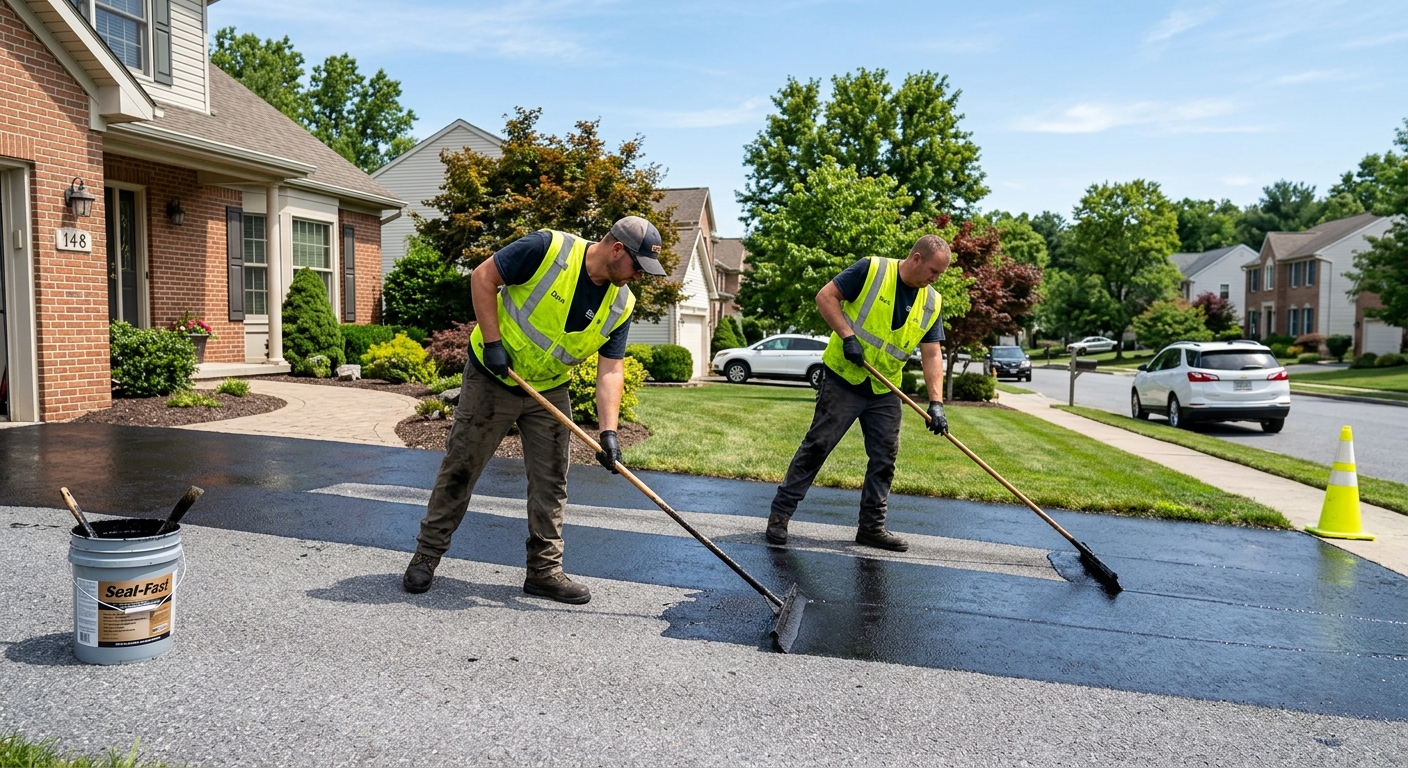
Driveway paving costs in Clarks Summit — 2026
Clarks Summit’s homeowners, living in a market where 82.4% of homes are single-family and the homeownership rate is 75.3% (U.S. Census Bureau, ACS 2024), face a substantial but necessary expense when it comes time to pave or repair a driveway. Regional freeze-thaw cycles are hard on pavement, and most paved driveways here were built decades ago—often atop glacial till, which is unpredictable and requires careful prep.
The biggest factor behind wide price differences in quotes is the base: excavation, base stabilization, and drainage work all happen before asphalt or concrete goes down, and are entirely buried from view when finished. One contractor may simply pave over what’s there; another may dig out soft spots, install proper stone depth, and compact it in layers as local conditions require. The first will quote lower, but that shortcut usually fails within five years. Square footage and existing base condition drive cost far more than the surface material.
Below are typical price bands for 2026 driveway projects in Clarks Summit. All prices are installed, with local haul and aggregate factors accounted for:
| Service |
Best for |
Lifespan |
Price range |
| Asphalt — full replacement with new base |
failed base, structural cracking |
20–30 yrs |
$3,600–$9,300 |
| Asphalt overlay / resurfacing |
sound base, surface cracking only |
8–15 yrs |
$1,550–$4,700 |
| Sealcoating — single application |
preventive maintenance on sound asphalt |
2–4 yrs |
$200–$750 |
| Concrete — new installation |
long service life, low maintenance |
30–50 yrs |
$5,200–$12,500 |
| Crack filling and patching |
isolated cracks under a quarter inch |
1–3 yrs |
$200–$800 |
| Gravel driveway |
rural, budget, long runs |
5–10 yrs with upkeep |
$900–$3,500 |
Estimates for a typical Clarks Summit driveway. Square footage and base condition drive these figures more than material choice.
Base preparation: the part you pay for and never see
For driveways in Clarks Summit, nearly all longevity comes from the layers you never see: the subgrade (natural soil), the compacted aggregate base, and finally the asphalt or concrete surface. Here, the subgrade is glacial till, which means variable clay, stone, and sand deposits from ancient glaciers. These soils absorb and hold water—bad news when winter rolls in.
Freeze-thaw cycles are your driveway’s biggest enemy. As ground moisture freezes, it expands, heaving the entire slab upward. When it thaws, the slab settles—but not always evenly. That’s frost heave, and it cracks and destroys even the thickest asphalt or concrete if the base was cut short or the drainage wasn’t addressed first. That’s why proper excavation depth, quality base stone, and full-depth compaction matter more here than in a gentle climate.
This is also where most corners are cut. A cheap paving quote may skip real excavation, use thin or poor-quality base stone (“millings” or fine rock instead of clean, angular 2A modified or #57), or lay over soft or rutted subgrade. Some crews may not compact the base in thin lifts, or won’t test compaction at all. The surface looks perfect that first week, but in two or three years, cracks and depressions show. By then, your cash is gone and so is the crew.
To protect yourself, you must demand in writing: at least 4–6 inches of compacted, clean 2A modified stone (or #57 where specified), proof that compaction was done in multiple lifts, and specification of drainage corrections (such as using geotextile stabilization in soft spots). Ask for these numbers and stone types on your contract, not a handshake promise.
Overlay, patch or full replacement?
Whether your Clarks Summit driveway needs spot patching, an overlay, or a full tear-out comes down to what’s happening below the surface. You can often self-diagnose, saving yourself from both unnecessary spend and quick-fix scams.
If you see “alligator cracking”—that is, a dense web of cracks across wide areas—it’s almost always base failure. An overlay (just new asphalt on top) will briefly improve the looks, but it cannot lock down soil that’s already shifting. Isolated, straight cracks under a quarter inch wide mean simple age, usually addressable with crack fill or sealcoating. Low spots or “birdbaths” that hold water point to movement in the subgrade. Crumbling at the edges shows the original install shorted proper edge support, a frequent issue in Clarks Summit’s mid-century driveways. And if you spot potholes, water has already broken through to the base, calling for repair and possibly reconstruction.
An overlay on a failed base just hides the problem for a season or two. If a contractor recommends it without examining the base—by probing, coring, or at least a firm stomp test on soft areas—they’re skipping the most important step. Here’s what typical driveway symptoms usually mean and what they cost to fix:
| What you see |
Likely cause |
Right fix |
Cost |
| Isolated cracks under 1/4 inch |
surface aging |
crack fill and seal |
$200–$750 |
| Alligator cracking over a wide area |
base failure |
full replacement |
$3,600–$9,300 |
| Depressions holding water |
subgrade movement |
excavate and rebuild that area |
$3,600–$5,700 |
| Crumbling edges |
no edge support |
edge repair, consider curbing |
$400–$1,500 |
| Potholes |
water into the base |
full-depth patch, then assess |
$250–$900 |
| Faded but sound surface |
oxidation only |
sealcoat |
$200–$750 |
How paving fraud actually operates
Paving frauds thrive in places like Lackawanna County, where neighborhoods are spaced out and word-of-mouth is slow to catch up. These scams are geared for driveways because a rushed job is quick, passable to the eye, and defective work won’t reveal itself for two or three freeze-thaw cycles.
The pitches are nearly always the same: a “leftover material” deal, a one-day special, an unmarked truck with out-of-area plates, or someone seeking cash up front. If they can’t furnish a proper written contract, or if a crew quotes you based on just a glance, move on. Some offer bargain “sealcoating” but spray a thin, low-grade oil emulsion that washes away in the first thunderstorm. Real sealcoating is thick, brush-applied, and meant for protection—not cosmetics.
Consumer laws in Pennsylvania anticipate exactly these problems. For any job over $500, the Home Improvement Consumer Protection Act guarantees you a detailed, written contract, and the right to cancel within three business days after signing. Never accept a verbal or diner-napkin bid, and never let anyone rush you into “today-only” pricing. You’re entitled to walk away and you should, especially in a market with moderate density and more than a few out-of-area operators passing through.
Five minutes of checking beats months of regret: verify their Home Improvement Contractor registration at hic.attorneygeneral.gov; check their workers’ compensation status via WCAIS (wcais.pa.gov); and never hand over money before seeing paperwork. That blocks 90% of traveling scams cold.
What to put in a Clarks Summit paving contract
In Clarks Summit, your best protection against disappointment isn’t the lowest bid, but an ironclad specification sheet attached to your contract. Codes here are shaped for real winters—frost, snow load, and moisture in local till make shortcuts expensive in the long run. Many contractors promise “three inches of asphalt,” but fail to say whether it’s after compaction (the real number) or before (often 30% thicker, but misleading). That ambiguity alone can halve your pavement’s strength and life if left unchecked.
Clarify in writing: exactly how deep the excavation goes, how much and what type of base stone is used (not just “stone dust”), that all lifts (layers) are compacted using real equipment (not just tires), both the binder and surface courses specified in inches after compaction, and what mix code is supplied from the local plant. For asphalt, edge treatment—whether it’s reinforced, butt-jointed, beveled, or just raked—spells the difference between crisp lines and premature crumble. These numbers are not extras in this climate; frost and unstable soil demand them.
- Excavation depth in inches (usually 8–12” here)
- Aggregate base depth (minimum 4–6” compacted 2A modified or #57 stone)
- Compaction done in lifts, with type of roller stated
- Binder course depth (e.g., 2” compacted 19mm base mix)
- Surface course depth (e.g., 1–1.5” compacted 9.5mm wearing course)
- Mix designations for both asphalt layers
- Edge treatment: description and material
- Drainage plan: slope direction, swale or drain tile locations if needed
- Approach and tie-in details—matching roadway or existing concrete
- Who is responsible for permits, traffic control, and cleanup
Asphalt or concrete for a Clarks Summit driveway?
In northeastern Pennsylvania’s climate—with deep snow, 6,100 heating degree days, and 36-inch frost depth—the choice between asphalt and concrete should be based on local conditions, not a generic cost comparison. Asphalt’s real advantage is flexibility: it bends slightly with ground movement, which is constant here with temperature swings and moisture changes in the subgrade. That’s why most driveways in Clarks Summit are asphalt, and why even older ones survive with surface wear instead of structural failure.
Concrete lasts far longer when conditions are right—30 to 50 years—but it’s rigid and vulnerable to spalling (flaking) under de-icing salts. In our area, salt use is heavy and unavoidable, making this the top cause of concrete driveway damage. Homeowners who can strictly avoid salt and maintain a flawless surface get decades from concrete; most won’t, so even a premium install can spall in ten years.
Pavers and gravel are legitimate alternatives: pavers are expensive up front but can be lifted and reset if ground settling occurs, making them a case-by-case solution. Gravel is the pragmatic option for rural, long or steep runs, easily repaired but requiring regular top-dressing.
| Option |
Installed cost |
Maintenance |
Freeze-thaw performance |
Lifespan |
| Asphalt — new install |
$3,600–$9,300 |
sealcoat every 3–4 yrs |
excellent, flexes |
20–30 yrs |
| Asphalt — overlay |
$1,550–$4,700 |
same |
good if base is sound |
+8–15 yrs |
| Concrete |
$5,200–$12,500 |
low, avoid de-icing salt |
fair, spalls with salt |
30–50 yrs |
| Pavers |
$8,300–$12,500 |
individual units replaceable |
good, settles gradually |
25–50 yrs |
| Gravel |
$900–$3,500 |
top-dress every 2–3 yrs |
excellent drainage |
indefinite with upkeep |
What you need before paving in Clarks Summit
For Clarks Summit homeowners, most routine driveway repaving or resurfacing does not require a building permit if the driveway isn’t being relocated or expanded, as supported by the regional enforcement picture. However, work at the driveway approach—the section connecting your drive to the public street—almost always does. For approach permits, contact either PennDOT District 4-0 if you’re tying into a state-maintained road, or your local municipality (for example, the City of Scranton Department of Public Works if inside Scranton city limits) for curb cuts and modifications in the right-of-way. This step is often missed by homeowners and newer contractors alike.
Bear in mind that significant expansion of your driveway’s impervious area (making it wider, longer, or switching to concrete or asphalt from gravel) may trip local stormwater rules—even where no other permit is needed. Beyond that, pushing water across your neighbor’s boundary may create civil liability, regardless of paperwork.
Finally, Pennsylvania requires any contractor working over $500 to carry a Home Improvement Contractor registration from the Office of Attorney General—check this online at hic.attorneygeneral.gov—and maintain workers’ compensation coverage, verifiable at WCAIS (wcais.pa.gov). If these are not provided before work starts, walk away.
Frequently asked questions — driveway paving in Clarks Summit
Why are paving quotes in Clarks Summit so different from each other?
The biggest reason for the wide gap in driveway paving quotes in Clarks Summit is what happens below the surface. Since 80.1% of homes here date to before 1980, many driveways were built over less-than-ideal glacial till, and each contractor makes different decisions on prep. One may just overlay the old surface, while another digs out the soft base, corrects drainage, and installs a proper stone bed. Surface looks can fool you, but you’re paying for those buried, unseen steps. A quote for a full replacement will sit between $3,600–$9,300 for a typical install, but a cheaper number often means shortcuts underground that won’t show for several winters. Ask for the base details in writing, not just the square footage price.
How do I verify a paving contractor in Pennsylvania?
In Pennsylvania, every paving contractor signing a job over $500 must carry Home Improvement Contractor (HIC) registration. You can—and should—check that number instantly at hic.attorneygeneral.gov. This tells you whether they’re operating legally, and whether there have been complaints or enforcement actions. For any crew or contractor with workers on your property, you’re also entitled to see proof of workers’ compensation, which can be confirmed via WCAIS (wcais.pa.gov). These checks trip up fly-by-night operators fast. Take five minutes before signing or handing over a deposit: a legitimate Clarks Summit paving business will always have these ready. Typical driveways run $3,600–$9,300 for a full base install, so verifying before you spend matters.
What does an asphalt overlay cost in Clarks Summit?
Asphalt overlay—sometimes called resurfacing—costs between $1,550–$4,700 for a typical Clarks Summit driveway in 2026. The price depends mostly on square footage and how much patching or edge repair is needed before a new asphalt layer is applied. An overlay is only appropriate when the underlying base is solid and free of structural cracks. This area’s freeze-thaw cycles mean surface fixes on a moving or broken base just don’t hold up, so a qualified contractor will probe for soft spots and recommend a full replacement if the subgrade is bad. If all you see are surface cracks and the driveway feels solid underfoot, an overlay can add 8–15 years of life.
Does Clarks Summit have local asphalt plants?
Clarks Summit isn’t large enough to host an asphalt plant itself, but Northeast Pennsylvania has several plants within a reasonable haul—asphalt and aggregate come from local quarries around Lackawanna County. Because haul distance affects cost and timing, most paving crews serving Clarks Summit source their asphalt directly each morning, and the plant location can influence the day’s production rate. For driveways, this “local plant” means lower mobilization costs and fresher material. This proximity gets factored into your quoted range—the typical installed price for a new asphalt driveway is $3,600–$9,300 in the current market.
Asphalt or concrete for a Clarks Summit driveway?
In Clarks Summit, where frost depth hits 36 inches and salt use every winter is a given, asphalt is the safer, less risky bet. Asphalt flexes with ground movement, tolerates freeze-thaw cycles, and can usually be repaired without major surgery. Concrete, while longer-lived on paper, suffers from salt-induced spalling—many local concrete driveways flake or chip within 10–15 years unless salt is strictly avoided (hard to do here). Asphalt’s regular maintenance is straightforward: sealcoating every few years at $200–$750 and eventual resurfacing. Concrete installs are more expensive up front ($5,200–$12,500), and repairs are trickier if the slab cracks or spalls. If you want to maximize lifespan without fussing over salt or patching, asphalt is the practical choice for most Clarks Summit households.
How long does a driveway installation take?
For a typical single-family Clarks Summit home, a full tear-out and replacement asphalt driveway usually takes two to three working days, weather permitting. Excavation and base prep are done first; sometimes, the base must sit for a day to dry or “proof roll” before paving. For overlays or simple resurfacing, the work can be completed in a single day if the weather is right. Concrete requires more time—a day for forming and pouring, but you’ll need to keep cars off for at least five days to achieve proper cure strength. Most local jobs fall into the $3,600–$9,300 price band for asphalt replacement, so a longer job isn’t just about the cost, but also making sure each stage is done right.
How often should I sealcoat my driveway in Clarks Summit?
In Clarks Summit’s climate, where de-icing salt and UV exposure both attack asphalt, sealcoating every three to four years is the best rhythm for preserving your investment. This area’s snow and freeze-thaw worsen surface wear—unsealed driveways lose their fine stone quickly and start to crack from the edges in. A single sealcoat application typically costs $200–$750 depending on size, and protects against water intrusion and oxidation. More frequent sealing (every year or two) isn’t better; too much buildup can peel. The sweet spot is every third or fourth summer, so long as cracks are filled promptly and you keep snow plows from scraping too closely.
What is the difference between binder and surface course?
An asphalt driveway in Clarks Summit will be built with two layers if done right: the binder (or base) course, and the surface (or wearing) course. The binder layer goes down first; it’s stronger, made with larger stone aggregate for stability, and laid thicker—typically 2–3 inches compacted. On top of this, the surface course goes down—1 to 1.5 inches compacted, using smaller aggregate for smoothness. Specifying “compacted” thickness rather than “laid” thickness is crucial, since asphalt compresses 20–30% under the roller. Cheap jobs will often skimp on base thickness or lay down both courses in a single lift, but a proper contract on a $3,600–$9,300 driveway will state both layers clearly, using PennDOT-approved mixes from the local plant.
Why are my driveway edges crumbling?
Most crumbling at the edges of Clarks Summit driveways traces to lack of edge support when the drive was originally built, especially in homes dating from the 1950s to ’70s. Old jobs here often stopped the base stone and asphalt just inches past the tire track, leaving nothing to anchor the pavement when winter hits and freeze-thaw cycles “pop” the unsupported edge off the stone. Combined with the glacial till subgrade, which can wash out if not compacted or drained right, those edges just don’t hold. Repairs run $400–$1,500 for a typical patch, and curbing or reinforced edges can prevent recurrence. The lesson: the extra base stone and edge attention specified at install saves years of frustration.