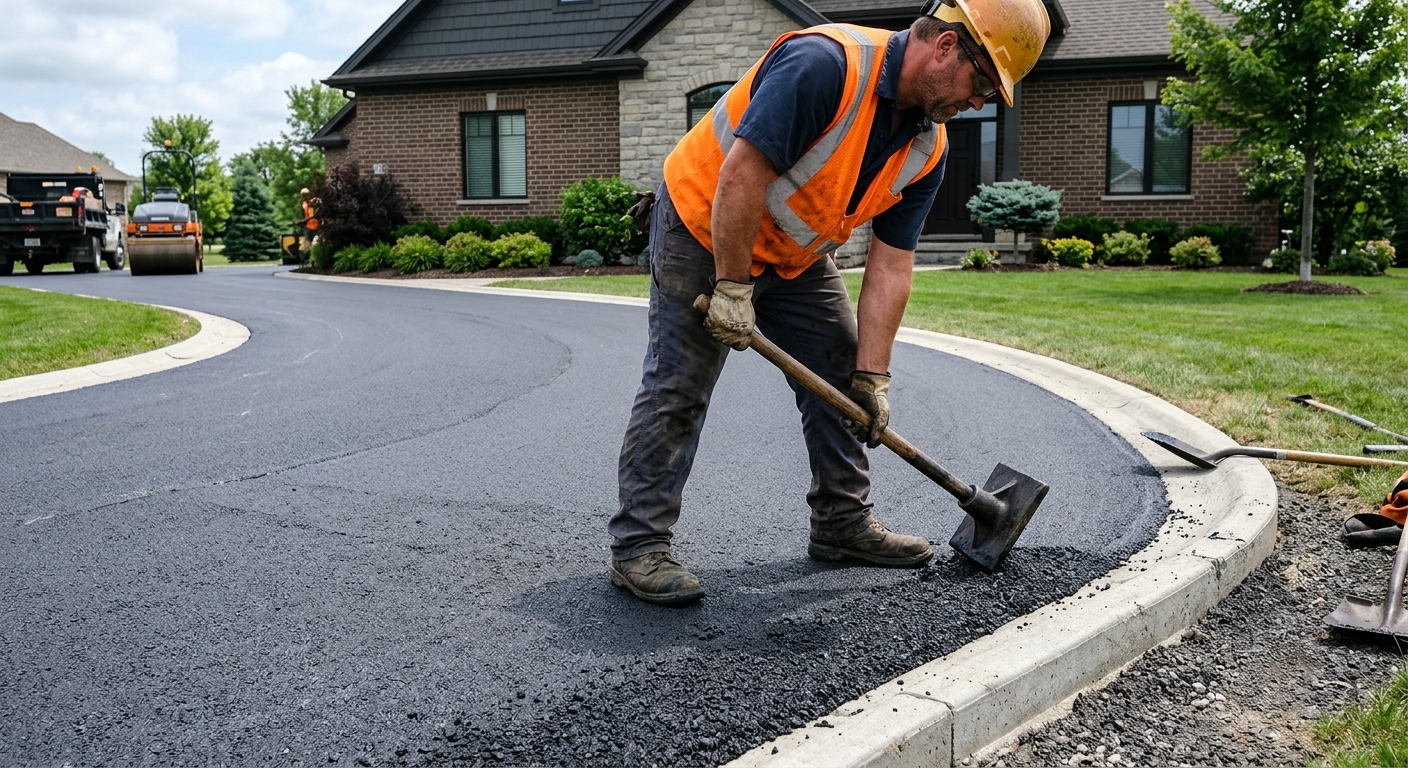
Driveway paving costs in Penn — 2026
Penn is a community with 69.4% single-family homes and a high homeownership rate of 83.2% (U.S. Census Bureau, ACS 2024). For most here, driveway paving is a major investment tied squarely to the household — not something typically handled by a landlord or split by tenants. South-central Pennsylvania's pronounced freeze-thaw cycles, with temperatures dropping to 12 °F in winter, put driveways through a punishing stretch each year. The local subgrade in Penn is shale, which usually means extra attention to base depth and drainage, both to prevent heaving and to make sure the base stays dry.
These conditions drive home a key point: most of what you pay for in any driveway job, whether new or replacement, is below the surface where you'll never directly see it. The depth and condition of the stone base, the quality of compaction, and whether drainage is properly managed — these define how long the driveway will last and how much of its price is real value. When you receive paving quotes, price differences almost always trace back to what is being done (or skipped) under the finished layer, not just the thickness or finish of surface material.
| Service |
Best for |
Lifespan |
Price range |
| Asphalt — full replacement with new base |
failed base, structural cracking |
20–30 yrs |
$3,500–$8,900 |
| Asphalt overlay / resurfacing |
sound base, surface cracking only |
8–15 yrs |
$1,500–$4,500 |
| Sealcoating — single application |
preventive maintenance on sound asphalt |
2–4 yrs |
$200–$700 |
| Concrete — new installation |
long service life, low maintenance |
30–50 yrs |
$5,000–$12,000 |
| Crack filling and patching |
isolated cracks under a quarter inch |
1–3 yrs |
$200–$800 |
| Gravel driveway |
rural, budget, long runs |
5–10 yrs with upkeep |
$900–$3,500 |
Estimates for a typical Penn driveway. Square footage and base condition drive these figures more than material choice.
When paving can actually be done in Penn
Driveway paving in Penn is shaped as much by the calendar as by the climate. With our winter design temperature dipping to 12 °F, the season for laying hot-mix asphalt is tightly bounded by the weather. Asphalt has to go down hot and be compacted before it cools and stiffens, which just isn’t possible when air or ground temperatures are low — the result would be a crumbly, porous surface that falls apart far too soon. As a result, local asphalt plants in York County simply close for several months. If the material isn’t being made, nobody’s paving.
Concrete projects also have a seasonal cutoff. The mix needs to cure without freezing, so once consistent below-freezing nights start in earnest, that window closes as well. Most years, this means the paving season runs from late March or early April through October, with occasional stretches in early November if temperatures permit. In practical terms, summer is high season; book too late and you’ll find crews are scheduled weeks out.
If you’re getting quotes for an asphalt job in late November or December, be skeptical — anyone willing to pour or pave out of season is likely skimping on standards. Conversely, shoulder seasons (spring and fall) are when you’ll see more scheduling flexibility and, sometimes, a bit of price competition among crews. If you want your pick of dates — or the chance at a better price — plan ahead and be ready as soon as the plants open.
Beyond replacement: layout changes
Many driveway projects in Penn move beyond a straight replacement, aiming instead to adjust a layout for the way families actually live. Common changes include widening an existing drive for a second vehicle, extending to reach a detached garage, adding a turnaround for safer street exit, or upgrading a gravel section to asphalt for year-round usability.
Whenever you break new ground or add square footage, you create a new footprint on previously undisturbed shale subgrade. That means a new compacted base is required and good drainage becomes even more important, both to avoid future heaving and to comply with codes. The seam where new paving meets old will always be a weak point — not likely to look or wear exactly like the rest. That’s unavoidable and why a reputable crew will properly dowel or tie in the join but never promise it will truly disappear.
In York County, expanding a driveway can also trigger impervious-surface limitations, affecting whether you can widen all the way to your property line. Local township codes vary, but stormwater management and runoff control are almost always part of the approval for substantial changes. If your new driveway will connect to a state road, PennDOT District 8 requires a Highway Occupancy Permit; if on a local street, the township handles it. You may need to show a plan for where the water will go before the town or county signs off.
Diagnosing a failing Penn driveway
Most Penn homeowners can get a pretty clear picture of their driveway’s condition with a close look and a few minutes spent walking the surface. The key is to focus on patterns, not just individual cracks or holes. If you’re seeing alligator cracking — a network of small, interconnected cracks over a big stretch — that points to a failed base: water got in, the stone shifted, and now the top layer just flexes and breaks. Putting an asphalt overlay on top of this is money tossed away; the new surface will follow the same fate in two or three years, if it survives one winter at all.
On the other hand, isolated straight cracks, especially if under a quarter inch wide, usually mean surface aging or shrinkage. Sealcoating and crack filling are worthwhile here and can buy time. Depressions, “birdbaths,” and standing water signal movement below, usually in the shale subgrade. This requires attention before any surface fix; left alone, these low spots will continue to worsen and invite water below.
Potholes mean water has broken through to the base, and unless each outbreak is patched deeply and the reason addressed, new ones will form. Edge crumbling nearly always comes back to missing or unreinforced edges — a common shortcut for cost-sensitive builders in the postwar home era around Penn. The right repair depends completely on the cause, not just the symptom you notice on top.
| What you see |
Likely cause |
Right fix |
Cost |
| Isolated cracks under 1/4 inch |
surface aging |
crack fill and seal |
$200–$700 |
| Alligator cracking over a wide area |
base failure |
full replacement |
$3,500–$8,900 |
| Depressions holding water |
subgrade movement |
excavate and rebuild that area |
$3,500–$5,500 |
| Crumbling edges |
no edge support |
edge repair, consider curbing |
$400–$1,500 |
| Potholes |
water into the base |
full-depth patch, then assess |
$250–$900 |
| Faded but sound surface |
oxidation only |
sealcoat |
$200–$700 |
Which surface survives Penn winters
In south-central Pennsylvania, every winter brings pronounced freeze-thaw cycling and moderate snowfall. This is a surface-breaking, base-shifting environment. Asphalt stands up well because it's flexible — it bends a bit, doesn’t mind a shifting subgrade as much, and is less likely to crack wide open when the ground heaves during a cold snap. That's why you see it on nearly every driveway and road here.
Concrete, meanwhile, is rigid and can last much longer if it survives the winter unscathed. But concrete’s weakness in Penn is how it reacts to de-icing salts, which are in steady use here from November through March. The scaling, pitting, and spalling you see in older slabs are from salt damage, not freeze-thaw alone. Avoiding salt, including what drips from your car, is crucial but rarely practical in this region. A concrete driveway comes with a higher up-front cost but needs little regular maintenance, aside from that salt vigilance.
Pavers are a niche choice, offering a classic look and easy spot repair, but they require a deep, well-compacted base on Penn’s shale and cost close to premium concrete. Gravel remains a viable budget option, especially where long drive runs or rural lots make asphalt or concrete cost-prohibitive. Gravel’s downside is more maintenance and dust, but its drainage properties are unmatched in this soil.
| Option |
Installed cost |
Maintenance |
Freeze-thaw performance |
Lifespan |
| Asphalt — new install |
$3,500–$8,900 |
sealcoat every 3–4 yrs |
excellent, flexes |
20–30 yrs |
| Asphalt — overlay |
$1,500–$4,500 |
same |
good if base is sound |
+8–15 yrs |
| Concrete |
$5,000–$12,000 |
low, avoid de-icing salt |
fair, spalls with salt |
30–50 yrs |
| Pavers |
$8,000–$12,000 |
individual units replaceable |
good, settles gradually |
25–50 yrs |
| Gravel |
$900–$3,500 |
top-dress every 2–3 yrs |
excellent drainage |
indefinite with upkeep |
Penn's ground and what it means for paving
The subgrade in Penn is shale, which shapes almost every paving job in this area. Unlike a tight clay that holds water and heaves aggressively, shale can offer decent drainage if graded correctly, but it breaks up unevenly. That means a standard “one size fits all” base rarely holds up over the long haul in Penn. Contractors in the York County area often need to over-excavate, adding depth to the base and ensuring every section compacts firmly. If drainage isn’t managed, shale can still trap water between layers and lead to freeze-thaw blowouts in winter.
Combine this with a 30-inch frost depth — deeper than you’ll find just east or west — and every base layer must be substantial enough to keep the surface stable through winter’s cycles of freezing and thawing. This is particularly important for the postwar homes common in Penn: many driveways here were put in with little more than a thin stone layer, so replacement projects often reveal soft spots, water pockets, or even bare soil under old pavement. That’s why so many local replacement jobs include not only new asphalt, but also a serious correction of the base. If this step is skipped, any new surface — regardless of material — is living on borrowed time.
Permits and approvals for paving in Penn
In Penn, which falls under York County codes, repaving or resurfacing an existing asphalt or concrete driveway in its current footprint will usually not require a building permit. In the City of York itself, a building permit is only mandatory if you’re reconstructing, widening, or making a significant alteration to your driveway — not simply resurfacing. That saves you a paperwork step for basic repairs or overlays.
However, any change at the street end — the “driveway approach” — falls to a different set of authorities. Connecting to a state road? PennDOT District 8 issues the required Highway Occupancy Permit before you cut a curb or pour a new apron. For driveways meeting local roads, your township will process the approach or apron permit.
Stormwater is another consideration. If your project increases the impervious area (meaning water can’t soak through), you may trigger runoff requirements or need to show where the stormwater will go. Even without a permit, draining water onto your neighbor’s property exposes you to liability if damage results, so it pays to get drainage right.
When hiring, confirm Home Improvement Contractor (HIC) registration with the Pennsylvania Office of Attorney General for any contract over
$500, and check workers’ compensation coverage via the Workers’ Compensation Automation and Integration System (WCAIS). Both steps protect you from uninsured losses and are required under state law.
Frequently asked questions — driveway paving in Penn
When can I seal a brand new asphalt driveway?
For a new asphalt driveway in Penn, it’s important to wait until the surface has fully cured before applying any sealcoat. This usually means holding off for at least one full summer season – typically about 90 days of warm weather. Applying a sealant too soon will trap the volatile oils still evaporating from fresh blacktop, leading to a soft, easily marked surface. In our climate, most drives paved in spring should be sealcoated the following fall; if paved in late summer, wait until next year. The wait is worth it: a properly cured surface will accept sealant evenly and gain maximum protection against oxidation, sunlight, and Penn’s freeze-thaw stress. The typical cost for a single application of sealcoating in Penn is around $200–$700, a small sum compared to the price of replacement if early sealcoating goes wrong.
What does sealcoating cost in Penn?
In Penn, pricing for a single round of professional sealcoating ranges from $200–$700, depending mostly on the driveway’s square footage and any crack filling you add on. Most homes in Penn fall near the middle of that range, with roughly $400 as a typical charge. This figure accounts for local labor, the cost of hauling in sealer from a York County plant, and the standard prep required after our winter freeze-thaw cycles. DIY sealers are sold at the big boxes but rarely last more than a season or two. If your asphalt is sound with just surface fading or minor cracks, a professional sealcoat every couple of years can stretch the lifespan of your drive and protect your larger $3,500–$8,900 replacement investment.
What is the difference between binder and surface course?
In asphalt construction in Penn and the rest of York County, the driveway is built up in layers. The binder course is the thick base layer — it provides structural strength, holding up to Pennsylvania’s freeze-thaw cycles and supporting vehicle weight. It uses larger aggregate and more asphalt cement for stability. The surface course is the top layer; it’s finer, smoother, and designed to shed water and resist wear from tires or snow shovels. Most residential driveways use a 2–3" binder and 1–1.5" surface coat, but jobs requiring extra strength or where drainage is tricky (like those built on Penn’s shale) sometimes add more binder for stability. A full replacement in Penn, including both layers, typically runs $3,500–$8,900, but the best longevity comes from a proper base beneath those courses, not from extra thickness alone.
Are pavers worth the cost in south-central Pennsylvania?
Pavers are one of the most expensive options in Penn, usually running between $8,000–$12,000 for a typical single-family driveway. The appeal is visual: pavers look rich and can be spot-repaired if you ever get settling or stain damage. In our climate, pavers cope well with freeze-thaw cycles as they flex and shift slightly, rather than cracking like concrete. On Penn’s shale base, a thicker, well-drained stone bed is a must or you’ll see shifting over time. The downsides are upfront cost and the need for regular weed and joint maintenance. Most Penn homeowners choose asphalt or concrete for cost reasons, but pavers do offer serious curb appeal and the longest potential lifespan with routine care. In the long run, the price premium is only justified if you want the look and accept the maintenance.
What kind of soil is under Penn driveways?
Penn driveways are almost always built over shale subgrade, the dominant soil type in York County. Shale differs from clay in that it can offer reasonable drainage if the base is installed right. But if left unmanaged during driveway prep, it can slake and become soft spots, especially with our deep winter frosts (30-inch frost line). That’s why replacement driveways in Penn often require over-excavation and thicker base material. Shale isn’t as unpredictable as glacial till in other parts of Pennsylvania, but it still demands attention — shallow or improperly compacted bases over shale are a big reason so many replacement jobs run $3,500–$8,900. If you have regular depressions or soft spots, odds are the shale wasn’t handled right the last time the driveway was rebuilt.
Do I need a permit to repave a driveway in Penn?
In many cases, repaving or resurfacing an existing driveway in Penn does not require a building permit — as long as you stick to the original footprint. This holds for most of York County. But if you’re widening, creating a new approach, or reconstructing a section, you may need permits from the City of York Bureau of Permits and Inspections (inside city limits) or your local township office. Any work at the road entry — the “approach” or curb cut — is always subject to separate approval, either from PennDOT District 8 (for state-maintained roads) or your township (for local streets). It’s not just bureaucracy: good drainage, sightlines, and surface grade all matter for safety and stormwater control. For simple overlays, the answer is usually no permit — but check if you plan any change to the size or entry point.
When is the best time of year to pave in Penn?
The ideal paving season in Penn runs from mid-spring through early fall — roughly late March to late October, depending on temperature. Our local asphalt plants shut down in winter and don’t reopen until overnight temperatures consistently stay above freezing. In this region, summer is peak season and crews are booked weeks out; spring and fall often offer the best scheduling flexibility. If someone offers to pave or pour concrete in Penn in late November or December, they’re ignoring cold weather standards, risking poor compaction or freeze damage. Waiting for the right season is worth it: $3,500–$8,900 is a major investment and the work needs to last. Plan your job early and get on a reputable contractor’s schedule for the best results.
Is gravel a cheaper option in Penn?
Yes, gravel remains the most budget-friendly driveway option in Penn and throughout York County. Installation costs for a new gravel drive typically run from $900–$3,500, mostly tied to the length of the run and base depth. On local shale, proper grading and a thick compacted stone base are still important to keep ruts and mud at bay. Gravel performs well in rural and longer drives because it drains exceptionally, tolerating freeze-thaw cycles without major upheaval. Maintenance, however, is ongoing — expect to add fresh stone every couple years after wet winters, and occasional grading to address washouts or potholes. For single-family homes wanting a low initial outlay, gravel is practical but comes with dust, tracking, and the need for annual upkeep the paved options don’t have.
Why does my driveway have depressions that hold water?
Depressions or “birdbaths” in a driveway in Penn nearly always stem from movement in the shale subgrade below or a thin, poorly compacted base layer — both common issues in postwar York County homes. Over time, freeze-thaw action shifts the ground, and if water makes it into those spots, repeated freezing can heave or settle the surface unevenly. The only sure fix is to dig out the affected area, correct the base, and repave that section — a repair that usually runs between $3,500–$5,500 if the problem covers a fair stretch. Filling depressions with surface patch material is a band-aid and doesn’t last through more than a winter or two. Good drainage and careful grading during installation are key to preventing these trouble spots from developing or returning.