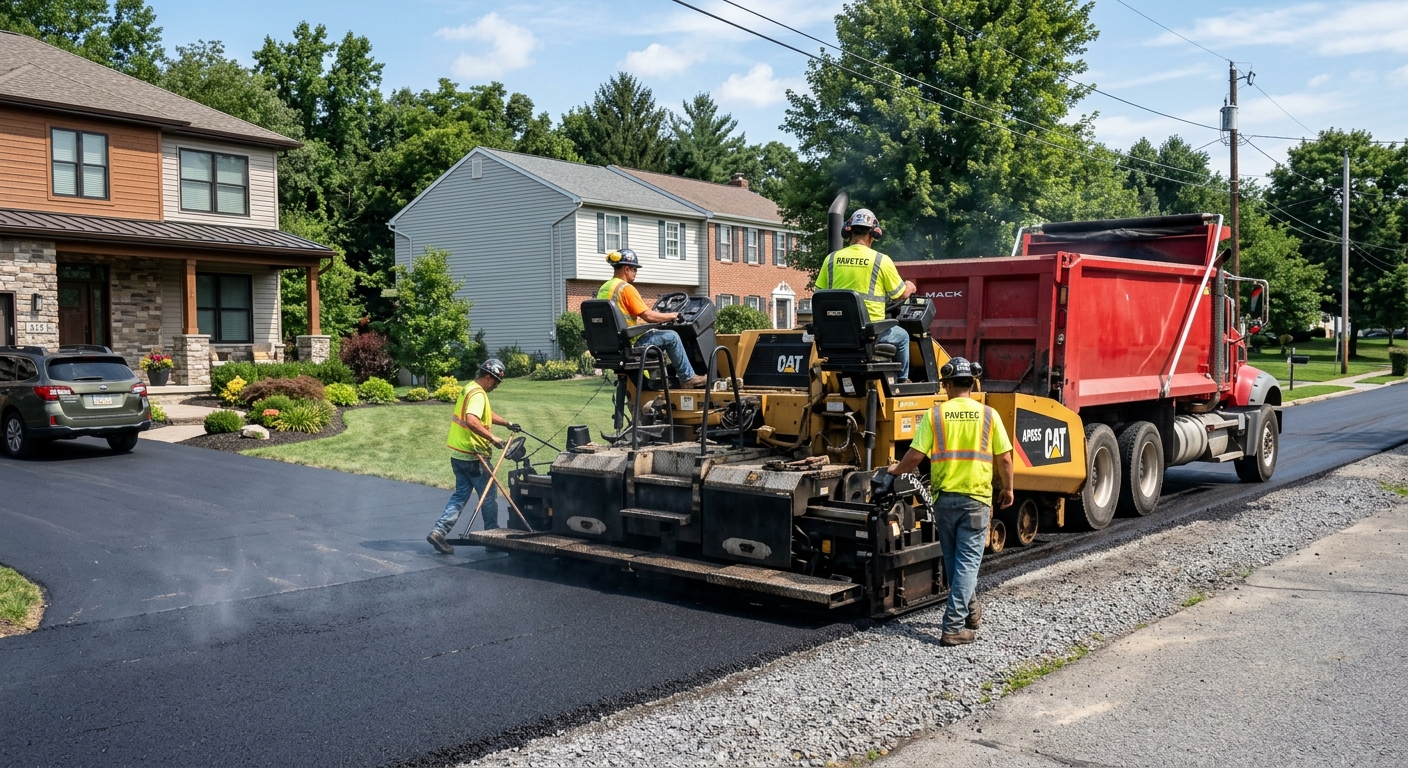
What a new driveway costs in Easttown
In Easttown, driveway paving is primarily a single-family homeowner project—nearly 73% of homes are detached, and with an 81.9% owner-occupancy rate (U.S. Census Bureau, ACS 2024), most residents are making improvements to properties they own. This sets a high standard for driveway work: most buyers plan to stay and want a surface that will last. Southeastern Pennsylvania’s moderate freeze-thaw cycle places extra demands on driveways. Subgrades over limestone and dolomite, common in Chester County, often require thicker, properly compacted bases to avoid settlement and reflective cracking. These factors drive the need for a thoughtful approach—and they also explain why you’ll see significant price differences from one paving quote to another. The bulk of your cost is in the prep and the unseen layers below the surface, not in the asphalt or concrete itself.
Outdated driveways from the 1960s–1980s in Easttown are now hitting the end of their structural life, so many homes need more than a simple resurfacing or “overlay.” The least expensive quotes often skip essential base work or proper edge treatment, setting you up for early failure. Always ask about excavation depth and what is included under the surface—because in this market, that’s where the price differences and real results hide.
| Service |
Best for |
Lifespan |
Price range |
| Asphalt — full replacement with new base |
failed base, structural cracking |
20–30 yrs |
$4,500–$11,500 |
| Asphalt overlay / resurfacing |
sound base, surface cracking only |
8–15 yrs |
$1,950–$5,800 |
| Sealcoating — single application |
preventive maintenance on sound asphalt |
2–4 yrs |
$250–$900 |
| Concrete — new installation |
long service life, low maintenance |
30–50 yrs |
$6,400–$15,500 |
| Crack filling and patching |
isolated cracks under a quarter inch |
1–3 yrs |
$200–$800 |
| Gravel driveway |
rural, budget, long runs |
5–10 yrs with upkeep |
$900–$3,500 |
Estimates for a typical Easttown driveway. Square footage and base condition drive these figures more than material choice.
The paving season in southeastern Pennsylvania
Scheduling paving in Easttown isn’t just about convenience—it’s determined by materials and the realities of southeastern Pennsylvania’s climate. Asphalt must be placed and compacted while hot: once temperatures fall, the mix cools too quickly, leading to poor compaction, a porous finish, and a short-lived driveway. That’s why local asphalt plants shut down for winter, with the winter design temperature here dipping to 14 °F and a moderate but real freeze-thaw pattern. Concrete, too, requires air and ground temperatures above freezing for a solid cure—it cannot be reliably installed or finished in true winter.
Most Chester County paving contractors operate from April through October, with May–September being the prime months. Early spring and late fall are shoulder seasons, where crews have some flexibility, but pushing into November is risky. If a contractor offers to pave in late November or over winter in this part of Pennsylvania, it’s a clear signal that their standards don’t match local best practice. Asphalt simply isn’t available from the plants, and any work done with leftover or cold mix is a gamble homeowners nearly always lose.
Locally, the presence of quarries and asphalt plants near Downingtown and Coatesville means material supply rarely delays projects. Still, demand peaks through mid-summer, making it harder to get competitive quotes and quick scheduling. Planning ahead for spring or fall not only gets you better availability but can also mean more attentive work at a more reasonable price.
Driveway permits, approaches and stormwater rules
Most Easttown homeowners can resurface or replace a driveway within the existing footprint without a building permit, unless the work extends into the public right-of-way. In much of Chester County, including many townships, only driveways that connect to a public road or are being expanded require permits—so if you’re just resurfacing a residential driveway outside the roadside zone, you often do not need to file with the township. However, any driveway approach where your drive meets a township, borough, or state road will nearly always require a dedicated driveway or Highway Occupancy permit. For driveways joining state roads in Chester County, the permit is issued by PennDOT Engineering District 6-0, not your local municipality—many are surprised by this, but it is a statewide rule.
Enlarging a driveway or creating new hard surface can trigger stormwater requirements, since Chester County’s soils don’t always drain quickly and dumping runoff onto a neighbor’s lot creates both liability and conflict. Even without a permit, you’re responsible for handling water on your own property.
For contractor verification, Pennsylvania requires Home Improvement Contractor (HIC) registration for any paving contract above $500—verify at hic.attorneygeneral.gov. All employers must also carry workers’ compensation insurance; you can confirm this at wcais.pa.gov before signing any contract. These protections are not optional, and skipping them exposes you to real risk.
What a real paving quote contains
Comparing driveway quotes in Easttown is only possible when you can see what’s included. A proper quote spells out the total measured square footage, the excavation depth (if any), the type and depth of aggregate base, the degree and method of compaction, and exactly how much and what kind of asphalt or concrete is being placed. Edge treatment, grading for drainage, and lawn restoration should be listed. Payment should be a small deposit up front, with the balance due only on satisfactory completion. Most reputable contractors provide a written warranty, but you need to read the exclusions—most will not cover cracking, even though that’s the failure homeowners worry about most.
A one-line quote—“pave driveway: $7,500”—gives you no way to compare anything but the number. Contractors know this, and it is the fastest way for a homeowner to overpay for a driveway built too thin or with minimal prep. The details that affect longevity and performance are not visible once the driveway is finished, so the time to demand specifics is before you sign.
| Line item |
What to look for |
Red flag if… |
| Area |
measured square footage stated |
eyeballed or absent |
| Excavation |
depth and disposal included |
'we'll pave over it' |
| Base |
aggregate type and depth in inches |
'proper base' |
| Compaction |
method, and done in lifts |
not mentioned |
| Asphalt |
courses and compacted depth |
'3 inches' unqualified |
| Drainage |
slope and water direction stated |
silent |
| Warranty |
what is covered and what is excluded |
verbal only |
| Payment |
modest deposit, balance on completion |
full cash up front |
Numbers, not adjectives
In Easttown, lasting paving results come from numbers written in your contract, not adjectives or vague promises. You want to see specific, measured depths for both excavation and the aggregate base—because Chester County’s ground, with its limestone and dolomite, settles more than many new residents expect. The freeze-thaw cycle here is moderate but real. Thin paving or shortcuts in compaction almost always show up as cracks or sinking after a hard winter, so the right spec matters much more than the advertised price per square foot. “We’ll put down three inches” means nothing unless it says how much is base, how much is surface, and whether it’s measured before or after compaction. Asphalt compacts by up to 25%, so “three inches laid” becomes just over two inches finished—a critical difference in this climate.
The only way to protect your investment is to insist on a contract that spells out every step, in writing, leaving no room for guesswork during installation. Quotes in Easttown should match the demands of our local soil and climate, and should never rely on what works “down south” or in benign conditions.
- Total area measured and stated in square feet
- Excavation depth below grass or previous material
- Aggregate base type (e.g., 2A modified) and compacted thickness
- Compaction method (vibratory roller/plate), done in lifts
- Binder course compacted thickness, in inches
- Surface course compacted thickness, in inches
- Mix designation (commercial or PennDOT-approved mix code)
- Edge treatment (straight cut, tamped, or reinforced)
- Grading plan with slope and water direction described
- Cleanup and lawn restoration commitments
Comparing materials in southeastern Pennsylvania
The choice between asphalt and concrete in Easttown should be guided by our climate and your long-term expectations. In southeastern Pennsylvania, asphalt holds a real advantage because it flexes with ground movement—this is important in an area with moderate freeze-thaw cycles and soil that can settle unpredictably over limestone and dolomite. Concrete, in contrast, is rigid. It usually lasts much longer—three or four decades is not uncommon—but it is vulnerable to spalling and scaling from de-icing salts, which are used heavily every winter by Chester County road crews and homeowners. The dominant cause of concrete driveway failure here isn’t wide cracking; it’s the surface breaking up after repeated exposure to salt and freeze.
Asphalt is less expensive, quicker to install, and can be resurfaced when it ages. It does need regular sealcoating, but for most Easttown homeowners it puts up with our conditions year in, year out. Concrete is a premium option, but to get its full life the owner must avoid salt-based de-icers—something most households struggle with during icy Pennsylvania winters. Pavers can be a high-end choice for decorative drives or historic homes, settling gradually and allowing easy unit replacement after frost heave. Gravel drives persist in rural Chester County, offering low up-front cost and superb drainage, but at the price of regular grading and top-dressing.
| Option |
Installed cost |
Maintenance |
Freeze-thaw performance |
Lifespan |
| Asphalt — new install |
$4,500–$11,500 |
sealcoat every 3–4 yrs |
excellent, flexes |
20–30 yrs |
| Asphalt — overlay |
$1,950–$5,800 |
same |
good if base is sound |
+8–15 yrs |
| Concrete |
$6,400–$15,500 |
low, avoid de-icing salt |
fair, spalls with salt |
30–50 yrs |
| Pavers |
$10,500–$15,500 |
individual units replaceable |
good, settles gradually |
25–50 yrs |
| Gravel |
$900–$3,500 |
top-dress every 2–3 yrs |
excellent drainage |
indefinite with upkeep |
The honest case for and against sealcoating
Sealcoating is a maintenance service almost every Easttown driveway owner will consider, but the reality is more nuanced than the ads suggest. Sealcoating’s main value is protecting asphalt from oxidation (“drying out”) and from stains caused by oil or gasoline. It does refresh the appearance, giving faded driveways a new, jet-black surface, but it adds no structural strength and cannot repair real damage. If your asphalt base is failing or you have alligator cracks, sealing will do nothing but cover up the problem for a season or two.
Sealcoating too often—especially every single year—builds up thick layers that become brittle, then crack and peel. The best interval in Chester County is every 3–4 years, and your first application should wait until the new asphalt has cured, usually at least 6–12 months. Sealing too early traps volatiles, which shortens the life of the pavement underneath.
Crack filling actually does more for a driveway’s structural life than sealcoating. Proper crack filling blocks water from seeping into the base, stopping freeze-thaw damage at its source, whereas a thin sprayed-on sealcoat by a fly-by-night crew—often using diluted materials—might only last a single season. In Easttown, you can expect to pay $250–$900 for a legitimate sealcoating job. If an estimate comes in far lower than that, question what’s being sprayed and how long it will last, because cut-rate jobs usually have little real value.
Frequently asked questions — driveway paving in Easttown
Does Easttown have local asphalt plants?
Local homeowners in Easttown benefit from the presence of several asphalt plants and quarries nearby, especially around Downingtown and Coatesville. This means contractors can get fresh mix quickly and don’t have to rely on material trucked in from far away, keeping prices and scheduling competitive for this area. Because haul distances are short, you’re not waiting hours for a delivery, which is critical since hot-mix asphalt must be placed while it is still workable. Generally, this helps keep the installed cost for a new asphalt driveway in the market range of $4,500–$11,500, and more importantly, ensures that work isn’t delayed by supply issues as it sometimes can be in rural counties or on the wrong side of the metro area. Still, book early during peak paving season, as every contractor taps into the same plants when demand soars.
How much does a concrete driveway cost in Easttown?
In Easttown, Chester County, a new concrete driveway typically costs between $6,400–$15,500. The wide range depends on the size of your driveway, access for equipment, and the amount of site preparation (such as excavation or additional gravel base) needed—especially common here due to settlement-prone limestone and dolomite soil. Most households see bids around $10,500 for a standard double drive. Concrete costs more than asphalt to install, but can last 30 to 50 years with minimal care. Just remember, surviving winters here means avoiding salt de-icers, as winter salt is the biggest threat to concrete driveway longevity in Pennsylvania’s climate.
Is an overlay worth it or should I start over?
Overlaying (or resurfacing) your existing Easttown driveway can be a smart choice if the base is stable and cracks are only at the surface—think minor weathering, not major heaving or deep potholes. Price-wise, overlays run $1,950–$5,800 compared to a full replacement, which starts at $4,500 or more. If you have widespread cracking, drainage issues, or your driveway sinks in places, overlaying is almost always throwing good money after bad—the new surface won’t last because the problems below remain. In Chester County, where many homes built in the 1960s–1980s have failing driveways, ripping out the old base and starting over is more expensive now, but saves you from redoing the work in just a few years.
What is the difference between binder and surface course?
On a replacement or full-depth new driveway in Easttown, the asphalt is typically laid in two layers. The binder course is the first, thicker layer, made of slightly coarser asphalt mix. Its job is to build strength and bridge any minor imperfections in the stone base. The surface course—the final layer—is finer, smoother, and forms the visible top. Together, they usually add up to 3 to 4 inches compacted for most driveways in Chester County. The binder is essential for structure, especially over local limestone soils that need more support to avoid settlement. If a quote only mentions “three inches of asphalt” without saying how much is binder and how much is surface, it’s not specifying enough for Pennsylvania conditions.
Why are my driveway edges crumbling?
In Easttown and the wider Chester County area, driveway edge failure happens most often when asphalt or concrete is laid too thin at the borders or left unconfined (not properly tamped or supported). Our region’s freeze-thaw cycles mean water easily works in from the side, then expands and contracts, breaking up weak edges. On older driveways, it’s sometimes the result of the initial paving being flush with the lawn, so weather and mowers break down the transition. A lasting fix involves cutting a clean edge and rebuilding with the right thickness—and specifying this in the contract for new work. Edge failures often precede wider driveway problems, especially where the local limestone base is thin or missing.
How often should I sealcoat my driveway in Easttown?
For Easttown driveways, sealcoating every 3 to 4 years strikes the right balance. Sealcoating too often (every year) leads to a thick, brittle buildup that can peel and crack, especially after Pennsylvania’s humid summers and winter freezes. Waiting too long lets the asphalt oxidize and age prematurely, especially given the sun exposure and temperature swings here. If your drive is brand new, best practice is to let it cure for 6–12 months before the first sealcoat—sealing too soon can actually harm the material below. Some residents try to keep up appearances for resale, but true preservation (and worthwhile investment) only needs a professional seal every few years, typically costing $250–$900 depending on driveway size.
What does sealcoating cost in Easttown?
A quality sealcoating job for a typical Easttown driveway runs between $250–$900. The price is driven by driveway size, the number and width of cracks to fill first, and whether the application is brushed or sprayed. Low-end quotes may skip essential crack and edge prep, using watered-down sealer that lasts less than a year—so be wary of anything much under $250 for a full-size drive. Avoid “drive-by” sealcoaters that pour thin spray from large tanks on truck beds, as the short-term shine won’t prevent weathering or extend your driveway’s life. Proper prep and material matter here, as southeastern Pennsylvania’s climate exposes shortcuts fast.
Are there stormwater rules on paving in Easttown?
Yes, homeowners in Easttown need to pay attention to stormwater regulations when paving or expanding driveways. Expanding any hard surface (asphalt or concrete) increases runoff, and in Chester County’s local townships, significant expansions can trigger requirements to handle runoff on your own property—like adding swales or a dry well. Even if you’re not required to pull a permit for a resurfacing, local practice and civil law hold you responsible for managing water so it doesn’t flow onto your neighbor’s lot. This is especially important on slopes over the area’s limestone soils, which don’t always absorb water quickly. Always discuss drainage in your contract and confirm with your township if you have any doubt about the need for stormwater controls.
Can asphalt be laid in cold weather?
In Easttown, true cold-weather asphalt work is a non-starter. Local asphalt plants close for the winter, usually by late November, and PennDOT’s winter design temperature is just 14 °F. Below about 45 °F, hot-mix asphalt can’t be laid or compacted properly; it cools too quickly and never bonds or densifies right, leading to a driveway that fails quickly. If someone offers to pave your drive in December or February in Chester County, they aren’t working with fresh hot-mix from the plant. Any work done in cold conditions is almost always a short-term patch, not a proper driveway replacement, and you’ll be redoing it far sooner than expected—regardless of what the quote says or promises about performance.