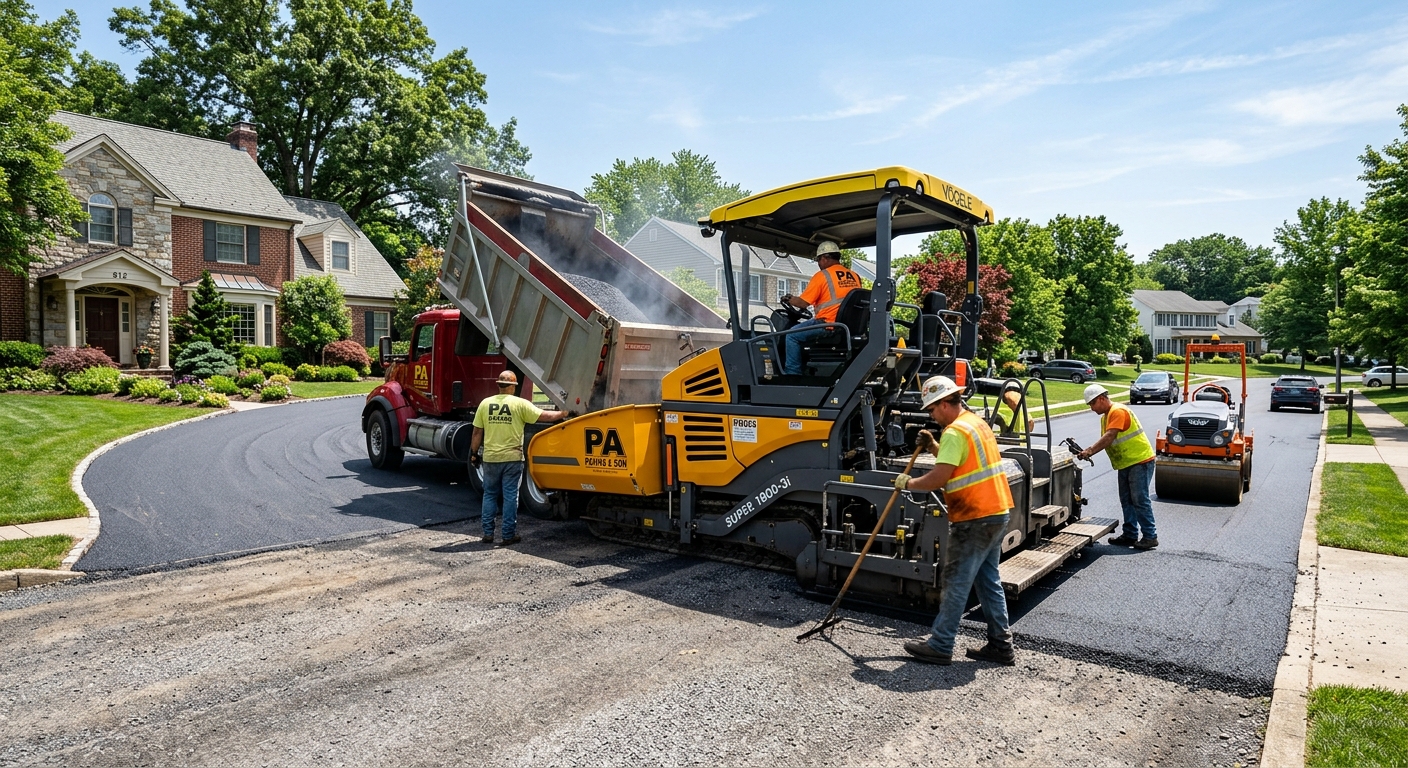
What a new driveway costs in Forks
Forks is a township where most homes are owner-occupied and built as single-family properties, with 90.1% homeownership and 68.4% of households in detached houses (U.S. Census Bureau, ACS 2024). That means almost every driveway is privately maintained and, when it wears out, it’s up to the homeowner to replace or repair it.
Driveway paving costs vary in Forks, and a big reason is what you can’t see. In our local climate, with hard freezes and rapid spring thaws, the wrong base or poor drainage means failure in five years instead of 25 — and most of the price difference between two bids is below the surface, not in the blacktop on top. The region’s Lehigh Valley limestone karst subgrade demands real grading and stone depth to prevent the settlement and rutting you see elsewhere in Pennsylvania. If an old driveway is crumbling or the surface bubbles after winter, chances are the problem started underground.
| Service |
Best for |
Lifespan |
Price range |
| Asphalt — full replacement with new base |
failed base, structural cracking |
20–30 yrs |
$3,900–$10,000 |
| Asphalt overlay / resurfacing |
sound base, surface cracking only |
8–15 yrs |
$1,650–$5,000 |
| Sealcoating — single application |
preventive maintenance on sound asphalt |
2–4 yrs |
$225–$750 |
| Concrete — new installation |
long service life, low maintenance |
30–50 yrs |
$5,500–$13,500 |
| Crack filling and patching |
isolated cracks under a quarter inch |
1–3 yrs |
$200–$800 |
| Gravel driveway |
rural, budget, long runs |
5–10 yrs with upkeep |
$900–$3,500 |
Estimates for a typical Forks driveway. Square footage and base condition drive these figures more than material choice.
Local soil, drainage and driveway lifespan
Most of Northampton County, including Forks, sits on Lehigh Valley limestone karst subgrade. That matters for driveways: limestone is prone to settlement, especially if rainwater collects or subgrades aren’t compacted right. If you’ve noticed your or your neighbor’s driveway sinking or cracking from underneath, it’s not just age — it’s our geology at work. Combine that with the northeastern Pennsylvania frost depth of 36 inches and regular freeze-thaw cycles, and you get a recipe for heaving and sinking if the base isn’t deep and well-drained.
Older driveways (especially those from the 1900–1940 era seen in neighboring Easton and Bethlehem) often lack an engineered stone base, since past standards were minimal or non-existent. Modern driveways in Forks should be built wider and on a thicker, well-compacted subbase — at least 6–8 inches of crushed stone over karst — sloped to carry water away. Skimping on base depth or ignoring drainage issues is a false savings; you may pay for the same job a second time when the first one settles or washes out. Good driveways here last 20–30 years, but only if the base is right for our challenging ground and winters.
What you need before paving in Forks
In Forks Township, repaving an existing driveway in exactly the same footprint typically does not require a new building permit. That saves you some paperwork—and it's a common scenario, as many local homes just need their old blacktop replaced. However, if you plan to expand your driveway, relocate it, or make a new curb cut, you may enter permit territory. The real wrinkle comes where your driveway meets the public street: driveway approaches (the section crossing the right-of-way) usually require a separate permit. Forks is served by both township and PennDOT District 5-0, depending on whether your street is local or state—so always check before changing the driveway entrance.
Watershed permitting is another concern, since adding new pavement adds "impervious surface." This can trigger township runoff or stormwater review, and under Pennsylvania law, it's your responsibility to ensure runoff from your driveway doesn't damage a neighbor’s property, whether or not you pulled a permit. Ignoring this will make both the township and your neighbor unhappy.
Always verify that your contractor is registered with the state’s Home Improvement Contractor (HIC) registry at hic.attorneygeneral.gov. For any contract over $500, you need a written agreement. Pennsylvania requires all employers to carry workers' compensation; you can check compliance at WCAIS (wcais.pa.gov). Five minutes of checking now beats years of headaches if something goes bad.
What a real paving quote contains
A professional paving quote in Forks should spell out every detail, because the difference in two prices is almost always what lies beneath. It starts with the measured square footage—if it’s not there, you can’t compare apples to apples. Excavation needs to state depth and where the old material is going. The base should specify the exact type of stone aggregate, how deep, and whether compaction is done in layers. For asphalt, you want to see the plan for binder and surface courses, each with compacted depth (not just “three inches” loose, since it compresses nearly an inch when rolled). Edge restraints, grading for drainage, and how the site gets cleaned up should be detailed. Payment terms matter—modest deposit, balance due on completion. Nearly all paving warranties exclude cracking, which is the most common failure, so read the fine print.
The most common way homeowners overpay here is by accepting a one-line “all-in” quote with no specs. If you can’t tell what you’re getting, you aren’t getting what you should.
| Line item |
What to look for |
Red flag if… |
| Area |
measured square footage stated |
eyeballed or absent |
| Excavation |
depth and disposal included |
'we'll pave over it' |
| Base |
aggregate type and depth in inches |
'proper base' |
| Compaction |
method, and done in lifts |
not mentioned |
| Asphalt |
courses and compacted depth |
'3 inches' unqualified |
| Drainage |
slope and water direction stated |
silent |
| Warranty |
what is covered and what is excluded |
verbal only |
| Payment |
modest deposit, balance on completion |
full cash up front |
The driveway scams that work in Forks
Driveway paving draws its share of scams, and Forks residents should stay alert. One common pitch is “leftover asphalt” from a supposed job down the road—a ploy that counts on the homeowner saying yes to cheap work without specs or a contract. Another is “today only” pricing from an unmarked truck sporting distant or out-of-state plates, pressuring you to pay cash up front before the crew disappears. Beware thin, oil-based spray sealant sold as a full sealcoating—your driveway will look shiny for a week and start peeling or streaking with the first hard rain.
Transient crews target saturated suburban areas like the Lehigh Valley, including Forks, because most homes are single-family with driveways visible from the road, and neighbors are used to seeing construction trucks. Paving defects often take several seasons to show—by then, the operator is long gone and the warranty means nothing.
The Home Improvement Consumer Protection Act (HICPA) gives you two key shields: for any contract over $500, you must receive a written agreement, and you have three business days to cancel. Never agree to implicit or cash-only terms or allow work to start without paperwork. Anyone offering to “waive your insurance deductible” is breaking the law.
Five minutes with the state’s HIC registry at hic.attorneygeneral.gov, a check for workers’ comp coverage on WCAIS, and a quick search for out-of-area vehicle plates will sidestep 99% of paving scams in Forks.
Widening, extending or adding a parking pad
Upgrading your driveway in Forks isn’t just about replacing the old asphalt—many homeowners want to widen for extra vehicles, extend to a detached garage, or add a turnaround or parking pad. Any project that extends your paved footprint involves more than just extra blacktop. It means building a new stone base on undisturbed ground, addressing new drainage patterns, and tying the new section to the old—where the seam will always be a potential weak spot for cracks or settling.
Township permits often come into play for these expansions, especially if you’re working near the street (which may require an approach permit from the township or PennDOT District 5-0) or adding several hundred square feet. Projects that add impervious surface can also trigger stormwater review and runoff controls, even if your neighbor’s property is downslope. Setback rules may apply depending on how close you build to the property line—don’t rely on the old driveway’s location as a guide if you’re going bigger.
If all you need is a patch or slight reshaping, you may avoid permits, but for any meaningful change in shape or size, check local requirements up front so you don’t build yourself into a code problem.
The specifications to demand in writing
The only real protection for a homeowner paving a driveway in Forks is to insist on every material and process spec in writing—otherwise you’re just a price shopper, and that’s how corners get cut. Our local freeze-thaw cycle and the Lehigh Valley’s limestone karst demand deeper and better-graded bases than milder climates. The right way is always specified in inches and materials: how deep is the excavation? What type and depth (after compaction) of stone aggregate under the blacktop? Then, for asphalt, the thickness of the binder base and the surface course—both listed as compacted, not loose, because three inches laid may be two once it's rolled.
When a quote just says “we’ll put down three inches of blacktop,” you’re left guessing—is that before or after the roller? Is it one layer or two? Is there even stone beneath it, or are they paving dirt? You don’t want to discover the answer in March when you see heaving or cracks.
- Measured square footage of the driveway area
- Excavation depth (in inches)
- Aggregate base type (e.g., 2A modified) and depth after compaction
- Compaction method (machine-rolled, number of passes, in layers/lifts)
- Binder course asphalt depth (compacted) with mix designation
- Surface course asphalt depth (compacted) with mix designation
- Total finished asphalt thickness (compacted)
- Edge treatment (how edges are finished and retained)
- Drainage plan (slope percentage and direction)
- Cleanup and site restoration description
- Warranty terms, including specific exclusions on cracking
Frequently asked questions — driveway paving in Forks
What is the difference between crack filling and sealcoating?
Crack filling in Forks refers to injecting specialized asphalt-based material directly into individual cracks—usually those under a quarter inch wide. The goal is to prevent water from getting into the base, stopping freeze-thaw from making the crack worse. Sealcoating, on the other hand, is a liquid application sprayed or squeegeed over the entire driveway surface to slow down UV damage and water infiltration. It's for preventive maintenance—it won't fill deep or wide cracks. Most homeowners should use both at the right times. For reference, a full crack-filling and patching service can run $200–$800, while sealcoating is $225–$750 per application. Keep in mind: neither process will fix major structural issues, and in Forks’ climate, combining them stretches out the lifespan of a sound driveway.
Why are my driveway edges crumbling?
Driveway edge failure in Forks is a classic sign the asphalt is too thin at the edges, missing proper aggregate support underneath, or being driven over by vehicle tires off the edge. Our freeze-thaw cycles, combined with the limestone subgrade, mean water seeps in, freezes, and cracks off unsupported asphalt. Older driveways in Forks often lack any sort of edge restraint or proper stone shoulder. A correctly built edge has the same stone base and asphalt thickness as the center, sometimes angled out to shed water. Quick fixes like dumping cold patch on the edge rarely last; in many cases, edge repairs cost about $200–$800 but may need a full replacement if the underlying base is gone. Ask your contractor about edge detail in the specs before work starts.
Is gravel a cheaper option in Forks?
Gravel is often a budget-friendly option for long or rural driveways in Forks, and can be especially practical where runs are long and pavement isn’t a priority. Installation costs are lower—usually $900–$3,500—and upkeep is just periodic grading and topping up. Gravel makes sense if you’re on a tight budget or the driveway gets little winter use. Just be aware that limestone subgrades in the Lehigh Valley can mean more frequent regrading due to rutting, especially after winter thaws. Gravel driveways also track dirt and stone, so consider what suits your property and usage before going this route.
Are pavers worth the cost in northeastern Pennsylvania?
Interlocking pavers look great but aren’t priced for most Forks driveways. Material and labor costs are much higher than asphalt ($3,900–$10,000) or even concrete ($5,500–$13,500). Pavers can handle freeze-thaw cycles better if installed over a well-compacted, deep base designed for our frost depth, but they do require maintenance: sweeping sand, fixing shifts, and sometimes clearing weeds between joints. Many Forks homeowners find that the cost per square foot doesn’t justify the look compared to durable, well-built asphalt or concrete unless it’s a short approach or part of a landscaping design.
Are door-to-door pavers a problem in Forks?
Yes. In Forks and across the Lehigh Valley, “gypsy” pavers—crews who canvas neighborhoods in unmarked trucks—are a chronic issue. They often offer “leftover” asphalt, cash-only “deals,” or verbal quotes and disappear the same day, leaving you with thin, short-lived work. Pennsylvania’s Home Improvement Consumer Protection Act (HICPA) requires a written contract on any job over $500 and gives you three business days to cancel, but transient pavers sidestep these requirements or hope you don’t know the law. If you’re approached, check registration at hic.attorneygeneral.gov and never pay full cash up front. A legitimate repaving in Forks is normally $3,900–$10,000 for full-depth replacement, so “special deals” are rarely what they seem.
What slope does a driveway need for drainage?
On limestone karst ground in Forks, getting driveway slope right is critical: too flat and you’ll have water pooling, too much and your car begins to slip in winter. The rule of thumb is at least a 2% slope away from the house and towards the street—about a quarter-inch drop per foot. This helps direct runoff to the right places and keeps water out of your garage or foundation. Good drainage makes a difference in how long your driveway lasts, especially with our 36-inch frost depth and regular freeze-thaw cycles. With proper grading built into the project, you’ll protect your investment—poor drainage is a leading cause of driveway failure well before the 20–30-year mark for a proper asphalt install.
What does an asphalt overlay cost in Forks?
An asphalt overlay (also called resurfacing) is a good middle-ground fix if your base is sound but the top layer is cracking or worn—very common in Forks driveways built on good stone. In 2026, you should expect to pay $1,650–$5,000, with most typical jobs around $3,300 for a standard two-car driveway. It’s less costly than a full removal and replacement, but overlays don’t fix problems under the surface; if your base is settling, you’ll just be masking the issue. In almost all cases, asking for the overlay thickness in writing (both loose and compacted) prevents future headaches—don’t accept “just a new layer” as a spec.
Are there stormwater rules on paving in Forks?
Yes, stormwater management is part of every paving project in Forks. When you add new driveway, widen it, or install a parking pad, you’re increasing “impervious surface” — which means less water soaks into the ground, increasing runoff. Local rules vary in detail, but if you expand beyond what’s already paved, expect the township to review your plan for how water leaves your property. Directing runoff onto a neighbor’s land is a liability, permit or no permit. If the job is just a same-size replacement, you usually avoid review, but anything bigger may trigger site plan checks. Adding new surface without attention to drainage can undermine either your drive’s life or your neighbor’s good will, so build for compliance and real-world results—not just code minimum.
How long does a driveway installation take?
In Forks, most driveway replacements—from removal to final compaction—take two to four days, weather permitting. Day one is demolition and excavation, day two usually sees base grading and compaction, and paving is scheduled once the base passes a quick rain test for drainage. Longer, more complex jobs (especially with curves, parking pads or drainage work) can spill into a week. Concrete driveways ($5,500–$13,500) add extra time as each stage needs curing. The largest variable is weather; a string of wet days or a late spring frost can slow things down. For overlays or smaller jobs, the crew may be in and out in a day, but always ask your contractor for the schedule in writing—unforeseen delays are less painful when communication is clear up front.