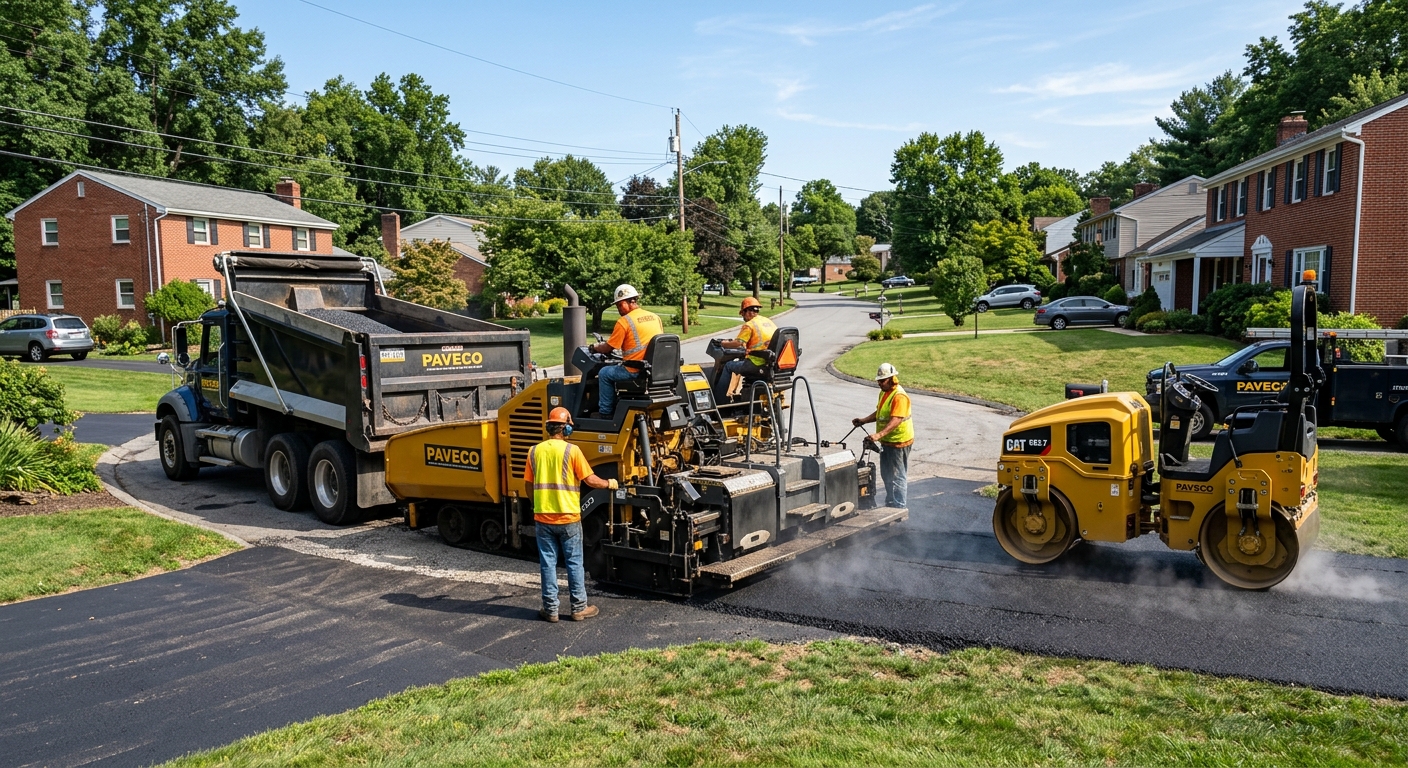
Northampton paving prices by scope — 2026
In Northampton County, where 69.3% of residents own their homes and 39.1% live in single-family houses (U.S. Census Bureau, ACS 2024), driveway paving is one of the larger investments most detached homeowners face. Our price structure reflects not just Lehigh Valley's competitive contractor market, but the region’s tough winters and the limestone karst subgrade under Bethlehem and Easton. Freeze–thaw cycles cause movement below the surface, so the true difference between driveway quotes is usually buried out of sight, in how well the base is built and drained, not just the asphalt on top.
A Northampton driveway is tested from the first three winters onward, and prices spread wide for a reason. Crews with proper excavation, thick, compacted aggregate, drainage correction, and careful grading charge more—but cut repeated replacements and repairs. Most of what you pay for is in that unseen work.
Here’s a snapshot of driveway services and prices in Northampton for 2026:
| Service |
Best for |
Lifespan |
Price range |
| Asphalt — full replacement with new base |
failed base, structural cracking |
20–30 yrs |
$3,500–$8,900 |
| Asphalt overlay / resurfacing |
sound base, surface cracking only |
8–15 yrs |
$1,500–$4,500 |
| Sealcoating — single application |
preventive maintenance on sound asphalt |
2–4 yrs |
$200–$700 |
| Concrete — new installation |
long service life, low maintenance |
30–50 yrs |
$5,000–$12,000 |
| Crack filling and patching |
isolated cracks under a quarter inch |
1–3 yrs |
$200–$800 |
| Gravel driveway |
rural, budget, long runs |
5–10 yrs with upkeep |
$900–$3,500 |
Estimates for a typical Northampton driveway. Square footage and base condition drive these figures more than material choice.
Base preparation: the part you pay for and never see
Base preparation is the single most important step in driveway longevity for Northampton County homes. All driveways start at the subgrade—the raw soil on your property, which in Northampton’s Lehigh Valley is largely limestone karst. This soil type can settle unpredictably if water isn’t managed, creating dips and cracks. On top of the subgrade goes the compacted aggregate base—typically crushed stone—that spreads loads and provides drainage. Only then is the asphalt or concrete poured.
Our winters, with repeated freeze–thaw cycles and a frost depth of 36 inches, are punishing. Water in the subgrade freezes, expands, and heaves the driveway up from below—a process called frost heave. When the ice melts, the slab may not settle evenly, and you get cracks from beneath. That’s why base depth and drainage matter more in Northampton than in milder climates; a thick asphalt or concrete layer over a shallow, under-compacted base will look fine at first but fail by year three.
Most cheap quotes get cheap by skipping steps where no homeowner’s watching: shallow excavation (or none), laying new material over a soft or broken base, skimping on aggregate, rushing compaction, or skipping lift-by-lift rolling. You may not see these shortcuts the day the job is done—but you’ll see the result when frost, water, and traffic make the base collapse underneath.
You should require these details in writing on your estimate:
- Base depth: at least 6–8 inches of compacted aggregate for asphalt in this climate
- Aggregate: 2A modified crushed stone or equivalent, not recycled debris
- Compaction: done in 2–3 lifts, machine compacted after each layer
These numbers determine how long your new driveway lasts in Northampton’s demanding ground conditions. Don’t accept vague language here—make every bidder put these specifics on paper.
Comparing materials in northeastern Pennsylvania
Choosing between asphalt and concrete in Northampton isn’t just a matter of cost—it’s about performance in our tough Northeastern Pennsylvania climate. Asphalt is flexible, which matters when the ground moves through 40+ freeze–thaw cycles every winter. When limestone karst below shifts, asphalt can flex without breaking. That’s why you see so many blacktops in the Lehigh Valley.
Concrete, done right, lasts 30–50 years. But it’s rigid, and its real enemy here isn’t cracking, it’s spalling—thin surface flakes breaking off. Around Bethlehem and Easton, de-icing salt is used heavily, and salt attacks the top surface of concrete every winter, especially if improper mixes or curing are used. If you choose concrete, you can’t use salt-based de-icers. That’s more behavioral discipline than most homeowners maintain over decades.
Pavers are an option for those who want style and individual unit replaceability. They handle frost well if set over a deep, well-drained base. Gravel is the go-to for long rural drives or situations where price or drainage are key.
| Option |
Installed cost |
Maintenance |
Freeze-thaw performance |
Lifespan |
| Asphalt — new install |
$3,500–$8,900 |
sealcoat every 3–4 yrs |
excellent, flexes |
20–30 yrs |
| Asphalt — overlay |
$1,500–$4,500 |
same |
good if base is sound |
+8–15 yrs |
| Concrete |
$5,000–$12,000 |
low, avoid de-icing salt |
fair, spalls with salt |
30–50 yrs |
| Pavers |
$7,900–$12,000 |
individual units replaceable |
good, settles gradually |
25–50 yrs |
| Gravel |
$900–$3,500 |
top-dress every 2–3 yrs |
excellent drainage |
indefinite with upkeep |
Driveway permits, approaches and stormwater rules
For most Northampton homeowners, repaving an existing asphalt driveway in the same footprint does not require a building permit, especially in townships like Palmer, where minor patching and repairs are routine without one. But if you plan to expand your driveway or install a new one in Bethlehem, you’ll likely face a zoning or building permit review by the City of Bethlehem Bureau of Code Enforcement.
The critical spot many overlook is the driveway approach—the section that ties your driveway to the road. On state routes in Northampton County, PennDOT District 5-0 issues approach permits. For local public roads, the township or city manages curb cut and apron approvals. Permit requirements are stricter on these points than on repairs to the driveway inside your property.
Expanding your driveway or increasing impervious area can trigger stormwater reviews. Proper grading is essential—directing new runoff onto a neighbor’s property can bring not just complaints but legal liability, permits or not.
When hiring a contractor, Pennsylvania law requires Home Improvement Contractor (HIC) registration for jobs over $500—verify registration at hic.attorneygeneral.gov. Employers must have valid workers’ compensation insurance, verifiable through the WCAIS system. Homeowners in Northampton should insist on seeing proofs before work begins.
Comparing paving estimates in Northampton
A proper paving estimate in Northampton should let you compare apples to apples—most don’t. Before you hire, make sure every estimate spells out the measured square footage, demo and excavation scope, aggregate type and depth, method and depth of compaction, number of asphalt lifts, edge treatments, drainage and grading, restoration, payment schedule, and warranty. Without these, you have no idea what is actually being built.
Many quotes are just a single line and a total price. You can’t compare that to anything—this is how homeowners routinely overpay for jobs that are underbuilt and fail early in Northampton conditions. If you see specifics you can’t verify, ask to see where they’re written in your contract. Most driveways that fail in the Lehigh Valley go down because shortcuts were taken where no one was looking.
| Line item |
What to look for |
Red flag if… |
| Area |
measured square footage stated |
eyeballed or absent |
| Excavation |
depth and disposal included |
'we'll pave over it' |
| Base |
aggregate type and depth in inches |
'proper base' |
| Compaction |
method, and done in lifts |
not mentioned |
| Asphalt |
courses and compacted depth |
'3 inches' unqualified |
| Drainage |
slope and water direction stated |
silent |
| Warranty |
what is covered and what is excluded |
verbal only |
| Payment |
modest deposit, balance on completion |
full cash up front |
Why you can't pave in February
Seasonality for driveway paving in Northampton isn’t a matter of preference—it’s physical law. Hot-mix asphalt demands installation temperatures well above freezing. If it’s too cold, the mix stiffens before it can be properly compacted, creating voids and a weak, short-lived surface. Our winter design temperature is 4°F, and Lehigh Valley asphalt plants shut down from late fall until spring. So, in reality, the material simply isn’t available for a good chunk of the year.
Concrete is just as sensitive. Pouring it when you’re seeing typical January numbers around Easton and Bethlehem—over 6,100 heating degree days—means it may freeze before it cures, leading to weak, surface-flaked slabs.
The practical paving window here is April through October. Early spring and late fall (“shoulder seasons”) often have the best scheduling flexibility and prices, while peak summer dates book up early. If a crew in Northampton offers to pave for you in late November or February, be very suspicious. They’re either cutting corners, using leftover cold mix (no good for driveways), or risking a bad product.
The other side: don’t rush to be “first on the pad” in April if the ground hasn’t thawed thoroughly, or you’ll trap water and set up for early base failure. Patience pays off in this climate.
Sealcoating: what it does and what it doesn't
Sealcoating is often oversold in Northampton, but it’s not snake oil when used correctly. A quality sealcoat forms a thin layer over your asphalt, shielding it from oxidation by the sun, and from oil or fuel spills. It also restores a fresh black appearance, which looks good and improves curb appeal, especially after harsh Lehigh Valley winters that dry out and gray the surface.
What sealcoating doesn’t do: add strength, bond the surface, or stop cracks forming when the base fails. If your asphalt is already fractured, water is already working underneath, or you’re seeing soft spots, sealcoating won’t fix it—it’s time to consider patching or replacement.
Don’t be pressured into annual sealing—too many coats build up and can actually crack and peel. For new installations, wait a full season (at least 6–12 months) before the first sealcoat, so volatiles can dissipate and the surface finishes curing. Every 3–4 years afterward is more than enough. Look for a price at the middle band—$200–$700 per application for most Northampton driveways—because a very cheap price signals a diluted or thin spray-on coat that won’t last a winter.
Crack filling is the real game-changer in Lehigh Valley. Filling small cracks before winter prevents water from entering, freezing, and wrecking the base. A genuine crack fill involves cleaning the crack, prepping the edges, and then using hot rubberized filler—never a cold, sloppy pour. Done right, it can extend a driveway’s life by years, far more than just regular sealing.
Frequently asked questions — driveway paving in Northampton
How long does a driveway installation take?
For a typical Northampton single-family home, a full asphalt driveway replacement with new base takes 2–4 days once scheduled—one for excavation and base, one for grading and compacting, and one for paving. Weather, scope, and permit timing can add a few extra days, especially if rain or late approvals from the City of Bethlehem Bureau of Code Enforcement are involved. Larger or unusually wide driveways covering the more generous lot sizes in some Northampton townships might push to a week. An overlay (asphalt resurfacing) is faster, with most crews in this part of Pennsylvania able to complete it in a single day, weather permitting. A new concrete driveway installation needs at least 5–7 days before you can drive on it, due to curing. Prices for full asphalt replacement run $3,500–$8,900 depending on square footage, condition, and prep.
What causes concrete to spall or flake in Northampton?
In Northampton and the broader Lehigh Valley, the most common cause of concrete spalling (surface flaking) is repeated cycles of de-icing salt exposure and rapid freeze–thaw. When salt is used on driveways and sidewalks during Bethlehem or Easton's harsh winters, it breaks down the concrete’s top layer, allowing water to penetrate. When that water freezes, it expands and pops off surface flakes. Using poor mixes or rushing the finishing during cold weather can make this problem worse. Even with a properly installed concrete driveway, which can run $5,000–$12,000, you’ll have to avoid salt-based de-icers entirely—or you’ll see surface damage within a few years regardless of the concrete’s thickness or workmanship.
Is sealcoating a scam?
Sealcoating isn’t a scam when it’s done at appropriate intervals and for the right reason. In Northampton, a sealcoat protects the asphalt binder from oxidation and light chemical spills, helps keep out water, and makes the driveway look like new. The key is that it doesn’t repair base damage or major cracking—so if someone in Pennsylvania claims sealcoating will “double the life” of your failing blacktop, walk away. Once every 3–4 years is plenty for most driveways, and the going rate is $200–$700 per coat here. Beware of anyone selling annual sealing or offering prices way under that band; cheap jobs cut corners or use watered-down material that peels or wears off quickly.
Do I need a permit to repave a driveway in Northampton?
In Northampton County, repaving an existing driveway, especially if you’re not expanding or changing the footprint, typically does not require a permit in most townships such as Palmer. However, in the City of Bethlehem, expanding or installing a new paved area usually means you’ll need a zoning or building permit review. Importantly, any work on the driveway approach—where it ties into a public street—requires a separate permit from either the township, city, or PennDOT District 5-0 for state routes. Patch or keep your surface in good shape, but always double-check with your municipal code office before changing your driveway’s size or connection to the road. For cost, a routine asphalt overlay runs $1,500–$4,500.
How much does a concrete driveway cost in Northampton?
For a standard Northampton driveway, a professionally installed concrete driveway costs between $5,000–$12,000, with most projects coming in around $7,900. Prices vary depending on width, total square footage, whether excavation or extra grading is needed, and any decorative work. Concrete is more expensive upfront than asphalt, but the trade-off is durability—if you can avoid using salt. Keep in mind that older homes in Bethlehem and Easton, many dating from 1900–1940, may need their narrow, original driveways widened to modern standards, which can push the cost to the higher end of the range.
Is gravel a cheaper option in Northampton?
Gravel is the lowest-cost driveway option in Northampton, with most installations running $900–$3,500 depending on length and aggregate depth. For rural or semi-rural homes with long runs, gravel makes sense because of its drainage—especially over Northampton’s limestone karst soil, which can settle unpredictably. The downside is more frequent maintenance: plan on top-dressing every 2–3 years and keeping the edges weeded. Gravel won’t suit every yard in the Lehigh Valley, but for those set back off the road or with budget constraints, it’s a perfectly legitimate choice.
Does road salt damage driveways in Northampton?
Yes—road salt is a leading contributor to driveway damage in Northampton County. Salt is heavily used here in the winter, especially around Bethlehem and Easton, to keep driveways and streets safe. On asphalt, it accelerates surface wear but rarely causes structural failure. On concrete, however, repeated salt exposure leads to spalling and surface flaking, sometimes within a couple of winters. Driveways installed for $5,000–$12,000 will last decades if you avoid using salt-based de-icers. If you do need to melt ice, sand or calcium magnesium acetate are safer alternatives for concrete.
How deep should the aggregate base be here?
In Northampton County, the aggregate base under a new driveway should be at least 6–8 inches thick after compaction—especially important over the area’s limestone karst soil. This depth provides enough strength and drainage to withstand the 36-inch frost depth and repeated freeze–thaw cycles our climate delivers. For concrete driveways, stay at or above 8 inches. If you see lower numbers—or if the depth isn’t specified—ask for clarification and get it in writing. Skimping on base depth is the most common shortcut that leads to early failures in the Lehigh Valley, costing you a full replacement down the road at $3,500–$8,900 for asphalt or more for concrete.
Is an overlay worth it or should I start over?
An asphalt overlay, at $1,500–$4,500, can make sense in Northampton if your base is sound and surface cracks are cosmetic—not structural. You’ll get 8–15 extra years of use at a fraction of the price of a full replacement. But overlays won’t fix underlying soft spots, deep cracks, or any base that’s already washing out from Lehigh Valley freeze–thaw. If you’re seeing settlement, chronic puddling, or cracks going through both layers, it’s time to replace from the base up, even at a higher upfront cost. Don’t throw good money after bad—get a professional assessment before you overlay.