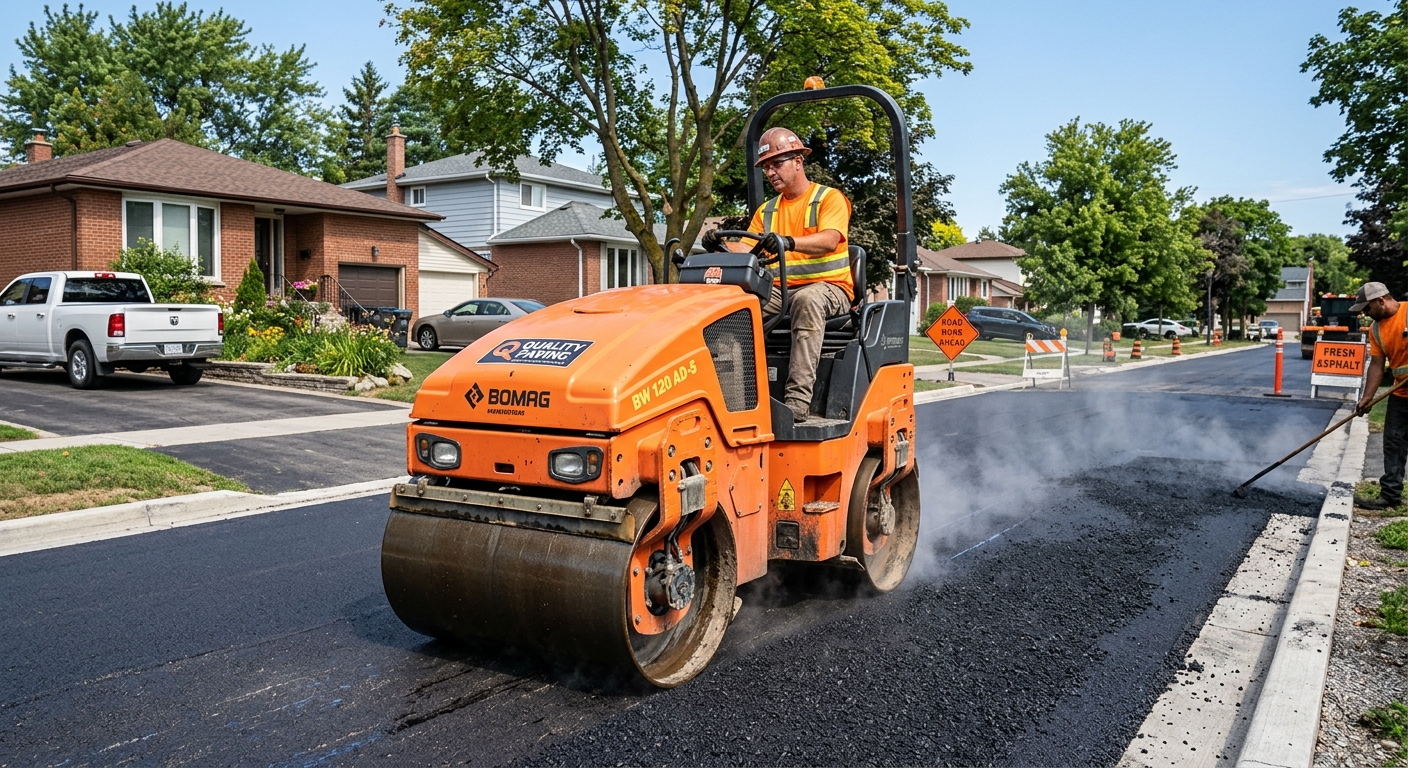
Allentown paving prices by scope — 2026
In Allentown, where only 24.2% of homes are single-family houses and the homeownership rate is 42.3% (U.S. Census Bureau, ACS 2024), driveway paving is a significant expense for individual owners—not a routine part of living in an apartment or attached home. Local freeze-thaw cycles and variable soils mean price comparisons aren't apples-to-apples: for Lehigh County homeowners, most of the cost difference between two quotes isn’t in what you see on top. It’s in the layers you can’t check once the crew is gone.
With driveways, the depth and compaction of the stone base under the asphalt or concrete will make or break the job. Western Lehigh County has especially challenging subgrade conditions over limestone karst—the risk of hidden voids requires more base stone and careful construction than in many other regions. Installing over old, failed driveways or skipping excavation is what leads to the kind of cracking and heaving you see after a couple of winters here. The visible surface may look identical on day one, but under real Allentown conditions, one will last decades while the other fails fast and costs more in the long run.
| Service |
Best for |
Lifespan |
Price range |
| Asphalt — full replacement with new base |
failed base, structural cracking |
20–30 yrs |
$3,500–$8,900 |
| Asphalt overlay / resurfacing |
sound base, surface cracking only |
8–15 yrs |
$1,500–$4,400 |
| Sealcoating — single application |
preventive maintenance on sound asphalt |
2–4 yrs |
$200–$700 |
| Concrete — new installation |
long service life, low maintenance |
30–50 yrs |
$4,900–$12,000 |
| Crack filling and patching |
isolated cracks under a quarter inch |
1–3 yrs |
$200–$800 |
| Gravel driveway |
rural, budget, long runs |
5–10 yrs with upkeep |
$900–$3,500 |
Estimates for a typical Allentown driveway. Square footage and base condition drive these figures more than material choice.
Why Allentown driveways fail from the bottom up
The heart of every long-lasting driveway in Allentown is what lies underneath. A proper driveway is built from the soil up: first the subgrade (earth that has to be stable and well-draining), then a compacted aggregate base—stone crushed to specific sizes and thickness—and finally the asphalt or concrete surface. Each layer spreads the weight of cars and trucks down to the soils below. If the subgrade isn't sound, or the stone base is too thin, no surface—no matter how thick—can make up for it.
Northeastern Pennsylvania’s freeze-thaw cycles make this doubly important. When water in the soil under your driveway freezes, it expands, lifting (heaving) and breaking the slab from beneath. In parts of Lehigh County, especially over limestone karst, hidden pockets or “voids” can form and collapse, leaving sections unsupported. This is why a deep, well-compacted base matters more in Allentown than many other places. Base drainage also matters, because standing water equals more frost heave risk and early failure.
This is where bad contractors shave costs: skipping full excavation, laying thin stone, skipping compaction, or simply patching over a failed base instead of rebuilding it. None of this shows on day one, but in three years, you’ll see cracks, dips, and edge crumble that could have been avoided. If a quote is much lower, ask for these details in writing:
- Aggregate base depth: at least 6–8 inches of compacted stone in most Allentown soils; 10–12 inches over softer ground or limestone subgrades.
- Aggregate type: clean, angular crushed stone, not recycled debris or round river gravel.
- Compaction in lifts: every 3–4 inches compacted separately with a vibratory roller, not all at once.
These are non-negotiable. Anything less is just asking for early failure in Pennsylvania’s freeze-thaw climate.
The paving season in northeastern Pennsylvania
In Allentown, paving season is sharply defined—there is no fudge factor with our winter. Hot-mix asphalt must be laid at above 50°F for the mix to remain workable and compact tight. Below that, the asphalt cools too quickly, leaving a porous, brittle surface that falls apart after a couple of winters. Concrete is not forgiving either: pouring or finishing below freezing leads to weak, surface-scaled slabs. Since the region’s winter design temperature drops to 4°F and we average 6,100 heating degree days, cold weather is a given, not a possibility.
Local asphalt plants serve the Lehigh Valley, but they close for the cold months, so material is simply not available in deep winter. The practical window for paving runs April through early November. The earliest rush (April–May) and the fall push (September–early November) are often when crews are less booked and prices are a bit more negotiable. By midsummer, every reliable crew in Allentown and the surrounding Lehigh County is busy, so expect longer waits and premium prices.
If a contractor offers to install your asphalt or concrete after mid-November, be cautious—they are either cutting corners on quality or using leftover cold mix, which does not last in our climate. The hard stop on season is not preference: it’s chemistry and climate. Schedule early or plan to wait until spring.
Permits and approvals for paving in Allentown
If you are resurfacing an existing driveway in most Lehigh County townships—meaning no change to its size or layout—you often do not need a permit. This includes basic maintenance like sealcoating, patching, or even an asphalt overlay, as long as you aren’t changing the footprint. But for Allentown residents, installing a brand new driveway, widening, or making an additional curb cut usually means a zoning and building permit review with the City of Allentown Bureau of Building Standards.
The most overlooked permit is for the approach, or where your driveway meets the public road. On state routes—common in Lehigh County—this permit comes from PennDOT District 5-0, not your township or city. For local roads, approach permits are issued by the local township office or city bureau. If you change the driveway entrance, don’t skip this step; it can stall or even jeopardize a project after the work is done.
Adding pavement increases runoff on your property. If your project expands impervious surface, you may face stormwater requirements—and legally, you cannot direct runoff onto a neighbor’s lot, even if the city gives you a permit. This liability is enforced locally.
For your own protection, always verify the contractor’s Home Improvement Contractor (HIC) registration at hic.attorneygeneral.gov and check for current workers’ compensation coverage at WCAIS (wcais.pa.gov) if they employ a crew.
Comparing materials in northeastern Pennsylvania
Our climate in the Allentown region, with dozens of annual freeze-thaw cycles and de-icing salt in winter, puts every kind of driveway material to the test. Asphalt is flexible: it flexes with ground movement, so unlike concrete, it does not crack as easily during New Year’s cold snaps or early spring thaws. The tradeoff is that it’s not as long-lived—expect 20–30 years if the base is right, but sealcoating (every few years at $200–$700 per application) is essential to protect from oxidation and water intrusion.
Concrete, on the other hand, is rigid and can last 30–50 years in our region, but it does not like our winters. The main failure in Lehigh County is spalling and scaling from repeated use of salt-based de-icers, not cracks. If you opt for concrete here, you must commit to using sand or non-salt de-icers—easier said than done in a region with frequent ice storms and heavy snow. Upfront costs are higher—typically $4,900–$12,000—but maintenance is lower, so it balances out if you care for it.
Paver driveways suit high-end projects with budgets to match; they settle gradually rather than crack sharply, and units are individually replaceable. Gravel remains cheapest and makes the most sense for long rural drives or properties where runoff is a priority. Keeping a gravel drive in shape means regular top-dressing and regrading, but it takes our wet springs and freezing winters in stride.
| Option |
Installed cost |
Maintenance |
Freeze-thaw performance |
Lifespan |
| Asphalt — new install |
$3,500–$8,900 |
sealcoat every 3–4 yrs |
excellent, flexes |
20–30 yrs |
| Asphalt — overlay |
$1,500–$4,400 |
same |
good if base is sound |
+8–15 yrs |
| Concrete |
$4,900–$12,000 |
low, avoid de-icing salt |
fair, spalls with salt |
30–50 yrs |
| Pavers |
$7,900–$12,000 |
individual units replaceable |
good, settles gradually |
25–50 yrs |
| Gravel |
$900–$3,500 |
top-dress every 2–3 yrs |
excellent drainage |
indefinite with upkeep |
How to tell if the base is gone
If you want to know whether your driveway needs a full rebuild or a simple fix, you need to look below the surface signals. In Allentown, the harsh winters are tough on every layer, but most visible failures start at the base. Wide areas of "alligator cracking"—a broken-glass pattern—almost always mean structural base failure. At that point, an overlay is a waste of money; the cracks will telegraph through the new layer within a couple of seasons.
Isolated, narrow cracks (under 1/4 inch) are usually signs of normal surface aging or seasonal movement—a crack fill and seal job will buy you time. Depressions that hold water (the “birdbath” effect) point to localized subgrade movement, which demands excavation and base rebuild in those spots. Crumbling at the edges signals poor edge support, which is common in older Allentown driveways with undersized bases or minimal curbing. Potholes mean water has found and weakened the base, so at minimum, you need a full-depth patch and a close inspection for broader issues.
If a contractor quotes you for an overlay or a patch without actually probing the base with a test pit or core sample, ask why. That’s the difference between a fix and a fleeting cover-up.
| What you see |
Likely cause |
Right fix |
Cost |
| Isolated cracks under 1/4 inch |
surface aging |
crack fill and seal |
$200–$700 |
| Alligator cracking over a wide area |
base failure |
full replacement |
$3,500–$8,900 |
| Depressions holding water |
subgrade movement |
excavate and rebuild that area |
$3,500–$5,400 |
| Crumbling edges |
no edge support |
edge repair, consider curbing |
$400–$1,500 |
| Potholes |
water into the base |
full-depth patch, then assess |
$250–$900 |
| Faded but sound surface |
oxidation only |
sealcoat |
$200–$700 |
Beyond replacement: layout changes
Many Allentown and Lehigh County homeowners need more than a basic replacement—driveways from the 1950s–1970s era often don’t fit two modern cars, and some never had a sturdy base for trucks or delivery vans in the first place. Typical layout changes include widening for a second car, extending to reach a detached garage, creating a parking pad, or paving what used to be a gravel stretch to reduce mud and maintenance.
Changing the driveway footprint always means building a new base over undisturbed soil, which is more involved and expensive than resurfacing. The seam where new pavement meets old is a permanent weak point, so expect some minor differential movement there. Allentown zoning imposes setbacks and impervious surface limits. Expanding your driveway increases stormwater runoff, which can trigger local stormwater management rules. For anything that changes where your drive meets the street, a new driveway approach permit is needed—handled by PennDOT for state roads or the local municipality for side streets.
In short, if you’re doing more than a basic replacement, be prepared for extra steps and approvals—especially to keep water off your neighbor’s yard and out of the street.
Frequently asked questions — driveway paving in Allentown
When can I seal a brand new asphalt driveway?
It’s best to wait 90 days to 6 months before sealing a freshly paved asphalt driveway in Allentown. This lets the new asphalt fully cure and release the excess oils that help it stay flexible during installation. If you seal too soon, you trap those volatiles, softening the surface and leading to premature wear. The ideal window falls in the late summer or early fall after a spring paving, or the following spring if you paved late in the year. Sealcoating typically costs $200–$700 around here, and good crews will check the surface before they start. One tip: you only need to seal every 2–4 years—doing it annually is a waste of money on a residential drive in Pennsylvania’s climate.
How do I verify a paving contractor in Pennsylvania?
In Pennsylvania, any contractor performing home improvements over $500 must have a Home Improvement Contractor (HIC) registration. Before hiring, visit hic.attorneygeneral.gov to confirm the contractor’s HIC number is active and in good standing. For larger projects with a crew, you should also verify workers’ compensation insurance is in force by checking the state’s WCAIS system at wcais.pa.gov—this protects you from liability if someone gets hurt on your property. Remember, state law (the Home Improvement Consumer Protection Act) requires a written contract for anything over $500, so don’t skip that step. If your home is in Allentown and was built before 1978, make sure the contractor has the necessary EPA Lead RRP certification; you can verify that at certifiedrenovatorsearch.epa.gov.
How many freeze-thaw cycles does Allentown get?
Allentown experiences dozens of freeze-thaw cycles each winter. Temperatures often swing above and below freezing from late fall through early spring. This repeated expansion and contraction is what does the most damage to driveways in Lehigh County—especially when water gets into cracks or the subgrade. It’s why a deep, compacted aggregate base is so important here and why cutting corners will cost more in repairs later. If a contractor doesn’t build for harsh weather, the money you save up front on a new driveway—typically $3,500–$8,900—won’t last five years.
Asphalt or concrete for a Allentown driveway?
In Allentown’s climate, most homeowners select asphalt because it withstands freeze-thaw cycles better and flexes rather than cracks when the ground moves in winter. Asphalt driveways typically cost $3,500–$8,900 for a full install. Concrete is a good long-term choice, lasting 30–50 years, but it’s more prone to surface scaling and spalling when exposed to de-icing salts, which we use heavily here. While concrete driveways cost more up front—usually $4,900–$12,000—they require the owner to avoid common salt-based deicers, a rule many people ignore after one bad ice storm. Ultimately, the best choice depends on budget, your willingness to maintain, and whether you can avoid using salt every winter.
What does compaction in lifts mean?
Compaction in lifts is the practice of spreading gravel or asphalt in thin layers (usually 3–4 inches thick), then compacting each layer individually before adding the next. In Allentown, this is essential because our freeze-thaw cycles and wet springs demand a dense, stable base. If a contractor just dumps all the base stone or asphalt in at once and runs a roller over it, only the very top compacts, while the bottom layers remain loose. This leads to early settling, cracks, and even deep rutting in a matter of seasons. Always require compaction in lifts in your contract, especially for a full replacement (typical price: $3,500–$8,900). It's the single best insurance you can buy against early driveway failure in this part of Pennsylvania.
How long before I can drive on a new asphalt driveway?
In Allentown, you can usually drive on a new asphalt driveway after 2–4 days in warm weather—sometimes a little longer if it’s cool or humid. Asphalt cures by oxidation, so temperature and airflow matter. When it’s hot out, avoid sharp turns, parking in one spot for long stretches, or putting heavy objects on the surface for a couple of weeks. For concrete, expect a longer wait—usually 7 days before cars and 28 days before trucks. Rushing this step voids your warranty and can leave ruts or scuffs, costing you repairs (which can easily run $1,500–$4,400 for overlays). Follow your contractor’s guidance, and don’t let anyone rush the process.
How long should an asphalt driveway last in Allentown?
With good construction—a thick, well-compacted aggregate base and a topcoat at least 2–2.5 inches thick—an asphalt driveway in Allentown should last 20–30 years. The key is sound base work: if the builder cuts corners here, you’ll see major cracking or settling inside of ten years. With Lehigh County’s freeze-thaw cycles, sealcoating every 3–4 years (at $200–$700 per application) and filling any cracks early can help push toward the 30-year mark. Poor grading, thin base, or standing water will all shorten the life, so invest up front or expect to rebuild sooner.
Is gravel a cheaper option in Allentown?
Yes, gravel driveways cost less to install in Allentown than asphalt or concrete—usually $900–$3,500 depending on length, site prep, and base material. Gravel drains well, which is an advantage in our wet climate and over limestone soils with potential for hidden voids. The downside: you’ll need to top-dress or add new stone every 2–3 years and occasionally regrade to fix ruts or washouts. For long rural runs or properties with wide frontages, gravel remains cost-effective and practical. For short suburban driveways, asphalt or even a basic concrete pad might make more sense in the long run due to maintenance needs and appearance.
How much does it cost to widen a driveway?
Widening a driveway in Allentown, whether to add a parking pad or convert a single to a double width, usually costs $3,500–$8,900 for asphalt and $4,900–$12,000 for concrete. The main expense isn’t just laying more surface—it’s excavating a new base over undisturbed soil and tying new paving into the existing. Permit needs increase, especially if you’re expanding toward property lines or adding to the impervious surface area. Seam transitions can be weak points, so expect some differential settling. For smaller widenings, edge prep and matching the old grade is crucial to keep the new section from sinking or separating through a few freeze-thaw cycles.