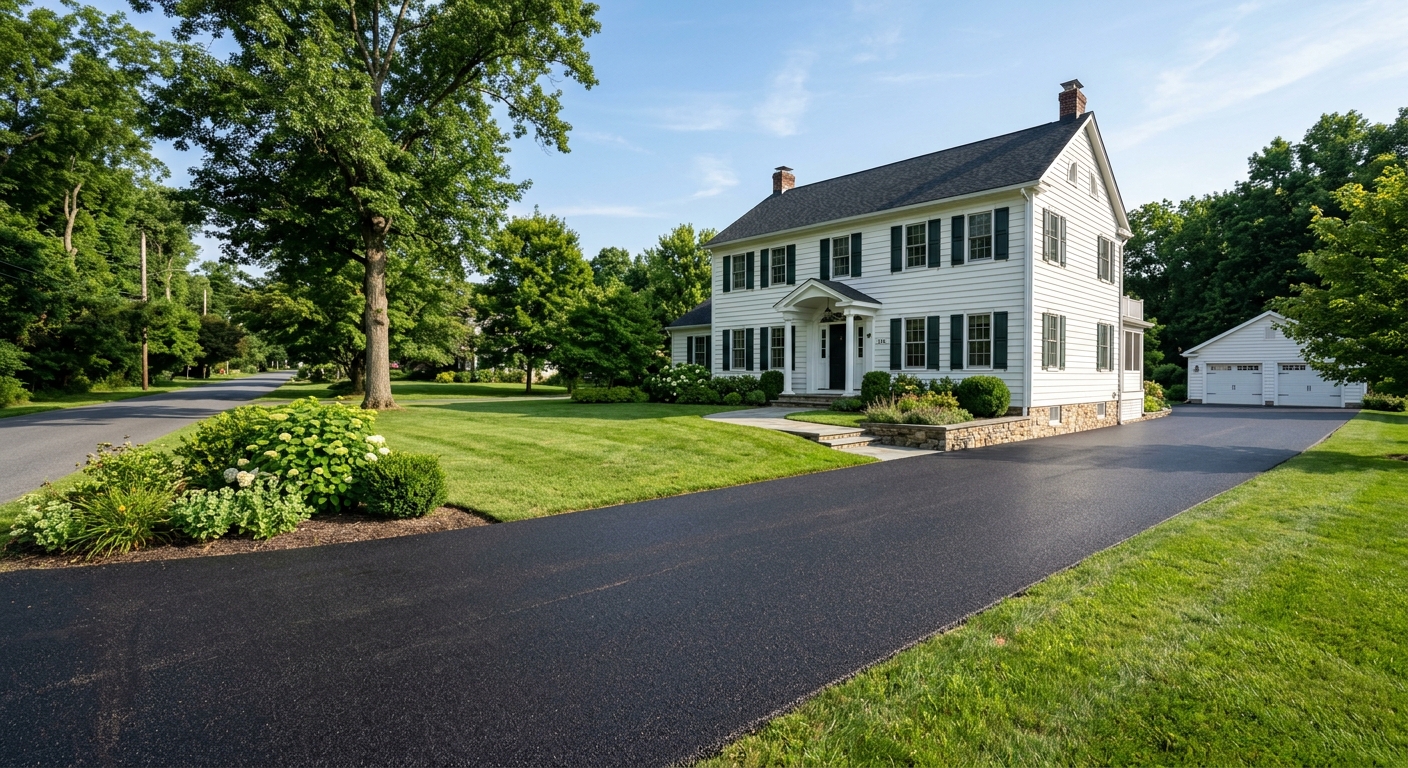
Vernon paving prices by scope — 2026
In Vernon, where 71.6% of homes are single-family and the homeownership rate stands at 82.0% (U.S. Census Bureau, ACS 2024), driveway paving is a homeowner expense that’s both visible and, most of the time, not negotiable. Replacement and resurfacing play out differently here than in many places, thanks to our freeze-thaw cycle and deep frost line. Glacial till soils and a high water table near Meadville mean drainage and base preparation drive what you really pay, not just the material you see on the surface.
The truth is, most of the price difference between two Vernon paving quotes is hidden—literally underground. Digging out a failed base versus putting a thin overlay over a bad one can swing the cost by thousands, even when two jobs look nearly identical when the trucks pull off. Prices vary, but if one quote is much lower than others, nine times out of ten it’s because the preparation you can’t see won’t hold up past a few winters.
| Service |
Best for |
Lifespan |
Price range |
| Asphalt — full replacement with new base |
failed base, structural cracking |
20–30 yrs |
$3,400–$8,800 |
| Asphalt overlay / resurfacing |
sound base, surface cracking only |
8–15 yrs |
$1,450–$4,400 |
| Sealcoating — single application |
preventive maintenance on sound asphalt |
2–4 yrs |
$200–$700 |
| Concrete — new installation |
long service life, low maintenance |
30–50 yrs |
$4,900–$11,500 |
| Crack filling and patching |
isolated cracks under a quarter inch |
1–3 yrs |
$200–$800 |
| Gravel driveway |
rural, budget, long runs |
5–10 yrs with upkeep |
$900–$3,500 |
Estimates for a typical Vernon driveway. Square footage and base condition drive these figures more than material choice.
Driveway permits, approaches and stormwater rules
In much of rural Crawford County, including large areas of Vernon Township, repaving your driveway in its existing footprint usually does not require a municipal permit if you're not changing its connection to the road. However, your approach—the section of driveway that meets a public road—most often does require a permit, but not from the code office most homeowners expect. For example, if your drive connects to State Route 19 or 27, the authority is PennDOT District 1-0, not the township or county. For any work on the apron in Meadville, permits are managed by city codes.
Anytime you expand your driveway’s surface area, you increase impervious coverage. That can trigger local runoff or stormwater requirements, and it may affect your tax bill. Even if there’s no permit needed, Pennsylvania law holds you responsible for stormwater leaving your property—diverting runoff to a neighbor or public right-of-way can turn into a civil matter regardless of paperwork.
By state law, any contract over $500 for paving must be in writing (Home Improvement Consumer Protection Act) and you have a three business-day right to cancel. Always verify contractors have Home Improvement Contractor (HIC) registration through the Pennsylvania Attorney General’s directory at hic.attorneygeneral.gov. For crews with employees, workers’ compensation coverage is mandatory and can be confirmed using the WCAIS system (wcais.pa.gov).
What's under the asphalt matters more than the asphalt
A long-lasting Vernon driveway is all about what you never see after the paving truck leaves: the layers under the asphalt. The assembly goes like this—first the subgrade (natural soil), then a compacted aggregate base, and, finally, the surface asphalt. Each layer spreads and drains loads to the layer beneath. If the base is too thin, weak, or poorly compacted, even the thickest, nicest asphalt will soon crack or settle.
Here, with glacial till soil and a high seasonal water table, the risk isn’t just soft spots. It’s frost heave. Water in the subgrade freezes with our deep (36-inch) frost line, expands, and lifts sections of the driveway, sometimes unevenly. The resulting cracks and dips aren’t surface problems—they start below, and no amount of patching on top will solve them.
This is where a bargain quote cuts corners. Skipping excavation, laying asphalt over an old, cracked base, or using short, shallow lifts of base gravel are classic shortcuts. Often, no compaction testing is done between layers, so the finished result looks great but fails in year three—after the crew is long gone. Most base failures we fix are rooted in this invisible part of the work.
What should you demand in writing? For here: 6–8 inches of compacted aggregate base (crushed limestone is common), installed and compacted in 2-inch lifts. The contract should state base thickness, aggregate type, and that compaction will be done in layers before paving. This is even more vital near Meadville, where the water table and winters punish shortcuts fast.
Why you can't pave in February
In Vernon and greater Crawford County, paving isn’t something you can opt to do in winter—our climate simply locks out the work. Hot-mix asphalt only compacts correctly above a set temperature, and in our region, winter design temps can hit 5 °F and ground frost runs 36 inches deep. Try laying asphalt cold and you’ll get a porous, short-lived driveway; the mix cools too fast and never bonds properly.
This isn’t just a contractor excuse: the asphalt plants themselves shut down for the winter. No fresh material means no job gets done, period. Concrete isn’t immune either; it should not be placed below freezing, or the curing and strength are badly compromised. With Lake Erie–effect snows and long freeze periods, paving season here starts as the ground thaws (late April or May), peaks in summer, and winds down by October or early November.
In practice, shoulder seasons are best for scheduling—contractors have room, and prices may be sharper. Summer is the rush. If a crew offers to pave in late November or really any time snow is a risk, consider that a clear signal about their standards and what you’ll be left with. The right contractor will be straight about the calendar.
The driveway scams that work in Vernon
Paving scams are sadly a fixture in rural counties with scattered homes like Crawford, where neighbors are far apart and it’s a long drive to track down a bad operator. You’ll see the classic pitches: “leftover material from a job up the road,” “we’re only in town today,” unmarked pickups with out-of-state plates, cash-up-front demands, and quick verbal quotes with vague promises. Some just spray a thin layer of oil or watered-down sealant, calling it “sealcoating,” and leave before it dries.
Why does this work here? Because base failures—the thing that kills a new driveway—may not show up until two or three freeze-thaw cycles have passed. By then, the crew is long gone. A thin rural market also means fewer people sharing bad experiences, and less municipal oversight outside towns like Meadville.
Pennsylvania’s Home Improvement Consumer Protection Act is there for this reason: if your paving job costs over $500, you’re entitled to a written contract and a three business-day right to cancel. Don’t ever waive your right, and never let a contractor suggest you “save the deductible.” They’re not allowed, and it’s a warning sign.
You can defeat most scams with five minutes: verify HIC registration at hic.attorneygeneral.gov; check workers’ comp at wcais.pa.gov if anyone but the owner is working; never pay in full before the job is done; and always insist on a written contract. These simple steps block nearly every bad operator.
Caring for a new Vernon driveway
A new driveway in Vernon will last, if you do a few things right. Number one: fill cracks as soon as you see them—especially before a freeze-thaw cycle drives water down to the base. This low-cost fix can buy you years, with crack filling running $200–$800. Keep the edges of your drive supported; edge crumbling is a first sign of shoulder erosion and leads to faster breakup. Make sure water runs off and away—not just from the surface, but down the sides, too. Ponding means your base won’t last long.
Don’t park heavy point loads (like jack stands or dumpsters) on any new asphalt; they’ll create dents that don’t recover. On brand-new driveways, wait at least three days before parking, and avoid turning your wheels while stationary for the first month—especially in summer heat when asphalt is softest.
De-icing is a special issue here. For concrete, avoid salt; it reacts with the surface and can speed spalling and flaking. Use sand for traction or calcium chloride, which is less aggressive—but more expensive. On asphalt, the bigger concern is freeze-thaw cycling from constant melting and refreezing: use sand, or apply just enough salt to break the bond without overdoing it. Our Lake Erie snow means you’ll use a lot no matter what, so choose your treatment carefully.
Overlay, patch or full replacement?
How do you tell if you need a patch, an overlay, or a new driveway altogether? You don’t have to guess or rely only on a contractor’s advice—there are clues you can check yourself. If you see alligator cracking (many small, connected cracks) across a wide area, your base has failed and needs excavation, not just new asphalt on top. Isolated, straight cracks are often just age, and those can be sealed. Birdbaths or depressions holding water point to subgrade movement—if the soil shifted, the surface above won’t last until you rebuild that spot. Edge crumbling is a sign the shoulder isn’t supported. Potholes show water already made it to the base, so a patch may buy time, but the root trouble may be deeper.
Overlaying sound, level base with surface cracks is cost-effective. But putting a new layer over a failed or shifting base is just burning money—the cracks will be back in a couple of freeze-thaw cycles. If a contractor is quoting an overlay without probing the base (sometimes with a core sample or test pit), they’re not looking at your actual problem.
| What you see |
Likely cause |
Right fix |
Cost |
| Isolated cracks under 1/4 inch |
surface aging |
crack fill and seal |
$200–$700 |
| Alligator cracking over a wide area |
base failure |
full replacement |
$3,400–$8,800 |
| Depressions holding water |
subgrade movement |
excavate and rebuild that area |
$3,400–$5,400 |
| Crumbling edges |
no edge support |
edge repair, consider curbing |
$400–$1,500 |
| Potholes |
water into the base |
full-depth patch, then assess |
$250–$900 |
| Faded but sound surface |
oxidation only |
sealcoat |
$200–$700 |
Frequently asked questions — driveway paving in Vernon
How much does driveway paving cost in Vernon?
In Vernon and the rest of Crawford County, the cost to pave a driveway swings mainly on the condition of your base and the size of the job, not just the surface material. Asphalt full replacement, including excavation to address our glacial till soils and drainage, typically runs $3,400–$8,800 for an average-size drive in 2026. Asphalt overlay, for cases when the base is sound but the surface is worn, costs less: $1,450–$4,400. Concrete, priced for longevity, ranges from $4,900–$11,500. Small patch or crack repairs start at $200–$800. Keep in mind the bulk of Vernon homes are older single-family properties with driveways that may need more than just new surface. Always ask what is (and is not) included in your quote.
How thick should asphalt be for a residential driveway in Vernon?
For our Lake Erie snow-belt winters and freeze-thaw cycles, thickness is not optional—it’s critical. In Vernon, a new residential asphalt driveway should have at least 6–8 inches of compacted aggregate base (like crushed limestone), followed by 2.5–3 inches of finished hot-mix asphalt, laid and compacted in two lifts. Less than that, and your driveway will start to heave, crack, or rut after a few winters. Cheap quotes often skimp here, especially on base preparation, and while that can drop your price below $3,400, it always cuts years off the life of your investment. Always get base depth and asphalt thickness in writing before work starts.
What causes concrete to spall or flake in Vernon?
Concrete spalling—when the surface flakes or peels away—is common on older drives in Vernon, especially those poured before modern air entrainment was standard. In our area, the main culprit is freeze-thaw cycling: water seeps into the top layer, then expands as it freezes, popping off flakes. De-icing salt and poor drainage make it worse, and the Lake Erie snowbelt delivers plenty of the freeze-thaw swings that drive this problem. Salt-based ice melt used over winter years can accelerate spalling. Concrete installation here costs $4,900–$11,500—protect it by sealing and using sand for traction rather than salt, and by sloping your drive for drainage from the start.
How much does it cost to widen a driveway?
Widening your driveway in Vernon can range widely in price depending on whether you’re just adding gravel, resurfacing asphalt, or matching a concrete apron. For asphalt, adding a few feet along the edge and tying it in correctly with a compaction-tested base generally costs $1,450–$4,400 for a modest extension but can rise into the full replacement range ($3,400–$8,800) if substantial grading or subgrade correction is needed. Concrete widening is on the higher end, at $4,900–$11,500, as it requires saw-cutting and sometimes doweling into existing slabs. In Meadville, if your apron ties into a city street, you’ll need a permit for the widened approach.
How do I verify a paving contractor in Pennsylvania?
In Pennsylvania, and especially in rural spots like Vernon where travelers and out-of-county crews are frequent, you should always verify two things: Home Improvement Contractor (HIC) registration and workers’ compensation coverage. HIC registration is state-required for any contract over $500 and can be checked online at hic.attorneygeneral.gov. It’s not just paperwork—it means the contractor is legally allowed to work and subject to consumer protection rules, including a written contract and cancellation rights. For any crew with employees, their workers’ compensation status must be current (check at wcais.pa.gov). Never hire a paving crew, even for a smaller patch job ($200–$800), without running these checks—it’s free, quick, and deters most scammers.
Are door-to-door pavers a problem in Vernon?
Yes, they are, and they target areas like Vernon where driveways are visible from the road, people are spread out, and it’s easier to move on before defects show up. These operators often roll in with unmarked or out-of-state trucks, claim to have leftover asphalt from a big local job, and pressure you for a cash-only, one-day deal. They rarely provide a written contract—which Pennsylvania law requires for jobs over $500—and disappear before problems appear. If you ever feel rushed or are told “we won’t be back this way,” that’s a red flag. Use your three-day cancellation right, check HIC registration, and ask for written proof that matches their vehicle and name. It’s the best defense against these pitches.
Does sealcoating fix cracks?
Sealcoating is often sold as a magic cure, but in Vernon, it’s purely preventive—not a repair in itself. Proper sealcoating extends the life of intact asphalt, slows oxidation, and adds a layer of UV and water resistance, but it won’t fill or stop even minor cracks. Those need to be cleaned, widened if necessary, and filled with hot-applied crack filler first. For a sound surface, sealcoating done every few years (costing $200–$700) is money well spent. But if you have visible cracks, water will keep getting in unless they are sealed separately—don’t let anyone sell a thin spray as a fix for real cracks or base issues.
Asphalt or concrete for a Vernon driveway?
The right choice depends on your priorities—cost to install, ease of repair, and long-term durability. In Vernon, asphalt is more common and less expensive for most homes: installation runs $3,400–$8,800 and repairs are straightforward. It tolerates frost heave better and can be patched or overlaid when needed. Concrete costs more up front ($4,900–$11,500), but offers a longer lifespan, lower maintenance, and holds its grade better in the long run. Our aggressive freeze-thaw climate means both materials need a solid base and good drainage; salt use can shorten the life of concrete, while asphalt benefits from regular sealing. Match your budget and expectations—either can work with proper prep.
When is the best time of year to pave in Vernon?
In Vernon, the paving season is dictated by climate, not by crew preference. Asphalt plants simply aren’t open in the winter, and both asphalt and concrete need above-freezing ground and air temps to set and cure properly. The sweet spot is late spring through early fall—roughly mid-May to October. Scheduling in shoulder seasons (late spring or early fall) can sometimes save a bit, as crews are more available before the summer backlog swells. If a contractor suggests paving in November or pushing into colder spells, be very cautious—it’s often a shortcut that leads to early failure. For reference, a new asphalt drive in this window will cost $3,400–$8,800, but it’s money wasted if laid out of season.