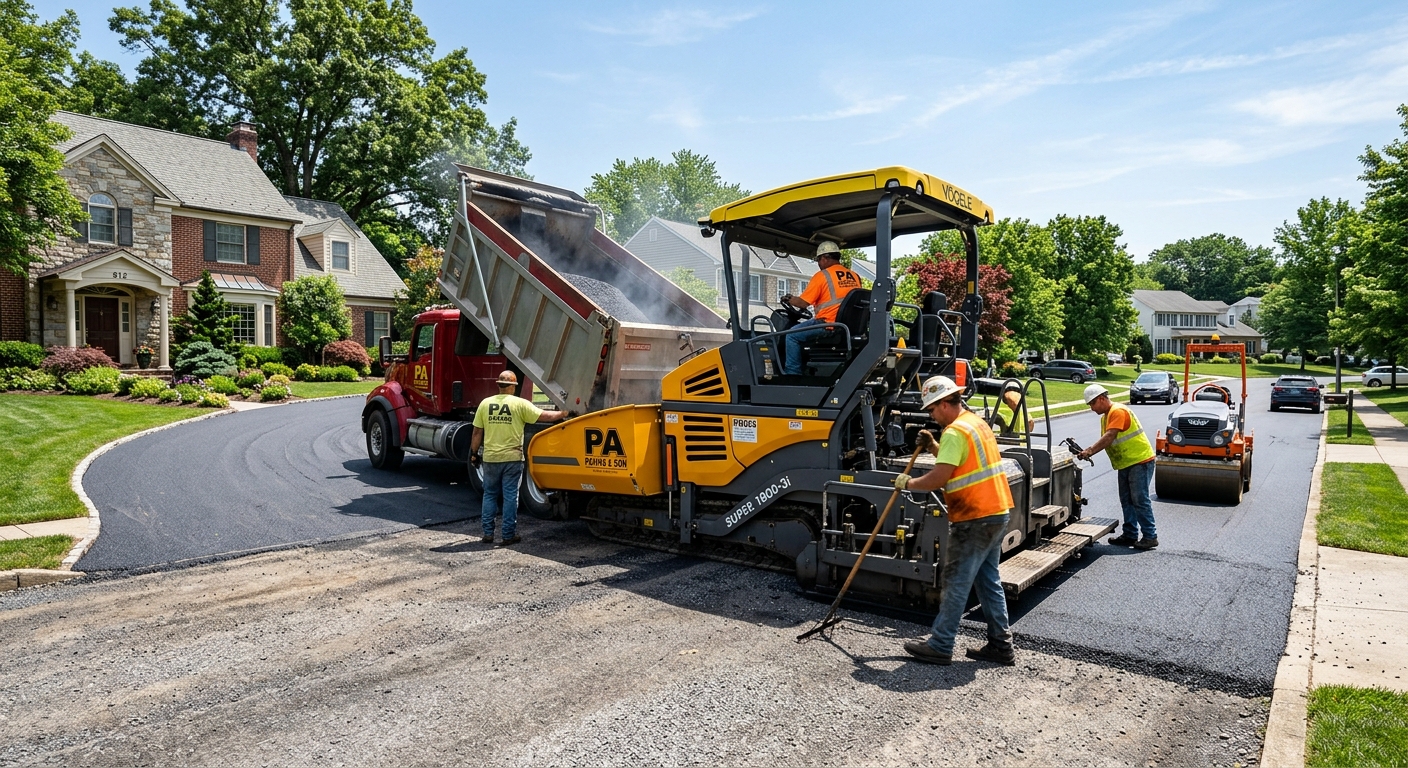
Driveway paving costs in Summit — 2026
Summit Township sees driveway needs typical of Erie County’s spacious, owner-occupied homes: 71.2% of houses here are single-family, and homeownership rates push 81.1% (U.S. Census Bureau, ACS 2024). Most driveways are private expense, not landlord concern, so it pays to get the right job done up front. Paving here is shaped by more than just square footage: the local freeze-thaw swings, lake-effect snowfall, and Summit’s glacial till and clay soils mean subgrade preparation is a bigger factor than material. These conditions drive up the need for thicker, well-compacted bases to survive frost heave. The choice between asphalt and concrete does matter, but most of the price between two quotes is buried under the surface — in excavation depth, stone base thickness, and drainage. You can’t see these after paving, but they decide whether you’re calling for repairs in five years or enjoying a stable driveway for decades.
| Service |
Best for |
Lifespan |
Price range |
| Asphalt — full replacement with new base |
failed base, structural cracking |
20–30 yrs |
$3,400–$8,700 |
| Asphalt overlay / resurfacing |
sound base, surface cracking only |
8–15 yrs |
$1,450–$4,300 |
| Sealcoating — single application |
preventive maintenance on sound asphalt |
2–4 yrs |
$200–$650 |
| Concrete — new installation |
long service life, low maintenance |
30–50 yrs |
$4,800–$11,500 |
| Crack filling and patching |
isolated cracks under a quarter inch |
1–3 yrs |
$200–$800 |
| Gravel driveway |
rural, budget, long runs |
5–10 yrs with upkeep |
$900–$3,500 |
Estimates for a typical Summit driveway. Square footage and base condition drive these figures more than material choice.
Why driveways behave differently in Summit
Summit’s underfoot is mostly glacial till and lakeplain clays — soils notorious for holding water and swelling when frozen. This isn’t a problem you’ll find in sandy or rocky counties nearby. In Erie County’s climate, with its deep 36-inch frost line and 45-pound ground snow load, clay bases buckle and heave with the freeze-thaw swings, cracking driveway slabs from below. That’s why any long-lasting Summit driveway, especially one built before modern standards (when most of the area’s stock was built between 1940 and 1970), will almost always need extra base depth or added drainage now. Older, narrow driveways here commonly rest on a thin or even non-existent stone base, which just doesn’t cut it against winter here. If your driveway is original or looks like it’s been patched for decades, assume the base is shallow or poorly compacted. That means your next paving job will likely need full excavation and improvement, not just a surface fix — an approach that’s overkill for sandy soils, but absolutely needed in glacial clay. Ignoring this means the freeze will destroy your new driveway just as quickly as it did the last one.
Diagnosing a failing Summit driveway
Before calling contractors, take five minutes and really look at your Summit driveway. What you see on the surface can tell you most of what you need to know. If you spot widespread “alligator cracking” — those interconnected cracks looking like reptile skin — across a large area, it’s the sign of base failure. Repairing the surface won't last, because the problem is underneath. On the other hand, isolated, straight cracks a quarter inch or less wide point to surface aging and can be filled and sealed economically. Depressions, “birdbaths,” and puddling after rain mean the stone base or subgrade has shifted or settled. Edge crumbling nearly always means there was little to no edge support — very common in the original, narrow driveways from the 1940s–1970s that run through Summit. Potholes indicate water’s already penetrated below and started undermining the structure. Never accept an overlay over a driveway with these deeper issues; it will fail quickly, and any contractor recommending one without physically probing the base is cutting corners you’ll pay for twice. Below is a quick diagnosis guide for common driveway problems and the solutions that actually work here.
| What you see |
Likely cause |
Right fix |
Cost |
| Isolated cracks under 1/4 inch |
surface aging |
crack fill and seal |
$200–$650 |
| Alligator cracking over a wide area |
base failure |
full replacement |
$3,400–$8,700 |
| Depressions holding water |
subgrade movement |
excavate and rebuild that area |
$3,400–$5,300 |
| Crumbling edges |
no edge support |
edge repair, consider curbing |
$400–$1,500 |
| Potholes |
water into the base |
full-depth patch, then assess |
$250–$900 |
| Faded but sound surface |
oxidation only |
sealcoat |
$200–$650 |
Why Summit driveways fail from the bottom up
The biggest reason a Summit driveway doesn’t last? It’s almost always about what’s underneath — not what you see on paving day. Every driveway has layers: the undisturbed soil (subgrade), a compacted stone (aggregate) base, and only then the asphalt or concrete. The base takes the brunt of weight and frost, distributing load evenly. Our local glacial till and lakeplain clay hold water far more than sand or gravel. When winter hits and water in that clay freezes, it expands and pushes upward — this “frost heave” is why Summit’s 36-inch frost depth is code, and why a thin or poorly compacted base cracks and tears the surface above, no matter how thick the asphalt goes down.
A cheap quote in Summit usually means one thing: less base, or worse, skipping the excavation entirely. Unscrupulous crews may lay new asphalt over a weak or failed base, scrimp on expensive #57 or 2A aggregate in favor of whatever’s cheapest, pile it thick in one pass instead of compacting in 3–4 inch “lifts,” or forgo proof-rolling to check compaction. None of these are visible when they drive away, but you’ll know the results by the third winter when ruts, cracks, and birdbaths appear.
Insist on seeing these specifics in your contract: at least 6–8 inches of compacted aggregate base for clay/till soils, using locally sourced 2A modified stone or similar; asphalt placed at a true 2–3 inches compacted; and written proof the base was compacted in lifts. If they can’t give you those details, find someone who will. The money you save upfront gets paid out in patching down the line.
Caring for a new Summit driveway
Extending the life of your new Summit driveway is mostly about keeping water and freeze cycles away from the base. First and foremost, fill cracks right away, every season — letting water in means frost will open them wider each winter. Keep driveway edges supported with compacted soil or stone to prevent crumbling and edge failure, especially important in the deep-snow Lake Erie zone. Make sure water can run off — clean swales, ditches, and drains so water doesn’t pool or seep under the driveway. Avoid parking heavy vehicles, dumpsters, or using jack stands that concentrate weight, which can dent even concrete over time.
For new asphalt, don’t drive on it for at least 3–7 days, and avoid turning the wheels while stationary for several weeks. Curing matters in our region’s 5°F winter temps and high summer humidity.
With de-icing: salt can pit and weaken concrete, and in asphalt the worry is not melting but re-freeze — water from melted snow can seep and then freeze again, causing cracks. Alternatives like calcium magnesium acetate or sand are less damaging but cost more and may require special ordering.
The freeze-thaw cycles in Summit (thanks to the snow belt) mean these habits pay off in extra lifespan, not just appearances.
What you need before paving in Summit
If you’re repaving or resurfacing your driveway in Summit on your existing footprint, you usually don’t need a building permit just for the paving itself. But pay attention to the approach — where your driveway connects to the public street. In Erie County, PennDOT District 1 controls permits for driveways joining state highways, while local townships like Summit issue permits for curb cuts and approaches on their own roads. This surprises many homeowners, so check for your specific street — and know that skipping this step can mean costly rip-outs later.
If your project widens the driveway or increases paved area, municipal stormwater rules may kick in: you can be responsible for runoff from new impervious surface. Directing water onto a neighbor’s property brings liability, regardless of permits, so plan drainage properly.
Always check that your contractor is registered for projects over $500 as required by Pennsylvania’s Home Improvement Contractor registry (verify at hic.attorneygeneral.gov) and that every employee on site is covered by workers’ compensation, as required by state law (you can check at WCAIS, wcais.pa.gov). Demand written proof — lack of coverage can put you at enormous risk if there’s an injury.
How often should a Summit driveway be sealed?
Sealcoating gets a lot of press, but it isn’t magic for your Summit driveway. It protects asphalt from the sun’s UV rays (which harden and crack the binder) and from spilled oil or fuel — and it definitely improves surface appearance. But here’s what matters: it doesn’t add strength, fill more than hairline cracks, or do anything for a driveway whose base is failing under the surface. You wouldn’t call sealcoating a structural repair, because it isn’t one.
Even in Summit’s tough winters, sealcoating every year is overkill. In fact, applying it too soon or too often actually hurts the surface — trapped layers can peel away, and sealing fresh asphalt before it finishes curing (generally wait at least 90 days, better six months, in Erie County’s climate) will bubble and break it down. A realistic interval for most driveways in Summit is every 2–4 years. Anything advertised more often is either a spray-on “black water” job that will be gone with the first season or an attempt to lock you into unnecessary services.
Crack filling does more for longevity than sealcoating alone — water always does the real damage. Make sure any sealcoating contractor is actually cleaning and prepping the surface, not just giving a quick spray. The right application at $200–$650 for a typical driveway pays off; that sub-$150 bid often means watered-down material or no base prep at all. Save your money for what matters.
Frequently asked questions — driveway paving in Summit
What does an asphalt overlay cost in Summit?
An asphalt overlay in Summit, where your existing driveway’s base is still solid but the surface is deteriorated, typically runs between $1,450–$4,300. Most homes in Summit are single-family, and the price covers prep, minor crack sealing, and a new asphalt layer. The range is due to square footage (most Summit driveways are longer than urban ones), plus any leveling needed for birdbaths or minor settling. If your driveway is more than simple surface cracks — meaning there are deep depressions, lots of alligator cracking, or serious potholes — these cost estimates no longer apply and you’ll need a full excavation. Always insist the contractor checks the base before quoting; overlays over a bad base waste every penny.
Why does my driveway have depressions that hold water?
In Summit, driveways often develop depressions or “birdbaths” because of subgrade movement — a direct issue with our glacial till and lakeplain clay soils. These clays expand when wet, then shrink or settle over time, especially with the 36-inch frost depth we experience every winter. If your driveway is older or shows this kind of settling, it likely wasn’t built with enough compacted aggregate or the subgrade wasn’t prepared right. Just patching the low spots offers a quick fix but rarely lasts. Fixing it properly means excavating down to stable soil, installing proper stone, compacting in layers, and repaving. Expect costs in the range of $3,400–$5,300 for this type of sectional rebuild in Summit.
Do I need a permit to repave a driveway in Summit?
Usually, you don’t need a building permit to repave or resurface an existing Summit driveway if you aren’t changing its footprint. But if your driveway connects to a state road, you’ll need a permit from PennDOT District 1 (not your local township). For local township roads, check with Summit Township for curb cut or approach permits, especially if you’re replacing or widening the entrance. Any project that adds new paved area can bring stormwater rules into effect, so you’ll need to confirm drainage plans. No matter what, jobs over $500 must be in writing per Pennsylvania law, and your chosen contractor should be registered and carry workers' compensation — you can verify this online for Summit jobs.
How thick should asphalt be for a residential driveway in Summit?
For Summit’s freeze-thaw zone and glacial clay soils, thickness matters. A proper residential asphalt driveway here should have a minimum of 6–8 inches of compacted aggregate base, followed by 2–3 inches of asphalt (once rolled and compacted). That’s stricter than in parts of Pennsylvania with lighter soils or less winter stress, but it’s absolutely necessary in Summit; skipping base thickness is the most common reason new driveways fail in just a few years. If a contractor quotes only for surface thickness or ignores the stone base, beware — you could spend $3,400–$8,700 on a project that doesn’t outlast the warranty.
Is an overlay worth it or should I start over?
Whether an overlay is worth it in Summit depends entirely on what’s under the asphalt. If your base is sound — no large areas of alligator cracking, no extensive depressions or edge failures — an overlay can buy you another 8–15 years for $1,450–$4,300. If the base has already failed, overlays won’t last: you’ll be patching and sealing constantly, and the overlay may crack within a couple of winters due to frost heave. Given Summit’s high freeze-thaw cycles, paying for a true replacement with a rebuilt base is the better investment for long-term peace of mind.
Can asphalt be laid in cold weather?
In Summit, paving season generally runs mid-spring through early fall. Laying asphalt in cold weather is risky: below 50°F, the mix cools too fast, which means it won’t compact properly and can ravel, crack, or delaminate early. Scheduling a big project too late in the year may tempt a crew to rush. That said, small patching jobs can be done with cold mix at lower temps, but they aren’t meant as long-term fixes. For a full driveway replacement at $3,400–$8,700, wait for proper temperatures — if a contractor offers to pave during a Summit cold snap, it isn’t your driveway that will last.
How many freeze-thaw cycles does Summit get?
Summit, sitting in Erie County’s lake-effect snow belt, sees dozens of freeze-thaw cycles each year. Our winters swing hard, and thaws often happen even in midwinter, then refreeze sharply at night. This relentless cycling is destructive for driveways, especially those on clay soils; it’s why base preparation and drainage get so much attention locally — more so than in central or eastern Pennsylvania. Homeowners here see earlier and deeper cracks if small maintenance jobs are skipped. Investing in a quality base or regular crack sealing (usually $200–$650 every couple of years) is a direct hedge against our climate.
Why are paving quotes in Summit so different from each other?
Wide price differences almost always trace to what’s below the surface. Summit’s glacial till and clay, plus deep frost, requires base depths and prep some out-of-town contractors ignore. If one quote is much lower, it often means less excavation, thinner or cheaper stone, rushed compaction, or no edge support. You might save upfront but risk replacing the whole thing sooner. Always compare contracts line by line: did they specify 6–8 inches of compacted aggregate? Will they provide written compaction results? Cheap surface jobs can look great for 18 months, then buckle in Summit’s third winter. Pay the extra for work that includes base rebuilding — it costs more ($3,400–$8,700) but actually lasts.
Is sealcoating a scam?
Proper sealcoating in Summit is real maintenance: it helps block UV and minor chemical spills, and keeps driveways looking fresh. But it isn’t required every year and does nothing for structural defects or failing bases — don’t believe any pitch that says otherwise. The real scams are ultra-cheap “spray and drive” jobs or insisting on annual sealing, which can actually damage the surface over time. Your money is better spent on timely crack filling and ensuring good drainage. Occasional, quality sealcoating (every 2–4 years, at $200–$650) is wise, but if someone knocks on your door offering to seal for a “today only” price, step back — in Summit, over-sealing and poor prep are the biggest ways to burn your budget.