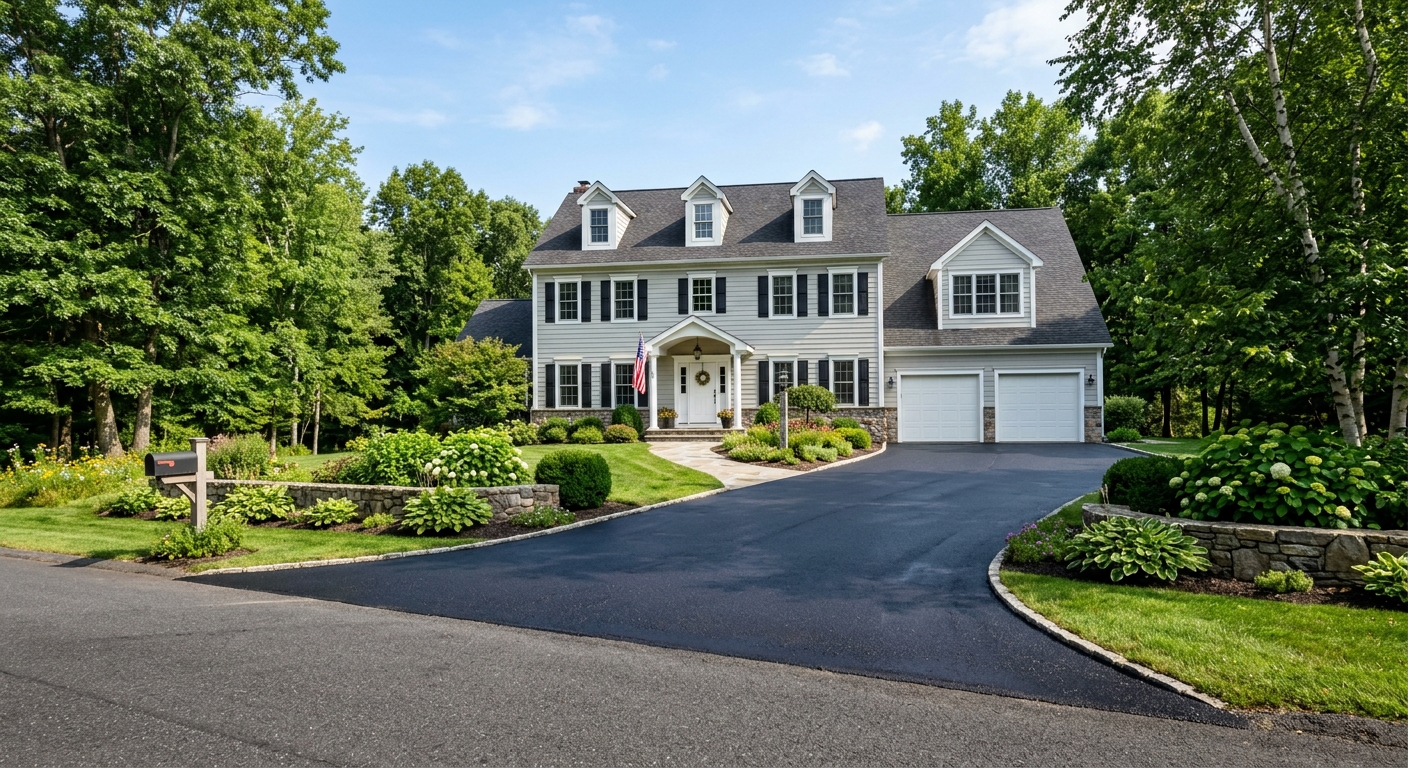
What a new driveway costs in Cumru
In Cumru Township, where over 72.1% of homes are owner-occupied and 63.1% are single-family (U.S. Census Bureau, ACS 2024), driveways are a common and visible expense for most property owners. Many of these homes were built before 1980 and now have aging asphalt surfaces suffering from Berks County’s pronounced freeze-thaw cycles. This repeated expansion and contraction puts most of the wear—and risk of failure—below the surface, in the parts you can’t see. That’s the main reason why two estimates for the “same” driveway often differ by thousands of dollars: it comes down to excavation, base preparation, aggregate thickness, and how well the subgrade is handled. The surface material is only part of the story.
Berks County driveways frequently sit over shale or limestone, which demand a thicker aggregate base than elsewhere to avoid settling and cracking. Whether you’re patching minor cracks or going for a full-depth replacement, the real cost and longevity depends on what goes into the ground—literally. The table below gives realistic cost ranges for Cumru driveways, based on base condition and intended lifespan. Your quote will vary with square footage and how much of the underlying base needs rebuilding.
| Service |
Best for |
Lifespan |
Price range |
| Asphalt — full replacement with new base |
failed base, structural cracking |
20–30 yrs |
$3,600–$9,300 |
| Asphalt overlay / resurfacing |
sound base, surface cracking only |
8–15 yrs |
$1,550–$4,700 |
| Sealcoating — single application |
preventive maintenance on sound asphalt |
2–4 yrs |
$200–$700 |
| Concrete — new installation |
long service life, low maintenance |
30–50 yrs |
$5,200–$12,500 |
| Crack filling and patching |
isolated cracks under a quarter inch |
1–3 yrs |
$200–$800 |
| Gravel driveway |
rural, budget, long runs |
5–10 yrs with upkeep |
$900–$3,500 |
Estimates for a typical Cumru driveway. Square footage and base condition drive these figures more than material choice.
Asphalt or concrete for a Cumru driveway?
With south-central Pennsylvania’s pronounced freeze-thaw cycling and moderate winters, the choice between asphalt and concrete isn’t just about price—it’s about how the material handles those conditions. Asphalt is more flexible: as the ground swells and shrinks with each freeze and thaw (which happens dozens of times a season here), asphalt bends and springs back, while concrete is rigid and can crack or spall. Berks County roads and driveways are frequently doused with salt, and de-icing salt is hard on concrete. Even the best concrete surface here is vulnerable to scaling: the top layer breaks up, especially heading into its second or third decade.
To truly get 30–50 years from a concrete driveway in Cumru, you must avoid using salt-based de-icers—an expectation most homeowners simply don’t fulfill by the third or fourth icy winter. Concrete costs more up front, but demands ongoing care most people choose not to do. Asphalt is lower cost and stands up better under this county’s winter routine. For older homes (over 61% built before 1980), replacing a worn asphalt drive is often a better long-term bet.
Pavers split the difference: they cost as much as or more than concrete, but individual units can be replaced as needed. Gravel remains a functional option for rural properties or longer runs, though maintenance is required to maintain drivability.
| Option |
Installed cost |
Maintenance |
Freeze-thaw performance |
Lifespan |
| Asphalt — new install |
$3,600–$9,300 |
sealcoat every 3–4 yrs |
excellent, flexes |
20–30 yrs |
| Asphalt — overlay |
$1,550–$4,700 |
same |
good if base is sound |
+8–15 yrs |
| Concrete |
$5,200–$12,500 |
low, avoid de-icing salt |
fair, spalls with salt |
30–50 yrs |
| Pavers |
$8,300–$12,500 |
individual units replaceable |
good, settles gradually |
25–50 yrs |
| Gravel |
$900–$3,500 |
top-dress every 2–3 yrs |
excellent drainage |
indefinite with upkeep |
Why you can't pave in February
In Cumru and throughout Berks County, paving is governed by Pennsylvania’s climate realities—not just contractor preference. Hot-mix asphalt must be placed and compacted at temperatures above 50°F; any colder, and it cools too quickly to achieve the density needed and ends up porous or brittle. Once local asphalt plants close (typically late November to early April), the product simply isn’t available until spring. Even for concrete work, extended periods below freezing—like the 12 °F winter design temperature for this area—risk a driveway that doesn’t cure properly, reducing strength and lifespan.
Heavy freeze-thaw cycling, paired with 30 inches of frost depth, means a winter-time pour or paving attempt will likely fail before its time. If a paving crew is offering to install your driveway in late November, December or, worse, February, they’re either cutting corners or planning to use cold-patch (a temporary product unsuitable for driveways).
For homeowners, the reliable paving season in Cumru is late April through October. Shoulder season (late spring and early fall) can yield better prices and crew availability—most high-demand summer slots are claimed early, especially as more subdivision driveways hit 40+ years and need replacement. Waiting for proper conditions is always the better investment here.
What you need before paving in Cumru
For most residential driveways in Cumru, you won’t need a building permit just to resurface your existing asphalt. In Berks County townships, simple resurfacing—provided you don’t expand or change the driveway’s footprint—commonly proceeds without any permit or inspection at all. That’s a relief for most homeowners looking to repair worn surfaces, but there’s one catch: where your driveway meets the public road, different rules apply.
If you alter or rebuild the driveway approach (the “apron”) to a state-owned road, you must obtain a Highway Occupancy permit from PennDOT. For driveways meeting local township roads, the permit is handled by the local township office. Any work that increases the impervious area over 5,000 square feet or disturbs one acre of earth—especially expansions—will likely require stormwater review and could trigger additional runoff controls in certain areas. It’s your responsibility to ensure expanded runoff doesn’t impact neighboring lots, regardless of permits.
Always verify your contractor’s Home Improvement Contractor (HIC) registration at hic.attorneygeneral.gov—required on all Pennsylvania residential paving contracts over $500—and confirm their workers' compensation compliance at WCAIS. These are state-level protections for the homeowner.
Drainage: the failure nobody plans for
Water is behind nearly every costly driveway failure in Cumru. Proper grading is essential—more so than the material you use. Without enough slope, water will pool, seep into the base, freeze, and heave the pavement. This is the main local cause of premature cracks, sags, and potholes, especially given Berks County’s repeated freeze-thaw cycling and 30-inch frost depth.
A driveway needs a minimum slope of about 2% (a quarter inch per foot) to shed water properly. For long, flat runs, a gentle crown at the center can direct water to either edge—while some setups deliberately cross-slope toward a swale or drain. The worst scenario is a driveway sloping toward your garage or basement; this almost guarantees water intrusion. Where the grade can’t be raised, trench drains or linear channel drains—a narrow grate stretching across the drive—can intercept water and move it safely away. The best setups “daylight” runoff directly, but in tight lots, dry wells may be needed to avoid surface discharge.
It’s essential to keep your runoff on your own property. Redirecting water onto your neighbor’s land is a liability risk, no matter what your permit says. Setting drainage and base right at installation is not a place to save pennies—you only see the cost years later when the surface fails early.
Changing the footprint of a Cumru driveway
Changes beyond a straight replacement—widening for extra parking, extending to a detached garage, swapping gravel for asphalt, or adding a concrete pad—are common projects in Cumru’s older subdivisions. But any time you change the driveway’s footprint, you’re starting with undisturbed ground, not a compacted base. That means excavation is deeper, more aggregate is required, and the new section’s joint with the old will always be more vulnerable to cracking, as subgrades settle at different rates.
Expansion also triggers new scrutiny: paving closer to lot lines may be limited by setback rules, and enlarging impervious surface can set off stormwater review—especially for substantial additions. Any new or widened approach to a public road requires checking both township and PennDOT requirements before work begins.
For these projects, the right process—proper excavation, aggregate, and phased compaction—is even more important than on a simple overlay, since corners cut underground will show above after a couple winters.
The specifications to demand in writing
If you want your Cumru driveway to last, move beyond comparing quotes only by price. The surest way to protect your investment is to make every contractor quote the job to clear, written specifications—especially excavation depth, base material, and course thickness as compacted. “Three inches of asphalt” can mean two very different things: are they placing three inches loose (which compacts to two), or giving you three inches measured after compaction? In Berks County’s climate, with pronounced freeze-thaw swings and shallow bedrock, you need specs that exceed those for milder states.
Here, a typical build is 6–8 inches of crushed stone base (up to 10" over weak soil), compacted well in lifts, then a two-course asphalt system—2.5"–3" compacted binder, finished with a 1.5"–2" compacted surface. The coarse and fine mixes must match local road standards. Edges are best finished with a backing berm or hand-tamped for stability.
- Excavation depth (and confirmation of organic material removal)
- Aggregate base depth (measured after compaction)
- Type of base (crushed stone gradation or equivalent)
- Compaction method (roller tonnage, number of passes, and compaction test if possible)
- Binder course asphalt depth (as compacted)
- Surface course asphalt depth (as compacted)
- Type of asphalt mix (state or local specification number)
- Edge support (berm, backing fill, or other treatment)
- Drainage details (minimum % slope, direction, and type if drains installed)
- Seam treatment (for projects tying into old pavement)
Frequently asked questions — driveway paving in Cumru
When can I seal a brand new asphalt driveway?
Sealing a freshly paved asphalt driveway in Cumru should only be done after it has fully cured—typically a full summer season or at least 90 days from installation, depending on the weather. The high clay content in local soils slows water evaporation, so rushing to seal too soon can actually trap oils, leading to a softer, shorter-lived surface. Most professionals recommend waiting until the following spring or early fall. If you seal during hot weather or before the surface has faded from jet black to a dark brown, you risk peeling and uneven curing. Once cured, a single coat runs $200–$700 for most Cumru driveways. Skip sealing in late fall or early spring, when the weather is too cool for proper drying.
How much does a concrete driveway cost in Cumru?
For a new concrete driveway in Cumru Township, expect to pay between $5,200–$12,500, with most standard single-family drives in the $8,300 range. This range includes excavation and installation over a suitable aggregate base, which is critical in Berks County due to freeze-thaw cycles and local limestone subgrade. Concrete costs more than asphalt up front, but if salt is avoided and joints are maintained, it can last 30–50 years. Just be aware: local driveways often fail due to spalling from winter de-icing, not structural cracks. If durability with minimal maintenance is your goal and you’re willing to avoid salt, concrete is worth the investment—but the success is as much about behavior as material.
Do I need a permit to repave a driveway in Cumru?
In most cases in Cumru, you do not need a building permit simply to repave or resurface an existing driveway, as long as you are not changing its location or expanding it. That makes life easier for homeowners looking to maintain or freshen up their driveway. However, if your project involves rebuilding the approach where your driveway meets a state road, PennDOT requires a Highway Occupancy permit; on township roads, the local authority handles it. Major expansions can also trigger stormwater review. For a standard repaving, budget between $1,550–$4,700 and check with your township for any one-off local requirements.
Asphalt or concrete for a Cumru driveway?
Most homeowners in Cumru find asphalt to be the better value for our conditions. Priced from $3,600–$9,300 for a full replacement, asphalt driveways flex and hold up well under the region’s freeze-thaw cycles. Concrete, while longer-lasting (30–50 years), costs more up front and requires strict avoidance of de-icing salts, which is hard for most families to maintain every winter. In Berks County, the dominant driveway failure is from salt-induced spalling, not structural breakdown. Asphalt’s lower replacement cost and resilience to ground movement makes it a more forgiving option for our climate, especially for the 60% of homes built before 1980.
What causes driveway cracks in Cumru?
In Cumru, the majority of driveway cracks are caused by freeze-thaw cycles and poor drainage. When water seeps into base material and then freezes, it expands, pushing up and breaking the surface. Driveways over local shale and limestone subgrades are especially vulnerable if the original builder skimped on aggregate base depth. Older driveways (most homes here are pre-1980) may also show fatigue cracks from aging binder. Timely repairs—like crack filling for $200–$800 and regular resealing—can slow deterioration, but a structurally failed base means only full replacement will solve the problem long-term.
Is gravel a cheaper option in Cumru?
Gravel is the lowest-cost option for rural and long Cumru driveways, with prices from $900–$3,500 for most installations. It offers excellent drainage and can be topped up or reshaped as needed for several years. That said, gravel requires periodic maintenance; surface stone migrates and ruts develop in wet seasons, especially with Berks County’s freeze-thaw swings. Snow removal can be tricky, as plows scrape up stone and create dips. For higher-end neighborhoods or frequent vehicle traffic, asphalt or concrete is more practical, but gravel remains a budget-friendly choice for long runs or secondary vehicle access.
How many freeze-thaw cycles does Cumru get?
Cumru experiences pronounced freeze-thaw cycling each winter, which is tougher on driveways than the actual snowfall. While exact counts vary year to year, it’s not unusual for Berks County to see dozens of cycles in a single winter—temperatures rise above freezing by day and drop back below freezing at night. This repeated expansion and contraction is what causes most asphalt and concrete failures locally, making a well-compacted base and proper drainage essential if you want your investment (whether $3,600–$9,300 for asphalt or more for concrete) to last its expected lifespan.
How long does a driveway installation take?
For a typical single-family home in Cumru, a new asphalt driveway installation takes 2–4 days, depending on site conditions and weather. Day one goes to excavation and base preparation (critical on local shale and limestone), then several days may be needed for base settling or inspection if required. Paving and compaction follow, with cure time needed before regular traffic resumes. Concrete takes longer—generally 3–7 days—because the material must cure to strength, especially important in cooler months. If you only need resurfacing, work can be completed in a day and driven on the next, at $1,550–$4,700 for most jobs.
What slope does a driveway need for drainage?
In Cumru, a minimum slope of 2% (about 1/4 inch per foot) is required to ensure proper water runoff and avoid pooling on the driveway surface. This is particularly critical in Berks County, where heavy rain and repeated freeze-thaw cycles turn puddled water into driveway cracks and base failure. When driveways slope toward the house or garage, extra measures—like a trench drain or channel drain—should be considered. If your existing driveway pools water, address the problem the next time you resurface, as it adds little to the cost ($3,600–$9,300 for a full asphalt rebuild) but saves major repair bills later.