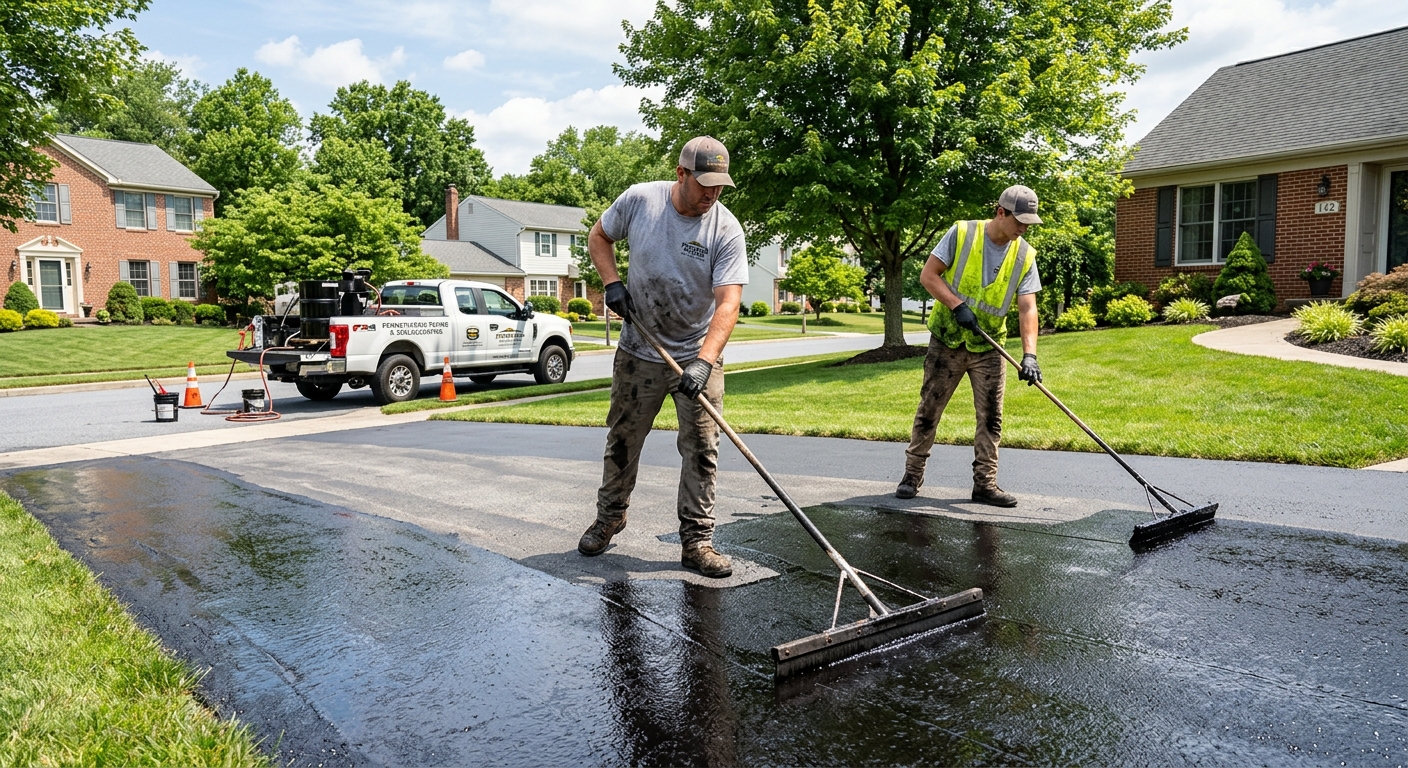
Driveway paving costs in Lewisburg — 2026
Lewisburg has a fairly low homeownership rate—just 40.0% of residents own their homes—and only 43.6% of housing units are single-family homes (U.S. Census Bureau, ACS 2024). The result: driveway paving costs here generally matter most for detached homes, especially those built before 1980. Driveway repairs and replacements are common in these older properties. In Lewisburg, nearly all detached homes must contend with long, cold winters, freeze-thaw cycles, and local alluvial silty soils, which call for thicker and better-drained base layers under every paved driveway.
When it comes to asphalt and concrete paving, most of the price difference between two quotes is buried beneath the surface—literally. The quality, thickness, and compaction of the stone base are far more important than the asphalt thickness a contractor promises. Homeowners can't see sub-base depth or prep, but this is exactly where cheap bids cut corners to win jobs. This is especially true in the Union County market, where aggregate and hot-mix asphalt come from outside the county, making transport and material handling a real cost factor.
| Service |
Best for |
Lifespan |
Price range |
| Asphalt — full replacement with new base |
failed base, structural cracking |
20–30 yrs |
$3,200–$8,300 |
| Asphalt overlay / resurfacing |
sound base, surface cracking only |
8–15 yrs |
$1,400–$4,100 |
| Sealcoating — single application |
preventive maintenance on sound asphalt |
2–4 yrs |
$175–$650 |
| Concrete — new installation |
long service life, low maintenance |
30–50 yrs |
$4,600–$11,000 |
| Crack filling and patching |
isolated cracks under a quarter inch |
1–3 yrs |
$200–$800 |
| Gravel driveway |
rural, budget, long runs |
5–10 yrs with upkeep |
$900–$3,500 |
Estimates for a typical Lewisburg driveway. Square footage and base condition drive these figures more than material choice.
Driveway permits, approaches and stormwater rules
In Lewisburg and surrounding areas of Union County, a building permit is generally NOT required to repave your asphalt or concrete driveway if you’re keeping the same footprint. This saves most homeowners a paperwork headache. However, if you are expanding or replacing your driveway—especially where it meets a public road—you usually need a specific approach or driveway permit. In East Buffalo Township, for instance, any driveway installation, repair, or work toward installation or repair requires a driveway permit, while driveways onto a PA state route anywhere in Union County need a Highway Occupancy Permit from PennDOT Engineering District 3-0.
If your project increases impervious surface (by widening or changing materials), local stormwater rules kick in. Even with a permit, you’re liable if runoff from your new driveway dumps water onto your neighbor's property, causing damage. It’s not just good manners—improper runoff can mean legal headaches and forced remediation.
For contractor verification, Pennsylvania requires Home Improvement Contractor (HIC) registration for contracts over $500. Always check your contractor at hic.attorneygeneral.gov. Employers must also carry workers' compensation insurance, which you can independently verify via WCAIS (wcais.pa.gov). Insist on both checks before signing anything. For homes built before 1978, ask for EPA Lead RRP certification as well.
The honest case for and against sealcoating
Sealcoating is widely marketed as a driveway cure-all across Lewisburg, but it's not magic. What sealcoating does do: it protects asphalt binder from the sun's oxidation, shields against gas and oil drips, and regains that dark, new look. Done right, every 2–4 years, it slows the day-to-day breakdown of the asphalt surface and buys you a little time. You’re looking at $175–$650 per application for most single-family drives here.
What sealcoating will NOT do: it will not mend underlying base movement, fix structural cracks, or extend the life of a driveway that's already failing underneath. Laying sealer on top of cracked or alligatored pavement is the driveway equivalent of painting over rust. Worse, too-frequent sealcoating (annually, for example) only creates a brittle, flaky mess—multiple built-up layers will peel. Sealing new asphalt too soon, before it has cured and weathered, actually locks in oils that should be evaporating, weakening the pavement instead.
On most Lewisburg driveways, crack filling is actually more important than sealing. Cracks wider than a quarter inch let water into the base, where freeze-thaw cycles do real damage. A careful hot-pour or rubberized filler lasts two to three times longer than a quick spray-over.
A "bargain" sealcoat job done in an hour with thin, oil-based liquid sprayed from an unmarked tank—often at the low end of the price range—won't last a season and may actually break down your asphalt. You're paying for diluted material and shortcuts, not protection. Good sealcoating is a planned, multi-step process—proper cleaning, edge cutting, filling, and a full cure period. If the price feels too good to be true, that's what you get.
Choosing a paving company
Choosing a paving contractor in Union County should involve more than looking for a low price and a friendly handshake. Pennsylvania requires Home Improvement Contractor (HIC) registration for any contract over $500—verify this at hic.attorneygeneral.gov. For anyone with employees on site, workers’ compensation insurance is legally mandatory; don’t just take their word for it—check at wcais.pa.gov.
Local know-how matters: Lewisburg’s driveway market is thin, and aggregate supply is trucked in from plants near Williamsport. Any contractor who cannot name a regular supplier for stone and hot mix is either brokering jobs or farming the work out. Ask for references on jobs that have been down for at least three years—recent work often looks good regardless of quality. Rented equipment and phone-only contacts are warning flags; longevity, owned machinery, and a verifiable business address matter.
- Home Improvement Contractor (HIC) registration — verify online
- Workers’ compensation with active Pennsylvania policy — WCAIS lookup
- Local street address (not just a P.O. Box or mobile number)
- Owned paving and compaction equipment, not a truckload of rentals
- Name and location of aggregate/asphalt supplier (Williamsport area is standard here)
- References from driveways at least three years old, ideally nearby
- Detailed written estimate including base depth and materials
- Timeline from tear-out to finished paving
- Knowledge of local permit requirements (borough, township, PennDOT)
- EPA Lead RRP certification if your home was built before 1978
- Proof of liability insurance
Red flags: today-only pricing, payment before demo, refusal to put scope and spec in writing, or any suggestion to skip required permits. These save you from Lewisburg’s most common driveway regrets.
The driveway scams that work in Lewisburg
Paving scams find Lewisburg and the Union County area for good reason: this is a rural market with more driveways per person, homes further apart, and limited code checks. Most scam pitches follow a pattern: “We have leftover asphalt from a job down the road,” or, “We can give you a today-only low price if you pay cash now.” The crew rolls up in an unmarked truck, with plates not matching Union County, and the “contractor” never puts a detailed scope in writing. This isn’t just aggressive sales; it’s designed to block your legal protections before you realize what’s missing.
The oil-based spray “sealcoat” scam—where they charge for a full professional application but deliver watered-down sealer or even just waste oil—is just as common. Here, the damage won’t show until next spring. Because driveways are a big, visible investment, many homeowners feel pressured to act quickly or lose the “deal.” Scammers count on this, especially in less densely-watched neighborhoods.
Pennsylvania consumer law is on your side. The Home Improvement Consumer Protection Act (HICPA) gives you an absolute right to a written contract for any job over $500 and three full business days to cancel it—no reason needed, no penalty. If a contractor offers to waive your insurance deductible or refuses formal paperwork, they’re acting illegally. Use these rules; do not be rushed.
Taking five minutes to verify a contractor’s PA HIC registration, workers' compensation insurance, and business location eliminates almost every local paving scam. If a company won’t provide these, walk away. Protect yourself and your pocketbook.
Base preparation: the part you pay for and never see
Base preparation is the single most important—and least visible—step in any Lewisburg driveway project. A proper driveway is built in layers: first the native subgrade (local alluvial silt along the Susquehanna can be soft and moisture-prone), then a compacted stone aggregate base, topped by hot-mix asphalt or concrete. Each layer spreads out the weight of vehicles to the layer below. Cut corners underneath and no amount of asphalt thickness on top will save your driveway.
Our climate delivers ruthless freeze-thaw cycles. Water trapped in silty subgrade expands when it freezes, pushing up and breaking pavement from underneath—a process called frost heave. The only proven defense is a thick, well-drained stone base, matched to local soil conditions. That’s why a standard “three inches of blacktop” without documented base prep may look good today but will rut, crack, and heave within three or four winters here.
Cheaper bids commonly skip excavation, lay new material over a failed base, use less stone, or skip compaction between base layers (“lifts”). No homeowner can check this once material is down; you have to insist on clear, written specs up front.
For Lewisburg, you should see a base depth of at least 6–8 inches of compacted crushed stone, and the quote should state the aggregate type (typically 2A modified). Compaction must be performed in separate lifts, with a heavy roller or plate compactor—not just a few passes with a small machine. If you don’t see these details, you’re likely paying today for a driveway that will not last a decade. Always demand, in writing, the base depth in inches, aggregate specification, and a statement that compaction was performed in lifts.
What to put in a Lewisburg paving contract
Shopping driveway bids by price alone is the surest way to waste money in Lewisburg’s climate. Compare quotes by what you’re actually buying—the written technical specs that control lifespan. A proper contract spells out excavation depth, base thickness, material type, how compaction is performed (and in how many lifts), the actual compacted thickness (not loose, uncompacted), the mix designation, and how asphalt edges are protected.
Don’t be fooled by, “We’ll put down three inches.” Is that three inches after packing or three inches before? Asphalt and stone compact by up to 25%. Insist on compacted thicknesses, not “as laid.” Our freeze-thaw cycles and silty soils demand deeper, stronger assemblies than in milder climates. Skimping here means cracks, ruts, and potholes within a few winters.
- Excavation depth (inches below finished grade)
- Aggregate base depth (measured after compaction)
- Aggregate material type (e.g., 2A modified stone)
- Base compaction method (roller type, vibratory plate)
- Number of compaction lifts for base stone
- Binder course thickness (after compaction)
- Surface course thickness (after compaction)
- Hot-mix asphalt type/designation (e.g., PennDOT ID-2)
- Edge support method (tapered, concrete, stone shoulder)
- Final grading and water drainage direction
If a contractor skips any of these or is vague (“2 to 3 inches, more or less”), they’re planning to save money at your expense. The right spec, in writing, is worth more than a nice price.
Frequently asked questions — driveway paving in Lewisburg
How long before I can drive on a new asphalt driveway?
After a new asphalt driveway is installed in Lewisburg, you should generally wait at least three full days before driving on it, especially with SUVs or trucks. That time frame lets the hot mix cool, settle, and start the curing process. In mid-summer, the surface will remain soft and susceptible to marks for a few weeks. Parking in the same spot repeatedly or turning your wheels while stationary can dent the asphalt, especially in the first week. During cooler weather, the curing process is slower, so err on the side of caution. Even after initial curing, it will take several months for the asphalt to fully harden. For context, the typical cost here runs $3,200–$8,300 for a full replacement, so protecting your investment those first few days is well worth it.
How long should an asphalt driveway last in Lewisburg?
Properly installed, a new asphalt driveway in Lewisburg should deliver at least 20–30 years of service. Our climate—with heavy freeze-thaw cycles, snow loads, and a high water table near the Susquehanna—means only driveways with deep, well-compacted stone bases reach the top end of that range. Cheaper installs, often with 3–4 inches of surface over a thin or inadequately compacted base, usually start to show cracks or settle well before 15 years. Typical replacement costs here are $3,200–$8,300. Solid base prep and timely crack sealing do more for lifespan than any other factor.
How much does driveway paving cost in Lewisburg?
Lewisburg homeowners looking for a new asphalt driveway can expect to pay between $3,200–$8,300 for a standard-size, full replacement job with new stone base. Asphalt overlay, which is only suitable if your existing base is in good shape, is less costly at $1,400–$4,100. New concrete driveways fall between $4,600–$11,000. Narrow, older driveways that need widening or subgrade correction can push prices to the top end. These numbers reflect the higher cost of trucking materials into Union County from Williamsport, as well as the extra stone required for silty subsoils common in the area.
Do I need an approach permit where my driveway meets the road?
Yes, for nearly every property in Union County—including Lewisburg Borough and the surrounding townships—any work where your driveway meets a public road, such as replacing or widening the apron or approach, typically requires a permit separate from your building or zoning approvals. For driveways connecting to Pennsylvania state routes, the responsible authority is PennDOT Engineering District 3-0, which issues Highway Occupancy Permits. Some townships, including East Buffalo, require a driveway permit for ANY installation or repair. Permits ensure safety, proper drainage, and compliance with local road standards. Not securing the right permit can mean fines or forced rework—never rely on a contractor saying it's “not needed.” The cost of permitting is minor compared to a full driveway replacement at $3,200–$8,300.
How much does it cost to widen a driveway?
Widening an existing driveway in Lewisburg—common if you have one of the 1950–1970 vintage narrow single-lane drives—usually falls between $1,400–$4,100 for asphalt overlay on a sound base, or at the high end of the full replacement range, $3,200–$8,300, if you’re rebuilding the base. The final price depends on the length and width of added pavement, site grading, and whether the township requires a new approach or drainage work. Permitting may also add to the cost if a wider apron or connection to a state road is involved.
Does sealcoating fix cracks?
No, in Lewisburg sealcoating does not repair cracks—it only provides a superficial seal to the top of the asphalt, protecting against sun damage and oil spills, and improving appearance. Cracks that are left unfilled will continue to admit water, which then freezes and expands, making the cracks worse and leading to base damage. For drives with cracks under a quarter inch, targeted crack filling and patching ($200–$800) is the right solution, keeping water out of the base and greatly slowing further deterioration. Sealcoating, at $175–$650, extends surface life if applied at the right interval, but should always follow good crack repair.
Does road salt damage driveways in Lewisburg?
Yes. The winter highway treatments used in Union County routinely include both road salt and abrasives. Salt accelerates the freeze-thaw cycle by melting ice and letting water seep into even tiny cracks in both asphalt and concrete. This leads to more frequent surface breakups and potholed edges, especially on older drives or those without proper drainage. For concrete, salt can also cause surface spalling and scaling. Regular maintenance, such as crack filling and sealcoating (every 2–4 years for $175–$650), helps limit damage, but even the best-constructed driveways here will need attention over time due to our heavy salt use.
How deep should the aggregate base be here?
In Lewisburg and the rest of Union County, with silty river soils and deep frost to 36 inches, driveway base depth is critical. For asphalt or concrete driveways, a minimum of 6–8 inches of compacted aggregate (usually 2A modified stone) is recommended, sometimes more if drainage or heavy vehicle loads are expected. Base thickness is where most cheaper bids cut, but it’s also what ruins a new drive after a few winters. For gravel driveways, the same 6-inch target holds for the main travel path. Investing in proper base prep, even if the upfront cost is a bit higher ($3,200–$8,300 for a standard-size replacement), pays back in longevity and fewer repairs.
Should I repair or replace my Lewisburg driveway?
The decision between repair and replacement depends on the condition of your drive and its base—not just what you see on top. If your driveway has isolated cracks less than a quarter inch wide, or small areas of surface damage but the base is stable, crack filling ($200–$800) or an overlay ($1,400–$4,100) is usually worthwhile. If you have widespread alligator cracking, settled sections, or soft spots, those are signs the base has failed—replacement is the honest answer. With most Lewisburg homes built before 1980 and many driveways now decades old, a full replacement is a sound long-term investment, though always get a professional opinion before spending $3,200–$8,300.