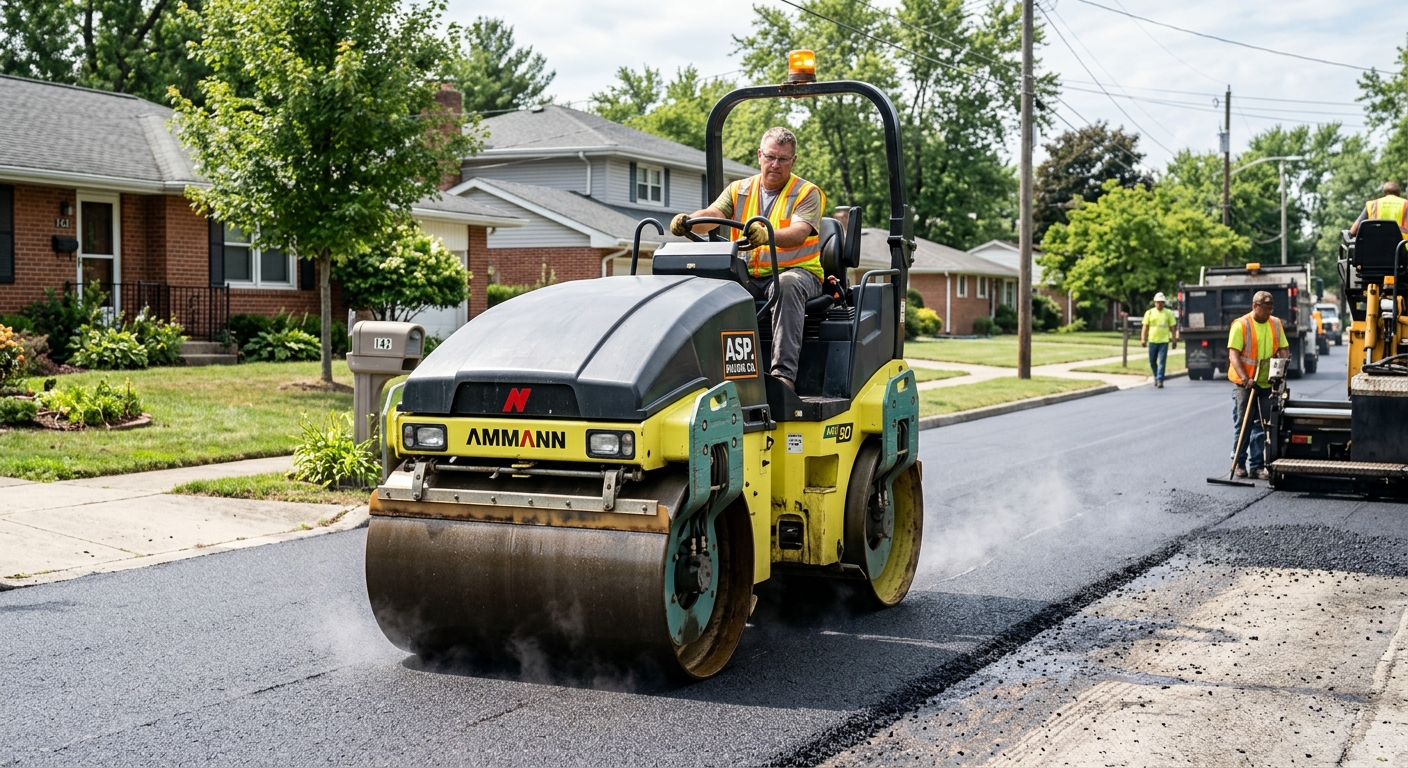
Driveway paving costs in East Hanover — 2026
In East Hanover, the reality of maintaining a driveway comes home to nearly every property owner. With 80.3% of local homes being single-family (U.S. Census Bureau, ACS 2024) and a homeownership rate of 85.8%, driveways here are not just a one-time builder’s expense but a recurring, long-term responsibility for most residents. Our southern Dauphin County climate—marked by pronounced freeze-thaw cycles and periodic moderate snowfall—puts driveways, especially asphalt, to a severe test every winter. Compounding matters, the local limestone karst and shale soils can’t be ignored: they require a thicker base to prevent settlement, and water management is critical. Homeowners should know the price spread between two paving quotes is almost never about asphalt thickness or visible details—most of that gap is buried, literally, in the quality, thickness, and compaction of the aggregate base. You’ll see price differences, but you won’t see most of what you’re paying for. Below is a summary for East Hanover’s typical choices:
| Service |
Best for |
Lifespan |
Price range |
| Asphalt — full replacement with new base |
failed base, structural cracking |
20–30 yrs |
$3,700–$9,500 |
| Asphalt overlay / resurfacing |
sound base, surface cracking only |
8–15 yrs |
$1,600–$4,800 |
| Sealcoating — single application |
preventive maintenance on sound asphalt |
2–4 yrs |
$200–$750 |
| Concrete — new installation |
long service life, low maintenance |
30–50 yrs |
$5,300–$12,500 |
| Crack filling and patching |
isolated cracks under a quarter inch |
1–3 yrs |
$200–$800 |
| Gravel driveway |
rural, budget, long runs |
5–10 yrs with upkeep |
$900–$3,500 |
Estimates for a typical East Hanover driveway. Square footage and base condition drive these figures more than material choice.
Asphalt or concrete for a East Hanover driveway?
Choosing between asphalt and concrete in East Hanover always comes down to local climate and how driveways fail here. Our freeze-thaw cycle is the main culprit—temperatures yo-yo across freezing each winter, and that forces the ground to move. Asphalt handles this far better; it’s flexible enough to shift and rebound without splitting open. Concrete is much more rigid. While a professionally placed concrete driveway can last decades longer, in south-central Pennsylvania it is salt, not just cold, that ends up breaking most concrete. De-icing salts eat away at the top layer, causing spalling and scaling, and most homeowners end up using salt when it’s icy—despite every warning. That’s the honest tradeoff: a concrete driveway costs more but only survives its full lifespan when strict with maintenance.
Pavers work if you want a flexible, attractive option and are willing to accept some settling. Gravel remains a legitimate answer on budget or rural properties, especially for long runs—good drainage and regular top-dressing can give almost indefinite life, but most East Hanover HOAs and zoning rules limit where gravel is allowed.
| Option |
Installed cost |
Maintenance |
Freeze-thaw performance |
Lifespan |
| Asphalt — new install |
$3,700–$9,500 |
sealcoat every 3–4 yrs |
excellent, flexes |
20–30 yrs |
| Asphalt — overlay |
$1,600–$4,800 |
same |
good if base is sound |
+8–15 yrs |
| Concrete |
$5,300–$12,500 |
low, avoid de-icing salt |
fair, spalls with salt |
30–50 yrs |
| Pavers |
$8,500–$12,500 |
individual units replaceable |
good, settles gradually |
25–50 yrs |
| Gravel |
$900–$3,500 |
top-dress every 2–3 yrs |
excellent drainage |
indefinite with upkeep |
Getting thirty years out of a driveway
If you want to see three decades from an East Hanover driveway, outright replacements can be avoided by focusing on five essentials. First: fill cracks as soon as you see them, before water makes it to the base. The moment water sits and freezes, it opens the crack wider and weakens the foundation—the main reason driveways fail early in south-central Pennsylvania’s freeze-thaw climate. Second: keep the edges supported with topsoil or a structural border. Edges that break away let water intrude and accelerate failure. Third, make sure drainage works—standing water is rot to both concrete and asphalt. Fourth, keep point loads off the drive: dumpsters or jack stands can indent new asphalt or crack concrete. Fifth, for new asphalt, respect the curing time: don’t park on it for at least a week, and avoid turning wheels in place for another month if you can.
De-icing is where material matters. Salt will attack concrete and cause pitting, while on asphalt, it’s the melt-refreeze cycle that does the damage. If you can, use calcium magnesium acetate or sand for traction, but neither is cheap. Real-world, most people still use salt occasionally. The lesson is: maintenance, especially keeping water and chemicals off the surface, matters more than any sealer or coating for long-term survival in this climate.
The honest case for and against sealcoating
Most of what you read about sealcoating is written by contractors who want to sell it every year. Here is how it really works for East Hanover homeowners: sealcoating protects the asphalt binder against UV rays and slow oxidation. It keeps gas, oil, and de-icer from softening or staining the surface, and it will make faded asphalt look new for a season or two. What it does not do is add structural strength, heal cracks, or extend the life of a driveway once the base has started to fail. If your drive is already alligator-cracked or soft at the edges, sealcoating is just paint on a bruise.
There’s a downside: sealing too often, especially with cut-rate products, builds up layers that crack, peel, and make a mess. Sealing new asphalt too soon traps oils and can even delay full curing. Every two, even three years is more than enough for most East Hanover drives. The first seal should wait until the new surface has gone through a full summer and fully cured out. Crack filling matters more than sealcoating—when done right, hot-applied crack filler bonds and stretches with freeze-thaw cycles, and stops water from attacking the base.
If you’re quoted $200–$750 for a typical seal, a price far under that means someone is spraying water-thin sealant from a tank and moving on—don’t expect real protection, and never let it substitute for real repairs.
Permits and approvals for paving in East Hanover
For most East Hanover driveways, repaving or resurfacing an existing footprint on a local non-state road does not require a new permit—saving you a call to the township code office. If you’re widening your drive, changing grade significantly, or touching the apron at the road, that’s different. Any work where your driveway meets a state route—the approach—requires a permit from the PennDOT Engineering District 8‑0 Highway Occupancy Permits office, not just your township. In Harrisburg, even curb or apron work on local roads requires a street opening permit, but East Hanover follows township procedures for its own roads.
Stormwater matters. Adding impervious area or altering drainage can run afoul of runoff rules and may subject you to new requirements. Never direct water toward a neighbor’s property—your liability remains, permit or not.
Pennsylvania requires any contractor doing over $500 in work be registered for Home Improvement Contractor (HIC) status; check hic.attorneygeneral.gov. Workers’ compensation is mandatory for all employers and can be verified via WCAIS (wcais.pa.gov). These checks are critical for legitimate paving jobs here.
The paving season in south-central Pennsylvania
Paving season in East Hanover isn’t negotiable—it’s dictated by weather and material supply. Hot-mix asphalt must go down warm enough to be compacted properly; if the ground or air is cold—think below 45–50 °F—the mix becomes unworkable and won’t bond. Plants around Harrisburg and Middletown shut down for the winter, so you can’t buy hot asphalt locally except during the real season. Concrete needs consistent above-freezing conditions to cure—a sudden cold snap can ruin a new slab overnight. Our winter design temperature is 12 °F, and freeze-thaw cycles are a given no matter the month once October rolls around.
The true window for paving runs from late April through early November. Shoulder seasons—the early spring and late fall—see more crew openings, and contractors may negotiate to fill the schedule. In midsummer, crews are booked out and you’ll wait weeks if you don’t schedule early. If a crew promises to pave your drive in late November or during a December warm-up, their standards aren’t where you want them—they’re either desperate or cutting corners. Advance planning in East Hanover nearly always secures a better product at a fair price.
Finding a legitimate paver in Dauphin County
Hiring a paving contractor in East Hanover—and anywhere in Dauphin County—means doing the right checks. Pennsylvania makes this process plain: a Home Improvement Contractor registration is mandatory for jobs over $500, verifiable at hic.attorneygeneral.gov. Workers' compensation is equally required for all employers, and WCAIS (wcais.pa.gov) is where to confirm active coverage. A real local contractor won’t hesitate to provide proof. Local quarries and asphalt plants ensure supply around Harrisburg and Middletown; a contractor who can’t name where their asphalt is coming from is middle-manning your job at best.
- Verify Pennsylvania Home Improvement Contractor registration for any job over $500.
- Confirm workers’ compensation coverage at WCAIS for any crew on your property.
- Ask for a verifiable local business address (not just a mobile number).
- Insist on job references from three or more years ago—driveways look fine at first but only time proves quality.
- Name their asphalt supplier—local plants operate within short haul distance here.
- Look for owned, not just rented, paving and compacting equipment. Rentals often mean little control or expertise.
- Get a written contract with HIC language and a clear right of cancellation.
- Check that their liability insurance aligns with Home Improvement Consumer Protection Act requirements.
- Avoid door-to-door crews offering same-day discounts or requiring upfront cash.
- Request proof of prior municipal approvals if your paving work involves permits.
- Inspect their previous jobs yourself, if possible—recent work can mask problems still to come.
- Ask how they handle drainage, as settling is a real risk with local shale and limestone soils.
Red flags here include “too good to be true” pricing, evasive or mobile-only contact info, no local references, or refusal to provide insurance and registration documents. Real companies stand behind their work—and their paperwork.
Frequently asked questions — driveway paving in East Hanover
How thick should asphalt be for a residential driveway in East Hanover?
Asphalt in East Hanover should be installed at a finished compacted thickness of 3 to 4 inches for standard residential driveways that see passenger vehicles, with a crushed stone base of at least 6 inches over limestone or shale soils. This thickness resists the shifting caused by our pronounced freeze-thaw cycles and the potential for settlement in local subgrades. For heavier loads, like RVs or large delivery vehicles, an additional inch is worthwhile. Most legitimate bids for full asphalt replacement, which covers tear-out and new base, fall in the $3,700–$9,500 range for a standard two-car drive in East Hanover. Underbidding on thickness below these specs is a shortcut that turns up as cracks and soft spots after a few winters here.
Can I cancel a paving contract I signed at my door?
In Pennsylvania, the Home Improvement Consumer Protection Act gives homeowners the right to cancel a residential paving contract within three business days of signing if the agreement was made at your home or anywhere other than the contractor's place of business. This applies throughout East Hanover and every job over $500 must be backed by a written contract with clear language about your right of cancellation. If you decide to back out, you must do so in writing within that three-day window. Contractors cannot waive this right or ask you to sign it away. Be cautious about paying upfront before this period expires, as reputable local contractors are familiar with these consumer protections and won’t pressure you.
What kind of soil is under East Hanover driveways?
East Hanover driveways typically sit over limestone karst and shale subgrades, the most common soil types around Harrisburg and throughout Dauphin County. This combination creates two challenges: limestone soils can settle if not compacted and drained correctly, and shale holds water that can freeze and heave pavement. Both factors mean thicker aggregate bases are needed here than in most other parts of Pennsylvania, especially to guard against the pronounced freeze-thaw cycling we get each winter. Proper installation, which falls in the $3,700–$9,500 range for full replacement, covers the cost of digging deep enough to provide a solid base and drainage layer.
How far ahead should I book a paver in East Hanover?
In East Hanover, it’s wise to book a reputable paving contractor 4–8 weeks in advance, especially during the late spring and into summer when demand peaks. Asphalt plants in the Harrisburg area operate seasonally, closing for much of the winter and reopening in the spring, so the best crews get booked up quickly as soon as weather breaks. Last-minute jobs can cost more or end up squeezed in during less-than-ideal conditions. For a standard two-car driveway, expect typical pricing to land between $3,700–$9,500 for a full replacement when scheduled during prime season. Calling early ensures your work gets scheduled in the right weather window and with the crew’s full attention.
Asphalt or concrete for a East Hanover driveway?
In East Hanover, asphalt is generally the better value for most homeowners. Our climate’s pronounced freeze-thaw cycling means that flexible asphalt resists cracking and heaving better than rigid concrete, especially over the area’s limestone and shale subgrades. Concrete can last much longer—30 to 50 years—if you avoid de-icing salts, but nearly every East Hanover driver ends up using salt at some point, which causes spalling. Concrete also costs more upfront, typically $5,300–$12,500 versus $3,700–$9,500 for asphalt replacement. If you want curb appeal and lower maintenance, and can strictly avoid salt, concrete is an option. Most families in the area find asphalt tougher and more forgiving in the real world.
How much does it cost to widen a driveway?
Widening a driveway in East Hanover often involves excavation, building out the base on local limestone or shale soils, and either repaving the entire surface or tying in an overlay. For asphalt, expect the project to fall in the $3,700–$9,500 range for a full replacement job, depending on how much additional width is needed and any drainage improvements required. If you’re only resurfacing with an overlay, smaller additions might land between $1,600–$4,800. Keep in mind, widening at the street often means a separate permit from PennDOT for state roads. Always check local requirements before starting work, as unapproved changes at the approach can cause future headaches.
Why are paving quotes in East Hanover so different from each other?
East Hanover paving quotes can range widely, sometimes by thousands of dollars, because what really determines quality and cost isn’t obvious from looking at a finished driveway. The main hidden driver is the thickness and compaction of the stone aggregate base—especially important over our limestone and shale soils, which can settle if not prepared properly. Cheaper quotes may cut corners on base depth, asphalt thickness, or drainage work. A full asphalt replacement should run $3,700–$9,500 for a typical two-car drive. Outlier low prices often mean fast, superficial jobs that show problems after a winter or two. Ask bidders to detail how they’ll build and compact the base—this is where your driveway’s lifespan is set.
When can I seal a brand new asphalt driveway?
For a new asphalt driveway in East Hanover, sealcoating should wait at least three to six months—and preferably after the first full summer of curing. This gives the asphalt surface time to release volatiles and fully harden under sun and weather, which is especially important in our climate that swings from hot summers to cold, damp winters. Sealing too soon can trap oils and lead to a soft or streaky finish. A standard single application should cost $200–$750 for a two-car drive, with reapplications needed only every two to three years. Properly timed sealing helps lock in the finish and repellency—done too early, it can actually reduce the surface’s life.
What are the signs of a failing driveway base?
In East Hanover, the earliest sign your driveway base is failing is the appearance of alligator cracking—tight, interconnected cracks that look like a reptile’s back. You might also notice soft spots where the surface flexes underfoot or under vehicle weight, especially after heavy rain or snowmelt. Potholes and edge breakup that return soon after patching mean the base is no longer providing support. This happens most often where water seeps into cracks and freezes, or where the highway limestone or shale under your drive settles unevenly. Once these symptoms appear, patching and sealing will no longer provide more than temporary relief. A full-depth replacement in the $3,700–$9,500 range is usually needed to eliminate these issues for the long term.