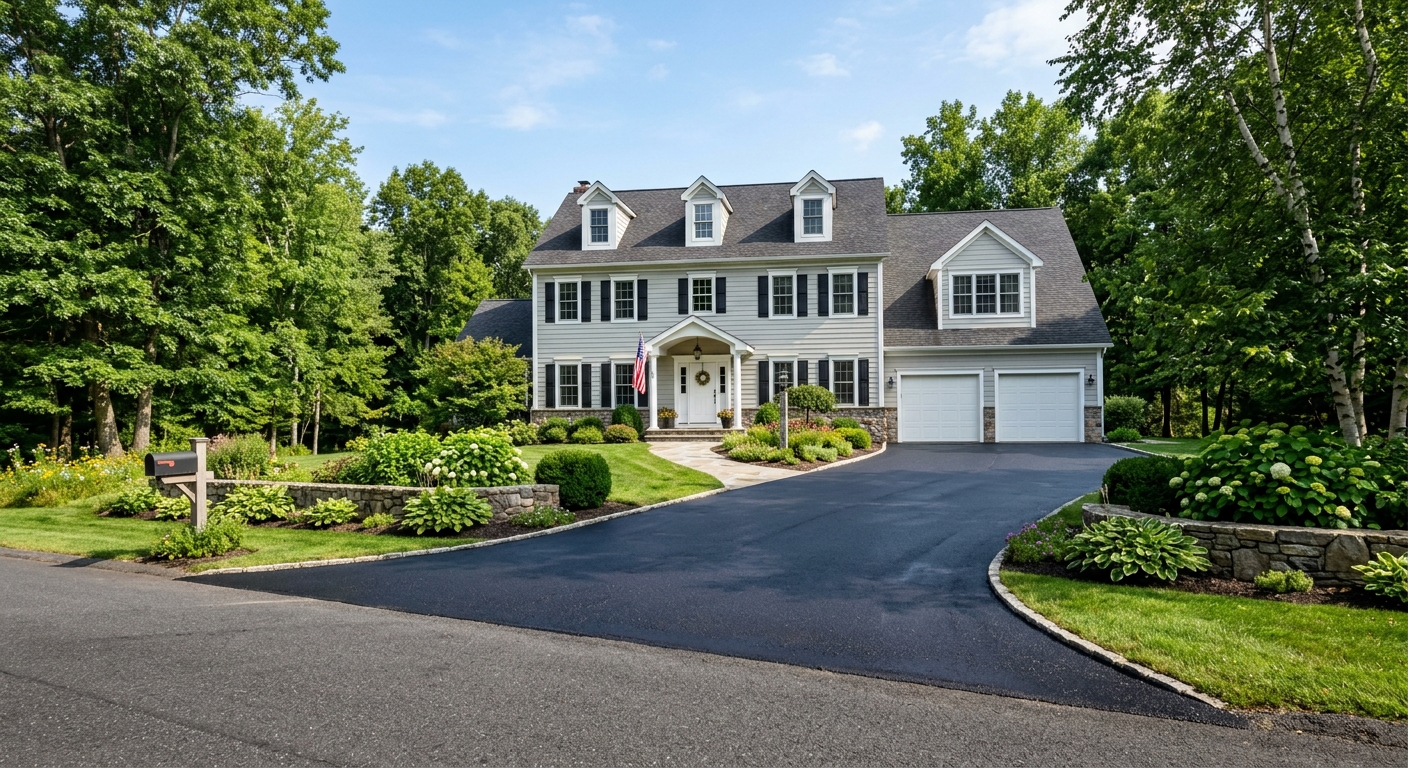
Driveway paving costs in Archbald — 2026
In Archbald, where 84.3% of homes are single-family and 73.2% are owner-occupied (U.S. Census Bureau, ACS 2024), driveway paving is a common investment as properties age and needs change. The climate here is tough on surfaces: freezing winters, significant snow loads, and a regional soil comprised mostly of glacial till, which can complicate subgrade preparation and drainage. Driveway longevity and structural performance in Archbald hinge less on what you see above ground and more on what lies underneath—the base, compaction, and drainage. Most of the cost difference between two bids is not in the asphalt or concrete itself, but in how thoroughly the base is rebuilt and whether drainage measures are addressed properly. If you see two contractors offering noticeably different prices for the “same” project, the less expensive one may be neglecting base thickness, drainage, or compaction—corners that lead to early failure in our climate, especially with repeated freeze-thaw cycles. The right paving solution balances upfront price with long-term durability by fitting the base and drainage to Archbald’s soils and unique weather challenges.
| Service |
Best for |
Lifespan |
Price range |
| Asphalt — full replacement with new base |
failed base, structural cracking |
20–30 yrs |
$3,400–$8,800 |
| Asphalt overlay / resurfacing |
sound base, surface cracking only |
8–15 yrs |
$1,450–$4,400 |
| Sealcoating — single application |
preventive maintenance on sound asphalt |
2–4 yrs |
$200–$700 |
| Concrete — new installation |
long service life, low maintenance |
30–50 yrs |
$4,900–$12,000 |
| Crack filling and patching |
isolated cracks under a quarter inch |
1–3 yrs |
$200–$800 |
| Gravel driveway |
rural, budget, long runs |
5–10 yrs with upkeep |
$900–$3,500 |
Estimates for a typical Archbald driveway. Square footage and base condition drive these figures more than material choice.
Permits and approvals for paving in Archbald
If you are repaving your driveway in the same footprint in Archbald, you generally do not need a building permit, provided you are not changing its size or layout. However, whenever you alter the entry—where your driveway meets the public road—an approach or curb cut permit is usually required. For driveways that connect to state routes, the responsible authority is PennDOT District 4-0. For township or borough streets, you must check with your local municipality about permits for driveway approaches or curb modifications. This often surprises homeowners who assume that a general building permit covers all aspects; in reality, a driveway approach permit is a separate step with its own requirements.
Expanding or changing the shape of your driveway, or adding new impervious surfaces, can also trigger stormwater management requirements. It is not just about the paperwork, either—Pennsylvania law puts liability on you if runoff from your property causes issues for a neighbor, regardless of whether a permit was obtained. Proper grading and drainage are nonnegotiable, even for small projects.
When hiring a contractor, make sure they hold current Pennsylvania Home Improvement Contractor (HIC) registration. You can verify a contractor’s HIC registration number at hic.attorneygeneral.gov. Ask for proof of workers’ compensation coverage, which is mandatory for all employers in Pennsylvania, and verify as needed at WCAIS (wcais.pa.gov).
How often should a Archbald driveway be sealed?
Sealcoating is widely sold as the answer to asphalt longevity, but in Archbald’s climate, it plays a more limited role. A proper sealcoat application protects the asphalt binder from sunlight, oxidation, oil, and gas spills, and it certainly improves a tired surface’s appearance. But it does not add structural strength, repair base damage, or extend the useful life of a driveway that has already failed under the surface. If your driveway has significant alligator cracking or areas that move underfoot, sealcoating is a cosmetic fix at best.
Too-frequent sealing leads to buildup, causing peeling and crackling—especially a problem in Lackawanna County’s freeze-thaw cycles. The first sealing should wait a full season, or until the new asphalt is fully cured, so that trapped volatiles can escape. After that, a sealcoat every 3–4 years is typical for Archbald, not every year.
Routine crack filling actually matters more to the lifespan of your driveway than sealcoating. Sealing keeps oxidation at bay, but cracks are where water finds its way to the base and does the most damage, especially with glacial till soils that do not always drain quickly. If you go with sealcoating, ensure it's a quality product applied at the correct thickness—not just a quick spray-on application, which often costs less than $200 and typically lasts a single season, if that. Suspiciously low prices are a red flag that the job will be done too thin, not last, or be diluted product. For an average drive in Archbald, expect a proper single-application job to be in the $200–$700 range, with a professional crack fill as part of the prep.
Asphalt or concrete for a Archbald driveway?
In Archbald—and across northeastern Pennsylvania—the climate is hard on driveways. Freeze-thaw cycles are fierce here, especially with a frost depth of 36 inches and winters dipping down to 4 °F. Asphalt's flexibility lets it bend with ground movement, so it holds up better where the ground shifts due to frost or moisture. This means asphalt usually tolerates our climate well, rarely cracking from frost heave—just as long as its base was properly installed and drains well.
Concrete costs more up front, but if it survives the early years, it can easily last twice as long as asphalt. That said, concrete is rigid and prone to spalling and surface scaling if salt-based de-icers are used—and in Lackawanna County, these are the norm for winter safety. Most homeowners use salt on ice sooner or later, even with best intentions, and this is the fatal flaw of concrete here: scales, pits, and chunks coming loose after a few rough winters.
Pavers are a premium option when budget allows, and while materials are pricier, individual units can be swapped out if they settle or crack. Gravel works for rural or long runs, drains well, and soaks up freeze-thaw cycles, but requires regular topping-up and grading.
| Option |
Installed cost |
Maintenance |
Freeze-thaw performance |
Lifespan |
| Asphalt — new install |
$3,400–$8,800 |
sealcoat every 3–4 yrs |
excellent, flexes |
20–30 yrs |
| Asphalt — overlay |
$1,450–$4,400 |
same |
good if base is sound |
+8–15 yrs |
| Concrete |
$4,900–$12,000 |
low, avoid de-icing salt |
fair, spalls with salt |
30–50 yrs |
| Pavers |
$7,800–$12,000 |
individual units replaceable |
good, settles gradually |
25–50 yrs |
| Gravel |
$900–$3,500 |
top-dress every 2–3 yrs |
excellent drainage |
indefinite with upkeep |
Overlay, patch or full replacement?
Diagnosing your own driveway in Archbald is possible—and helpful, since so much depends on what lies under the surface. If you see alligator cracking (numerous small, interlocking cracks over a large area), the base has likely failed. An overlay in this case is a short-lived fix, as the underlying issues will break through within a year or two. Isolated linear cracks are a much better sign; they mean the top layer is aging, but the base is likely sound. Depressions or “birdbaths” suggest the subgrade has moved, often due to poor drainage or water retention in glacial till soils. Crumbling along the edges points to inadequate edge support, common in Archbald’s mid-century developments. Potholes mean water has already found its way below the surface, requiring a full-depth patch and sometimes more.
If a contractor quotes you an overlay without really probing the base (with a core test or digging a section), be wary—there’s no shortcut when structural issues are present. When in doubt, a full replacement costs more now but saves continual spending on repeat overlays.
| What you see |
Likely cause |
Right fix |
Cost |
| Isolated cracks under 1/4 inch |
surface aging |
crack fill and seal |
$200–$700 |
| Alligator cracking over a wide area |
base failure |
full replacement |
$3,400–$8,800 |
| Depressions holding water |
subgrade movement |
excavate and rebuild that area |
$3,400–$5,400 |
| Crumbling edges |
no edge support |
edge repair, consider curbing |
$400–$1,500 |
| Potholes |
water into the base |
full-depth patch, then assess |
$250–$900 |
| Faded but sound surface |
oxidation only |
sealcoat |
$200–$700 |
Local soil, drainage and driveway lifespan
In Archbald, driveways are almost always built over glacial till—a soil that can hold water in pockets and turns unstable during repeated freeze-thaw cycles. The glacial till found here is a wild card: sometimes firm, sometimes silty, almost always uneven. Its poor drainage and variable compaction mean that a standard-depth base is rarely enough. For long-term performance, often a deeper, well-draining sub-base is needed, sometimes with the addition of geotextile fabric to stabilize soft areas.
This regional subgrade isn’t just a headache for new installations—it’s the hidden culprit behind much of the edge failure, sinking, and heaving seen in Archbald’s mid-20th-century driveways. Many older driveways, installed when base standards were less enforced, simply don’t have the support or drainage needed for Northeast Pennsylvania’s climate: a 36-inch frost line and brutal winter/spring freeze-thaw swings. For new work or replacement, contractors have to excavate deeper and add more aggregate to resist heaving and improve drainage, which moves the price up—but saves years of patching and early replacement.
Beyond replacement: layout changes
If you are thinking about more than a straight replacement, Archbald homeowners have typical expansion projects: widening a single-lane drive for a second car, extending for a turnaround or a new garage, or paving over an old gravel run. Each move means starting with a new base on undisturbed glacial till, matching the depth and compaction standards for long life. Be aware that the seam where new pavement meets old will always be a potential weak point, even when bonded carefully—freeze-thaw cycles exploit these joints.
New layouts mean more impervious surface, which can trigger stormwater review even on residential projects. Setback rules will also limit how close to the property line you can pave. Approach permits (where the drive meets the public road) involve local authorities for most township streets, or PennDOT District 4-0 for state routes, and can turn into the longest part of the process. Before starting, a good contractor will help you check local rules and guide you through municipal or state permitting, since requirements and timelines vary by block and street.
Frequently asked questions — driveway paving in Archbald
Why are paving quotes in Archbald so different from each other?
The main reason quotes differ—sometimes by thousands of dollars—for driveway work in Archbald is what happens below the surface. With our glacial till soils and freeze-thaw cycles, a proper job means excavating deeper, bringing in more aggregate, and getting drainage right. That adds material, trucking, and time, which aren’t always part of the lowest bid. Overlays, for example, cost as little as $1,450, but only work if the base is solid. Some contractors quote thin overlays or skimp on base work to appear more competitive; others give a true scope for long life. Always read what’s included—total inches of base, compaction, drainage—because you cannot price-compare if details like those are missing. If a quote seems too good, ask how they’re handling the base and subgrade. Cheap initial work too often means patching and early failures here in northeastern Pennsylvania.
Are there stormwater rules on paving in Archbald?
Yes, when you expand a driveway or significantly increase paved area in Archbald, stormwater rules can apply. Northeastern Pennsylvania’s soils, like glacial till, do not drain quickly, so new impervious surface (asphalt, concrete) can create runoff that affects neighbors or the street. Local officials—and even PennDOT if you connect to a state road—may require you to show that your new drive does not direct water where it can cause problems. Runoff onto adjacent property can make you liable, even if you got every permit. For most residential replacements in the same footprint, stormwater review isn’t triggered, but widening, adding a turnaround, or building close to your property line usually brings it up. For planning, expect more review the bigger the expansion, and always discuss drainage in advance. Fixing a runoff mistake costs much more than doing it right the first time.
When can I seal a brand new asphalt driveway?
New asphalt should not be sealed for at least one full season in Archbald’s climate. Asphalt needs to finish curing, which means letting remaining volatiles and oils escape; sealing too soon traps these and leads to peeling and surface failure. With cool, wet springs and hot summers in northeastern Pennsylvania, waiting 3–6 months is usually best, but up to a year is safest for a standard 2–3-inch residential mat. After curing, a sealcoat—costing $200–$700 in this market—will protect against oxidation and spilled oil, but don’t rush it. A reputable contractor will always advise a wait, and won’t try to upsell you on sealing new blacktop under any circumstances. Patience early on extends your driveway’s life and keeps maintenance predictable.
How long before I can drive on a new asphalt driveway?
For a typical Archbald driveway, you should wait at least 24–48 hours before driving on new asphalt, and longer during hot, humid weather. The surface remains soft for a week or longer, so try to avoid sharp turns, heavy vehicles, or parking in one spot for several days. In peak summer, especially after a thick mat is laid, it’s best to stretch your waiting period to three days to minimize tire marks and surface scuffing. Full curing takes months (which is why you wait to sealcoat), but normal, careful use is fine after a couple of days. If you had a major project—one costing upwards of $5,400—extra caution is smart, as a heavy investment deserves those first few days of care to ensure decades of service.
Why does my driveway have depressions that hold water?
Depressions or “birdbaths” in an Archbald driveway almost always stem from movement or soft spots in the underlying glacial till base. Our local soils do not always settle evenly, and freeze-thaw can amplify slight differences in compaction or drainage—water gets trapped, freezes, expands, and leaves behind a pocket. If these areas hold water consistently, it’s likely a section of the subgrade was not compacted deeply enough when built. Repair means excavating the affected area, rebuilding the base, and compacting it properly—expect costs around $3,400–$5,400 if it’s a large section, less for a small patch. Simply overlaying won’t solve the problem, as new asphalt will sag the same way over a weak spot. The fix is all about getting the base right, not just the surface.
Is an overlay worth it or should I start over?
An overlay in Archbald makes sense only if your base is sound—no movement, widespread cracking, or deep depressions. For driveways that are just oxidized or have minor surface cracks, a resurfacing overlay (costing $1,450–$4,400) can buy you another 8–15 years. But if you have alligator cracking, heaving, or visible subgrade failure, overlays are just a temporary cover-up. The Northeast Pennsylvania freeze-thaw cycle and glacial till soils mean that over a bad base, new asphalt fails in just a season or two. A full replacement is a bigger upfront cost, but in these situations it’s the only investment that lasts. Don’t let a contractor talk you into an overlay without proving the base is truly stable beneath.
How much does it cost to widen a driveway?
Widening a driveway in Archbald ranges from $3,400–$8,800, depending on how much new area you’re adding and whether the approach or entry apron also needs to be moved or widened. Costs track with total square footage and difficulty of soil preparation—our glacial till often means extra excavation and base stabilization for any new section. Add to that the permitting for approach work (with PennDOT or the township if the curb cut changes), and possibly stormwater review if you’re adding significant impervious area. The seam between old and new is always a concern in our climate, so matching thickness, compaction, and drainage is vital for long service life after expansion.
Does road salt damage driveways in Archbald?
Yes—road salt is especially hard on concrete driveways in Archbald’s snow and ice conditions. Concrete is prone to spalling, scaling, and early failure after repeated salt exposure, particularly problematic in a region where de-icing is the norm each winter. Asphalt handles salt better—it doesn’t spall—but it’s still worth rinsing after the last freeze when possible. For concrete, avoid all salt-based de-icers and use sand or non-chloride products when necessary. If longevity is the goal, know that concrete’s theoretical 30–50 year life (for a driveway that costs $4,900–$12,000) drops if you must use salt every winter. Most Archbald driveways are now replaced with asphalt for this reason.
What does compaction in lifts mean?
Compaction in lifts is a key step for long driveway life—especially in Archbald’s soils. It means installing base materials (like stone and asphalt) in several thin layers or “lifts,” then compacting each layer with a roller or plate tamper before adding the next. This technique ensures each inch of material is densely packed and eliminates air pockets where water could accumulate and freeze. In local glacial till, this keeps driveways from settling irregularly or cracking after our harsh winters. Driveway work in the $3,400–$8,800 range should always specify number and thickness of lifts, for both base and asphalt. Skipping this step or rushing it is the number one cause of premature failure here—no matter what surface goes on top.