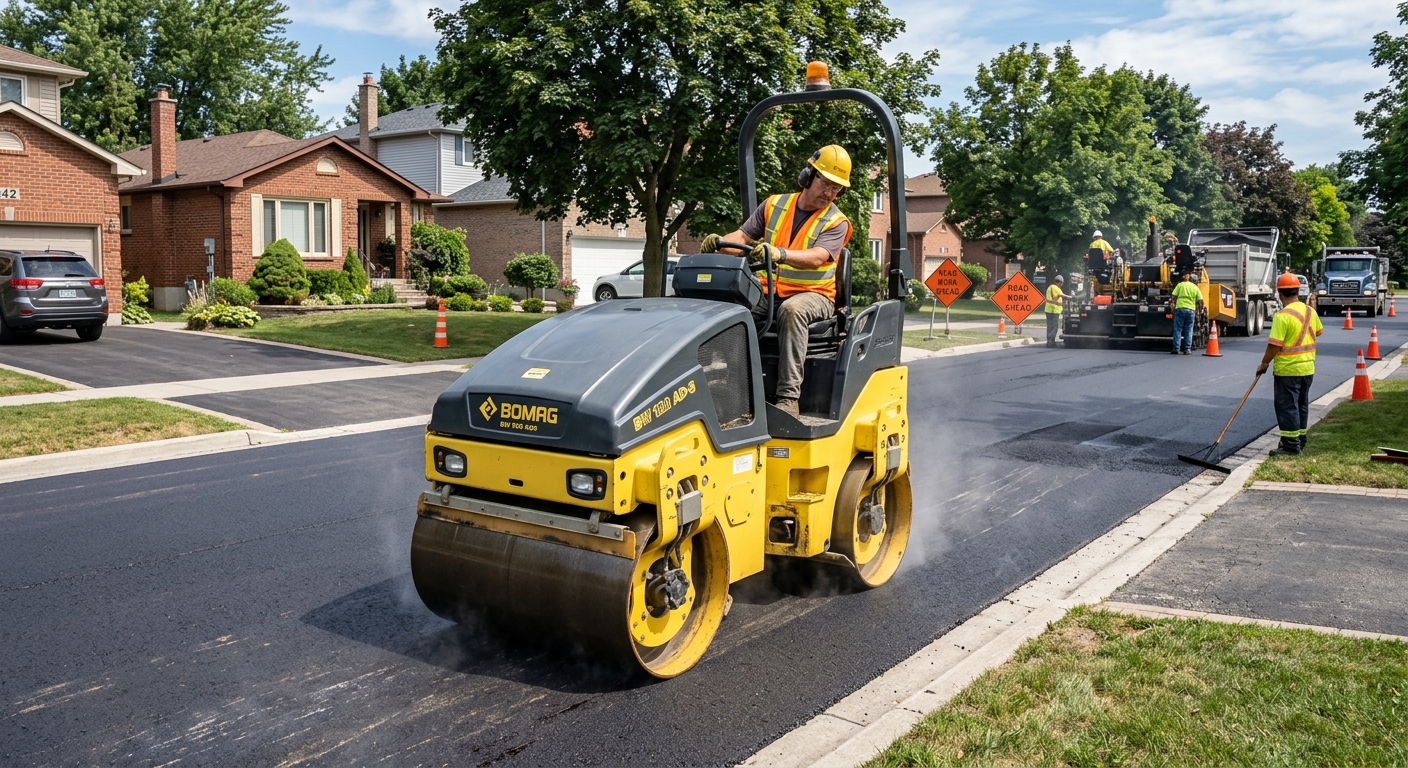
What a new driveway costs in Reading
Reading’s driveways are almost entirely a detached-home project. Less than 12% of dwellings here are single-family homes, and the homeownership rate is just under 40% (U.S. Census Bureau, ACS 2024), so when you do need a new driveway, it’s a significant investment for the few owner-occupied properties in the city and its suburbs.
The biggest difference between a quote at the high end and the low end is found underground, in the base. Very little of the paving price is in the visible surface. Reading sits in southern Pennsylvania’s freeze-thaw zone, where we see about 30 inches of frost depth each winter and repeated cycles of freezing and thawing. This punishes marginal base work—skimped stone, poor drainage, or thin layers almost always means the job fails early, though that’s not apparent until a few years down the line.
Eastern Berks County soils, often shale and limestone, also mean that driveways need thicker aggregate bases and careful grading. Expect that responsible contractors in Reading, Spring, and Exeter Townships pay close attention to these subsurface conditions, which is why their proposals may come in above state or national averages.
| Service |
Best for |
Lifespan |
Price range |
| Asphalt — full replacement with new base |
failed base, structural cracking |
20–30 yrs |
$3,400–$8,700 |
| Asphalt overlay / resurfacing |
sound base, surface cracking only |
8–15 yrs |
$1,450–$4,300 |
| Sealcoating — single application |
preventive maintenance on sound asphalt |
2–4 yrs |
$200–$650 |
| Concrete — new installation |
long service life, low maintenance |
30–50 yrs |
$4,800–$11,500 |
| Crack filling and patching |
isolated cracks under a quarter inch |
1–3 yrs |
$200–$800 |
| Gravel driveway |
rural, budget, long runs |
5–10 yrs with upkeep |
$900–$3,500 |
Estimates for a typical Reading driveway. Square footage and base condition drive these figures more than material choice.
Grading and water management on a Reading driveway
Water—and how you deal with it—is what makes or breaks a driveway in Reading and Berks County. Proper grading isn’t about looks; it’s the defense against freeze-thaw cycles that tear up the pavement from below. At a minimum, the driving surface should slope away from structures at 1–2% (about an eighth to a quarter inch per foot). Most driveways here use a cross-slope to direct water off the pavement, and you often see a gentle crown in wider runs.
A driveway that pitches toward the garage or house spells trouble—water will pond, work its way into the base, and once winter hits, freeze and heave. In these spots, you can’t always fix the grade without major excavation. That’s where trench or channel drains at the garage entry can save a foundation.
Eastern Berks’s shale and limestone subgrade actually helps drainage, compared to heavy clay, but if you pave over pockets of impermeable fill, water will still be trapped and cause soft spots. Whenever you daylight a drain (discharge it on the surface), be sure the outlet isn't pushing runoff onto a neighbor’s property—no permit protects you from resulting liability.
Some townships may require dry wells or other measures if you’re adding significant new hard surface. But even when the rules are silent, the driveway’s future depends on getting every drop of water off and away from it, fast.
Sealcoating: what it does and what it doesn't
Most advice out there on sealcoating comes from people looking to sell you frequent applications. Here’s the straight story for Reading homeowners. Sealcoating, at its best, puts a barrier between the asphalt binder (the “glue” in blacktop) and the sun, air, and dripped car fluids. It slows oxidation, gives a uniform black look, and can make your driveway look years younger for a modest outlay—a typical application here runs between $200–$650.
But sealcoat doesn’t add strength or fix any structural problem. Alligator cracking, low spots, and failing edges aren’t improved beneath a layer of sealer. If your driveway’s base is failing, sealcoat is just paint on a rusting car.
What most contractors won’t admit: too-frequent sealing is almost as bad as too little. Building up layers every year traps water between coats, which then cracks and peels in freeze-thaw. For new asphalt, you want to wait at least six months to a year so the material can fully cure; put sealer on too soon and you lock in solvents that should escape.
Crack filling is a better investment than overspending on sealcoating, especially for cracks under a quarter inch. It keeps out water, the main driver of base failure. And the job quality matters—a thick, broomed application lasts far longer than the cheapest spray treatment, which may look good for a season and then disappear. If a price comes in well below $200, it usually means a watered-down product or no prep at all.
What you need before paving in Reading
If you’re repaving an existing driveway in Berks County and not changing its footprint, you usually don’t need a building permit—most townships, including Reading, allow basic resurfacing without one. But where your driveway meets the street, you’re dealing with a separate permit. If your driveway ties into a state route, you need a Highway Occupancy Permit from PennDOT; otherwise, your local township office handles aprons and approaches.
If you expand your paved area, especially in Spring Township where new impervious surface over 5,000 square feet triggers review, you may face stormwater engineering or even runoff retention requirements. Even if you don’t need a permit, no code lets you direct runoff onto a neighbor. Liability follows the water, not the application.
Contractors are subject to the Home Improvement Contractor (HIC) registration from the Pennsylvania Office of Attorney General for jobs over $500—verify registrations at hic.attorneygeneral.gov. Workers’ compensation is mandatory for all employers in Pennsylvania; you can check coverage status through WCAIS at wcais.pa.gov.
Get a written contract; HICPA requires it over $500, along with a three-business-day right to cancel. If a contractor offers to "waive your deductible" for insurance work, that’s prohibited in Pennsylvania.
The specifications to demand in writing
When you’re looking at bids in Reading, the most important information is what can’t be seen after the blacktop goes down. It’s not enough to compare the per-square-foot price. Always demand a written quote with full specifications, especially here, where freeze-thaw cycles and deep frost (30 inches) can destroy underbuilt driveways in just a few winters.
What does this mean? Every dimension, material, and method—stated numerically. Excavation depth, base depth (and type—Berks’s shale and limestone subgrade often means two 3-inch lifts of clean stone, not cheap recycled fill), compaction method and confirmation it will be done in lifts, not all at once. Asphalt thickness should be as "compacted," not just as laid—hot asphalt can lose a third of its depth under the roller. Mix type—because the wrong aggregate will pop out in our freeze cycles. Edge treatment, like hand-tamped borders or concrete restraint, guards against crumbling.
Beware the “three-inch” promise: is that before or after rolling? It should be at least two courses, each compacted, and the spec should say so in writing.
- Measured square footage of the paved area
- Excavation depth below finished grade
- Base aggregate type (e.g., crushed stone, size) and total compacted depth
- Base installation in two or more compacted lifts
- Binder course thickness as compacted (and mix ID)
- Surface course thickness as compacted (and mix ID)
- Compaction method (roller weight, passes per lift)
- Edge treatment (hand-tamped, concrete border, etc.)
- Final grading and drainage slope direction
- Cleanup, disposal, and restoration of disturbed areas
Reading a driveway proposal
A proper Reading driveway proposal spells out every step: how many square feet are being paved, the depth of any excavation or removal, the type and amount of stone for the base, compaction details, and the thickness of each asphalt layer quoted as compacted. Good bids also cover edge support, drainage strategy, and what happens to the lawn edge or landscaping after the work is done.
Payment terms should be modest—no heavy up-front asks. Warranties should be written, and you should know exactly what is and isn’t covered. Most driveway warranties in Pennsylvania exclude new cracks, so if a contractor promises otherwise, ask for it in writing.
A one-line quote with just a price can’t be compared to anything—and that’s how most people end up overpaying for underbuilt driveways in Berks County. Demand line items, and you’ll spot where corners might be cut.
| Line item |
What to look for |
Red flag if… |
| Area |
measured square footage stated |
eyeballed or absent |
| Excavation |
depth and disposal included |
'we'll pave over it' |
| Base |
aggregate type and depth in inches |
'proper base' |
| Compaction |
method, and done in lifts |
not mentioned |
| Asphalt |
courses and compacted depth |
'3 inches' unqualified |
| Drainage |
slope and water direction stated |
silent |
| Warranty |
what is covered and what is excluded |
verbal only |
| Payment |
modest deposit, balance on completion |
full cash up front |
Why driveways behave differently in Reading
Eastern Berks County and Reading sit atop shale and limestone subgrades—those aren’t details just for geologists. Shale, while stable, can fracture and become soft when saturated, and limestone is notorious for hidden air pockets that can lead to later settlement if not compacted and bridged with a substantial base layer. As a result, most Reading-area driveways need a thicker aggregate base than you’d see in places with sandier or clay-heavy soils.
Pair those local ground conditions with our 30-inch frost depth and regular freeze-thaw cycling, and it’s easy to see why driveways laid on the cheap seldom last past their warranty. When moisture gets into a thin base, then freezes, the expansion pushes up from below, making cracks and potholes almost inevitable in a few winters.
On top of that, a huge number of houses around Reading were built during the 1950–1980 suburban surge—driveways from that era were often built quickly, sometimes over fill and without enough stone or compaction. That means the odds are good that an older driveway is overdue for full-depth reconstruction, rather than patching or just a cosmetic overlay. A job that cuts corners on base prep here nearly always shows its flaws within a few years; spending more up front on base pays off on our ground.
Frequently asked questions — driveway paving in Reading
Is an overlay worth it or should I start over?
If your Reading driveway has only surface cracks and the base underneath remains solid (no soft spots or severe settling), an overlay can be a cost-effective choice. Overlays are suited for driveways from the 1970–1980s that haven’t shifted or crumbled at the edges. But if you see structural cracks, deep dips, or signs of base failure—in older parts of Berks County, this is common due to original light-duty construction—then a full replacement is usually the wiser investment. Patch-and-overlay might run you $1,450–$4,300, but if the base fails, that whole investment peels up in a winter or two, costing more in the end. Get a professional to core-drill and check the base if there’s any doubt.
What does an asphalt overlay cost in Reading?
For most residential driveways in Reading and the nearby suburbs, an asphalt overlay—meaning you’re resurfacing the existing blacktop if the base is still solid—runs between $1,450–$4,300, with an average sized drive typically landing close to $2,900. The main variables are square footage and how much edge prep is needed. If your driveway has been there since the 1970s or 1980s, the base may not be up to current specs, so have it checked before deciding on an overlay. If you hear a lower price, ask if it covers milling and cleaning the surface, or just a thin cap—which won’t last long in Berks County’s freeze-thaw cycle.
Why are paving quotes in Reading so different from each other?
The big price swings you’ll see between Reading paving quotes nearly always come down to what’s done under the surface and how well specs are spelled out. Some contractors quote only a thin overlay, while others budget for proper excavation and base rebuilding—which matters most in Berks County’s shale and limestone subgrade. Quotes from reputable outfits tend to land in the $3,400–$8,700 range for a full replacement with new base, as our climate and frost depth drive up the required thickness. Watch out for “lump sum” numbers with few details; you can’t compare those to bids that break out base depth, type, and compaction.
How deep should the aggregate base be here?
In eastern Berks County—Reading, Spring, Exeter, and nearby townships—the local shale and limestone subgrade and our 30-inch frost depth dictate a thicker base than in milder regions. You want at least 6–8 inches of compacted, clean crushed stone; often, two lifts of 3–4 inches each are specified for proper stability. Some older driveways from the 1950–1980s have only 2–4 inches or were built over fill, which is why so many fail early and need full-depth replacement (costing $3,400–$8,700). A thick, well-compacted base is the difference between a driveway that lasts and one that ripples and cracks within a few seasons.
Are there stormwater rules on paving in Reading?
Yes, and they’re worth understanding before you widen or replace your drive. In Spring Township, for example, any new impervious area over 5,000 square feet or more than one acre of disturbance triggers a permit and possible stormwater review. Even where no permit is needed for plain resurfacing, local codes and liability concerns forbid you from channeling runoff onto a neighbor’s property. If you add surface and change how water flows, you may need drains or even dry wells—costing extra on top of your paving price ($1,450–$8,700, depending on the degree of work). Check with your municipal office if you’re planning more than a straight replacement.
Are door-to-door pavers a problem in Reading?
You do see seasonal crews knock on doors in Reading and the wider Berks County suburbs, especially after a patch of warm weather or when major roadwork finishes. Pennsylvania requires any contractor doing home improvement work worth more than $500 to have a Home Improvement Contractor (HIC) registration, and reputable crews list their number—check it at hic.attorneygeneral.gov. Door-to-door gypsy pavers seldom provide written contracts or warranties and often cut corners on the base, so the work may fail within a couple of years. Even a low price—sometimes under $1,450 for an overlay—comes with big risks. Don’t hire from a flyer or a pickup without PA registration.
Can asphalt be laid in cold weather?
In Pennsylvania (Reading included), it’s not advisable to pave asphalt below 45°F, and you want daytime temps to be consistently warmer. Asphalt cools fast, and if it’s too cold out, there’s not enough time to spread and compact before it stiffens—leading to low spots or unbonded layers. Certain “cold patch” options exist for emergency repairs over winter, but those are temporary at best. You’re better off waiting until spring or early fall for full replacements or overlays ($3,400–$8,700 for full replacement). Ask your contractor about temperature windows and don’t let anyone rush you into a cold-weather install.
When can I seal a brand new asphalt driveway?
In Reading’s climate, a new asphalt driveway needs time—six months to a year—to cure before you put sealer on it. Asphalt is full of oils and volatiles when fresh; sealing too early locks those in, which leads to a soft, sticky surface or later peeling when trapped water freezes. Wait through one warm summer if you pave in spring, or until the next spring if you pave in the fall. A quality sealcoat application in Reading costs $200–$650 and does its best work on fully cured, stable asphalt. Your contractor should give you specific timing based on mix type and season.
Why are my driveway edges crumbling?
Driveway edge ravel—the crumbling at the sides—is very common in Reading and throughout Berks County. Local driveways from the 1950–1980s era often lack proper thickness and edge support, especially those paved over fill. Water penetrates and freezes in winter, breaking up the binder at the margins. Without a hand-tamped edge or a stone shoulder, the asphalt unravels with every frost cycle. To fix, a proper repair means saw-cutting the bad edge, rebuilding the base, and finishing with at least 6 inches of compacted stone and a neat, tamped margin—expect repairs to run $200–$800 and up, but patching alone won’t stop the cycle if base problems aren’t addressed.