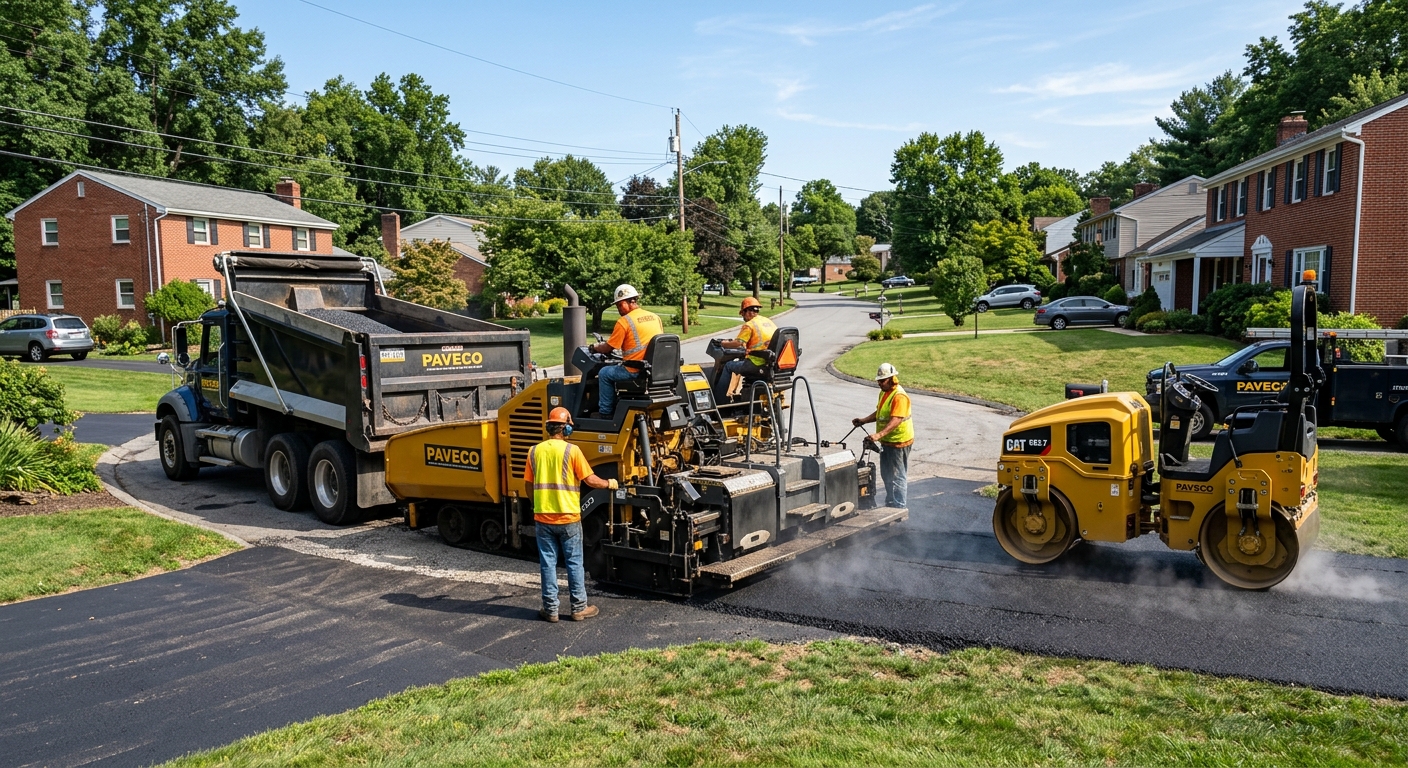
What a new driveway costs in Union
In Union, where 68.2% of homes are single-family and 88.1% are owner-occupied (U.S. Census Bureau, ACS 2024), most homeowners are facing driveway expenses that come with detached or semi-detached housing. Driveway paving isn’t a routine cost, so it pays to understand what drives prices here in southwestern Pennsylvania. Our heavy freeze-thaw climate and the stubborn clay and shale soils unique to Washington County mean driveways need more attention to base preparation than in a milder region. Many driveways look similar from the street, but the less visible work — excavation depth, base thickness, drainage correction — determines both price and how long the driveway will last. The gap between two quotes for a Union install is almost always explained by what goes on under the asphalt or concrete.
| Service |
Best for |
Lifespan |
Price range |
| Asphalt — full replacement with new base |
failed base, structural cracking |
20–30 yrs |
$3,300–$8,600 |
| Asphalt overlay / resurfacing |
sound base, surface cracking only |
8–15 yrs |
$1,450–$4,300 |
| Sealcoating — single application |
preventive maintenance on sound asphalt |
2–4 yrs |
$200–$650 |
| Concrete — new installation |
long service life, low maintenance |
30–50 yrs |
$4,800–$11,500 |
| Crack filling and patching |
isolated cracks under a quarter inch |
1–3 yrs |
$200–$800 |
| Gravel driveway |
rural, budget, long runs |
5–10 yrs with upkeep |
$900–$3,500 |
Estimates for a typical Union driveway. Square footage and base condition drive these figures more than material choice.
Asphalt or concrete for a Union driveway?
Southwestern Pennsylvania’s climate makes asphalt the practical standard in Union. Here, freeze-thaw cycles are not occasional; they happen repeatedly each winter. The ground pushes and moves as water in the subgrade freezes and expands, especially in our region’s clay-heavy soil. Asphalt, being flexible, gently rides these cycles — it will deform over time, but typically won’t crack wide open unless the base fails.
Concrete, on the other hand, is rigid and much more likely to spall or scale in these conditions, especially with regular use of de-icing salt — which is common here. Concrete can easily last twice as long as asphalt if it survives, but salt damage is usually what ends its life, not cracks from movement. To get the full 30–50 years from concrete, you must avoid salt-based de-icers. Most homeowners don’t, and the surface pays for it. Up front, concrete will always cost quite a bit more than asphalt in Union.
Paver and gravel driveways fill smaller niches. Pavers cost more than plain concrete but let you replace individual units if there’s movement. Gravel is truly low-cost but needs regular top-dressing, and loose gravel is generally not favored in town settings — better for long, rural runs.
| Option |
Installed cost |
Maintenance |
Freeze-thaw performance |
Lifespan |
| Asphalt — new install |
$3,300–$8,600 |
sealcoat every 3–4 yrs |
excellent, flexes |
20–30 yrs |
| Asphalt — overlay |
$1,450–$4,300 |
same |
good if base is sound |
+8–15 yrs |
| Concrete |
$4,800–$11,500 |
low, avoid de-icing salt |
fair, spalls with salt |
30–50 yrs |
| Pavers |
$7,700–$11,500 |
individual units replaceable |
good, settles gradually |
25–50 yrs |
| Gravel |
$900–$3,500 |
top-dress every 2–3 yrs |
excellent drainage |
indefinite with upkeep |
Why Union driveways fail from the bottom up
Every driveway in Union, whether asphalt or concrete, starts out strong and even — but what determines how long that will last is invisible: the layers underneath. There’s the native subgrade, almost always a mix of heavy clay and shale here in Washington County. Over that goes the compacted crushed stone, usually #2A modified, at least 6–8 inches deep for asphalt, sometimes 8–10 for concrete. Finally comes the pavement layer itself.
The freeze-thaw cycle is what breaks driveways in Union. Water held in our clay-rich subgrade expands as it freezes, heaving parts of the driveway upward — sometimes by inches — and dropping it again in spring. That cycle shatters every surface over time, but it happens faster when the base is thin or poorly compacted, and when drainage lets water collect underneath. If the base can’t spread load or keep water moving, the asphalt or concrete layer above won’t last, no matter how thick or well-laid it is.
This is where bargain quotes usually cut corners: skipping deep excavation, laying over a failed base, skimping on stone thickness, using the wrong aggregate, or paving in thin lifts without compacting each one. You won’t notice anything wrong the day the job’s done, but cracks, settling, and edge failures show up in Union by the time you hit the third or fourth winter — and by then it’s too late for a warranty call.
When you get an estimate, demand written specs: minimum 6–8 inches of compacted 2A modified for asphalt, documented compaction in 2–3 lifts, and a well-graded surface for drainage. These need to be in the contract, not just a spoken promise.
Permits and approvals for paving in Union
If you’re repaving your driveway without widening it or moving the entrance, you usually do not need a building permit in Union. Many local municipalities, including those surrounding the City of Washington, don’t require permits for straightforward resurfacing on a previously permitted driveway, especially along PennDOT-maintained roads. But when you alter the driveway approach — where it meets the public street — that nearly always requires a special permit. For local streets, this goes to the municipal office; for driveways connecting to a state route, permits come from PennDOT District UNKNOWN, not the borough or township.
Any time you increase your driveway’s size, you may trigger stormwater management requirements. More impervious surface means more runoff, and in Union’s hilly terrain, it can quickly create drainage issues. Even if permits aren’t required, you’re liable if runoff from your drive damages your neighbor’s property.
By state law, any paving contract over $500 must be in writing under the Home Improvement Consumer Protection Act. Contractors must hold Home Improvement Contractor registration from the Pennsylvania Office of Attorney General — verify at hic.attorneygeneral.gov — and carry active workers' compensation insurance, checked with the WCAIS system. These are your basic legal protections and should always be confirmed before signing a contract.
Maintenance that actually works
If you want your driveway in Union to last its full expected life, a few simple tasks matter more than expensive treatments. First and foremost: keep cracks filled before water gets below the surface. In our climate, once water gets into the clay or shale base and freezes, it wrecks the driveway by the next spring. Edge support is next. The asphalt or concrete at the perimeter needs a shoulder of soil or stone, so it won’t crumble under vehicle weight or erode in rain.
Controlling drainage is always worth the small effort — clear away leaves and silt from edges and downspouts so standing water never gets a foothold. Heavy vehicles, jacks, dumpsters, or parking with wheels turned in place all risk gouging or flexing your drive, especially before the asphalt fully cures — wait 2–3 days in summer, longer if it’s cool.
For de-icing, avoid salt on concrete altogether. It causes expensive surface damage here, much faster than in a mild region. On asphalt, the problem isn’t the salt, but the freeze-thaw cycling that comes with periodic melting. Alternatives like calcium magnesium acetate are safe but pricey — most homeowners here use sand or plain traction grit instead, replacing them as needed after snow events.
Choosing a paving company
A good paving job in Union is built on trust and verification. Start by checking if the contractor is registered as a Home Improvement Contractor with the Pennsylvania Office of Attorney General (hic.attorneygeneral.gov) — this is required for any contract over $500. Demand proof of active workers' compensation insurance using the state's WCAIS online system (wcais.pa.gov).
Look for a company with a clear, local business address in the region — not just a cell phone. Established contractors own their equipment and work out of a physical yard. References should be from jobs at least three years old, since even a bad resurfacing looks fine on year one. Ask who their asphalt supplier is; with several plants in the Pittsburgh–Washington corridor, any reputable paver can name theirs offhand. If they can’t, they may be simply brokering your job — or worse, showing up from out of state with leftover material.
- Registered with the Pennsylvania Office of Attorney General (HIC registration)
- Workers' compensation insurance confirmed via WCAIS
- Permanent local business office address
- Owned (not rented) paving equipment
- References from jobs at least three years old in Washington County
- Able to provide address of their asphalt supplier
- Written, itemized contract (not handshake or verbal)
- Proof of proper permit for approaches, if relevant
- No requests for up-front cash or pressure for immediate decisions
- Drainage and base repair experience for local clay/shale soils
- Detail compaction method and base thickness in writing
Red flags: door-to-door offers, unmarked vehicles, failure to provide paperwork before starting, and any unwillingness to name local references. Most paving scams in Union start at your front door and end with a rushed, thin job that fails in a few winters.
What to put in a Union paving contract
The only way to get true value from a paving job in Union is to push every contractor — including me — to spell out the details in writing. Price alone guarantees little when subgrade and freeze-thaw risk are this high. Never accept a quote that says only, “2 inches of blacktop.” Here’s why: asphalt is installed thicker than its final, compacted depth, and only the compacted thickness counts for longevity. Base preparation is even more critical, because of our clay and shale soils; shallow or loosely compacted bases collapse within a few winters of freeze and thaw.
Your contract should state, in inches, both the excavation depth and the aggregate base (2A modified, at least 6–8 inches), and specify “compacted in lifts.” For the asphalt, insist on separate numbers for binder course and surface course, with compacted depths (such as “2.5” base, 1.5” surface after compaction”) and the exact mix designations. Specify edge restraint — a squared, compacted shoulder or formed concrete edge helps prevent crumbly sides. Drainage details matter, since water pooling or poor slope here means rapid frost heave and early failure.
- Total excavation depth (inches from finished grade)
- Base material type (e.g., 2A modified stone) and compacted thickness
- Proof of compaction in lifts (number and thickness of each lift)
- Binder course and surface course depths, listed as compacted
- Mix designations for asphalt or concrete
- Edge restraint method (shoulder or formed edge)
- Driveway slope and drainage direction
- Asphalt delivered and laid hot (never cold patch for a full drive)
- Permits secured, if approach or expansion involved
- Cleanup and final payment terms based on owner inspection
Frequently asked questions — driveway paving in Union
How long does a driveway installation take?
In Union, the actual installation time for a new asphalt or concrete driveway is usually 1–3 days, depending on the scope and weather. Most of that time is spent preparing the subgrade and compacted base, which is the most critical part in our region’s clay and shale soils. After paving, you’ll typically need to wait 2–3 days before driving on new asphalt (longer in cool or damp weather), and at least a week for concrete. Factors like excavation, base repair, and approach permits can add a few days, especially if you’re widening or connecting to a public road. If you’re on a tighter budget and opt for an overlay on an existing asphalt drive, the work is faster—often completed in just one day—and usually costs between $1,450–$4,300. But always confirm the contractor’s schedule and curing recommendations before planning to park.
How much does driveway paving cost in Union?
Driveway paving costs in Union vary with your driveway’s size, shape, and the underlying base. Full replacement with new base is typical for older homes—expect to pay between $3,300–$8,600 for asphalt and $4,800–$11,500 for concrete. Asphalt overlays are less, ranging from $1,450–$4,300, but only suitable if the base is sound. Maintenance like sealcoating falls between $200–$650 per application. Since two out of three homes in Union were built before 1980 (U.S. Census Bureau, ACS 2024), verifying the driveway’s base condition matters more than material choice. Most importantly, don’t base your decision on price alone—specifications for excavation, drainage, and compaction drive both the upfront and long-term costs in our region’s climate.
Why are my driveway edges crumbling?
In Union, crumbling driveway edges are a sign that the base wasn’t extended wide enough or the soil shoulder has eroded. Our clay and shale subgrade, coupled with hilly lots, means water can easily pool at the sides and soften the edge. Over time, vehicle weight and wheel turns without proper edge support cause the asphalt or even concrete to crack and break away. This is common within a few years of a new install if the contractor didn’t specify edge restraint or compact a supporting berm. Edge repair can run $200–$800 depending on the extent, but the best solution is a proper rebuild with a wider base next time. For now, try to shore up the edges with soil or stone to prevent further damage and keep water draining away.
Are door-to-door pavers a problem in Union?
Yes, they show up every summer in Union and throughout Washington County. These crews often offer “leftover asphalt” at a steep discount, pressure for same-day decisions, and rarely provide a written contract. Many lack Home Improvement Contractor registration or active Pennsylvania workers’ compensation insurance. Even when the initial price sounds good—sometimes as low as $1,450—the job is almost always rushed and lays thin asphalt over an unprepared base. The driveway often cracks, sinks, or erodes within two winters. Local homeowners are far better off with a reputable, established contractor who can give references from jobs done three years ago, not last week.
Can I cancel a paving contract I signed at my door?
Yes, Pennsylvania’s Home Improvement Consumer Protection Act gives you three business days to cancel any home improvement contract signed in your home—even if you agreed with a door-to-door paver. This right is absolute for contracts over $500, and the contractor must provide written notice of your cancellation rights. Don’t be pressured by claims about quick deals or leftover material. If you cancel in writing within three days, you owe nothing. If you’ve paid any money, it must be returned. For driveways, where a bad job can cost $3,300–$8,600 to correct, never sign or pay on the spot—even if the price seems good. Call a local office, verify their HIC registration through hic.attorneygeneral.gov, and get the details in writing before you commit.
Is an overlay worth it or should I start over?
In Union, overlays (or resurfacing) are a smart choice only when the existing base is sound—meaning no major settling, potholes, or alligator cracking. An overlay usually costs $1,450–$4,300, compared to $3,300–$8,600 for a full replacement. If your base hasn’t moved and cracks are only in the top layer, a properly prepped overlay extends the driveway’s life by 8–15 years. But if water has already softened the base or frost has pushed up chunks of asphalt, resurfacing will hide failure for a year or two and then break up again. Don’t let anyone talk you into resurfacing over a failed base—it’s money wasted in our freeze-thaw-heavy part of Pennsylvania.
Is sealcoating a scam?
Sealcoating is not a scam, but it’s often oversold in Union. Sealcoating protects asphalt from UV damage and water intrusion but does not repair cracks or extend structural life. It’s suitable for preventing further weathering on a driveway with a sound base—a single coat every few years, at $200–$650, is fine maintenance. Beware any contractor who claims that sealcoating can fix deep cracks, potholes, or structural issues. These require proper repairs. Also, don’t let someone pressure you for annual sealcoating; in Pennsylvania, with our cooler climate and less direct sun, every 3–4 years is plenty for most driveways. Always ask what brand of sealer is being used, and never let anyone apply a "leftover load" at a price that sounds too good to be true.
How thick should asphalt be for a residential driveway in Union?
In Union’s clay and shale soils with our constant freeze-thaw cycles, thickness matters. For a standard single-family driveway, you want at least 6–8 inches of compacted aggregate base, plus 3–4 inches of asphalt placed in two lifts (typically 2–2.5 inches binder, 1–1.5 inches surface, all measured after compaction). Thinner installations, even at the higher end of the price range ($3,300–$8,600), just don’t last here. If your contractor offers a lower price but specs less base or only one asphalt lift, you’re buying a shorter lifespan and more repairs. Insist these depths be written in your contract—it’s the one way to ensure you get what you’re paying for and withstand Union’s winters.
Is gravel a cheaper option in Union?
Gravel is the least expensive driveway solution in Union—typically $900–$3,500 depending on length and access. It works best on rural properties or where budgets are tight, and it’s tolerant of our heavy freeze-thaw cycles and hilly landscape. Drainage is excellent, since water passes right through. But gravel does need regular top-dressing every couple years, plus grading after heavy rain or plowing. For most homes inside Union limits, gravel isn’t usually favored because it tracks dust and stone onto the street and into garages, and may not meet some local codes or HOA standards. Still, for long rural runs or temporary fixes, it’s sometimes the most sensible option.