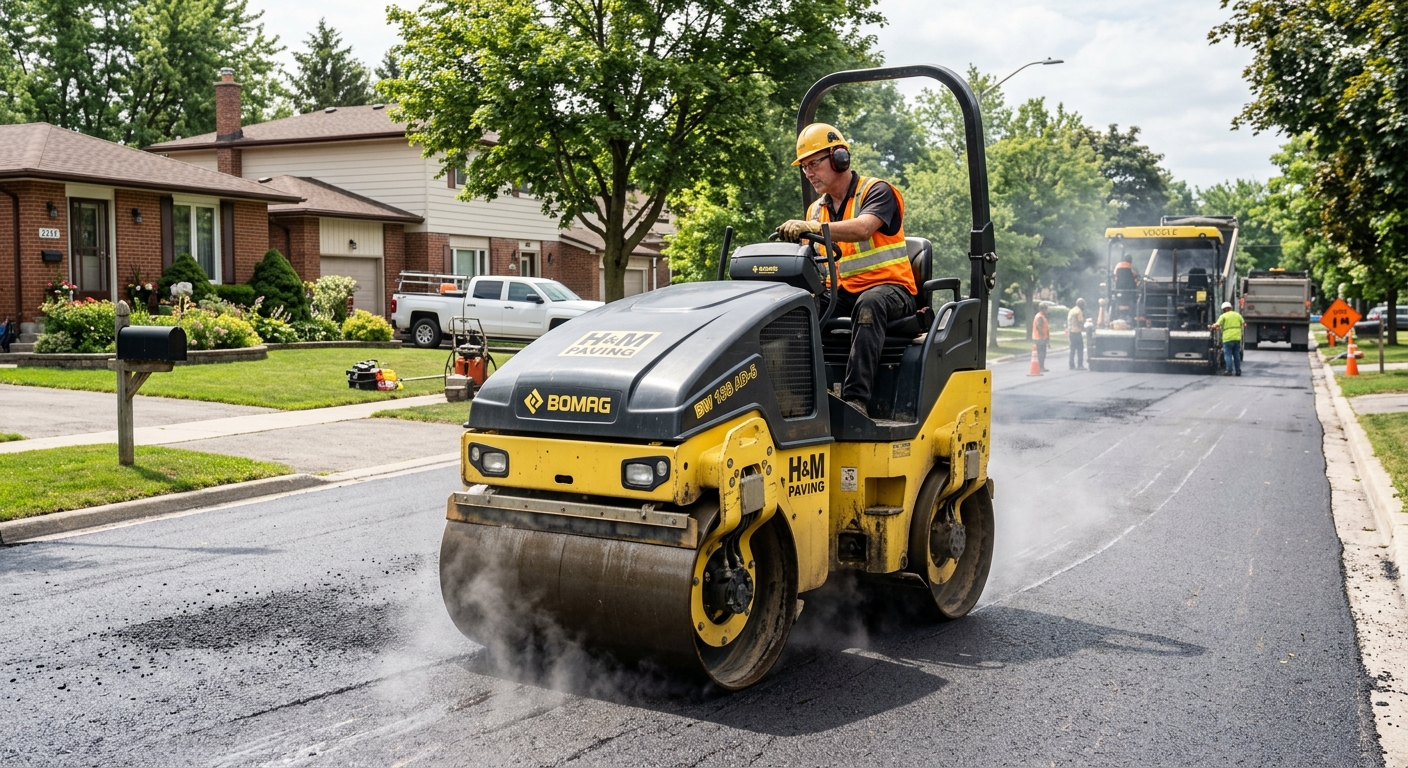
What a new driveway costs in Shenango
In Shenango, a driveway is one of the largest exterior expenses for single-family homeowners—and in this township, that’s most residents, with 84.7% homeownership and nearly 80% living in detached homes (U.S. Census Bureau, ACS 2024). When you price a new driveway, the number that matters most is how solid the surface will be three or four years from now, not what it looks like on the day of completion. That’s because our southwestern Pennsylvania climate pounds driveways with heavy freeze-thaw cycles, and the local clay-over-shale subgrade means water sits under the surface and multiplies the stress.
Whether you choose asphalt or concrete, most of the cost is buried under the top layer—your money goes into excavation, aggregate, drainage, and compaction. Two Shenango driveways that look identical in photos could vary by thousands of dollars because of what’s under the blacktop or slab. Cheap jobs often skip proper prep, but those savings unravel after a few winters as cracks, bumps, and potholes appear.
| Service |
Best for |
Lifespan |
Price range |
| Asphalt — full replacement with new base |
failed base, structural cracking |
20–30 yrs |
$3,400–$8,600 |
| Asphalt overlay / resurfacing |
sound base, surface cracking only |
8–15 yrs |
$1,450–$4,300 |
| Sealcoating — single application |
preventive maintenance on sound asphalt |
2–4 yrs |
$200–$650 |
| Concrete — new installation |
long service life, low maintenance |
30–50 yrs |
$4,800–$11,500 |
| Crack filling and patching |
isolated cracks under a quarter inch |
1–3 yrs |
$200–$800 |
| Gravel driveway |
rural, budget, long runs |
5–10 yrs with upkeep |
$900–$3,500 |
Estimates for a typical Shenango driveway. Square footage and base condition drive these figures more than material choice.
Base preparation: the part you pay for and never see
The base beneath your Shenango driveway dictates whether it lasts or falls apart after a few winters. Here, the build starts with the subgrade—typically heavy clay over shale, as found throughout Lawrence County. That soil holds water and expands as it freezes, a process called frost heave. The next layer is compacted crushed stone aggregate, and above that sits the asphalt or concrete. Each layer spreads and carries the load.
Why does this matter so much in southwestern Pennsylvania? Repeated freeze-thaw swings force water in the clay subgrade to freeze, expand, and lift sections of driveway. When it thaws, those lifted spots settle unevenly—cracking your pavement from below. In this climate, base thickness and drainage are not optional upgrades; they’re what prevent cracks and sinking and are a bigger concern here than in milder regions.
Shortcuts are easy to hide: skipping excavation, a thin or loosely compacted aggregate base, or laying new asphalt over a failed base all look fine the day of paving. But by year three, you’ll see cracks, dips, or potholes as the Shenango winters take their toll. The cheapest bid is almost always cutting corners under the surface, and there’s no way to “fix” a thin or soft base except to start over.
For Lawrence County’s clay soils and freeze-thaw cycle, demand these specifics in writing:
- Excavation: Typically 10–12 inches below final surface (to get below frost depth)
- Base: At least 6–8 inches compacted crushed limestone (2A or 2B aggregate)
- Compaction: Done in 2–3 lifts, not all at once, with a plate compactor or roller after each lift
- Drainage: Subsurface grading to move water away—never to a neighbor’s property
Get these on paper, not on trust, or you may be rebuilding sooner than you expect.
The specifications to demand in writing
A strong driveway in Shenango comes down to what’s in writing on your contract. It’s not enough to hear “three inches of blacktop”—thickness, compaction, and materials have to be spelled out. Our climate’s deep freeze-thaw swings and Lawrence County’s heavy, poor-draining clays demand more than just a standard build. Thin paving jobs that might perform for years in milder areas won’t survive long here. That’s why you want exact specs—a contract that states depths as compacted, not just as laid, since compaction shrinks the total. Ask for the PennDOT mix code, base material details, and lift thickness, because hand-waving is how jobs get cheap and get weak.
When a crew says “three inches,” you don’t know if they mean before or after rolling. Asphalt can compact as much as 25–30%, so “three inches laid” might mean “two inches finished”—not enough to last. The fix is clear, written figures. For this climate, typical specs should be deeper than what’s found in milder states. Edge restraint is especially key when the base is clay, as edges are the first to fail.
- Excavation depth in inches below finished grade
- Minimum aggregate base thickness (6–8 inches compacted limestone)
- Base aggregate type and gradation (2A or 2B stone, not millings as base)
- Compaction method — plate compactor or roller, every 2–4 inches (“in lifts”)
- Asphalt binder course — compacted thickness (at least 2 inches)
- Asphalt surface course — compacted thickness (1.5–2 inches)
- Material specs, such as PennDOT mix designation (e.g., ID-2)
- Edge treatment method (sod backfill, curb, or taper)
- Drainage plan and direction of runoff
- Seam details if tying to old pavement
Overlay, patch or full replacement?
If you’re deciding whether to overlay, patch, or fully replace your Shenango driveway, the real answer is in your base. No amount of fresh blacktop will solve a base that’s already failed. Here’s what you can look for before calling a contractor: widespread alligator cracking—that scaly, broken pattern—nearly always means the base has moved or eroded, and putting fresh asphalt over it is just burning cash. Isolated, straight-line cracks are less urgent, often just surface aging. If you notice low spots holding water, your subgrade has settled or heaved. Crumbling shoulders? Your drive was built too close to the edge, or skimmed on support. Potholes mean water has punched through to the base and driven out stone below.
If a contractor quotes an overlay without cutting test patches or probing the base, that’s a red flag. They should be willing to diagnose, not just resurface. Here’s how to match what you see with the best fix:
| What you see |
Likely cause |
Right fix |
Cost |
| Isolated cracks under 1/4 inch |
surface aging |
crack fill and seal |
$200–$650 |
| Alligator cracking over a wide area |
base failure |
full replacement |
$3,400–$8,600 |
| Depressions holding water |
subgrade movement |
excavate and rebuild that area |
$3,400–$5,300 |
| Crumbling edges |
no edge support |
edge repair, consider curbing |
$400–$1,500 |
| Potholes |
water into the base |
full-depth patch, then assess |
$250–$900 |
| Faded but sound surface |
oxidation only |
sealcoat |
$200–$650 |
Driveway permits, approaches and stormwater rules
In most of Shenango Township and rural Lawrence County, you often don’t need a building permit just to resurface or patch your existing private driveway, especially when it’s not being changed in size or location. That’s less paperwork for you, but don’t assume you’re off the hook completely. The spot where your driveway meets a public road—the approach or apron—usually does require a separate permit, and the agency is often not the one people first expect. If the driveway connects to a state route, you need a Highway Occupancy permit from PennDOT District 11-0 for any new or widened approach. For connections to city streets in New Castle, the city’s Code Enforcement Department manages these permits.
If you expand your drive or add surface (going from gravel to asphalt, or widening the slab), you could trigger local runoff or stormwater requirements, especially near streams. Sending water from your drive onto your neighbor’s lot is a liability, even if you have all proper permits—always direct water to a suitable discharge or daylight it safely.
Pennsylvania requires contractors to register for a Home Improvement Contractor (HIC) number for jobs over $500. You can verify registration at hic.attorneygeneral.gov. All employers must carry workers’ compensation insurance in Pennsylvania—verify active coverage at WCAIS (wcais.pa.gov) to protect yourself from liability.
Widening, extending or adding a parking pad
Thinking about widening your Shenango driveway for a second car, running it to a detached garage, or adding a new parking pad or turnaround? These projects are different from straight replacements. Any new paved footprint means you’re building over undisturbed clay subgrade that’s never been compacted, so the base needs to be dug, filled, and rolled just like for a new driveway. Where new paving meets the old, the seam will always be a weaker point—that joint will show first in heavy freeze-thaw cycles, so ask how transitions will be handled.
Adding square footage to your driveway can set off stormwater runoff rules or impervious surface limits in some municipalities, and may require an approach permit if you’re making a new entrance or modifying the width at the road. Always keep new work away from property lines unless you’ve checked setback rules with your township office—they’re stricter than most people expect. And remember, any change in surface or drainage can put you at risk if runoff goes onto a neighbor’s land. Pull permits as needed, especially for new connections or extensions to public streets.
Grading and water management on a Shenango driveway
Water destroys more driveways in Shenango than any other factor, and grading is your top defense. At a minimum, your driveway should slope away from structures and the road at 2% (about a quarter-inch per foot) so water runs off before it can sit on or seep into the pavement. For wide driveways, a slight crown—higher in the middle—lets water exit both sides. If your drive slopes back toward your house or garage, water will pool and infiltrate alongside foundations or through hairline cracks—freeze-thaw action then pries the surface apart each winter.
Channel or trench drains can collect and move water if you’re boxed in by grade, but they need to empty somewhere—ideally daylighting to a safe spot, not just onto your neighbor’s property. On Lawrence County’s typical clay soils, poor drainage is magnified. Water lingers right against the aggregate base, then freezes, heaving the drive and causing cracks or humps. Dry wells are an option, but fill up fast in clay and may not solve the problem long-term if undersized.
If you redirect water off your property without thinking about final discharge, you risk legal—and neighbor—trouble. Permits can keep you compliant, but only good grading, base preparation, and controlled runoff keep your driveway sound through Shenango’s wet springs and hard winters.
Frequently asked questions — driveway paving in Shenango
Asphalt or concrete for a Shenango driveway?
Both materials work in Shenango, but your choice depends on what you want out of your driveway. Asphalt is more popular here due to lower upfront cost and easier repair from freeze-thaw damage, especially with our heavy clay and shale soils. You’ll pay $3,400–$8,600 for a full asphalt replacement, while concrete runs higher at $4,800–$11,500. Asphalt can handle movement from our freeze-thaw cycles, but needs regular sealing to reach the upper end of its lifespan. Concrete lasts longer—30 to 50 years—but it has higher upfront cost and is less repairable if heaved or cracked by frost. If you’re in it for the long haul, concrete may be worth the price, but for most Shenango homeowners, asphalt’s flexibility and repairability make it the default choice.
What is the difference between crack filling and sealcoating?
Crack filling and sealcoating are two very different maintenance steps for Shenango driveways. Crack filling injects flexible rubberized material into individual cracks, stopping water from getting through. This is the first line of defense in our area because every freeze-thaw cycle can widen existing cracks and start new ones. Sealcoating is a thin, tar-like layer squeegeed or sprayed over the full driveway to protect the asphalt from weather and UV rays. In Shenango, with our heavy winter conditions, sealing gives you 2–4 years of surface protection per coat, costing $200–$650, while crack filling keeps isolated cracks from expanding into major base failures. The best approach is both: fill cracks, then seal for maximum life and minimum water infiltration.
How much does driveway paving cost in Shenango?
For most single-family homes in Shenango, a full asphalt replacement with new base runs $3,400–$8,600 depending on size, shape, and what’s needed for subgrade prep. An overlay (asphalt over an existing solid base) is less—$1,450–$4,300. If all you need is sealcoating for maintenance, it’s usually $200–$650. Concrete installation starts around $4,800 and can reach $11,500 for a long or wide driveway. These figures are for typical Shenango properties—problems like poor drainage, challenging access, or deep excavation can push the project toward the upper end. Always make sure a quote spells out what’s included under the surface; that’s what makes or breaks the job.
Do I need a permit to repave a driveway in Shenango?
In Shenango Township and much of rural Lawrence County, you usually don’t need a building permit to resurface or patch your existing driveway—this saves time and paperwork for most homeowners. But don’t overlook the approach: if you’re making a new connection to a public road or widening that approach, you’ll likely need a separate permit. For state routes, you need a Highway Occupancy permit from PennDOT District 11-0; for city streets in New Castle, the city Code Enforcement office handles those. Expanding your drive might trigger stormwater or impervious-surface rules in some townships. When in doubt, check with your municipality. Contractors working over $500 are required by Pennsylvania law to have a Home Improvement Contractor registration—always verify this before hiring.
How many freeze-thaw cycles does Shenango get?
Shenango and the rest of southwestern Pennsylvania experience dozens of freeze-thaw cycles each winter—our climate has a winter design temperature of 8°F and more than 5,600 heating degree days annually. That means temperatures swing above and below freezing repeatedly, causing water in our clay-rich subgrade to expand and contract. Each cycle lifts and re-settles driveway slabs or asphalt, so base prep and drainage are critical here. Driveways not built with at least 6–8 inches of compacted base often fail after just a few freeze-thaw seasons. Paying for a proper base might be the difference between lasting 20 years or redoing your drive after just five, especially with a replacement price of $3,400–$8,600.
How far ahead should I book a paver in Shenango?
In Shenango, most professional paving contractors book several weeks out during peak season (late spring through early fall). Because Lawrence County sits on the fringe of the Youngstown–New Castle metro, demand near New Castle is moderate and rural demand is thin—slots fill faster during dry spells. For a full replacement, aim to reach out 4–8 weeks before your target date. Basic sealcoating can sometimes be scheduled sooner, usually within two to four weeks if the weather cooperates. Don’t wait until cracks turn to potholes—solving problems early saves you from paying $3,400–$8,600 for a new driveway when crack filling or patching at $200–$800 would have bought you a few more years.
How much does a concrete driveway cost in Shenango?
For most single-family homeowners in Shenango, a concrete driveway runs $4,800–$11,500, with the typical price around $7,700. The wide range comes from differences in length, width, base prep, and driveway shape. Concrete costs more up front than asphalt, but often lasts decades longer—sometimes 30 to 50 years with little maintenance beyond sealing the joints. If your site has poor drainage or the drive will need tight curves, those factors may mean more labor and a cost above the average. Remember, most older homes in Shenango (built before 1980) need subgrade correction to support heavy concrete, so never accept a quote that’s just “per square foot” without base depth and soil prep included.
How thick should asphalt be for a residential driveway in Shenango?
With Lawrence County’s clay-heavy subgrade and demanding freeze-thaw cycles, you should require at least 6–8 inches of compacted crushed stone base beneath your asphalt. The asphalt itself should have a binder course of at least 2 inches and a surface course of 1.5–2 inches as measured after compaction. Quotes that only promise “three inches” often mean pre-compaction, which is not enough once rolled and settled. This spec is deeper than in milder areas, but Shenango winters demand it—going thinner often leaves you paying $3,400–$8,600 again much sooner. Strong specs in writing are the only way to ensure you get what you’re paying for.
What are the signs of a failing driveway base?
Signs of base failure on a Shenango driveway can’t be ignored. Widespread alligator cracking (that broken-glass look), deep depressions that collect water, or frequent potholes all indicate the base is weak or waterlogged. Crumbling or broken edges mean either the base wasn’t wide enough or there’s no edge support—common with our soft clay subgrade. If you repeatedly patch a spot and it keeps coming back, that’s evidence the problem is underneath, not the surface. Any of these signs mean a full replacement—priced at $3,400–$8,600—is likely smarter than repeated patching. Sealcoating or overlays won’t fix base problems in Shenango’s climate, so don’t waste money chasing the symptom when the cause is deeper.