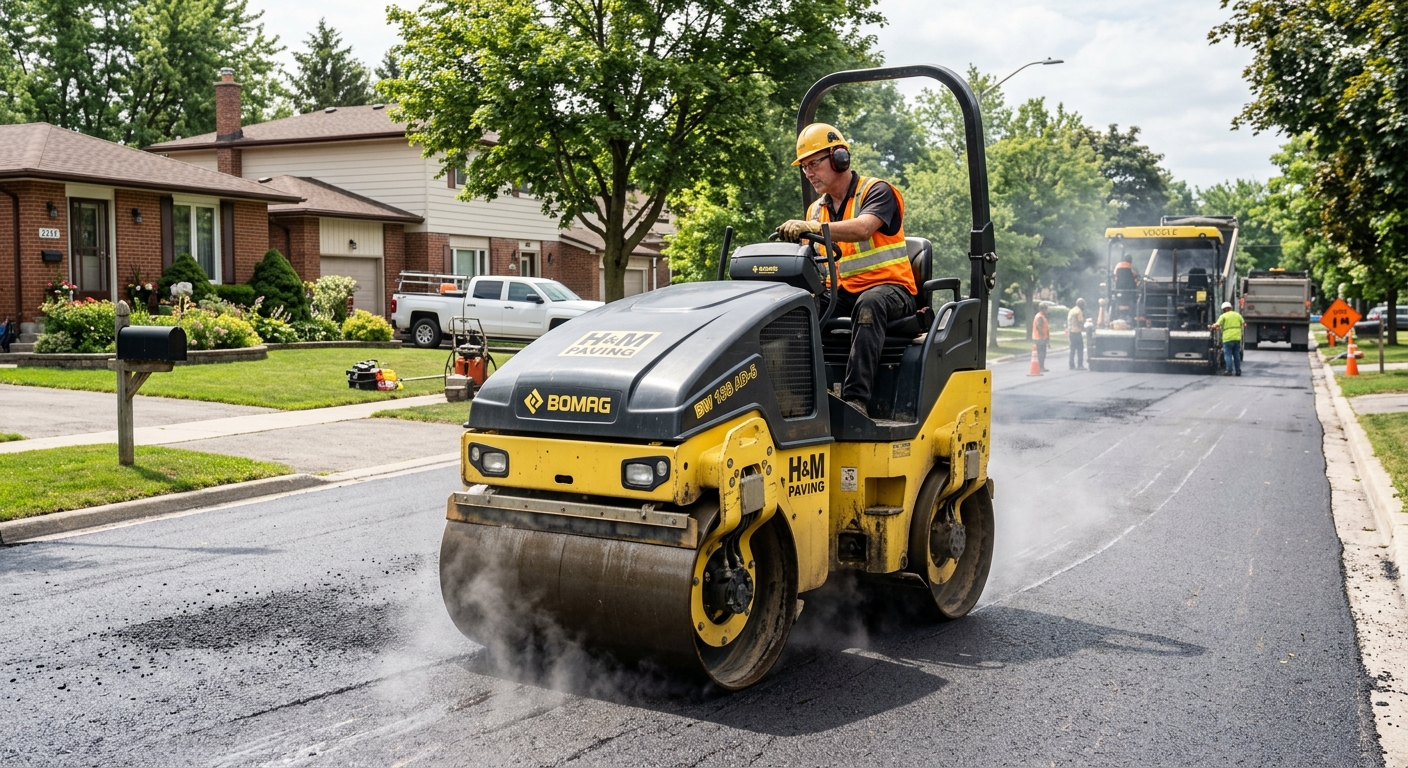
Driveway paving costs in New Holland — 2026
In New Holland, where over 65% of homes are single-family and the homeownership rate sits above 70% (U.S. Census Bureau, ACS 2024), driveway paving is a common project—and a meaningful investment. The area’s pronounced freeze-thaw cycles are tough on pavement. Local limestone subgrade in areas like East Hempfield demands good drainage and a thicker aggregate base to avoid future sinking and swelling. While asphalt and concrete are both used, most of what drives the price for driveways here isn’t visible from above. It’s the labor and materials beneath the surface—base depth, compaction, subgrade prep—that make up the difference between a cheaper quote and one that actually lasts through our winters.
While comparing estimates, remember that base preparation and drainage correction cost money but pay off for longevity. A surface that goes straight over soft or poorly compacted ground, especially in a climate like south-central Pennsylvania’s 30-inch frost depth, may look fine at first but can rut or crack soon after a hard winter. Here’s what a typical homeowner can expect to pay for major driveway services in New Holland:
| Service |
Best for |
Lifespan |
Price range |
| Asphalt — full replacement with new base |
failed base, structural cracking |
20–30 yrs |
$3,400–$8,700 |
| Asphalt overlay / resurfacing |
sound base, surface cracking only |
8–15 yrs |
$1,450–$4,300 |
| Sealcoating — single application |
preventive maintenance on sound asphalt |
2–4 yrs |
$200–$650 |
| Concrete — new installation |
long service life, low maintenance |
30–50 yrs |
$4,800–$11,500 |
| Crack filling and patching |
isolated cracks under a quarter inch |
1–3 yrs |
$200–$800 |
| Gravel driveway |
rural, budget, long runs |
5–10 yrs with upkeep |
$900–$3,500 |
Estimates for a typical New Holland driveway. Square footage and base condition drive these figures more than material choice.
How paving fraud actually operates
Paving is notorious for attracting transient scammers, especially in a rural county like Lancaster where homes are spaced out and word travels slowly. The classic pitch starts with a knock on the door: someone claims they have “leftover asphalt from a job down the road,” can “give you a deal if you decide today,” and pulls up in a truck with out-of-area plates or no markings at all. Sometimes they want cash up front, or promise to come back to finish after you’ve paid. They’ll offer a verbal quote, skip the written contract, and hand you a receipt scribbled on scrap paper. For sealcoating, the scam is a sprayed-on oil coat that looks dark but soaks away or tracks off in days—leaving almost no protection behind.
Why does it work here? Because in a thinly populated market like Lancaster County, confirming a contractor’s local history is harder, and neighbors are less likely to compare notes. The law tries to protect homeowners: under the Pennsylvania Home Improvement Consumer Protection Act, you have the right to a detailed written contract for any paving job over $500, and a three-business-day right to cancel after signing. That pause exists so you can get a real quote or verify credentials before committing.
Give yourself five minutes before you sign: check HIC registration at hic.attorneygeneral.gov, ask for a written scope and price, never pay fully in advance, and insist on proof of workers' compensation via WCAIS. Scammers won’t have the patience—or the paperwork.
Changing the footprint of a New Holland driveway
If you’re expanding your driveway in New Holland—adding a parking pad, extending to a detached garage, or widening for a second vehicle—you’re taking on a different class of project than simple resurfacing. Anything that puts pavement where there wasn’t any before means starting with a new stone base over undisturbed soil. These additions are permanent weak points at the seam with the old drive, so treating that joint with care is critical to keep water from sneaking under and breaking it up over the years.
Local limits may apply, even outside Lancaster city. Lancaster County townships usually don’t require permits for resurfacing a private driveway, but if you’re changing the layout—widening, lengthening, or creating a new entrance—check with your municipal office first. In Lancaster city, new driveway approaches and curb cuts always need a permit from the Bureau of Engineering, while properties near state routes get referred to PennDOT District 8-0. Stormwater rules are another catch: impervious coverage limits may prevent paving right up to the property line, and increasing runoff onto a neighbor’s yard can get you into costly disputes even if you’re inside your lot. Proper planning up front avoids headaches later.
Local soil, drainage and driveway lifespan
The ground under a New Holland driveway is most often limestone karst, especially if you live near East Hempfield Township. This type of limestone subgrade drains well but also settles unpredictably, sometimes causing dips or soft spots if the base isn’t thick enough or drainage isn’t handled properly. In older neighborhoods closer to Lancaster city, many driveways were originally built to standards that would never pass today, especially those serving pre-1940 homes with narrow, shared runs and awkward curves at the apron. These older drives may have thin or poorly compacted bases, causing faster rutting and winter heave.
The region faces pronounced freeze-thaw cycling and a 30-inch frost depth. If clay is present, you may see more heaving and cracking—water trapped in clay expands as it freezes, lifting the pavement—while shale or glacial till soils handle drainage differently, sometimes letting water move quickly under the base. The right fix depends on reading the ground: deepening the stone base over limestone, installing underdrains in clay-heavy plots, and redesigning the slope of the drive where runoff is an issue. The best investment is always below what you can see—paving on the cheap here can mean relaying the whole thing after only one bad winter.
Driveway permits, approaches and stormwater rules
In most Lancaster County townships, you generally do not need a formal permit to resurface or replace a private asphalt driveway in its existing footprint. That’s a break for New Holland homeowners—no extra fees or reviews just for routine maintenance. However, anytime you’re creating a new driveway connection or modifying the approach where your drive meets the public road, things change. In Lancaster city, these curb cuts and approaches need a permit from the City of Lancaster Bureau of Engineering; for properties that front on state roads, PennDOT District 8-0 issues the approach permit. These steps matter because improper construction at the approach can damage the sidewalk, storm drain, or curb, and you’ll be responsible for repair.
Anyone expanding a driveway or adding pavement should check local impervious-surface regulations. More paving means more runoff—which can trigger stormwater management requirements even if you’re not touching the public right-of-way. It also means you can’t simply send water onto the neighbor’s lot; you’re liable for runoff, and regrading must direct water properly.
No matter where you live in New Holland, any contract over $500 requires the contractor to have Pennsylvania Home Improvement Contractor (HIC) registration (verify at hic.attorneygeneral.gov). The crew must also show proof of workers' compensation; this is quickly checked through WCAIS (wcais.pa.gov). Don’t skip these steps—your wallet and property depend on it.
Caring for a new New Holland driveway
Keeping a New Holland driveway in shape starts with regular, simple maintenance. The cheapest and most impactful thing is sealing cracks before water gets to the stone base—no product or service adds more years per dollar spent. Next, make sure the edges are supported. Weak edges let asphalt crumble away, especially when vehicles roll off the side onto grass or gravel. Good drainage is critical: clearing leaves and debris from gutters and lower edges lets rainwater move off instead of soaking in.
Avoid point loads—don’t set metal jack stands or construction dumpsters directly on the surface. For brand-new asphalt, let it cure: you should wait at least a week before parking, and avoid turning your wheels sharply in place for the first month. In our freeze-thaw climate, winter maintenance takes care. For asphalt, the danger with salt isn’t chemical—it's the repeated cycle of melt and re-freeze pushing water deeper into the base and breaking it up from underneath. On concrete, salt is more damaging: it eats the surface and can cause rapid scaling. If you must de-ice, use calcium magnesium acetate or sand on concrete, and shovel promptly before ice reforms. These alternatives cost more up front, but you’ll avoid $3,400–$8,700 re-paves later.
Which surface survives New Holland winters
In New Holland, winter matters more than any other season for driveway performance. This region’s pronounced freeze-thaw cycles and 30-inch frost depth challenge anything paved that isn’t flexible or well-drained. Asphalt is naturally resilient here: it flexes when the ground moves, so it resists cracking and damage even as the limestone karst beneath settles or frost pushes up. When built up properly with a thick base and good drainage, asphalt survives decades of winters—expecting 20–30 years is fair.
Concrete lasts longer when it survives, with a potential for 30–50 years. But here’s the catch: it doesn’t flex, so cracking is more likely if the base moves. Worse, de-icing salts—which are almost a necessity during our icy winters—cause surface spalling and scaling. Most failures start where salt-laden meltwater sits, especially near street aprons. If you avoid salts and seal the surface, you’ll get the full concrete lifespan, but that’s a routine most people don’t stick with.
Interlocking pavers offer a third route, settling a little with the ground but allowing for easy replacement of individual bricks. Gravel is still valid for long drives and rural sites, draining well but needing re-grading and stone every few years. Here’s a comparison for the New Holland market:
| Option |
Installed cost |
Maintenance |
Freeze-thaw performance |
Lifespan |
| Asphalt — new install |
$3,400–$8,700 |
sealcoat every 3–4 yrs |
excellent, flexes |
20–30 yrs |
| Asphalt — overlay |
$1,450–$4,300 |
same |
good if base is sound |
+8–15 yrs |
| Concrete |
$4,800–$11,500 |
low, avoid de-icing salt |
fair, spalls with salt |
30–50 yrs |
| Pavers |
$7,700–$11,500 |
individual units replaceable |
good, settles gradually |
25–50 yrs |
| Gravel |
$900–$3,500 |
top-dress every 2–3 yrs |
excellent drainage |
indefinite with upkeep |
Frequently asked questions — driveway paving in New Holland
Do I need an approach permit where my driveway meets the road?
Yes, you do—especially if you’re changing the layout or installing a new driveway in New Holland. In Lancaster city, driveway approaches (curb cuts where your drive meets the public street) require a permit from the City of Lancaster Bureau of Engineering. If your property fronts a state road, PennDOT District 8-0 handles the approach application. This isn’t just bureaucracy; the purpose is to control stormwater runoff, sidewalk safety, and avoid utility conflicts. However, if you’re just resurfacing your existing drive and leaving the apron unchanged, you typically do not need a permit in a Lancaster County township. For new installations or widened drives, it’s vital to clarify with your municipal office. The actual repaving work might run $1,450–$4,300 for overlay or $3,400–$8,700 for a full replacement, but permits for approach work are separate—and skipping them can result in stop-work orders or fines.
Does sealcoating fix cracks?
No—sealcoating is more like sunscreen for asphalt, not a structural repair. In New Holland, a single sealcoat application ($200–$650) restores color and adds a layer of protection against sunlight and water, but it doesn’t fill or bridge existing cracks. If you apply sealcoat to a driveway with open cracks, water will still seep below and damage the base, especially over a freeze-thaw cycle. Proper crack filling is a separate, crucial step and should be done first—using hot-applied rubber for anything under a quarter inch. In our climate, neglecting cracks is the fastest way to shorten the service life of your drive. Sealcoating is a good routine every few years, but it’s not a cure for underlying problems. Get the cracks addressed before paying for a sealcoat; otherwise, you’re just hiding issues for a season.
Why are paving quotes in New Holland so different from each other?
Most of the cost difference in New Holland paving quotes comes from things you can’t see—mainly, how much work goes into base preparation and how deep the contractor builds the foundation. Our region’s limestone karst subgrade and freeze-thaw climate demand thorough compaction and extra stone base. Two contractors may both price “asphalt replacement” at $3,400–$8,700, but one may skimp on base depth, skip drainage corrections, or use thinner asphalt layers. These shortcuts won’t show for a year or two, but winter heave or surface settling will expose shoddy prep soon enough. Always ask each contractor for details: how thick is the stone? Is the old base getting removed? Will drainage need to be adjusted? The lowest price isn’t always the best value here; what’s under the surface matters most over time.
What is the difference between binder and surface course?
In Pennsylvania, and specifically in New Holland, most asphalt driveways get installed in two lifts: the binder course and the surface (or wearing) course. The binder course is a thicker, stronger mix placed on top of the stone base—it provides stability, handles heavy loads, and bridges minor imperfections in the subgrade. The surface course is finer and smoother, designed to resist water and the effects of sun and traffic. Skimping on either layer reduces lifespan. For most residential jobs, the total thickness of new asphalt is between 3 and 5 inches, depending on subgrade and expected use. If your installer offers a “one-layer” install at the lowest end of the market ($3,400–$8,700 for full replacement), get clarity—cheaper sometimes means missing the binder, and that costs you in service life when freeze-thaw cycles start working on the base.
Can I pave over my existing driveway?
You can, but with real caveats. In New Holland, asphalt overlays ($1,450–$4,300) are a good choice only if your existing base and pavement are structurally sound—basically, no deep cracks, holes, or severe settling. An overlay is 1.5 to 2 inches of new asphalt laid directly over the old surface after cleaning and sometimes milling. The danger is that any base or subgrade problems are just being covered, not fixed, so they will reflect back through the new surface in a few years. If your drive is already failing due to water damage, frost heave, or a thin base, it’s smarter to remove and rebuild from the stone up, despite the higher up-front cost. A reputable contractor will diagnose the issues first, not just sell you a quick overlay to win the job.
How much does a concrete driveway cost in New Holland?
For a new concrete driveway in New Holland, expect to pay between $4,800–$11,500 depending on the size, thickness, site access, and whether any removal or grading is needed. The typical job hovers closer to $7,700. Concrete is more expensive up front than asphalt, but it can last 30–50 years if maintained correctly and kept free from salt-based de-icers. It’s an especially good fit for homeowners looking for minimal maintenance and clean curb appeal. Bear in mind, the limestone karst subgrade in many parts of Lancaster County requires a thicker stone base for concrete than for asphalt, which can impact the total price. If you’re building new or replacing a failed surface, get a specific written quote spelling out base depth and control joint spacing.
What kind of soil is under New Holland driveways?
Most driveways in the New Holland area are laid over limestone karst, particularly in spots like East Hempfield Township. This subgrade drains well under normal conditions, but it can settle or even shift after prolonged wet periods, leading to dips and soft spots if the stone base isn’t thick enough. Older homes closer to Lancaster city may sit on a patchwork of fill, clay, or even pockets of shale. Each soil type behaves differently: clay holds water and expands in the freeze-thaw cycle, causing heave and cracks; limestone karst is stable but requires drainage design to avoid future settling. The base prep for your driveway—how deep the stone goes and whether underdrains are needed—should be matched to your actual ground. Quick, “surface only” fixes may be fine for one season, but in our climate you’ll pay for it later if the soil wasn’t respected.
How long does a driveway installation take?
For a standard New Holland driveway, expect asphalt replacement to take 2–4 days, depending on square footage and weather. The first day is spent removing the old pavement and prepping or replacing the stone base. Day two (sometimes three for larger jobs) involves grading, compacting, and then laying fresh asphalt. With concrete, the timeline is similar for prep, but add a few extra days for curing—most installers in Lancaster County will want cars to stay off a new concrete drive for at least a week. If complex drainage correction, driveway widening, or extra grading is needed, add another day. Prices will correspond to the labor and scale, ranging from $3,400–$8,700 for asphalt replacement on an average drive. Plan extra time in wet weather; the ground must be dry and firm for quality work.
How long should an asphalt driveway last in New Holland?
With proper prep and decent base, an asphalt driveway in New Holland will last 20–30 years—sometimes longer if you maintain edges, seal cracks early, and keep water draining away. Our freeze-thaw climate pushes the low end of that range, since expansion and contraction speed up aging where water can get through. A full replacement with new base, built up to modern standards, is a better investment here than a quick overlay. By contrast, a basic overlay on top of a sound base might buy you 8–15 extra years for $1,450–$4,300, but any underlying issues will still come back. Regular sealcoating and patching help, but nothing makes up for shortcuts below the surface. Don’t let a lower price tempt you into a thinner base—most failures happen below your feet, not out where you can see them.