What a new driveway costs in Monaca
Most homes in Monaca are single-family houses—nearly 77% by the latest census—and around 61% are owner-occupied. That means most driveways here are personal projects, not shared spaces. With almost 90% of homes built before 1980, many surfaces are overdue for either replacement or serious repair.
Freeze-thaw cycles are harsh in Monaca, and the glacial till and shale soils in the area worsen the challenge. Water under the surface freezes, expands, and cracks most driveways from below. When comparing prices, remember: the difference between a $3,300 estimate and an $8,400 one is rarely about thicker blacktop. It’s about what’s underneath your feet—the base—how well it was compacted, and whether drainage was handled the right way. You cannot judge that from a finished surface. A bargain price often means shortcuts underground, only visible three winters later when the cracks return and edges start to crumble.
| Service |
Best for |
Lifespan |
Price range |
| Asphalt — full replacement with new base |
failed base, structural cracking |
20–30 yrs |
$3,300–$8,400 |
| Asphalt overlay / resurfacing |
sound base, surface cracking only |
8–15 yrs |
$1,400–$4,200 |
| Sealcoating — single application |
preventive maintenance on sound asphalt |
2–4 yrs |
$175–$650 |
| Concrete — new installation |
long service life, low maintenance |
30–50 yrs |
$4,700–$11,000 |
| Crack filling and patching |
isolated cracks under a quarter inch |
1–3 yrs |
$200–$800 |
| Gravel driveway |
rural, budget, long runs |
5–10 yrs with upkeep |
$900–$3,500 |
Estimates for a typical Monaca driveway. Square footage and base condition drive these figures more than material choice.
Maintenance that actually works
In Monaca, freeze-thaw cycles and wet springs make driveway maintenance more than a suggestion—it’s a necessity if you want to get even a decade from asphalt or concrete. The number one thing that extends your driveway’s life is sealing cracks as soon as they appear. This keeps water out of the base and stops freeze-thaw expansion from tearing the pavement apart. It’s a small job, but it pays back more than any other repair.
Next, keep the edges supported with topsoil or stone shoulder—when the edge crumbles, the surface soon follows. Make sure water drains off and doesn’t pool on the drive surface or alongside it. Good grading is the long-term fix, but even clearing debris helps water move. Don’t park heavy point loads (like RV jacks or loaded dumpsters) in one place. On new asphalt, give it at least a week—or longer in fall—before parking on it, turning your wheels in place, or using jack stands.
De-icing is another local concern: salt deteriorates concrete quickly and isn’t great for newer asphalt either. For concrete, stick to sand or calcium magnesium acetate if you need traction. For asphalt, salt doesn’t damage the binder right away, but repeated melt-refreeze cycles speed up cracking. Alternatives like magnesium chloride work, but they’re pricier—usually not justifiable for most Monaca households.
How paving fraud actually operates
Paving fraud is alive and well in Beaver County, and Monaca is a soft target compared to city neighborhoods—fewer neighbors, longer sight lines, and less oversight make it easier for dishonest crews to vanish before poor work shows its colors. The worst gimmicks haven’t changed: a stranger in an unmarked truck knocks and claims they have "leftover blacktop from a job down the road, cash deal today." Or you get a verbal quote—no contract, pay half up front—and a job that runs two coats of oil-based sealer on faded asphalt. Sometimes they pressure you with discounts good "only if you sign today," or demand cash for "materials" immediately.
All of this is against Pennsylvania law. The Home Improvement Consumer Protection Act requires a written contract for any home paving job over $500, and you are legally entitled to cancel in writing within three business days, no matter what a contractor says. You must get a copy of every document with their Home Improvement Contractor registration number, and waiving your insurance deductible is prohibited. These protections exist because so many scams can be pulled on homeowners who don’t realize defects may show up years later.
A five-minute check solves most of this: ask for the contractor’s registration number and verify it on the state system, double-check workers’ compensation via WCAIS, and refuse any job without a signed contract and clear written scope of work.
Why Monaca driveways fail from the bottom up
What breaks most Monaca driveways is not what you see—it’s what’s hidden underneath. Every assembly starts with the subgrade (the original clay, shale, or fill beneath your property), then an aggregate base (limestone or gravel, well compacted), then the asphalt or concrete layer. Each piece spreads out the pressure from tires and foot traffic. If the base is weak, thin, or improperly compacted, no amount of thick blacktop or concrete saves the driveway. That’s the truth in this region, thanks to the heavy freeze-thaw pattern and wet, clay-heavy soils.
Frost heave is the main culprit: water trapped in the clay or till under your driveway freezes and expands, lifting areas unevenly. Over time, this breaks the surface from below. No shortcut fixes it after the fact. That’s why driveways in Monaca last 8 years or 30, depending on whether a proper base—at least 6–8 inches of crushed, compacted aggregate—was installed. More is better in Center Township’s glacial till/shale mix.
The cheapest paving quotes nearly always cut here: skipping full excavation of soft spots, laying thin or ungraded aggregate (or none), compacting it all at once instead of in 3–4-inch lifts, or failing to specify the type of aggregate. These flaws can’t be seen on the day of paving but become painfully obvious within three winters—settling, rutting, and edge collapse.
If you want quality, demand (in writing) the base depth in inches, type/gradation of aggregate used, and confirmation that compaction was performed in two or more lifts. Without it, you’re gambling with your money.
Drainage: the failure nobody plans for
Water wrecks more Monaca driveways than traffic does. Good drainage isn't a finishing detail—it’s core to the design. A flat or poorly sloped drive holds water, which soaks into the base, freezes, and lifts the pavement. Minimum slope for runoff is 1–2% (about 1/8 to 1/4 inch per foot). If the drive is wide, a crown lets water shed both directions; narrower drives may use a cross-slope.
The problem is worse here, with local clay holding water against the base. If your driveway slopes toward your garage or house—common on older properties—you risk both basement leaks and heaving asphalt. In cases where grades can’t be fixed by pitch, trench or channel drains set flush with the surface at the low point catch runoff. The water then needs to daylight out, or in tricky lots, go to a dry well. But beware: running drainage onto your neighbor’s property, even if the township says nothing, can leave you liable for any damage.
Plan drainage work as the first step, not the last. If you notice ponding or persistent dampness along the driveway edge—even in summer—it’s a red flag for base trouble to come.
Monaca's ground and what it means for paving
Most of Monaca sits on glacial till and shale. That’s a tough starting point for driveways. Glacial till is dense and often loaded with clay—fantastic at holding water, especially when compacted by heavy equipment. Shale can be solid but sharp and unforgiving as a subgrade, so transitions between the two are where failures often start. In Center Township, the need for thicker aggregate bases and cautious compaction is well-earned advice, not paranoia.
With a frost depth of 36 inches and frequent freeze-thaw swings every winter, any water held by the clay below your driveway will freeze, expand, and force movement in the upper layers. That means a thin base or “just compacted dirt” shortcut dooms the drive from day one. In older 1940–1970 mill-era housing, many driveways were poured or paved straight onto unmodified soil. That’s how you end up with decades-old cracks, heaves, and repeating patch jobs. In a county over, you might have sandy or more free-draining ground. Here, drainage and base preparation are what make a new driveway last more than a few years.
Driveway permits, approaches and stormwater rules
Most Monaca homeowners will not need a building permit just to repave an existing driveway in its current footprint, especially for routine sealcoating or basic resurfacing. For example, in Brighton Township, sealcoating an existing drive typically does not trigger any township permit. But whenever you expand the paved area, change the layout, or build new, expect to need a building or zoning permit—exact requirements are municipality-specific. In neighboring Beaver Borough, any new or enlarged paved area definitely requires a permit.
Don’t overlook the driveway approach: where your drive meets the public road. If your property connects to a state route—a common setup in Beaver County—the driveway approach permit comes from PennDOT District 11-0, not the borough or township.
Adding paved area increases impervious surface, and that can trigger stormwater runoff requirements. Beyond permits, it’s also a liability to direct water onto a neighbor’s property. Drainage planning is a must, not an afterthought.
To check if your contractor is registered, use the Pennsylvania Attorney General’s verification system. Confirm they have valid workers’ compensation via WCAIS for any crew on site. These are non-negotiable for any contract over $500 in Pennsylvania.
Frequently asked questions — driveway paving in Monaca
What are the signs of a failing driveway base?
If you live in Monaca, pay close attention to uneven sinking, repeated cracks in the same spots, standing water after rain, or edges that crumble even after patching. These are classic indicators the base—not just the surface—has failed. Minor surface cracks or “alligatoring” can sometimes be top-layer issues, but if repairs don’t hold, or if you see depressions that return after patching, you’re dealing with a base problem. In our climate, frost heave from clay or till below the drive often pushes up or breaks the top later. Professional assessment is worthwhile before you pay for a band-aid fix. If the base is shot, a full replacement in Monaca will typically cost $3,300–$8,400, but that’s how you actually solve the problem—not just cover it up.
Why are paving quotes in Monaca so different from each other?
The biggest reason quotes in Monaca are all over the map isn’t labor or surface material—it’s what’s done beneath the surface. Full excavation, correct base depth (at least 6–8 inches for our soil), fresh aggregate, and careful compaction cost real money and aren’t visible when the job is done. Some outfits skip base prep or just resurface a cracked drive, which cuts costs now but means you’ll pay again after a few harsh winters. Local soils—glacial till and clays—demand extra care. A job done cheaply almost always means shortcuts underground. That’s why you’ll see quotes from $1,400 (overlay) to $8,400 (complete rebuild) for the same square footage.
Can asphalt be laid in cold weather?
Asphalt installation in Monaca needs the right temperature to work. Most plants and contractors shut down new paving once daytime highs are consistently below 45°F. If it’s colder, the mix cools too quickly to compact properly, especially for full replacements. Overlay and patch jobs can push the season a little, but you risk poor bond and early cracking. Fall paving is common—just check the weather. Spring and early summer are better bets for quality. If someone offers a deep discount in late November, think twice. Even a sealcoating job won’t hold in cold—wait for a warm spell. Prices remain the same year-round, but quality does not. Full asphalt replacement here runs $3,300–$8,400, and you do not want to pay twice due to cold-weather shortcuts.
Does Monaca have local asphalt plants?
Yes, there are asphalt plants close to Monaca, mainly located near Aliquippa and Ambridge, which helps keep haul times down and quality up. The closer the plant, the hotter and easier the mix is to work with. In more rural parts of Beaver County, jobs further from these plants may cost a bit more due to trucking. But for Monaca itself, you’re well positioned to get fresh mix delivered on time. That’s factored into the typical replacement price of $3,300–$8,400 for a standard driveway here. If a quote seems especially low, make sure you’re not getting “leftover” material from a plant—fresh is best.
Do I need a permit to repave a driveway in Monaca?
For most Monaca homes, repaving or sealcoating the existing driveway footprint usually doesn’t require a building permit—Brighton Township, for example, doesn’t require one for routine sealcoating. But if you’re widening, lengthening, or changing layout, expect to pull a permit, as in Beaver Borough. For all new or enlarged areas, it’s automatic. Always check with your local code office, since rules vary by municipality here. The driveway approach (where it meets a state road) may require a separate PennDOT permit. A full replacement job is typically $3,300–$8,400, and you don’t want to back into a code violation at that price.
Is an overlay worth it or should I start over?
In Monaca, overlays or resurfacing are only worth it if the base is still solid—meaning no repeated settlement, soft spots, or deep cracks. An overlay runs $1,400–$4,200 and can buy 8–15 more years if the only issues are surface wear or minor alligatoring. But if water has reached the base or you see rutting, sinking, or major heaving, don’t waste money on a surface fix. Start over with a full replacement for $3,300–$8,400; that solves the underground problem and actually adds value. Always get your contractor to specify why they recommend one over the other.
What does sealcoating cost in Monaca?
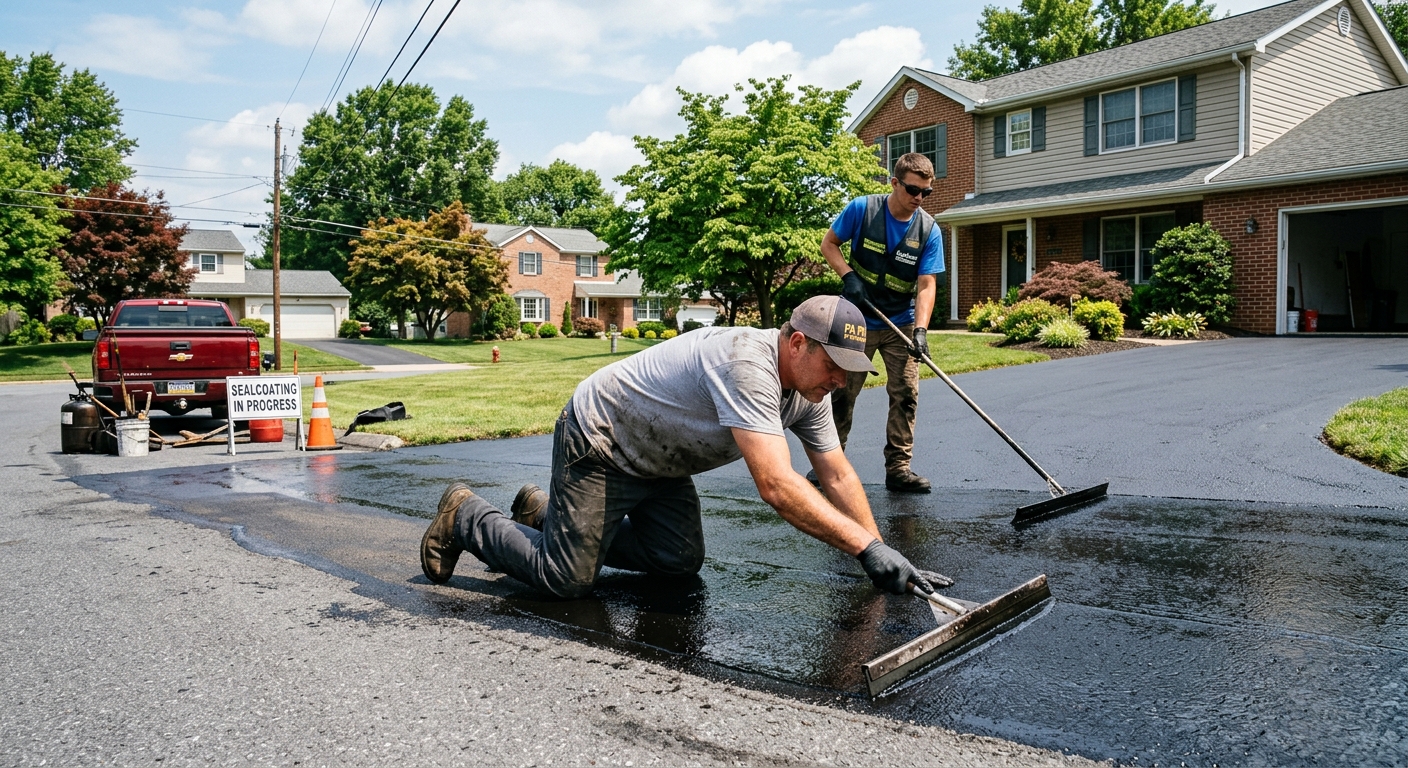
A professional sealcoating job for a standard Monaca driveway will usually run $175–$650. The price depends on size, surface prep, and whether cracks need filling first. Many older Monaca homes have driveways bigger than the current suburban average, but unless you have a particularly wide or extra-long drive, most fall at the lower end of this range. This price pays for two coats and minor hand-work at the ends. Avoid high-pressure spray jobs that charge just $75–$125—they usually don’t prep the surface or fill cracks, so you’re paying for a few months’ shine, not real protection.
How often should I sealcoat my driveway in Monaca?
In Monaca, sealing every 2 to 4 years is ideal. Our freeze-thaw swings and wet springs take a toll and wear the binder away faster than parts of the country with milder conditions. Don’t overdo it: too many coats end up trapping moisture, which can lift the seal. The sweet spot for most homes—especially if your base and surface are still in good shape—is every 3 years or at the first sign of graying and minor surface cracks. Professional sealcoating costs $175–$650 per application and extends the life of an otherwise solid drive. If you see surface cracks widening, don’t wait on sealing—patch first, then seal.
How deep should the aggregate base be here?
For Monaca’s soils—mainly glacial till and shale—a solid driveway needs a base of at least 6–8 inches of compacted crushed stone or approved aggregate. In the hilly or clay-heavy pockets near Center Township, pushing to 10 inches isn’t overshooting. The purpose is to keep water away from the top layer and distribute weight evenly through every season. Less than 6 inches is a gamble that will show up quickly in the form of heaves, potholes, and edge failure. This base preparation is what sets a quality full replacement job at $3,300–$8,400 apart from cheaper overlays or cut-rate work. Always get the specified base depth in your contract; don’t accept a vague description.