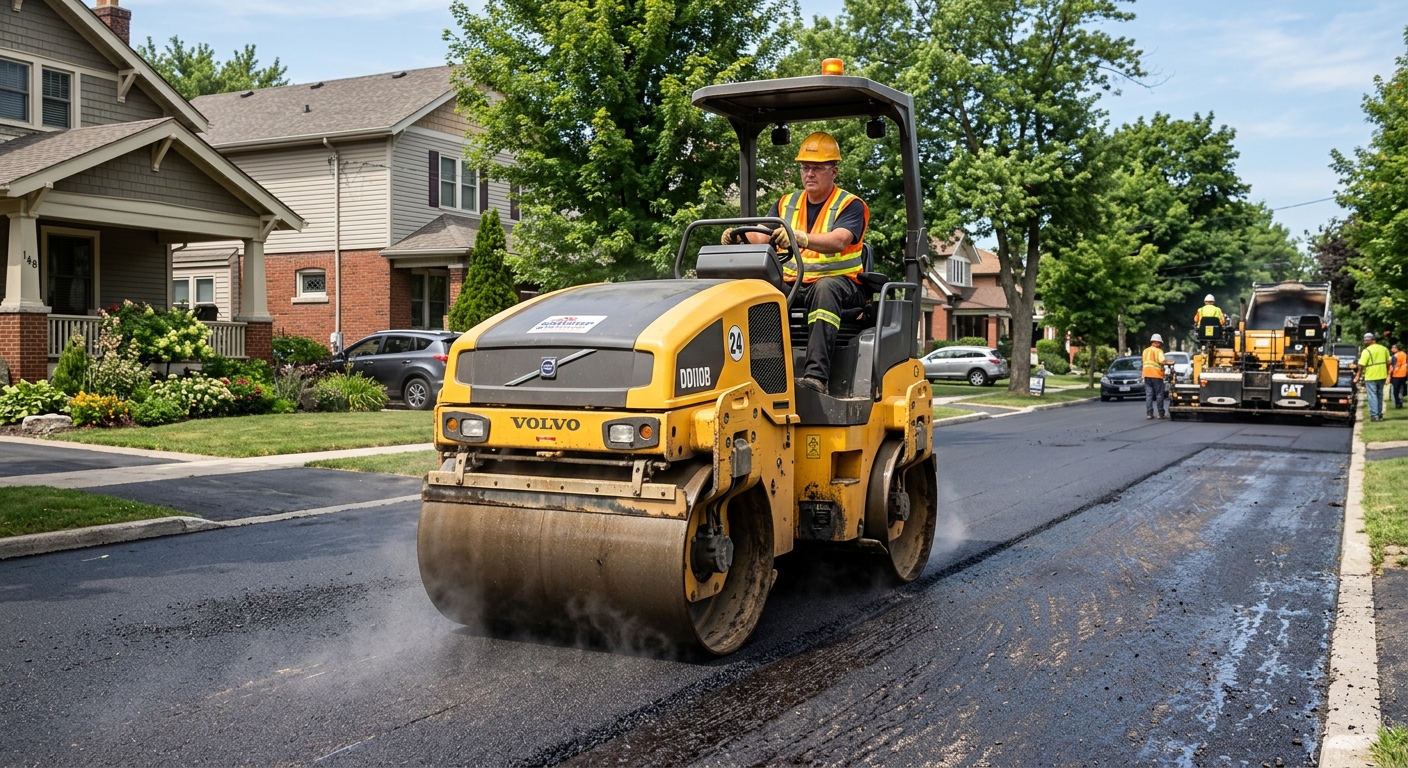
State College paving prices by scope — 2026
In State College, a new driveway is an expense most likely faced by owners of single-family homes—which make up just 25.6% of local housing. With a homeownership rate of 26.2%, most residents don’t have to worry about paving, but for those with older homes or a driveway showing age, the real cost issue is almost always what you can’t see. Pennsylvania’s north-central region brings freeze-thaw cycles, deep frost lines, and subgrades of limestone or shale. This means the biggest driver of cost isn’t the surface material but how well that underlying base is prepared or repaired—cutting corners here delivers a driveway that can look fine for now but will fail early. The surface can be top-grade asphalt or beautiful concrete, but insufficient aggregate base depth or compaction causes settling and cracks. Quotes can differ by thousands not for what goes on top, but for what’s buried underneath.
| Service |
Best for |
Lifespan |
Price range |
| Asphalt — full replacement with new base |
failed base, structural cracking |
20–30 yrs |
$3,300–$8,400 |
| Asphalt overlay / resurfacing |
sound base, surface cracking only |
8–15 yrs |
$1,400–$4,200 |
| Sealcoating — single application |
preventive maintenance on sound asphalt |
2–4 yrs |
$175–$650 |
| Concrete — new installation |
long service life, low maintenance |
30–50 yrs |
$4,700–$11,000 |
| Crack filling and patching |
isolated cracks under a quarter inch |
1–3 yrs |
$200–$800 |
| Gravel driveway |
rural, budget, long runs |
5–10 yrs with upkeep |
$900–$3,500 |
Estimates for a typical State College driveway. Square footage and base condition drive these figures more than material choice.
How paving fraud actually operates
Centre County’s moderate suburban market around State College and Bellefonte sits among widely spaced rural neighborhoods—prime territory for transient paving scams. These operators cruise in with out-of-area plates, make themselves highly visible, and prey on the fact that a brand-new driveway looks perfect but base deficiencies can take years to show. The most common hooks are “leftover material from a job down the road,” urgent today-only pricing, unmarked trucks, and demands for cash up front. Verbal quotes that promise a “deal” without paperwork, or a thin, quick oil-based spray sold as genuine sealcoating, are major warning signs. In rural or lightly populated areas around Centre County, your neighbor may be half a mile away, making verification and reference checks harder—this is exactly why these scams persist here.
Pennsylvania’s Home Improvement Consumer Protection Act (HICPA) is your defense: if the contract is over $500, you are legally entitled to a written contract and have three business days to cancel—even after signing. Do not accept any “deal” without paperwork; the law exists for your protection in precisely these situations. Never hand over cash or agree to work immediately; scammers count on pressure and urgency to prevent checks.
Take five minutes: confirm HIC registration at hic.attorneygeneral.gov, check workers’ comp status via WCAIS (wcais.pa.gov), demand a written description and scope, and never pay cash up front. No legitimate contractor objects to these steps.
How to vet a paving contractor in State College
With transient and cut-rate operations drawn to the visibility (and quick cash) of paving, verifying a contractor is essential in State College. Start with the basics: for contracts above $500, Pennsylvania law requires Home Improvement Contractor (HIC) registration—easily searchable and mandatory since a handshake here doesn’t count. Hire those with a verifiable local business address, not just a mobile number, and check that the company owns its paving equipment rather than rent by the week—fleeting operations tend to rent, vanish, and resurface under new names. For any base or overlay job, get references from three years ago or older; only these show whether the base prep and compaction stand the test of freeze-thaw. Ask who supplies their asphalt or aggregate—plants near Bellefonte and along College Avenue serve legitimate State College contractors. If they can’t name a supplier, assume they are not real operators.
- Check HIC registration at hic.attorneygeneral.gov
- Verify workers’ compensation status via WCAIS (wcais.pa.gov)
- Confirm a local business address (not only a cell number)
- Ask for references from jobs 3+ years old
- Request photos of recent and older work
- Verify they own their equipment—ask for the yard address
- Require a written contract with detailed scope
- Ask which aggregate or asphalt plant they use near State College
- Request a certificate of insurance—not a copy
- Check for branded trucks, not just magnetic signs
- Insist on payment terms in writing; avoid cash
- Meet the foreman who will be on site, not just the salesman
Red flags: any refusal to provide documentation, no local address, vague answers about supplier or base prep, and insistence on immediate cash payments.
Where the water goes
Water is the number one culprit in driveway failure in State College and throughout Centre County. Proper grading and drainage aren’t extras—they’re what keeps your new surface from cracking or sinking as soon as freeze-thaw weather arrives. Every drive should slope away from structures at minimum 2% (about a quarter inch per foot) to direct runoff correctly. Crowning—a slight high point down the center for wide driveways—helps, but most residential drives are cross-sloped. If your grade sends water toward your garage or home, you should consider trench or channel drains, since proper pitch isn’t always possible with existing topography.
In limestone or shale subgrades, common in our area, base drainage has to be managed: these soils percolate differently from clay, which holds water against the drive and accelerates damage in winter. Without drainage pipe, daylighted to a spot that won’t flood a neighbor or pond on your own property, or a dry well where surface escape isn’t possible, yearly repair bills are likely.
Never assume you can dump runoff onto the property next door—a mistake both ethically and legally. The permit doesn’t relieve you of that responsibility. Surface ponding leads to base infiltration: winter freezes expand trapped water, lift your drive and crack it from below. Design drainage first, not last.
Why driveways behave differently in State College
Driveways in State College and surrounding Centre County townships react uniquely because of the local subgrade—predominantly limestone and shale. Limestone can settle unexpectedly due to solution channels (karst), and shale breaks up under repeated freezing and thawing, undermining stability. Where clay is present, it acts as a reservoir, trapping water above the base and dramatically increasing the odds of frost heave each winter. Each soil type mandates its own base depth and, in many cases, a different approach to drainage and grading.
These challenges all intersect with the region’s deep frost line—36 inches down in Centre County—plus a heating season that seems never to let up. Many post-1950s subdivisions around State College and Ferguson Township have driveways now reaching fifty to seventy years old, and a lot of those were built when base standards were minimal at best. Instead of new layouts, resurfacing or full-depth rebuilds onto a properly compacted aggregate base are often the real solutions. Just paving over what is already cracking almost never works here—the conditions below the surface are too relentless for shortcuts.
Why State College driveways fail from the bottom up
Every driveway in State College rests on three layers: the native subgrade, a compacted aggregate base, and the asphalt or concrete surface. In Centre County, what’s below literally determines how long your investment lasts. A well-prepared limestone or shale subgrade gets shaped and compacted first. Over that sits a thick layer of crushed aggregate, which needs to be at least 6–8 inches deep for asphalt (more if clay or poor drainage is present). The aggregate must be compacted in 3–4 inch lifts with vibrating rollers, ensuring no soft pockets remain.
Freeze-thaw is relentless here—water trapped in the sub-base expands dramatically as it freezes. This lifts the pavement, often unevenly (frost heave), and cracks the surface from beneath. In some townships, limestone subgrade can settle in wet years, while shale can break down if unsupported. Skimp on base prep and you’ll be resurfacing in three to five years no matter what asphalt you use.
Cheap paving quotes cut where you cannot see—scant excavation, thin or poorly compacted aggregate, driveways “overlaid” onto failed bases, or no compaction test performed. None of this is immediately obvious; every newly laid drive looks great for a year or two. But a proper slate includes these specifics in writing:
- Aggregate base depth: 6–8 inches (asphalt), 8+ inches (concrete), adjusted for local soil
- Aggregate type: 2A modified stone or PA DGA, not sand or crusher dust
- Compaction: every lift (layer) compacted separately; ask for a compaction test schedule
Never accept vague wording. Only written standards protect you once the trucks are gone.
What you need before paving in State College
If you are only resurfacing or repaving your driveway within its original footprint in State College or surrounding Centre County municipalities, a full building permit is often not required; check with the Centre Region Code Administration first, but for most replacement jobs, the paperwork burden is low. However, the point where your driveway meets a public road—the approach—almost always needs a separate permit, and not from the agency most expect. For any driveway connecting to a Pennsylvania state highway, the approach permit comes from PennDOT District 2 in Clearfield, not your local borough or township.
If you expand your driveway’s width or add new impervious area, expect to address stormwater management requirements. You cannot channel new runoff onto a neighbor’s land or public right-of-way without causing both liability and future headaches—even if the borough signs off.
Before signing any paving contract over $500, confirm the contractor’s registration with the Pennsylvania Office of Attorney General (hic.attorneygeneral.gov), and check current workers’ comp insurance (wcais.pa.gov). Both are legally mandated and protect you as the homeowner.
Frequently asked questions — driveway paving in State College
Does road salt damage driveways in State College?
Road salt is a reality for snow and ice around State College, but it does take a toll on driveways over time. Salt accelerates the cycle of freeze-thaw damage, especially when water seeps into even tiny cracks or the driveway holds depressions. In concrete, salt can corrode reinforcing mesh and cause surface scaling; for asphalt, repeated salt exposure can dry and pit the surface, accelerating aging. Regular sealcoating every 2–4 years (at $175–$650 per application) helps slow this process. If you have heavy shade and ice build-up, consider a surface with good slope to minimize the need for constant salting. The bottom line: salt is tough on every surface, but the right maintenance in Centre County buys you years of life.
Why does my driveway have depressions that hold water?
In State College, depressions that trap water—commonly called birdbaths—are usually a sign of settling aggregate base, almost always from improper compaction or a subgrade that wasn’t prepared for our region’s harsh winters. Limestone and shale are prevalent in local soils, and both can shift if water infiltrates and freezes. These dips let water pool, which worsens base damage every freeze-thaw cycle. Patching can provide short-term relief ($200–$800), but if depressions recur, a full-depth base repair is usually needed. The best prevention is a properly designed base and correct drainage when your drive is first built or rebuilt.
Why are paving quotes in State College so different from each other?
Huge gaps between paving quotes in the State College area are nearly always due to what’s being done below the surface. Some bids propose a full teardown and rebuilding of the base (which costs more but lasts longer, at $3,300–$8,400), while others offer a thin overlay with only surface prep. Check that every quote specifies base depth, aggregate material, and compaction method. In Centre County, with limestone subgrade and hard winters, skimping here means redoing the job in a few years. Always ensure you are comparing written scopes, not just bottom lines.
What does an asphalt overlay cost in State College?
Most overlays in the State College area run between $1,400–$4,200 depending on size, prep, and base condition. An overlay involves placing new asphalt over a sound existing base—if your drive has only surface cracking with no deep depressions, it may be a good candidate. Remember: overlays only buy 8–15 years if the base is solid. If the base is compromised by our Centre County freeze-thaw cycles or limestone settling, an overlay won’t last, and a full replacement may end up less costly long-term.
How far ahead should I book a paver in State College?
Most reputable paving contractors in State College suggest scheduling at least 2–3 months in advance for work in peak season (late spring through early fall). Demand fluctuates, but local outfits book up quickly since real driveway building can’t be rushed before cold weather closes the window. Trying to squeeze into a contractor’s late-season calendar may lead to compromises on cure time. Don’t be afraid to wait for the right company—even if you see a lower off-season price (for example, $2,800 for an overlay), quality is in the prep, not just timing.
What does compaction in lifts mean?
Compaction in lifts is the process of building up the driveway’s aggregate base a few inches at a time, compacting each layer fully before adding the next. In State College, where limestone and shale subgrades make level support so important, this method ensures there are no soft pockets and that every inch of base is dense enough to resist frost heave. Local practice calls for 3–4 inch lifts, with each lift rolled until a set density is met—don’t accept vague promises. For an asphalt driveway (typical job $5,100), ask that “all lifts will be compacted and tested for density.” This is the difference between 30-year performance and a surface that ripples in its second winter.
What is the difference between crack filling and sealcoating?
Crack filling and sealcoating serve different but complementary purposes. Crack filling targets discrete cracks, using flexible material to keep water out and maintain the drive’s integrity. It’s essential for cracks under a quarter inch and might cost $200–$800 per job. Sealcoating spreads a protective coating across the entire surface, shielding asphalt from sun, salt, and water at $175–$650 per application. In State College’s climate, both prolong driveway life, but neither fixes underlying base problems—a mistaken belief that leads to early resurfacing.
Do I need an approach permit where my driveway meets the road?
Yes—for most State College homes, an approach permit is required for the area where your driveway meets a public street, especially if connecting to a state highway. PennDOT District 2 in Clearfield—rather than local code enforcement—is responsible for these approach permits in Centre County. Even a straightforward repaving may not need a full building permit, but changing or rebuilding the connection to the road almost always does. Failing to obtain the right approach permit can mean you have to redo the work, even if your paving contractor completes the job for $3,300–$8,400.
Can I pave over my existing driveway?
Paving over an existing driveway—known as an overlay—is common in State College if the underlying base remains sound, and it’s the least disruptive way to extend surface life for 8–15 years (costing $1,400–$4,200). However, if your current surface has deep cracks, sinking, or evidence of frost heave, just adding new asphalt rarely works. In Centre County’s climate with hard winters and frequent freeze-thaw, covering up defects gives quick cosmetic improvement but shortens total driveway life. Always have a contractor core or inspect the base before deciding.