Adams paving prices by scope — 2026
Adams Township, with nearly three quarters of homes being single-family and an 88.6% owner occupancy rate (U.S. Census Bureau, ACS 2024), sees a steady demand for driveway paving. Paving in Adams is not a cosmetic job—subsurface conditions and weather, especially our deep winter freeze-thaw cycles, drive both cost and longevity. The subgrade in this area, especially with pockets of rocky or shallow shale as found across parts of Cambria County, means that more of your paving dollar goes underground than you’ll ever notice.
Most price differences between paving estimates in Adams come down to how thoroughly the contractor prepares and rebuilds the base beneath the surface. Two identical-looking quotes on paper can hide very different approaches—skimped excavation, thin aggregate base, or skipped compaction are common ways for a crew to cut corners and underbid. What you see after paving is finished is never the full story.
Below are typical 2026 price bands for a residential driveway in Adams. These show the range for a typical install size; square footage and the shape your existing base is in will be the biggest factors affecting the bottom line.
| Service |
Best for |
Lifespan |
Price range |
| Asphalt — full replacement with new base |
failed base, structural cracking |
20–30 yrs |
$3,400–$8,700 |
| Asphalt overlay / resurfacing |
sound base, surface cracking only |
8–15 yrs |
$1,450–$4,400 |
| Sealcoating — single application |
preventive maintenance on sound asphalt |
2–4 yrs |
$200–$700 |
| Concrete — new installation |
long service life, low maintenance |
30–50 yrs |
$4,800–$11,500 |
| Crack filling and patching |
isolated cracks under a quarter inch |
1–3 yrs |
$200–$800 |
| Gravel driveway |
rural, budget, long runs |
5–10 yrs with upkeep |
$900–$3,500 |
Estimates for a typical Adams driveway. Square footage and base condition drive these figures more than material choice.
Drainage: the failure nobody plans for
When it comes to driveways in Adams, drainage isn’t a finishing touch—it’s the main event. Water that sits or flows the wrong way will shorten the life of any driveway, no matter how good the surface looks. Every driveway should be graded at a minimum 2% slope away from structures to shed water, with either a slight crown for wider driveways or a cross-slope, depending on your setup.
If your driveway slopes toward your house or garage, that calls for more than just a thicker pavement. Without correcting the grade, you may need a trench or channel drain at the garage entry, piped to daylight (the best solution when there’s a slope) or to a dry well when no downhill outlet is possible. In Cambria County’s climate, heavy rainfall or fast-melting snow will overwhelm poor grading—leading to ponding, which seeps into the base, freezes during our long, cold winters, and heaves the driveway. This process is hard on both asphalt and concrete.
Rocky or shallow shale soils, found in nearby Cambria Township, improve drainage compared to heavy clay—but even those can pool water if grading is skipped. No matter the soil, you cannot legally route runoff onto your neighbor’s property; if your driveway sends water over the property line, you have a liability problem even if there was never a local permit required.
When paving can actually be done in Adams
In Adams, paving season is strictly limited by our climate. Cold weather here isn’t just unpleasant—it’s a hard stop for driveway work. Hot-mix asphalt must be delivered and compacted while it’s still hot; if the air or base cools too quickly (common when winter design temperatures drop to 2 °F or below), you’re left with a porous surface that will crumble long before its time. This is why local asphalt plants around Johnstown and Ebensburg shut down for winter—the material just won’t work in freezing conditions.
Concrete has its own limits: it can’t cure properly below freezing, risking weak, flaking surfaces. Between the high snow loads, frequent temperature swings, and our long heating season, planning driveway projects in Adams is about respecting the calendar as much as the budget.
Expect capacity (and sometimes better pricing) in the shoulder months—May, September, and October. June to August is peak season, and crews are often booked weeks out. If someone offers to pave after the first hard frost in late November in Adams Township, be skeptical: it’s a sign they’re either cutting corners or don’t have many bookings because the quality isn’t there. Patience pays; don’t rush for an end-of-season special that ends with premature repairs.
What you need before paving in Adams
In Adams Township, if you are resurfacing an existing residential asphalt driveway—meaning no expansion, just a like-for-like replacement—a specific driveway construction permit is generally not required. This can save you some hassle and fees if your footprint remains the same. But, the spot most often missed is where your driveway meets the public road: the driveway approach. If your property fronts a state road, you’ll need an approach (driveway) permit through PennDOT District 10; for township roads, the local municipality handles these permits.
Keep in mind, as soon as you expand impervious surface—going wider, longer, or changing drainage—local runoff and stormwater regulations can trigger an added review, even if you didn’t need a basic paving permit. Know that even with all permits in hand, sending water into your neighbor’s yard is your liability and can mean legal trouble later.
For protection, the state requires every home improvement contract over $500 to be in writing, with a three-day right to cancel. Confirm your contractor is registered with the Pennsylvania Office of Attorney General at hic.attorneygeneral.gov, and that any crew they bring is fully covered by workers’ compensation (check at the WCAIS system: wcais.pa.gov). Following these steps is the best way to keep your project—and your wallet—safe.
Overlay, patch or full replacement?
Knowing the condition of your driveway’s base is what decides between patching, resurfacing, or full replacement. You can do a simple self-check before calling any contractor. Here’s what to look for in Adams:
If you see alligator cracking—a web of cracks, typically across wider areas—your base has failed. An overlay in this situation is wasted money, since the new surface will crack and sink as the base keeps moving. Isolated, straight cracks often just mean age and weathering, and can be patched and sealed if the base below is still solid. Depressions or “birdbaths” are signs of subgrade movement from freeze-thaw cycles or improper base work. Crumbling at the edges points to inadequate support, while potholes mean water has breached the surface and gotten into the base layer.
A reputable contractor will take core samples or dig test holes before making a recommendation. If they quote resurfacing without checking below the surface, they haven’t truly diagnosed the problem—full stop.
| What you see |
Likely cause |
Right fix |
Cost |
| Isolated cracks under 1/4 inch |
surface aging |
crack fill and seal |
$200–$700 |
| Alligator cracking over a wide area |
base failure |
full replacement |
$3,400–$8,700 |
| Depressions holding water |
subgrade movement |
excavate and rebuild that area |
$3,400–$5,300 |
| Crumbling edges |
no edge support |
edge repair, consider curbing |
$400–$1,500 |
| Potholes |
water into the base |
full-depth patch, then assess |
$250–$900 |
| Faded but sound surface |
oxidation only |
sealcoat |
$200–$700 |
How to vet a paving contractor in Adams
In Adams, the most important step in hiring a paving contractor is verifying that they are who they claim—and that they will stand behind the work for our climate. Begin by checking their Home Improvement Contractor (HIC) registration at hic.attorneygeneral.gov, which is required for jobs over $500. Confirm that anyone on site is covered by workers’ compensation insurance using the state’s WCAIS lookup; never take a handshake for protection.
Ask for more than a cell number—insist on a street address in or near Cambria County. Contractors serving Adams should have their own paving equipment, be able to name the local asphalt plants or quarries they source from (plants around Johnstown or Ebensburg are the hub here), and provide references for driveways they paved 3 or more years ago. If a contractor can’t say where their asphalt comes from, they’re likely brokering jobs or worse—no accountability and no warranty you can rely on.
- Check HIC registration at hic.attorneygeneral.gov
- Verify current workers’ compensation on wcais.pa.gov
- Get a local business address—not just a cell number
- Ask for references from at least 3 years back
- Check for owned paving equipment, not just rentals
- Have them name their asphalt supplier or plant
- Confirm written bids with a detailed scope of work
- Ensure contract language includes base preparation details
- Look for proof of local permitting experience
- Beware of “one-day only” or door-to-door offers
- Prefer contractors with documented work in Cambria County
- Avoid upfront cash or personal check payments
Red flags: no written contract, vague details about the base, unwillingness to provide proof of insurance, or references that are all less than a year old. If any of these come up, keep looking.
Why Adams driveways fail from the bottom up
The life of any driveway in Adams depends less on what you see on top and more on what’s hidden underneath. The structure starts with the native subgrade (the soil or rock under your property), then a compacted aggregate base, and finally the asphalt or concrete surface. Each layer supports the weight and disperses the force so the layers below aren’t overloaded.
In our area, shallow shale in parts of Cambria Township can help drainage, but it also requires a thicker base to shield the pavement from frost movement. When water sits in or under the base and freezes—a real risk here with our 2 °F winter design and 36-inch frost depth—it expands and heaves sections unevenly. That’s how cracks and surface distortion appear from the bottom up—even if the surface mix is thick.
Here’s the part most homeowners in Adams never see: cheap quotes usually mean corners cut under the ground. Skipping excavation, using too thin or poorly compacted aggregate, or laying new asphalt over a soft/failing base all “look fine” at first. The problems show in year three—cracks, dips, or major heaving—when the warranty is long gone and the original crew is nowhere to be found.
If you’re comparing bids, demand these numbers and details in the contract: aggregate base depth (for Adams, at least 6–8 inches on good subgrade, more on rocky or variable soil), the aggregate type (crushed stone, not recycled fines), and confirmation that compaction will be done in 2–3 inch lifts with a plate compactor or roller. A surface course of at least 2–2.5 inches compacted asphalt is typical. Anything less and you’re paying for a job that just won’t last through our winters.
Frequently asked questions — driveway paving in Adams
How much does it cost to widen a driveway?
Widening a driveway in Adams depends mostly on square footage and the need to expand the base. If you’re adding a few feet alongside an existing driveway, expect to pay for excavation and rebuilding the base as if it were new in that area. A typical cost for asphalt widening falls inside $3,400–$8,700 for a full replacement, but if you’re just expanding one side by a small amount, it can land at the lower end—unless tie-in and drainage work makes it more complex. Doing new concrete comes out higher, within $4,800–$11,500. Don’t skip permitting for the new curb cut if you’re widening toward the street, and ensure drainage still directs water away from your home and your neighbor’s property. Soil type and existing grade—both big factors in Adams and surrounding areas—may drive up preparation costs if conditions aren’t ideal.
Does road salt damage driveways in Adams?
Road salt use is a fact of life in Adams Township, given our harsh winters and frequent freeze-thaw cycles. For asphalt, salt mainly speeds up surface oxidation—causing fading and drying, which can lead to more cracking over time if left untreated. Concrete is more vulnerable; salt can accelerate surface scaling or spalling, especially if water gets into tiny cracks and then freezes. That’s why sealcoating every 2–4 years ($200–$700) is a smart idea here to protect your asphalt, and proper curing and sealing is critical for new concrete. Sweeping excess salt (and sand) off driveways after storms helps, but the weather in Cambria County means some salt impact is almost unavoidable. Good drainage and annual maintenance are your strongest defenses.
How long before I can drive on a new asphalt driveway?
In Adams, you should let a fresh asphalt driveway cure for at least 3–5 days before driving on it, especially early or late in the season when cooler temps slow down hardening. In the hottest part of summer, it may harden a little faster, but as a rule of thumb, don’t rush. Heavy vehicles, trailers, or sharp turns can make marks on new asphalt for the first month or two while it’s still setting. Concrete needs even longer—at least a week—before full vehicle use. The cost of a repeat repair here isn’t small, with a full replacement at $3,400–$8,700 for asphalt or $4,800–$11,500 for concrete, so it’s worth playing it safe in those first days.
Should I repair or replace my Adams driveway?
The best answer depends on what you see—and what lies underneath. In Adams, if your driveway has widespread alligator cracks or multiple areas of sinking and potholes, that means the base has failed and a patch or overlay is a waste of money. Only isolated linear cracks or minor surface wear can be safely repaired, which typically costs between $200–$700 for filling and sealing. Anything more severe, especially with the freeze-thaw cycles and rocky soils we get in Cambria County, means you’re past the point where patching offers a good return—moving straight to replacement ($3,400–$8,700 for asphalt) is likely smarter. If a contractor suggests overlay without testing the base, walk away.
What does sealcoating cost in Adams?
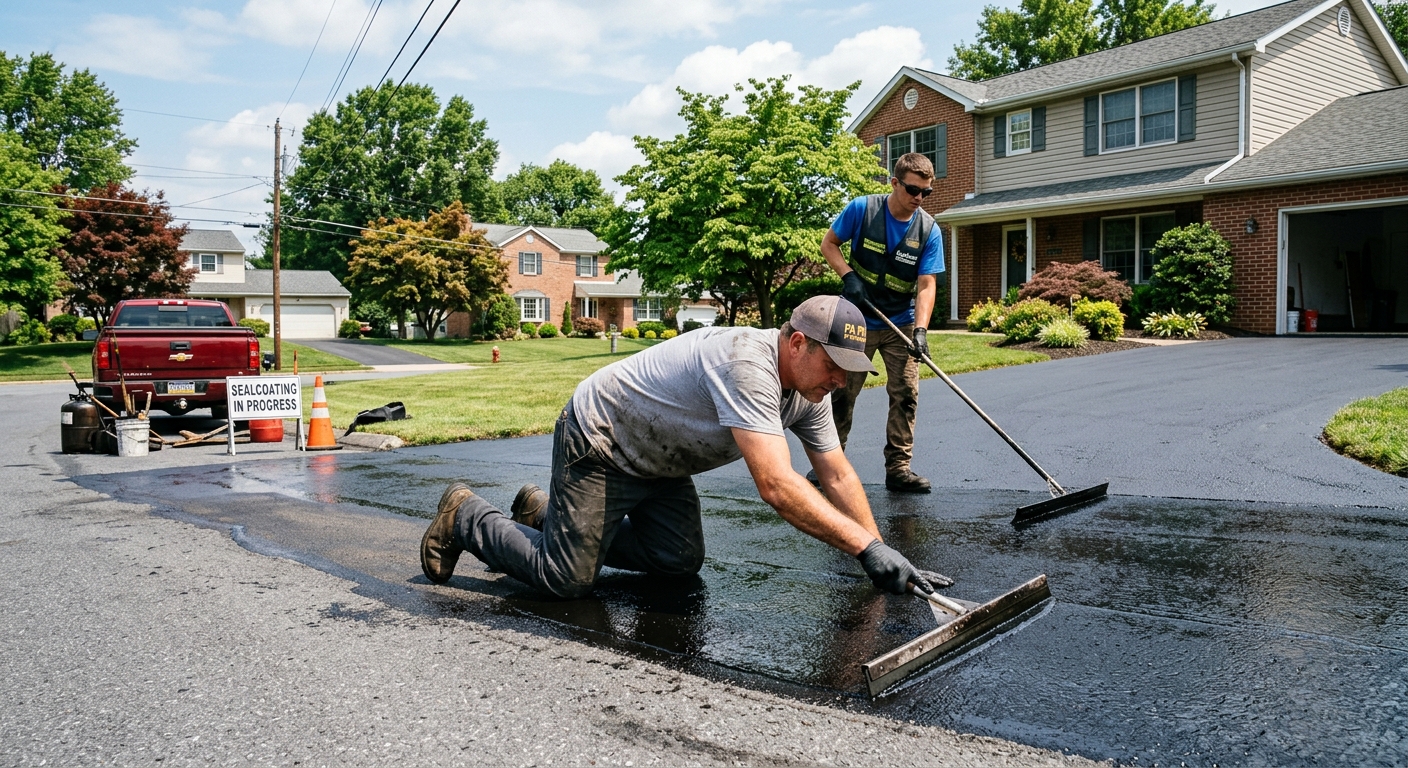
Sealcoating in Adams is usually priced by the square foot but falls for typical single-family driveways in the $200–$700 range per application, with the most common cost about $400. The rough winters, high snow loads, and repeated freeze-thaw in Cambria County make sealcoating every 2–4 years a worthwhile investment to stretch out your asphalt’s life, reduce oxidation from salt, and keep minor cracks from growing. Beware of prices way below this range—many “budget” sealcoats are thinned too much and don’t last through one full cycle of snow and melt. Get a quote that lists square footage and sealer type so you know you’re actually protecting your driveway.
How thick should asphalt be for a residential driveway in Adams?
In Adams, the typical asphalt thickness over a compacted aggregate base is 2–2.5 inches after compaction for most residential driveways. The aggregate base itself should be at least 6–8 inches deep on sound subgrade—if your soil is rocky or you’re at a lower spot, even more depth may be needed to hold up against frost and long heating seasons. Skimping on either the aggregate or the asphalt is the fastest route to premature failure in this climate. A driveway done right won’t be the cheapest quote—expect the total job to fall in the $3,400–$8,700 range for a full replacement including excavation and a fresh base, rather than just resurfacing.
When can I seal a brand new asphalt driveway?
After a new asphalt driveway is put down in Adams, it’s important to wait at least 60–90 days before sealcoating. Asphalt needs time to cure and release oils; sealing too quickly can trap these in and prevent the surface from hardening properly. Most Adams homeowners schedule the first sealing the following season, ideally late spring or early fall. Good sealcoating runs $200–$700 for standard driveways. This climate—with its cold winters and hot, sunny summers—makes following this timeline even more vital than in milder parts of Pennsylvania. Ask your contractor for their opinion based on the installation date and local weather patterns.
What causes driveway cracks in Adams?
In Adams—and most of Cambria County—the main culprits are our long freeze-thaw season, water infiltration, and poor subgrade preparation. When moisture gets into an unsealed crack or down into the base, it freezes and expands, pushing the surface up (a process called frost heave) and causing both cracks and eventual potholes. Shallow shale soils in the region can help drain water, but low points or compacted clay can hold it against the base, making the problem worse. Regular sealcoating ($200–$700) protects against this, but even the best surface will fail if the drainage or the base was skimped during installation. Watch for new cracks after rainy or snowy seasons—those signal you need preventive maintenance.
How do I verify a paving contractor in Pennsylvania?
Verifying a local paving contractor in Adams—or anywhere in Pennsylvania—starts online. Check that their Home Improvement Contractor (HIC) registration is active and matches the company’s contact information at hic.attorneygeneral.gov. This is required for any job over $500 and ensures they’re on record with the state. Next, use the WCAIS system (wcais.pa.gov) to confirm current workers’ compensation insurance, which is mandatory for anyone employing workers—no exceptions. Ask for a local street address and direct references from driveways they did 3+ years ago. Reliable pros in Adams will gladly tell you which Johnstown or Ebensburg plant they buy their asphalt from. Price isn’t the only check—if someone quotes much less than $3,400–$8,700 for full replacement or can’t document their credentials, that should be a deal-breaker.