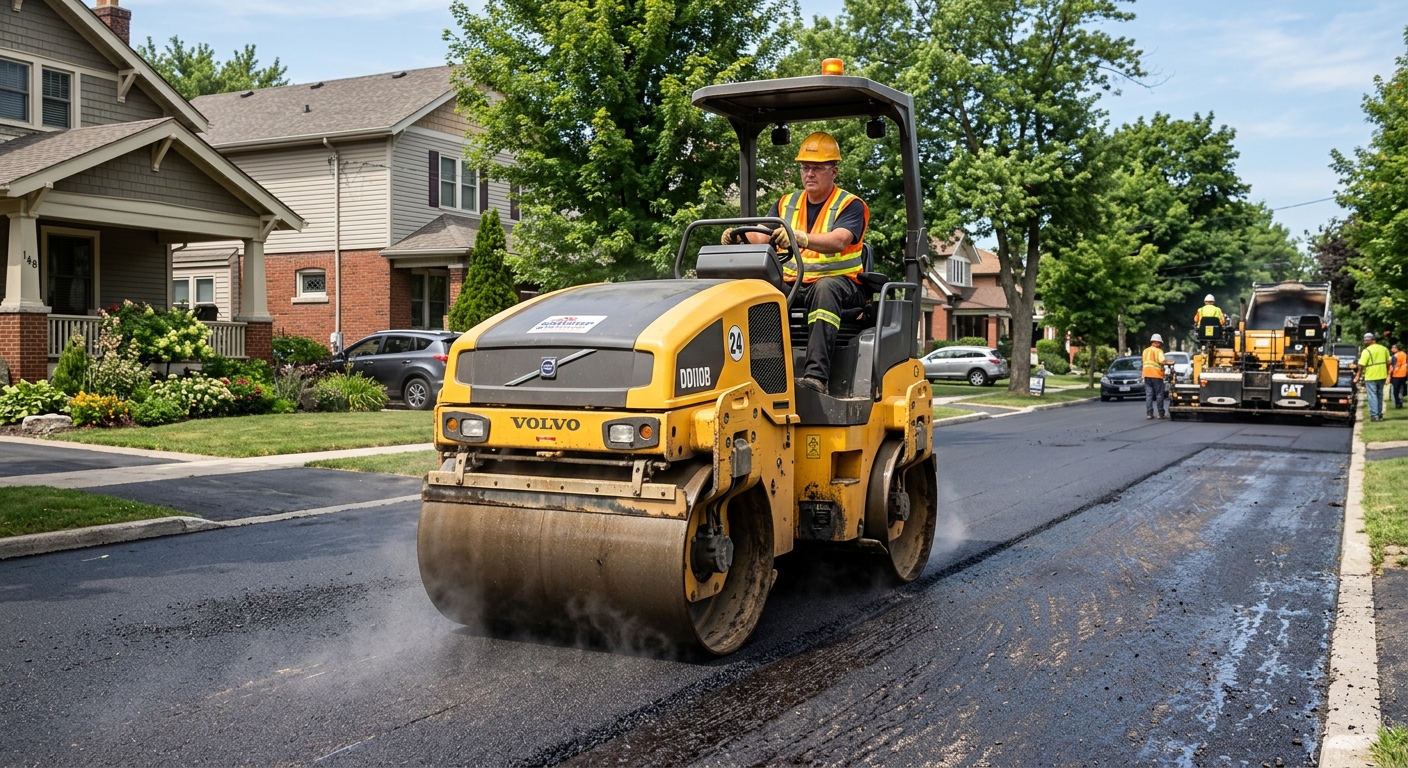
Pocono paving prices by scope — 2026
In the Poconos, where single-family homes make up 82.0% of housing and most residents own their homes (79.1%), driveway paving is a major investment. The region’s winters are rough on paving—freeze-thaw cycles and glacial till or rocky plateau soils, especially in areas like Coolbaugh Township, put added strain on driveways. What makes paving complicated here isn’t so much the choice of asphalt or concrete, but what’s underneath: the depth and quality of the base.
It’s the work you can’t see—proper excavation, thick enough aggregate, and solid compaction—that separates a long-lasting job from an early failure. Most of the difference between a cheap quote and a fair one is hidden. One contractor may offer bargain pricing by skipping base prep or using too little material, which can’t be seen on day one but will show up as cracks and sinking after just a few winters. The region’s severe ice-dam exposure and 40 psf snow loads reward those who invest in proper site work.
If you’re comparing bids, focus on the depth and materials below the surface, not just the final look. Here’s what typical driveway costs look like for Monroe County in 2026:
| Service | Best for | Lifespan | Price range |
| Asphalt — full replacement with new base |
failed base, structural cracking |
20–30 yrs |
$3,600–$9,300 |
| Asphalt overlay / resurfacing |
sound base, surface cracking only |
8–15 yrs |
$1,550–$4,700 |
| Sealcoating — single application |
preventive maintenance on sound asphalt |
2–4 yrs |
$200–$750 |
| Concrete — new installation |
long service life, low maintenance |
30–50 yrs |
$5,200–$12,500 |
| Crack filling and patching |
isolated cracks under a quarter inch |
1–3 yrs |
$200–$800 |
| Gravel driveway |
rural, budget, long runs |
5–10 yrs with upkeep |
$900–$3,500 |
Estimates for a typical Pocono driveway. Square footage and base condition drive these figures more than material choice.
What a real paving quote contains
Comparing paving quotes in the Poconos is tougher than it looks. The only way to sort a real estimate from a shortcut is by the details: a proper quote lists measured square footage, excavation depth (and disposal of spoils), the type and thickness of aggregate base, and how it will be placed and compacted. It specifies how many inches of asphalt, broken down by layers (“courses”), and describes how the edges are reinforced. Grading, drainage plans, and how the lawn will be restored should all make it in. Don’t forget the payment schedule—expect a small deposit, with most money due at completion, never all up front. Warranties are also spelled out, but in Monroe County, as elsewhere, nearly all exclude cracking, which is the most common driveway failure homeowners expect to be covered.
The quickest way to overpay is to accept a one-line quote with just a total and no specifications—this is the top way people lose value in a paving job. If nothing is stated, you have no idea what you’re getting. Use this table to decode a proper bid:
| Line item | What to look for | Red flag if… |
| Area |
measured square footage stated |
eyeballed or absent |
| Excavation |
depth and disposal included |
'we'll pave over it' |
| Base |
aggregate type and depth in inches |
'proper base' |
| Compaction |
method, and done in lifts |
not mentioned |
| Asphalt |
courses and compacted depth |
'3 inches' unqualified |
| Drainage |
slope and water direction stated |
silent |
| Warranty |
what is covered and what is excluded |
verbal only |
| Payment |
modest deposit, balance on completion |
full cash up front |
Drainage: the failure nobody plans for
Water is at the root of most driveway problems in Pocono. Slope and drainage aren’t just finishing touches—they determine how long your investment lasts. Every driveway needs a minimum slope of about 1/4-inch per foot for effective surface runoff. Two basic strategies work: crowning (a slight hump down the center, draining to both sides) or a steady cross-slope. Trouble starts when the drive slopes toward the house or garage door, funneling melt and rain right where you least want them.
When you can’t adjust grade enough, trench or channel drains may be the only way to move water away. But how water exits matters; “daylighting” means you run drainage pipe to daylight on your own property—or, if there’s nowhere for it to go, into a dry well. (Redirecting water to a neighbor’s land is a liability in Monroe County, even if the township never asks.)
The region’s cold punishes any ponded water that sneaks under the surface. Here, freeze-thaw cycles mean that any trapped water will freeze, swell, and heave the driveway, splitting it from below—they call it “frost heave” for a reason. On heavy glacial till and rocky soils, poor drainage makes it even worse, as water lingers and undermines the base. Good drainage keeps your investment out of the ditch, literally and legally.
What's under the asphalt matters more than the asphalt
The performance of a Pocono driveway comes down to what’s under the asphalt, not just what you see. The assembly starts with the natural subgrade—rocky glacial till or plateau soil in areas like Coolbaugh Township—topped with several inches of properly sized, well-compacted aggregate (often 2A modified stone), then capped with the asphalt or concrete itself. Each layer must be installed with care: the subgrade needs to be stable, the aggregate thick and compacted in lifts, and the top surface only as strong as what’s beneath.
Pocono’s notorious freeze-thaw cycle—with winter lows dropping to 4°F and frost driving down to 36 inches—means that water trapped beneath the surface freezes, expands, and heaves the pavement. This is classic frost heave. The thicker and better-drained your base, the less likely your driveway will crack and settle in year three instead of year twenty. On glacial till or rocky plateau soils, like much of Monroe County, a thicker base (often 8–12 inches) makes all the difference. Skimping here is how quotes get cheap: skipping excavation, using just a thin skin of aggregate, or not compacting in lifts. You don’t see it as they pack up, but you’ll notice after a few winters as the pavement sinks and splits.
If the contract details don’t spell it out, it wasn’t done—insist on a written base depth (in inches), the type of aggregate, and confirmation that it will be compacted in at least two lifts (layers), not all in one go. That’s the only way to avoid sinking money into repairs or a full rebuild later.
How often should a Pocono driveway be sealed?
Sealcoating is one of the most misunderstood driveway services in the Poconos. It does what it promises: slows asphalt binder oxidation from sunlight, helps prevent gas and oil stains, and gives a crisp, dark appearance. But sealcoating doesn’t add strength. It won’t repair a cracked or poorly built base, nor will it fix drainage issues. If there’s underlying failure, sealing just makes it look better until the damage reappears.
Most of the marketing out there pushes annual sealing, but too-frequent applications—especially in Monroe County’s climate—just build up layer after layer, which then crack and peel in sheets. For most driveways, every 3–4 years is ample, and always wait until new asphalt has fully cured (often six months or more) before sealing. Sealing too soon traps natural oils and softens the surface.
Crack filling actually preserves pavement more than sealing. Address cracks as they appear, using flexible, hot-applied filler. Spray-on “sealcoat specials” that cost far less than a pro application—such as a $200–$750 price tag—usually mean diluted product sprayed thin, which wears off after one season. A proper job involves cleaning, filling, then brushing or squeegeeing the sealer for full coverage. Don’t seal every year, and don’t use sealcoating as a fix for deeper issues. Money is better spent patching and filling cracks than over-sealing.
Permits and approvals for paving in Pocono
For most homes in Pocono and the broader Monroe County area, repaving an existing asphalt driveway does not require a building permit if you’re staying inside the current dimensions. This is particularly true in rural areas like Chestnuthill Township, where minor asphalt patching or maintenance can often proceed without paperwork. However, if you’re in a place like Stroudsburg Borough, adding a new driveway, expanding one, or changing the footprint will generally trigger a zoning or building review.
If your driveway connects to a public road—especially busy routes like PA Route 611 near Stroudsburg—you’ll need an approach permit, which is issued separately by PennDOT District 5, not the township. Many homeowners call the wrong office and lose time, so go to the right authority for the approach from day one.
Keep in mind that increasing the amount of hard surface may trigger stormwater requirements. Also: no permit allows you to direct runoff onto your neighbor’s land—that remains your responsibility regardless of township approval.
By law, any paving contract over $500 must be in writing under the Home Improvement Consumer Protection Act. Make sure your contractor is registered and check their Home Improvement Contractor status at hic.attorneygeneral.gov. If employees are involved, verify workers’ compensation through the state’s WCAIS system at wcais.pa.gov before signing any contract.
Which surface survives Pocono winters
Choosing between asphalt and concrete in the Poconos is a climate-driven question. Our winters push the freeze-thaw cycle hard: subzero temps, thick snow, and months of salting. Asphalt is flexible, so it gives a little with ground movement—helping it handle all that freezing and thawing by flexing instead of cracking. Concrete is more rigid and lasts two or three times longer when it survives, but our heavy salt use and ice-dam exposure turn de-icing into the top cause of surface failure. Concrete here tends to spall and scale from salt over a handful of winters, unless you strictly avoid salt-based ice control.
Asphalt is more affordable up front and easier to repair. Concrete is a true “set and forget” surface, but only for owners who avoid de-icing salt—a promise few keep through every Pocono February. Pavers are workable for short, decorative runs and can be relaid as the ground settles. Gravel works well for long rural driveways, but requires regular topping and grading.
| Option | Installed cost | Maintenance | Freeze-thaw performance | Lifespan |
| Asphalt — new install |
$3,600–$9,300 |
sealcoat every 3–4 yrs |
excellent, flexes |
20–30 yrs |
| Asphalt — overlay |
$1,550–$4,700 |
same |
good if base is sound |
+8–15 yrs |
| Concrete |
$5,200–$12,500 |
low, avoid de-icing salt |
fair, spalls with salt |
30–50 yrs |
| Pavers |
$8,300–$12,500 |
individual units replaceable |
good, settles gradually |
25–50 yrs |
| Gravel |
$900–$3,500 |
top-dress every 2–3 yrs |
excellent drainage |
indefinite with upkeep |
Frequently asked questions — driveway paving in Pocono
What is the difference between binder and surface course?
In Pocono, a proper asphalt driveway is built in at least two layers: the binder course and the surface course. The binder course goes down first—it’s a thicker, coarser mix that provides strength and flexibility as the base for the smoother top layer. The surface course, also called “wearing course,” is laid last; it uses smaller aggregate, so it compacts to a denser, smoother finish that stands up to traffic and weather. Without a solid binder course, the surface course can crack or rut, especially after a Pocono winter. When reviewing an asphalt quote in Monroe County, make sure both layers and their compacted depths are specified. A cut-rate bid often skips the binder or skimps on the thickness, shortening the life of an investment that typically costs $3,600–$9,300 for a full replacement.
When can I seal a brand new asphalt driveway?
If you’ve just installed a new asphalt driveway in Pocono, resist the urge to seal it right away. Fresh asphalt needs to cure—usually at least six months, and sometimes longer if it’s a cold or damp season. Sealing too soon traps natural oils and solvents in the pavement, which can keep it soft and prone to scuffing or early failure. Wait until the surface has lightened from deep black to charcoal gray before scheduling a sealcoating. Most experienced contractors recommend sealing every 3–4 years in Pocono, not annually. When you do get around to it, expect a typical sealcoating job to run between $200–$750 per application, depending on the driveway size.
Is gravel a cheaper option in Pocono?
Yes—gravel is the most budget-friendly driveway material in most parts of Pocono, including Monroe County’s rural stretches. Installation costs are much lower than asphalt or concrete, generally falling between $900–$3,500 depending on length and base prep. Gravel is especially popular for long driveways in rural developments and on rocky or sloped sites, because it naturally drains well and is easy to repair with fresh topping. That said, gravel requires ongoing maintenance: periodic regrading, weed control, and new material every few years. For short suburban drives or those in high-traffic areas near Stroudsburg, gravel can be a mess to manage and isn’t usually the long-term answer. But as a low-cost solution for long runs, it’s a realistic option here.
Do I need a permit to repave a driveway in Pocono?
For most driveway resurfacing jobs in Pocono—if you’re not changing the size, shape, or connection to the road—you usually don’t need a building permit, especially in unincorporated areas like Chestnuthill Township. However, if your plans include expanding the driveway or altering how it connects to a public road, you may need zoning or approach permits, especially in places like Stroudsburg Borough or for access to PA Route 611 (where PennDOT handles the approach). It’s never a bad idea to call your local codes office or PennDOT District 5 to avoid headaches. Whether or not you need a permit, every contract for work costing more than $500 must be in writing under state law, and your contractor should have Home Improvement Contractor registration for your protection.
How much does it cost to widen a driveway?
Widening an existing driveway in Pocono depends on how much new base and surface need to be added. For a simple extension alongside your current asphalt, you’ll usually pay the per-square-foot price for a full-depth install, since the crew has to excavate and rebuild the new section completely. Most jobs fall in the $3,600–$9,300 range for a full new install, but if you’re only adding three feet along the edge, the cost might run in the low end of that band. Don’t forget—changing the footprint almost always triggers a permit or zoning review, especially in Stroudsburg or Pocono Township, and can require approach approval from PennDOT if you’re modifying where the driveway meets a state road.
How far ahead should I book a paver in Pocono?
In Monroe County, reputable paving contractors are usually busiest from late spring through early fall, when weather allows for proper installation and curing. Many book out six to twelve weeks in advance, especially for larger jobs or installs that require site work in rocky or sloped Pocono terrain. If you’re hoping for a specific date (like before graduation or the first snow), call early. Last-minute bargains are rare, and their outcomes questionable. For work that comes with a legitimate warranty and written specs—like an asphalt replacement in the $3,600–$9,300 range—give contractors time to plan base prep and material delivery, since local aggregate is hauled from plants in Stroudsburg or Tobyhanna.
Can I pave over my existing driveway?
Paving over an existing driveway—called an “overlay” or “resurfacing”—is possible in Pocono if the current base is stable and free from structural cracks or drainage failures. If the old driveway has alligator cracking, soft spots, or sinks after rain, an overlay will just mask deeper issues, and problems will come right back. If you and your contractor agree the base is sound, overlaying is less expensive ($1,550–$4,700), and extends usable life by 8–15 years. Be wary of anyone pushing overlay when widespread cracking or heaving are present—the savings don’t last. For driveways with a failed base, start fresh to avoid double-paying for repairs later.
Does road salt damage driveways in Pocono?
Yes, road salt is a primary cause of winter driveway damage in Monroe County and all across the Poconos. Salt helps keep surfaces clear, but accelerates the breakdown of concrete, leading to surface pitting, spalling, and crumbling. Asphalt handles salt much better—it flexes in the freeze-thaw cycle, though prolonged pooling of salty meltwater at the edge can still cause issues over time. Concrete might last $5,200–$12,500 initially, but if you use rock salt or chemical de-icers every winter, don’t expect it to go 30 years without pitting and needing repair. If you do choose concrete, stick to plain sand for traction and clear snow quickly to limit exposure to salt.
What are the signs of a failing driveway base?
In Pocono, a failing driveway base isn’t always easy to spot early on—but a few giveaways are worth watching for. Look for repeated or widening cracks (often called “alligator crack”), areas that sink, ripple, or feel “spongey” underfoot, or puddles that don’t drain after rain—these are all signs water is getting under the surface and heaving or eroding the base. Catching these problems early can save you the cost of full replacement ($3,600–$9,300), but if left, you’ll see rapid surface breakdown every winter as freeze-thaw cycles lift and split the pavement. Temporary patching or overlays aren’t long-term fixes if the base is to blame. Only proper excavation, new stone, and compaction will restore structural strength for the long haul.