Driveway paving costs in White Oak — 2026
In White Oak, paving a driveway is a home investment that mainly affects single-family homeowners—about 72% of all homes here fit that bracket, according to the U.S. Census Bureau, ACS 2024. With a 68.2% homeownership rate, most driveways are privately maintained, and their longevity and appearance directly affect property value. Given the heavy freeze-thaw cycles we see in southwestern Pennsylvania and the clay and shale soils running through Allegheny County hillsides, the condition beneath the asphalt is what truly determines driveway lifespan and future costs.
It’s tempting to compare paving quotes by the lineal foot or just by the total. That’s misleading here. Most of the price difference between bids hides in the work you can’t see—specifically, how the contractor handles excavation, base preparation, and compaction. A driveway that looks fine for a year but crumbles or heaves after another freeze has usually been laid too thin, on an uncorrected base, or without enough drainage—the exact shortcomings that a rock-bottom price often hides.
| Service |
Best for |
Lifespan |
Price range |
| Asphalt — full replacement with new base |
failed base, structural cracking |
20–30 yrs |
$3,300–$8,500 |
| Asphalt overlay / resurfacing |
sound base, surface cracking only |
8–15 yrs |
$1,400–$4,200 |
| Sealcoating — single application |
preventive maintenance on sound asphalt |
2–4 yrs |
$200–$650 |
| Concrete — new installation |
long service life, low maintenance |
30–50 yrs |
$4,700–$11,500 |
| Crack filling and patching |
isolated cracks under a quarter inch |
1–3 yrs |
$200–$800 |
| Gravel driveway |
rural, budget, long runs |
5–10 yrs with upkeep |
$900–$3,500 |
Estimates for a typical White Oak driveway. Square footage and base condition drive these figures more than material choice.
How to tell if the base is gone
Most White Oak driveways fail from the ground up, not from wear on top. Before you spend on any paving work, you need to understand whether your base is still sound. Here’s how you can check, with nothing more than your eyes and a couple of minutes.
Broad areas of “alligator” cracking resemble the back of a reptile and signal that the base has failed—no overlay will last long on top of that, because the real problem is underneath. If you only see narrow, isolated cracks (usually less than a quarter inch wide), it’s likely just surface aging, which can be handled with crack filling and sealing. Depressions that turn into birdbaths after rain mean subgrade movement, often from White Oak’s clay and shale soils shifting with each freeze-thaw. Crumbling along the edges usually results from years of no edge support—cars compressing the sides where there’s no stone base holding things up. Potholes, meanwhile, are a sure sign that water has breached deep enough to break up the structure.
If a contractor quotes an overlay without poking at the worst spots, either with a probe or by making a small test cut, they haven’t checked for a failed base. A good installer will want to know what’s underneath, because your finish only lasts as long as your foundation.
| What you see |
Likely cause |
Right fix |
Cost |
| Isolated cracks under 1/4 inch |
surface aging |
crack fill and seal |
$200–$650 |
| Alligator cracking over a wide area |
base failure |
full replacement |
$3,300–$8,500 |
| Depressions holding water |
subgrade movement |
excavate and rebuild that area |
$3,300–$5,200 |
| Crumbling edges |
no edge support |
edge repair, consider curbing |
$400–$1,500 |
| Potholes |
water into the base |
full-depth patch, then assess |
$250–$900 |
| Faded but sound surface |
oxidation only |
sealcoat |
$200–$650 |
Permits and approvals for paving in White Oak
If you’re resurfacing or replacing a driveway on the same footprint in White Oak or most municipalities in Allegheny County, a formal building permit is not usually required—the FACTS support this and it can save you time. However, any work at the driveway approach (where your drive meets the public road) is a different matter. For homes connecting to a state route, the permit comes from PennDOT District 11-0, not the borough or county. It’s not uncommon for homeowners to be caught off guard by this and face fines or forced changes if work proceeds without this approval.
Adding width or changing the slope of the drive can trigger municipal review for runoff and drainage—expanding impervious surface can mean more water heading downstream, and that affects neighbors. Regardless of permits, you’re liable if you cause runoff onto an adjacent property or into the public right-of-way, so careful grading is essential.
Every paving contract over $500 in Pennsylvania requires the installer to have Home Improvement Contractor (HIC) registration, issued by the Pennsylvania Office of Attorney General. This must be verifiable at hic.attorneygeneral.gov. If your contractor hires workers, they must also carry workers’ compensation insurance—this, too, is verifiable through WCAIS at wcais.pa.gov. Both checks are worth ten minutes of your time for peace of mind.
White Oak's ground and what it means for paving
White Oak sits on a mix of clay and shale subgrade, just like much of Allegheny County. Clay holds water and swells with every freeze and thaw; shale breaks up under stress but drains better than pure clay. In practice, this combination works against driveway longevity if the installer tries to cut corners. Clay’s tendency to expand and contract means it can heave newly paved areas if not properly stabilized with extra stone and compaction. Shale, meanwhile, sometimes settles unevenly when disturbed, so a thick enough base—more than in sandy or gravel-rich areas—is critical.
Allegheny County’s frost depth is 36 inches. That’s deep, and it means any part of the subgrade that stays saturated is going to be affected in every cold snap. In older driveways—especially in neighborhoods that went up between 1945 and 1975—many bases were “builder grade” at best, laid with whatever fill was handy. Standards have improved, but those original installations are now well past design life, leading to the base issues and slab movement seen today.
For a White Oak homeowner, these local facts mean you should be wary of any installer proposing to pave over an old base without correction—especially if cracks, settlement, or edge break-up are already visible. The right design in this region isn’t just an option; it’s the difference between 20+ years of service and a rebuild in five.
Comparing paving estimates in White Oak
Paving quotes in White Oak range from thorough to nearly worthless. The only way to compare them is to insist on details—otherwise, there’s no way to know what you’re getting for your money. Each quote should break out the measured square footage, excavation and disposal of old material, type and compacted depth of aggregate base, the method and number of compaction passes, asphalt mix and number of layers (lifts), edge detail, grading for drainage, site cleanup, and the payment and warranty terms.
It sounds like a lot, but without these points, you’re left to trust that one contractor’s idea of “proper base” matches another’s. Spoiler: it never does. Pay close attention to warranties—most exclude any coverage for cracking, and you need to know exactly what is genuinely covered.
The most common problem seen in White Oak and across Allegheny County is the one-line, lump-sum quote. This is a contractor’s invitation to deliver the minimum and pocket the difference. If it doesn’t spell out what will be done, you can be sure there are corners being cut.
| Line item |
What to look for |
Red flag if… |
| Area |
measured square footage stated |
eyeballed or absent |
| Excavation |
depth and disposal included |
'we'll pave over it' |
| Base |
aggregate type and depth in inches |
'proper base' |
| Compaction |
method, and done in lifts |
not mentioned |
| Asphalt |
courses and compacted depth |
'3 inches' unqualified |
| Drainage |
slope and water direction stated |
silent |
| Warranty |
what is covered and what is excluded |
verbal only |
| Payment |
modest deposit, balance on completion |
full cash up front |
The paving season in southwestern Pennsylvania
Driveway paving in White Oak isn’t a year-round affair. Asphalt—at least any hot-mix that will last—depends on temperature. Below about 50°F, the mix cools too quickly when it comes off the truck, making it impossible to achieve proper compaction. Anything paved in cold weather will end up porous, riddled with air pockets, and short-lived. Local asphalt plants in Allegheny County shut down completely in winter, as the ground is usually frozen and the mix can’t be worked. Concrete can be placed a little longer into the shoulder seasons, but only if both air and ground temperatures are safely above freezing—otherwise, it can’t cure.
The winter design temperature in this region is 8°F, but more importantly for homeowners, average lows below freezing persist well into early March and begin again by late November. Expect paving crews to be busy from early May through October, with summer as the true peak—everybody wants work finished then, so you’ll pay more and wait longer for the best contractors. Shoulders of the season (late spring/early fall) not only offer better scheduling, but often slightly better pricing, as crews can be more flexible.
If anyone offers to pave in White Oak in December, be skeptical: the plants are likely closed, and any asphalt put down that late will have a short and troubled life. Good installers will book out, not rush bad work into the cold.
How often should a White Oak driveway be sealed?
Sealcoating in White Oak is preventive maintenance, not a cure-all. What it does is lay a thin, protective barrier over asphalt, shielding it from oxidation by sun and from damage by spilled fuel or oil. It also darkens faded pavement and improves curb appeal. But sealcoating cannot reinforce a weak or broken base, fix serious cracks, or resurrect a driveway whose structural life is up.
The right interval for sealing is typically every 2 to 4 years—longer is often better. Sealing too often causes buildup; extra coatings don’t bond well and can crack or peel, especially in our climate with its harsh freeze-thaw swings. For new asphalt, it’s best to wait at least one full year before sealing, so the surface is fully cured and volatiles have left. Applying sealer too soon can trap compounds in the mix, softening the pavement or causing premature peeling.
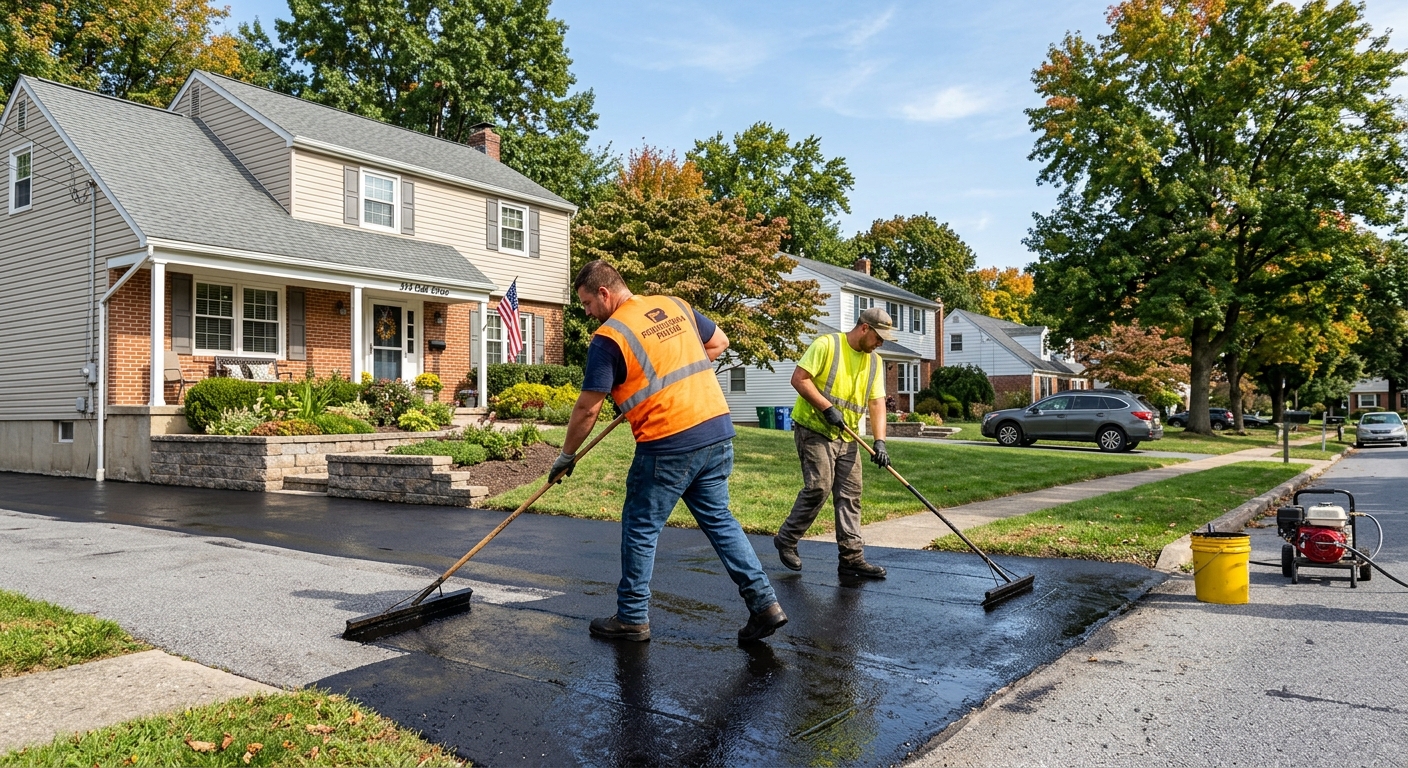
The true ongoing maintenance task is crack filling: a proper hot rubber fill keeps water from working into the base, which is what really destroys driveways here. A quality sealcoat job uses a squeegee to get into the pores, not just a quick spray-on, and of course, the price reflects that. Expect a legitimate job to run $200–$650 (typical $375 for an average two-car drive). If you’re quoted something suspiciously cheap, expect corners to be cut—thinned-out sealer, no prep, no crack fill, and results that last a season at most.
Frequently asked questions — driveway paving in White Oak
When is the best time of year to pave in White Oak?
For White Oak homeowners, the ideal paving window is late spring through early fall—roughly May through October. Asphalt requires both warm air and ground temperatures to be properly compacted. In this part of Allegheny County, hot-mix asphalt plants close for winter; material simply isn't available for projects in December through early March. Concrete also needs conditions above freezing to cure effectively. Trying to squeeze in driveway work outside of these months often means compromised quality, as the mix may cool too fast or the ground may not be stable after winter freeze-thaw cycles. This is why most paving contractors here book up quickly from June to August, when both weather and crew availability are optimal. You might find better scheduling and price flexibility in shoulder seasons—just avoid anyone promising durable results when the thermometer struggles to reach 50°F. A full asphalt replacement will run $3,300–$8,500 depending on size and prep.
Are pavers worth the cost in southwestern Pennsylvania?
Pavers—concrete or stone—offer a unique curb appeal and good drainage for White Oak homeowners, but they come at a much higher upfront investment than asphalt or standard concrete. Given our heavy freeze-thaw cycles and clay/shale soils, maintenance can be an issue. Paver surfaces here need deep, carefully compacted stone bases to avoid heaving and settling, as water moves through and under the surface. Regular re-leveling and sand replacement are expected every few years. Material and labor costs run two to three times a typical asphalt job. For context, a paver driveway might come in around $15,000–$25,000 for a two-car drive, which is well above the $4,700–$11,500 for concrete and $3,300–$8,500 for full-depth asphalt. For some, the look and permeability are worth it, but most local homeowners stick with asphalt or concrete for practicality.
Why does my driveway have depressions that hold water?
In White Oak, driveway depressions—often called 'birdbaths'—almost always trace back to subgrade movement. The local clay and shale soils hold water and shift with every freeze-thaw cycle. When the original builder didn’t use enough aggregate base or compact it properly, or when water finds its way under the pavement, the result is soft spots that settle. Vehicles then create and worsen the depressions over time. A surface patch will only hide the problem briefly; the base needs excavation and rebuilding for a long-term fix. For a standard area, expect a price of $3,300–$5,200 to address these properly—less for a small patch, more for a driveway-wide correction. Quick fixes will not hold in this region's climate.
How do I verify a paving contractor in Pennsylvania?
Every Pennsylvania paving contractor taking on jobs above $500 is required by law to be registered as a Home Improvement Contractor (HIC) with the Pennsylvania Office of Attorney General. You can verify a company’s HIC registration at hic.attorneygeneral.gov, making sure that both business name and registration number match. If you hire a contractor with employees (not just the owner), they must also carry workers’ compensation insurance. This is checked via the state’s WCAIS system at wcais.pa.gov. Don’t skip this step—being thorough saves headaches if there’s an injury on your jobsite. For your protection, always get a written contract (required by state law), which will spell out at least the basics of your agreement and should detail price (for example, $3,300–$8,500 for full-depth asphalt replacement).
What does compaction in lifts mean?
In driveway paving around White Oak, “compaction in lifts” means the installer spreads and packs the base (and sometimes the asphalt) in thin layers, not all at once. Each lift—usually 2 to 3 inches thick for asphalt, 4 to 6 inches for stone—is compacted with a roller before the next goes down. Proper compaction matters most in Allegheny County’s clay-heavy soils, which can settle or heave if left loose; it prevents shifting, rutting, and potholes. A single thick pour or dump can’t be compacted all the way through and will fail fast, especially here where frost depth reaches 36 inches. If a quote skips details on lifts or only mentions a total thickness (“three inches of asphalt”), ask questions—thin, poorly compacted asphalt is a leading reason for driveways needing premature replacement ($3,300–$8,500 for a do-over).
How many freeze-thaw cycles does White Oak get?
White Oak sees dozens of freeze-thaw cycles each winter, thanks to its southwestern Pennsylvania climate. The ground can move every time temperatures swing above and below freezing. Local building code reference points, like a frost depth of 36 inches and a winter design temperature of 8°F, reflect just how punishing this is for paved surfaces. Each cycle expands water trapped in the soil and under your driveway, creating cracks, pops, and shifting if the base was thin or poorly compacted. This is why driveways with strong, well-compacted aggregate bases last for decades here, while shortcuts show up in just a year or two. Repairs from this sort of damage—such as alligator cracking or depressions—often run in the $3,300–$8,500 band for full replacement.
How much does it cost to widen a driveway?
The cost to widen a driveway in White Oak depends on how much additional paving is needed and whether you’re replacing the entire drive or just adding a side strip. Any added width means new excavation, base, and surface paving, especially in Allegheny County’s clay/shale subgrade. For a typical two-car drive, widening by a few feet along one side often lands in the lower to middle part of the full-depth asphalt range, so you might pay $3,300–$5,500 or more—less if you’re already replacing, higher if major grading or drainage work is needed. Remember: any change where your drive meets a public road (the approach) may require a permit through PennDOT or the borough. Quick overlays are not advisable for new width—only for resurfacing the main area if the base remains sound.
What does an asphalt overlay cost in White Oak?
An asphalt overlay—sometimes called resurfacing—is a new 1.5 to 2-inch layer of fresh asphalt placed over a driveway where the base is still sound, but the surface has aged or cracked. In White Oak, this service costs $1,400–$4,200 for a typical single-family driveway. The exact price depends on square footage, driveway width, and the prep required (such as crack filling or edge milling). Overlays are a solid value when you have cosmetic wear or isolated surface problems, but not base failure—trying to overlay a driveway with deep alligator cracks, heaving, or subsurface movement is a waste of money, as those problems will show through quickly. Always have a contractor inspect and probe the base before considering this option.
Is sealcoating a scam?
In White Oak and all of Allegheny County, sealcoating is not a scam—but it is heavily oversold as a miracle fix. Proper sealcoating protects the surface from sun and chemicals, slows oxidation, and looks fresh, but it won’t add strength or fix a broken base. Be skeptical of anyone offering to “extend life by 10 years” with just a sealcoat; that’s simply not possible in our climate or soil conditions. If your driveway is aged but solid, a good sealcoat application every 2–4 years helps maintain appearance and surface protection (expect $200–$650 for a careful job). On any driveway with significant cracking, movement, or subsurface issues, money spent on sealcoating is money wasted—a patch on a major problem. Always ensure crack filling is part of the work, and avoid crews who spray and vanish in an afternoon for suspiciously low prices.