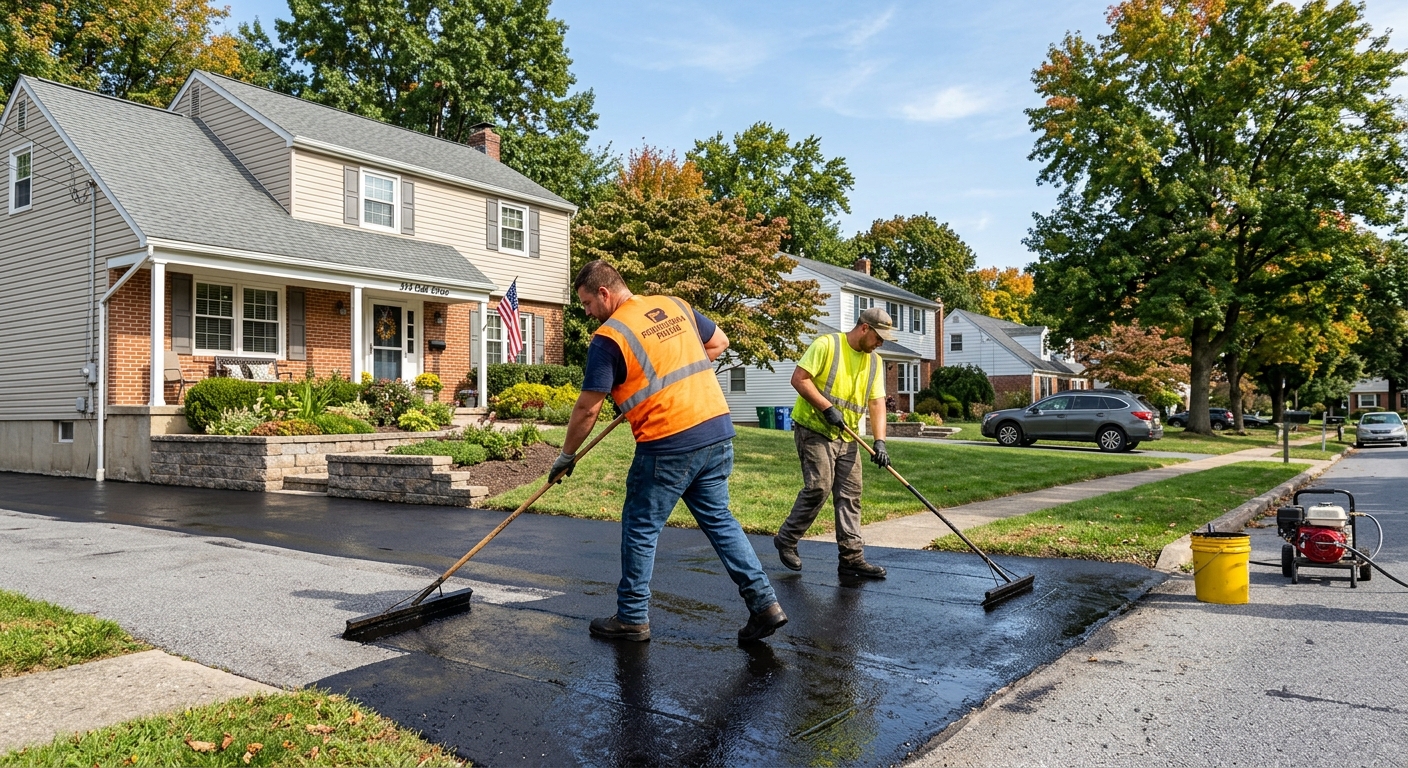
What a new driveway costs in Forest Hills
In Forest Hills, where over 70.0% of homes are owner-occupied and single-family houses make up more than 72.1% of housing (U.S. Census Bureau, ACS 2024), driveway paving is a regular expense for property owners—not just landlords or investors. Most Forest Hills driveways were installed before 1980 and have reached a point where surface fixes aren’t enough. The freeze-thaw cycles common to southwestern Pennsylvania, together with the shale and clay subgrade, mean that base preparation is what truly separates a good job from a driveway that cracks in three winters. You can't see or easily verify the most expensive part of a paving quote: what's under the surface.
Most of the price difference between contractors comes from what they do (or skip) underground. Thickness of aggregate base, quality of compaction, drainage corrections, and thickness of asphalt all drive costs far more than the difference between “cheap” and “premium” bituminous mix. Be wary of low bids: shortcuts here aren't obvious for a year or two, but they surface as cracks and potholes by the third spring.
| Service |
Best for |
Lifespan |
Price range |
| Asphalt — full replacement with new base |
failed base, structural cracking |
20–30 yrs |
$3,500–$9,100 |
| Asphalt overlay / resurfacing |
sound base, surface cracking only |
8–15 yrs |
$1,500–$4,500 |
| Sealcoating — single application |
preventive maintenance on sound asphalt |
2–4 yrs |
$200–$700 |
| Concrete — new installation |
long service life, low maintenance |
30–50 yrs |
$5,000–$12,000 |
| Crack filling and patching |
isolated cracks under a quarter inch |
1–3 yrs |
$200–$800 |
| Gravel driveway |
rural, budget, long runs |
5–10 yrs with upkeep |
$900–$3,500 |
Estimates for a typical Forest Hills driveway. Square footage and base condition drive these figures more than material choice.
Door-knocking crews and leftover material
Paving is notorious for attracting door-knocking crews with stories about “leftover material” from a job down the road. Their sales pitch often includes today-only pricing, an unmarked truck with out-of-town plates, and a strong push for cash before work begins. You might get a verbal quote and promises of a professional sealcoat, only to find out it’s thin oil-based spray that tracks onto your shoes and peels up within months.
The Allegheny County paving market is dense, with a lot of legitimate competition—and that makes it easier for unregistered, transient teams to blend in. Many homeowners are caught off guard because the finished product looks black and shiny for a season or two, while defects from skipped base or thin applications show after another hard freeze. You are legally entitled, under Pennsylvania’s Home Improvement Consumer Protection Act, to a written contract (required for jobs over $500) and a three business-day right to cancel—no excuses, no intimidation. Paying the deposit in cash or skipping the written contract waives away your leverage and makes it impossible to enforce a warranty. Never let yourself be pressured into a “today only” price, especially if it means forgoing basic paperwork.
In five minutes you can:
- Check HIC registration status at hic.attorneygeneral.gov
- Verify workers’ compensation at wcais.pa.gov
- Ask for a written contract with the total price and work scope
- Step away if you’re told you need to pay cash on the spot or if the truck has plates from out of state
These simple steps wreck every paving scam in Allegheny County.
Drainage: the failure nobody plans for
In Forest Hills, water management is the enemy of most driveways—especially with the region’s frequent freeze-thaw cycles and naturally heavy clay subgrade. Minimum slope for surface runoff isn’t optional; your driveway should have at least a 2% (quarter inch per foot) slope away from buildings or a gentle crown so water sheds to the sides instead of pooling. If your driveway pitches toward your garage or the foundation, a channel drain or trench drain might be needed, since regrading may not be an option on a tight Forest Hills lot. Basin drains that send runoff to daylight (outlet at surface lower down) are best. Dry wells can work but are less reliable in local clay, which holds water and slows drainage.
If runoff from your driveway crosses onto your neighbor’s yard and causes problems, you may be liable for damage—permits don’t change that. Most driveway failures here begin with water infiltrating the base, then freezing and heaving the slab or asphalt. That’s especially true on hillsides and poorly compacted fill common in Forest Hills. Good contractors will plan water management, not just pave what’s there. Skipping this step is the fastest way to see cracks, settlement, and spalling in the first few winters.
Driveway permits, approaches and stormwater rules
Repaving your existing driveway—so long as you aren’t expanding it or altering the curb or approach—typically doesn’t require a building permit in most Allegheny County municipalities, including Forest Hills. This saves you time and fees if you’re just resurfacing what’s already there. But the driveway approach—where your drive meets the public road—is a different matter. In Allegheny County, driveway approaches that connect to state routes require a Highway Occupancy Permit from PennDOT District 11-0. If you live in Pittsburgh, any work affecting the curb, sidewalk, or apron means dealing with the Department of Mobility and Infrastructure for the relevant permit.
Expanding your driveway and adding new impervious surface can trigger local stormwater rules. Regardless of what the permit says, you’re liable if runoff from your new pavement causes issues on a neighbor’s property. Before hiring, check that your contractor is registered as a Home Improvement Contractor with the Pennsylvania Office of Attorney General (look them up at hic.attorneygeneral.gov), and has valid workers’ compensation coverage (verify at wcais.pa.gov). Don’t settle for less—these are fast checks and shut out most fly-by-nights.
Sealcoating: what it does and what it doesn't
Sealcoating is often pitched as a cure-all for driveways in Forest Hills, but its actual benefits are more limited. A good sealcoat will block air, water, and UV, slowing the oxidative breakdown of the asphalt binder. It also protects against oil and gasoline drips, and refreshes the appearance of older pavement by restoring uniform color. However, sealcoating does not add any structural strength: if the base is failing or the surface is riddled with deep cracks, a sealcoat is just makeup over a problem.
Most problems come either from sealing too often or from an inferior product. Excessive layers crack and peel, and sealing new asphalt before it has cured (which can take several months) will trap moisture and solvents, damaging the driveway. Every two or three years is a reasonable interval in Forest Hills—not annually as some companies suggest. Crack filling matters more than routine sealing: filling deep or wide cracks (< 1/4 inch) keeps water out of the base, protecting your foundation from frost heave.
Watch for cut-rate drive-by sealing crews whose “sealcoat” is just a thin oil-based spray. For $200–$700, you should see hand or squeegee application of a quality acrylic or coal tar emulsion with careful crack prep. Anything less is a waste. A suspiciously cheap sealcoat almost always means no real product, no prep, or no warranty.
Why you can't pave in February
You simply cannot schedule quality driveway installation in Forest Hills during winter, and here’s why: hot-mix asphalt must be laid and compacted while it’s still well above 40°F, and most asphalt plants shut down late in the fall when the Pittsburgh region’s temperatures drop toward the winter design low of 8°F. Below this threshold, asphalt becomes unworkable in minutes, leading to a porous, brittle driveway with a drastically shortened lifespan. Concrete is also at risk—without above-freezing conditions for curing, it will crack and scale by spring.
Local asphalt supply comes from plants within the Allegheny County area, but even short haul distances can’t change the fundamental constraint: the paving season really runs from April to October. That means summer is the peak for bookings and highest prices, while spring and early fall offer better value and easier scheduling. If a crew claims they can pave your driveway in November or February, it’s a red flag that they plan to cut corners or aren’t getting work from better-informed customers. Wait for proper conditions. The handful of dry, mild weeks in the shoulder seasons are your best bet for quality work at a fair price.
Comparing paving estimates in Forest Hills
Comparing driveway quotes in Forest Hills means looking far beyond the total at the bottom of the page. A good estimate will state the measured square footage, the depth of excavation and disposal, the exact base type and thickness, number and depth of asphalt courses, edge treatments, drainage corrections, and outline what happens with soil and landscaping after the job. Payment terms should require only a modest deposit, with the balance on completion. Almost every warranty on paving around here excludes cracking, even though that’s the most common complaint later—read what's covered.
The most common—and most expensive—mistake homeowners make is accepting a one-line proposal with a lump sum and no specifics. This can’t be compared to anything and is often how corners are cut where no one sees until it’s too late.
| Line item |
What to look for |
Red flag if… |
| Area |
measured square footage stated |
eyeballed or absent |
| Excavation |
depth and disposal included |
'we'll pave over it' |
| Base |
aggregate type and depth in inches |
'proper base' |
| Compaction |
method, and done in lifts |
not mentioned |
| Asphalt |
courses and compacted depth |
'3 inches' unqualified |
| Drainage |
slope and water direction stated |
silent |
| Warranty |
what is covered and what is excluded |
verbal only |
| Payment |
modest deposit, balance on completion |
full cash up front |
Frequently asked questions — driveway paving in Forest Hills
When is the best time of year to pave in Forest Hills?
In Forest Hills, the ideal paving window is April through October. Asphalt plants in Allegheny County close for the winter, and both asphalt and concrete require a steady stretch of above-freezing temperatures to properly cure and compact. Trying to get work done in November or March risks poor results: asphalt cools too quickly to be compacted right, leading to soft spots and early cracks. Spring and early fall are best for scheduling since contractors have more availability, and you might get slightly better pricing than the peak of summer. If someone offers to pave outside of this window, it's a red flag they’re not following Pennsylvania’s best practices. For a standard replacement driveway, expect to pay in the $3,500–$9,100 range depending on size and site conditions.
Can I pave over my existing driveway?
In some Forest Hills homes, an asphalt overlay is a valid and cost-effective solution—if your base is still sound and cracks are shallow and not too wide. Overlaying is not appropriate if the pavement is flexing, deeply cracked, or showing areas of settling. Asphalt overlay prices typically run $1,500–$4,500 locally, noticeably less than full replacement with a rebuilt base. Always ask your contractor to confirm the base condition thoroughly (core samples, if in doubt)—otherwise, you risk overlaying over problems that will reflect through and crack again within a few winters. Overlays are best for driveways with cosmetic wear but structurally healthy subgrade.
How often should I sealcoat my driveway in Forest Hills?
Forest Hills sees heavy freeze-thaw cycles, but that doesn’t mean you should sealcoat every year. For sound asphalt, a quality sealcoat every two to three years is plenty—it protects against water, oil, and UV, but too many coats will flake and peel. For new asphalt, wait at least six months (ideally until the following paving season) before sealing so the surface has time to cure fully and shed volatile compounds. Proper crack filling ahead of sealing is far more important for maintaining the life of your driveway. For each service, expect to pay between $200–$700 depending on size and prep needed. If your asphalt is crumbling or the base is moving, sealcoating won’t solve those deeper problems.
How much does driveway paving cost in Forest Hills?
For most homeowners in Forest Hills, a complete asphalt driveway replacement with a new base falls between $3,500–$9,100. Smaller driveways or overlays can be less—typically $1,500–$4,500 for a resurfacing job where the base is still solid. Concrete driveways are more expensive, ranging from $5,000–$12,000 depending on thickness, finish, and site work. Costs vary based on access, grading required (especially on hilly lots), and the thickness of aggregate base needed for the local clay and shale soils. Always get at least two detailed bids to understand what's being included at each step.
What does sealcoating cost in Forest Hills?
Single-application sealcoating for an average Forest Hills driveway typically costs $200–$700. The low end covers basic jobs on small or well-maintained drives, while the upper range includes thorough crack cleaning, weed removal, and high-quality sealer applied by squeegee, not just a quick spray. If you get a much lower quote, question whether they are using quality material or cutting corners on prep. Genuine sealcoating won’t make a failing driveway last longer; it mainly protects the surface and improves appearance. For best results, combine sealcoating with crack filling every few years—not every year.
How deep should the aggregate base be here?
On Forest Hills' heavy clay and shale soils, the aggregate base for a driveway should be thicker than in regions with sandy or fast-draining subgrade. For a typical residential asphalt drive, you want at least 6–8 inches of compacted crushed stone base, and for concrete, 4–6 inches minimum (more is better on sloped lots or places with proven drainage issues). This adds to your up-front cost but pays off by resisting heaving and settlement from freeze-thaw cycles. Skimping on base is the number one way contractors cut hidden costs. For a full replacement with a new base, expect totals in the $3,500–$9,100 range for asphalt locally.
Does road salt damage driveways in Forest Hills?
Yes, regular road salt use during snowy Allegheny County winters does affect driveways in Forest Hills. Asphalt is less sensitive than concrete, but over time, salt will accelerate freeze-thaw cycles and soften the asphalt binder, causing premature cracking. Concrete is more prone to surface scaling and spalling from repeated deicing salt exposure. Good sealcoating ($200–$700 per application) can protect the surface from chemical absorption, but even that isn’t a cure-all. For concrete, ask about air-entrained mix and ensure good finishing practices. Rinse heavy salt residue off in spring to help extend your driveway’s lifespan, especially in shaded or north-facing areas where ice lingers.
Do I need an approach permit where my driveway meets the road?
If your Forest Hills driveway connects to a state route—such as a numbered road—a Highway Occupancy Permit from PennDOT District 11-0 is required for work on the approach. Doing paving, widening, or replacing the portion at the curb or gutter means you can't just proceed as a private project, and skipping the permit can cause headaches if there’s an accident or stormwater backup at that entry. In other towns in Allegheny County, allowing agencies may vary, but the general rule is that the apron and curb-cut at the road involve municipal or state oversight. Repaving does not usually need a permit if you’re not touching the approach, but check with your contractor and have them handle the paperwork.
What are the signs of a failing driveway base?
Signs your driveway base has failed in Forest Hills include: deep or wide cracks (wider than a pencil), areas of sinking or heaving especially after winter, repeated potholes in the same spots, and water pooling for days after rain (because the subgrade isn’t draining right). If you see cracks reflecting through every season, or parts of the driveway that move underfoot or under a car tire, repairs on the surface won’t last: the base itself is shifting or waterlogged. In these cases, spot repairs and overlays won’t hold up, and full replacement—the $3,500–$9,100 range for most typical jobs—is the best long-term fix. Addressing the underlying drainage at the same time is key to making it last another two decades.