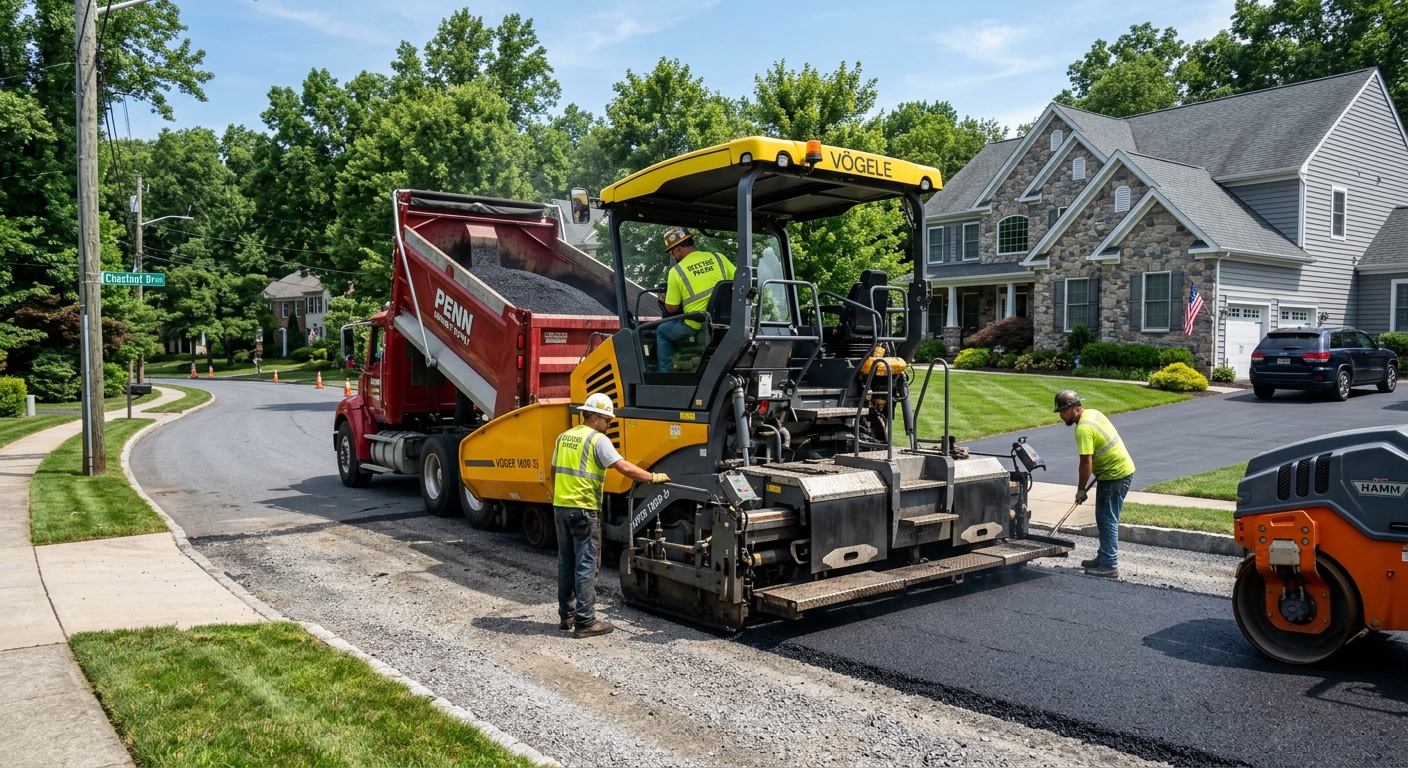
What a new driveway costs in Mount Pleasant
Mount Pleasant’s driveways are a typical expense for the area’s 81.2% single-family homes and 85.0% homeownership rate (U.S. Census Bureau, ACS 2024). For most residents, a driveway is more than just an entry — it’s a long-term investment in the property's function and curb appeal. But in southwestern Pennsylvania, and especially on the shale and clay subgrade found here, what you see on the day of paving hides most of what you’re paying for. With our frequent freeze-thaw cycles, the stone base beneath the asphalt or concrete is what truly determines how long your driveway lasts.
The sticker price you see isn’t just about the paving material, but about what’s happening underneath. Two driveways may look identical on day one, yet diverge sharply after a few winters. That’s because shortcuts in excavation and base preparation hide below the surface. It’s especially important here because Mount Pleasant’s clay and shale hold water and heave in winter, putting unrelenting stress on your driveway. A low price often means less attention where it matters most — in the base you never see.
| Service |
Best for |
Lifespan |
Price range |
| Asphalt — full replacement with new base |
failed base, structural cracking |
20–30 yrs |
$3,300–$8,500 |
| Asphalt overlay / resurfacing |
sound base, surface cracking only |
8–15 yrs |
$1,400–$4,200 |
| Sealcoating — single application |
preventive maintenance on sound asphalt |
2–4 yrs |
$200–$650 |
| Concrete — new installation |
long service life, low maintenance |
30–50 yrs |
$4,700–$11,500 |
| Crack filling and patching |
isolated cracks under a quarter inch |
1–3 yrs |
$200–$800 |
| Gravel driveway |
rural, budget, long runs |
5–10 yrs with upkeep |
$900–$3,500 |
Estimates for a typical Mount Pleasant driveway. Square footage and base condition drive these figures more than material choice.
Diagnosing a failing Mount Pleasant driveway
Most Mount Pleasant driveways have seen decades of freeze-thaw cycles, and diagnosing whether you need repairs or a full replacement comes down to the condition of the base beneath the surface. Contractors may give different answers based on what they want to sell, but you can do some basic triage yourself. Alligator cracking—those webs of small interconnected cracks spread over wide areas—almost always means the stone base has failed. No amount of overlays or patches will keep it together for long. On the other hand, straight cracks, less than a quarter inch wide and not clustered, mostly signal simple aging of the surface—these respond well to crack filling and sealcoating.
Keep an eye out for depressions (birdbaths) that hold water after a rain; these usually point to subgrade movement, often from water issues beneath the base. Crumbling along the edges is often a sign of inadequate support; poor installation skipped the base extension at the sides. Potholes mean water has already worked through the asphalt to the base, and patching them covers a symptom, not the cause. If a contractor suggests an overlay without coring or checking the base's condition, be wary; a fresh surface will look great, but will not last if the base underneath is unsound.
| What you see |
Likely cause |
Right fix |
Cost |
| Isolated cracks under 1/4 inch |
surface aging |
crack fill and seal |
$200–$650 |
| Alligator cracking over a wide area |
base failure |
full replacement |
$3,300–$8,500 |
| Depressions holding water |
subgrade movement |
excavate and rebuild that area |
$3,300–$5,200 |
| Crumbling edges |
no edge support |
edge repair, consider curbing |
$400–$1,500 |
| Potholes |
water into the base |
full-depth patch, then assess |
$250–$900 |
| Faded but sound surface |
oxidation only |
sealcoat |
$200–$650 |
Mount Pleasant's ground and what it means for paving
Here in Mount Pleasant and across much of Westmoreland County, driveways are built on shale and clay subgrade. These soils behave very differently than sand or gravel: clay retains water, swells in wet weather, and then contracts as it dries or freezes. Shale, while more stable and better-draining than pure clay, still poses its own issues, especially when mixed with fines or found in thin layers. The consequence? Without proper base depth and drainage, your driveway is set up for frost-heave, rutting, and edge failure within just a few winters.
Factoring in our 36-inch frost depth and the region’s harsh freeze-thaw cycles, the risks of movement and cracking are far higher than they would be in a place with milder winters or sandier soils. Add to this the legacy of post‑1960 suburban tract construction in Hempfield and North Huntingdon: many older driveways may have been laid with minimal excavation, a thin base, and little compaction. If your driveway falls in that bracket, resurfacing is often cost-effective—if the base is sound. But if your home is on a clay-heavy stretch or you see regular movement, a full base rebuild is the only fix that holds up for more than a couple of years.
This means any contractor working in Mount Pleasant should be specifying thicker compacted stone bases and confirming there’s proper drainage. If the subgrade isn’t right, nothing else will last—no matter how much you spend on surface materials.
Permits and approvals for paving in Mount Pleasant
If you’re simply resurfacing or sealcoating your existing residential driveway in Mount Pleasant—especially within Hempfield Township—a municipal permit is generally not needed. This streamlines maintenance work and spares you extra paperwork. However, any work that expands your driveway, alters its footprint, or affects curbs, sidewalks, or drainage may require a permit. In the City of Greensburg, for example, replacing or expanding a driveway that influences curb, sidewalk, or drainage installation nearly always triggers a zoning or building permit.
The most commonly overlooked requirement is the driveway approach—where your driveway meets the public road. This is not a local township decision: PennDOT District 12, coordinated through the Westmoreland County maintenance office, issues permits for driveway approaches on state routes. If your property fronts a state-maintained road, you need their signoff before altering the approach, not just the municipal building office.
Stormwater management also matters. Expanding your driveway increases impervious area, which can trigger runoff requirements under local codes. Regardless of permitting, you may be liable if increased runoff damages a neighbor’s property. Drainage correction should always be part of the plan—don’t assume it’s handled by default.
Finally, all contractors must have Home Improvement Contractor (HIC) registration from the Pennsylvania Office of Attorney General for contracts above $500. Confirm this at hic.attorneygeneral.gov before signing anything. Workers’ compensation coverage is mandatory for all contractors with employees, and you can verify coverage status at WCAIS (wcais.pa.gov).
Why Mount Pleasant driveways fail from the bottom up
The biggest reason driveways fail in Mount Pleasant isn’t the asphalt or concrete itself—it’s weak, thin, or water-logged base work underneath. The basic structure, from bottom to top, is the natural subgrade (the undisturbed soil), a compacted aggregate base (usually crushed stone), and then the asphalt or concrete surface. Each layer spreads the weight to the one below. But with our heavy freeze-thaw cycles and clay/shale soils, water trapped in the base or subgrade turns to ice in winter, expands, and heaves the driveway upward in uneven spots. Once things thaw, the ground drops back down, leaving cracks, depressions, and edge failures behind.
Frost heave is not just a theory here: shale and especially clay act like sponges, holding onto water and then swelling when frozen. In Westmoreland County’s 36-inch frost depth zone, a shallow base invites constant movement. Too many driveways in Mount Pleasant (especially those in post-1960 subdivisions) were installed with a bare minimum 4–5 inch stone base—and sometimes less. In this soil, a 6–8 inch compacted aggregate base is the bare minimum for durability. It’s critical that this stone be compacted in lifts—meaning a few inches at a time, rolled repeatedly—before the blacktop or concrete goes down.
This is where cheap quotes get you. Some contractors skip deep excavation and compaction, lay over a failed or thin base, or use fine or recycled stone instead of proper 2A crushed limestone. None of these shortcuts are visible when the job is done. But come year three, you’ll see new cracks, ruts at the car tires, and crumbling edges that never happen with a properly installed base. Always get it in writing: the base depth (inches after compaction), aggregate type (“2A modified stone” or similar), and confirmation that compaction was done in lifts. Insist on seeing the subgrade before paving starts, and don’t be afraid to walk if a contractor won’t specify these details clearly.
Finding a legitimate paver in Westmoreland County
Mount Pleasant and the larger Westmoreland County area aren’t immune to fly-by-night paving crews. The only way to avoid costly headaches is to verify contractors thoroughly—using resources actually checked locally. The Pennsylvania Office of Attorney General maintains the official list of Home Improvement Contractor (HIC) registrations, your first stop before you sign. And if a contractor claims to have employees, check their workers’ compensation coverage on WCAIS. Favor a local business address—not just a cell phone number—and a physical yard where equipment is stored. Real contractors own their rollers and skid steers; “we’ll bring it in from Pittsburgh” often means it’s rented or brokered work.
References matter, but they need to be at least three years old—a job that looks fine at year one can crumble if the base was cut short. Ask who their asphalt supplier is; someone working regularly in Mount Pleasant should name a Hempfield Township plant or a specific Westmoreland County supplier. If they don’t know or won’t say, you’re probably not dealing with a real installer.
- Verify HIC registration at hic.attorneygeneral.gov
- Check workers’ comp coverage at WCAIS for any business with employees
- Written contract as required for projects over $500
- Local business address, not just a PO box or cell phone
- Owned, not rented, paving equipment
- References from jobs at least 3–5 years old
- Ability to name local asphalt supplier (e.g. Hempfield Township plant)
- Clear, written scope: excavation, base depth, drainage, compaction
- No insistence on cash or up-front payment in full
- No offer to waive insurance deductibles (illegal under state law)
- Not just a “goes by” name or out-of-state plates on trucks
- Written warranty that details what’s covered and for how long
Red flags: refusal to put the base depth in writing, a price that’s far below local averages, pressure to “act today,” or crews that can’t give area references beyond the past year.
Comparing materials in southwestern Pennsylvania
When choosing between asphalt and concrete for a Mount Pleasant driveway, our local climate should dictate your decision. Southwest Pennsylvania’s repeated freeze-thaw cycles—dozens each winter—mean ground movement is routine. Asphalt is designed to flex and absorb this movement; it may deform slightly in harsh spells, but it generally won’t crack through quickly. That makes it an excellent match for our shale and clay soils. It does need periodic resealing, but it stands up better to temperature swings. Concrete, on the other hand, lasts longer when it holds up, but it’s rigid and less forgiving: every cycle of frost can add fine cracks or, more often in this area, lead to surface spalling and scaling—especially when residents use salt-based deicers in freezing weather.
Concrete still has a place here, especially if you commit to avoiding salt deicers and maintaining good drainage. But most local failures stem from winter salt use, not poor concrete. You’ll pay more up front, but you could get up to 50 years from a properly installed concrete drive. For rural or budget applications, especially for long lanes in Penn or Unity Township, gravel is preferable. Some opt for concrete pavers—these settle gradually and can be individually replaced if frost moves one out of line, but are at the high end on price. Each option suits a different set of priorities and budgets.
| Option |
Installed cost |
Maintenance |
Freeze-thaw performance |
Lifespan |
| Asphalt — new install |
$3,300–$8,500 |
sealcoat every 3–4 yrs |
excellent, flexes |
20–30 yrs |
| Asphalt — overlay |
$1,400–$4,200 |
same |
good if base is sound |
+8–15 yrs |
| Concrete |
$4,700–$11,500 |
low, avoid de-icing salt |
fair, spalls with salt |
30–50 yrs |
| Pavers |
$7,500–$11,500 |
individual units replaceable |
good, settles gradually |
25–50 yrs |
| Gravel |
$900–$3,500 |
top-dress every 2–3 yrs |
excellent drainage |
indefinite with upkeep |
Frequently asked questions — driveway paving in Mount Pleasant
Do I need an approach permit where my driveway meets the road?
Yes, most Mount Pleasant homeowners do need an approach permit for any work where the driveway meets a public road, especially if that road is a state route. This requirement is administered by PennDOT District 12 through the Westmoreland County maintenance office, not by your local township or the county seat in Greensburg. If you only resurface your driveway, and do not change the road connection, no permit is typically required. However, new installations or any work that expands or alters the approach area absolutely require approval from PennDOT. Failing to get a permit can lead to costly headaches down the road, including the possibility that the state could demand removal or correction at your expense. Budgeting for this approval is wise, but it won't usually add much to your costs compared to the total project price—for example, a new full-depth asphalt driveway typically runs $3,300–$8,500 in Mount Pleasant.
How long does a driveway installation take?
In Mount Pleasant and across Westmoreland County, most residential driveway installations are completed in 1–4 days, depending on size, weather, and site conditions. A straightforward asphalt replacement with no drainage issues could be done in a single day if the crew and equipment are ready, but more often, it's a two or three-day process. Base excavation and compaction, especially where clay or shale soils are present, can take longer—proper drying and compaction between lifts really matter here. Concrete driveways need extra days for proper curing before they're driven on, even if actual placement only takes a day. Unforeseen rain or the need to rebuild a failing base can stretch the schedule further. For budgeting, know that most contractors include all labor in the total project price—say, $4,700–$11,500 for a new concrete install—so delays are rarely a reason for extra charges unless you request additional work.
How thick should asphalt be for a residential driveway in Mount Pleasant?
Given the clay and shale subgrade and heavy freeze-thaw cycle in Mount Pleasant, a quality asphalt driveway should have at least 6–8 inches of compacted aggregate base and 2.5 to 3 inches of compacted asphalt surface for most single-family homes. Some contractors may quote less to lower their price, but that's a shortcut that rarely survives our winters. Anything less, and you risk rutting, alligator cracking, and frost heave within just a few years. Make sure your contract spells this out: base depth, stone type (such as 2A modified), and asphalt thickness after compaction, not just "paved surface." The extra base doesn't add much to the initial price band—$3,300–$8,500 for a Mount Pleasant replacement—but it saves you from having to redo the job prematurely.
How many freeze-thaw cycles does Mount Pleasant get?
Mount Pleasant and Westmoreland County experience dozens of freeze-thaw cycles each year, with temperatures regularly swinging above and below freezing from late fall through early spring. The combination of heavy clay and shale soils with a 36-inch frost depth (noted by regional code guidance) means each thaw and refreeze stresses the base and surface of your driveway. This is far more demanding than regions further south or in the center of Pennsylvania. These cycles are the number one reason properly built driveways here include deep stone bases and thorough drainage. The longer you try to cheap out on excavation, the more those cycles shorten driveway life. Most homeowners see an 8–15 year lifespan with an asphalt overlay ($1,400–$4,200)—but that only holds up when the base is already solid.
What are the signs of a failing driveway base?
Classic signs of a failing base on Mount Pleasant driveways include alligator (interconnected) cracking across large sections, deep depressions or birdbaths that hold water after rain, and new potholes that return even after patching. If the edges of your driveway crumble or shear off, especially where the blacktop is thin or unsupported, that’s another indicator the base is gone or was never installed properly for this soil type. Patching or overlays will only buy limited time if these problems are showing up—you’re likely looking at a full-depth replacement ($3,300–$8,500). Before you spend, always have a reputable contractor examine the base by probing or coring, not just by eye.
Can I pave over my existing driveway?
Paving over an existing driveway is sometimes possible in Mount Pleasant, but only if the underlying base is still sound. Overlaying on top of cracked or settled blacktop, or over a base that has failed from frost heave or drainage issues, is money wasted; new cracks will show up within a couple of winters because the problems below were never fixed. However, if your driveway has only minor, isolated surface cracks, or a faded, oxidized top layer, an overlay could earn you another 8–15 years for around $1,400–$4,200. Always have a contractor assess the base condition carefully before deciding—if they don’t test or core the base, find someone who will. In some cases, minimal repairs and sealcoating ($200–$650) might be all you need.
What is the difference between crack filling and sealcoating?
Both crack filling and sealcoating help extend the life of Mount Pleasant asphalt driveways, but they're not interchangeable. Crack filling targets specific, isolated cracks, usually less than 1/4 inch wide, keeping water out of the base and stopping damage from spreading beneath the surface. Sealcoating is a surface treatment—an emulsion brushed or sprayed onto the entire driveway that protects the asphalt from sun oxidation, water infiltration, salts, and chemicals. A single sealcoating typically lasts 2–4 years and costs between $200–$650 for a standard-sized Mount Pleasant driveway, while crack filling is often included or priced separately for larger repairs. They’re meant to maintain a driveway—not fix structural problems. If you have widespread cracking or base movement, neither will correct the underlying issue, but together they offer low-cost protection when the pavement is fundamentally sound.
How much does a concrete driveway cost in Mount Pleasant?
A new concrete driveway in Mount Pleasant generally runs from $4,700–$11,500. The final price depends on driveway size, slope, drainage requirements, thickness (more is better for longevity), and site-specific challenges such as clay-heavy soils that may require a deeper crushed stone base. While concrete driveways last longer—30 to 50 years when installed and maintained properly—they are more expensive up front than asphalt. Many failures in this area are not due to the concrete itself but from improper winter maintenance or heavy use of de-icing salt, which causes pitting and spalling in freeze-thaw conditions. If you’re considering concrete, be sure you (and everyone who will maintain it) can avoid salt-based deicers and keep the surface clean over winter to maximize that investment.
How much does driveway paving cost in Mount Pleasant?
In Mount Pleasant, the typical price to pave a residential driveway with new asphalt and a rebuilt stone base falls between $3,300–$8,500, depending on size, base depth required, and site conditions like slope or soil type. An asphalt overlay, suitable when the base is still solid, is less—$1,400–$4,200. Concrete driveways carry a higher up-front cost, usually between $4,700–$11,500, but can last much longer with proper maintenance. Basic sealcoating for existing surfaces usually costs $200–$650 per application. Pricing here is more sensitive to what’s below the surface than in some neighboring areas, because the clay/shale subgrade and freeze-thaw cycles punish shortcuts. Compare quotes carefully, but look beyond the lowest bid—ask what’s planned for base depth, compaction, and drainage.