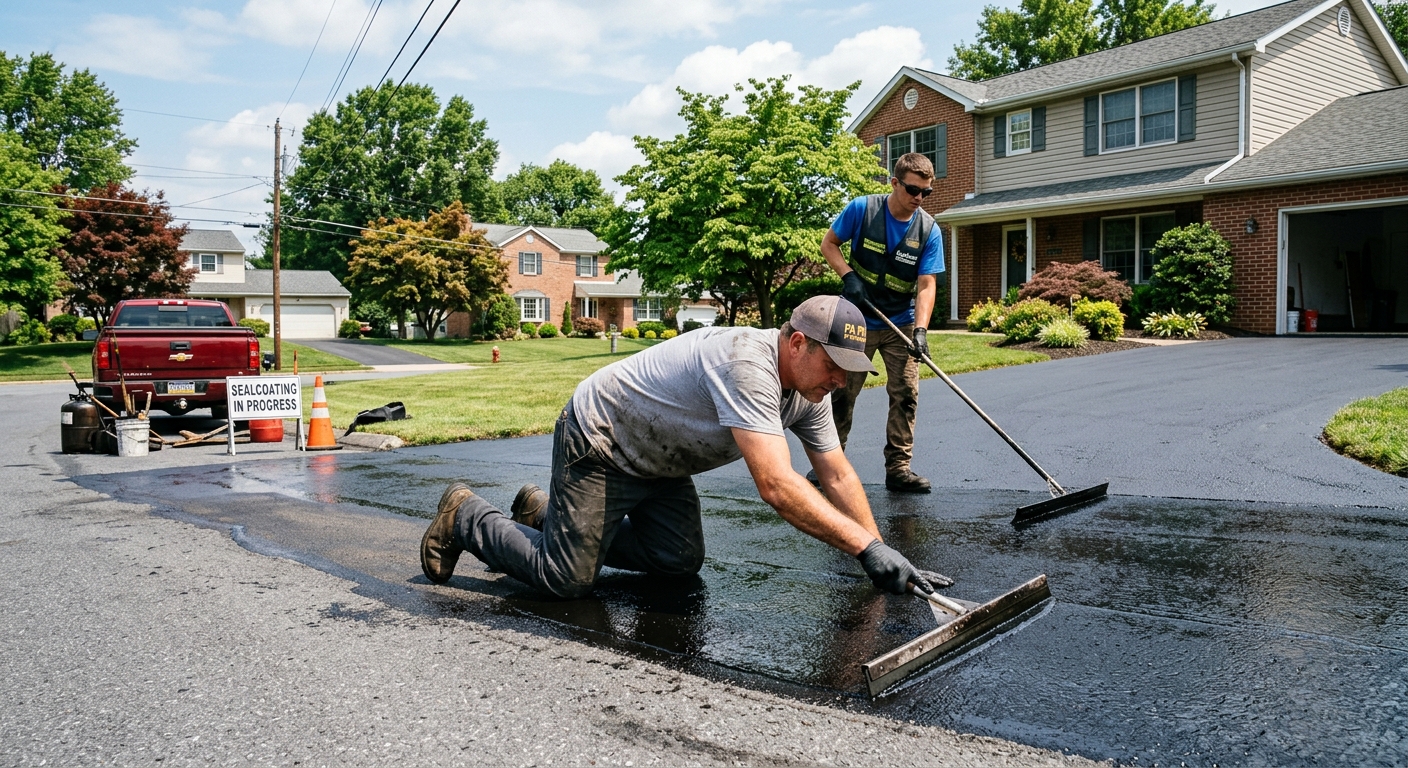
What a new driveway costs in Cumberland
Cumberland’s driveways are nearly all a single-family homeowner’s responsibility—over 69.8% of homes here are detached (U.S. Census Bureau, ACS 2024), and with homeownership at 83.1%, most residents are footing their own paving bills, not sharing costs. If your existing drive is cracking, rutted, or narrow gravel, it’s likely due for more than just a surface touch-up. In this part of Adams County, harsh freeze-thaw cycling is part of every winter, which means driveways face expansion, contraction, and slow damage from water that works into every seam and edge. With local limestone subgrades and possible sinkhole risks near Gettysburg, most of what determines your final price is buried—quite literally—underneath, in the base prep that you won’t see once the job’s done.
The visible paving—the black top or concrete surface—costs much less to lay than prepping the ground with excavation, grading, and stone base thick enough to survive Central PA’s cycles of freezing and thawing. When you compare quotes, know that the big price differences almost always reflect what’s done below the surface, not cosmetic details. Below is what you can expect for different projects around Cumberland:
| Service |
Best for |
Lifespan |
Price range |
| Asphalt — full replacement with new base |
failed base, structural cracking |
20–30 yrs |
$3,700–$9,500 |
| Asphalt overlay / resurfacing |
sound base, surface cracking only |
8–15 yrs |
$1,600–$4,700 |
| Sealcoating — single application |
preventive maintenance on sound asphalt |
2–4 yrs |
$200–$750 |
| Concrete — new installation |
long service life, low maintenance |
30–50 yrs |
$5,300–$12,500 |
| Crack filling and patching |
isolated cracks under a quarter inch |
1–3 yrs |
$200–$800 |
| Gravel driveway |
rural, budget, long runs |
5–10 yrs with upkeep |
$900–$3,500 |
Estimates for a typical Cumberland driveway. Square footage and base condition drive these figures more than material choice.
Widening, extending or adding a parking pad
When homeowners in Cumberland want to widen their driveway for a second vehicle, extend it out to a garage, or add a turnaround or extra parking pad, there’s more involved than just adding more pavement. Anytime you expand into undisturbed ground, it means building a new compacted stone base from scratch—and this is even more crucial around the central Adams County limestone subgrade, where the risk of sinkholes demands thicker base work and careful compaction.
No matter if you're swapping out an old gravel track for fresh asphalt or connecting a pad to an existing driveway, there’s always a permanent seam where new meets old. That seam is a built-in weak spot, so expect it to need maintenance or develop cracks sooner than the rest. On top of construction basics, adding any new impervious surface—whether it’s asphalt or concrete—can run up against township setback rules and local stormwater or runoff restrictions. For driveways extending to a state road, PennDOT District 8-0 is the authority that issues approach permits; if your project is on a township road, the local Adams County township office handles it, not the borough, so you’ll need to check those requirements before digging.
Meaning: before you plan any major expansion in Cumberland, budget not just for the obvious concrete or asphalt, but for base excavation and possible stormwater controls. Unless your lot is large and slopes away from the road, check how close you can get to property lines—those rules are enforced strictly here.
Maintenance that actually works
In Cumberland’s climate, real maintenance begins with keeping water from ever reaching the base. The single most effective thing you can do is fill cracks as soon as they appear—ideally before water has a chance to seep in and freeze below the surface. Filling the edges with soil or stone to prevent drop-offs keeps pavement supported and deters crumbling. Surface water should always be moving off the driveway, away from joints and foundations; pooling anywhere in Adams County’s freeze-thaw environment leads quickly to heaves and potholes.
Heavy point loads from dumpsters or jack stands will crush or dent even the best driveway. After any new asphalt job, letting it cure—a couple of days in cool weather, a week if it’s hot—before parking or turning sharp wheels on it matters more than homeowners think.
De-icing is a perennial question. On concrete, avoid rock salt—it accelerates surface damage, especially with Adams County’s cycles of melting and freezing. For asphalt, the issue isn’t the salt but the refreeze: melted snow that runs into tiny cracks, then freezes overnight, will break up even new blacktop. Sand, cat litter, or calcium magnesium acetate are safer but more expensive alternatives. The cost is higher per bag but far less than concrete patching at $200–$800.
Reading a driveway proposal
A clear, detailed driveway quote is your only defense against underbuilt work in Cumberland. Any proper estimate should list the measured square footage, not just an “average” guess. Excavation details matter—look for both the planned depth and how the old material is being disposed of (not buried on-site). A good bid will specify the type of stone base, its thickness after compaction, and describe how and in how many lifts it will be packed down.
Look for the asphalt’s compacted thickness and the number of courses (binder and surface), not just ‘X inches’—compacted is what lasts. Ask about edge treatments; miss these and edges will soon crumble, especially through Gettysburg and Cumberland Township, where unsupported edges leak and fail. The quote should describe grading and drainage, because Pennsylvania’s freeze-thaw cycles make water management the key to longevity.
Payment schedules matter, too: a modest deposit is normal, but not more than a third up front, with the rest due on completion. Warranty terms often exclude the thing most homeowners expect—cracking—so read the fine print. A one-line quote that gives just a grand total is a red flag. This is the single most common way Cumberland homeowners end up with thin, short-lived work.
| Line item |
What to look for |
Red flag if… |
| Area |
measured square footage stated |
eyeballed or absent |
| Excavation |
depth and disposal included |
'we'll pave over it' |
| Base |
aggregate type and depth in inches |
'proper base' |
| Compaction |
method, and done in lifts |
not mentioned |
| Asphalt |
courses and compacted depth |
'3 inches' unqualified |
| Drainage |
slope and water direction stated |
silent |
| Warranty |
what is covered and what is excluded |
verbal only |
| Payment |
modest deposit, balance on completion |
full cash up front |
Drainage: the failure nobody plans for
Water is the force behind almost every driveway failure in Cumberland. Grading isn’t just cosmetic—without the right slope, water will pool, infiltrate, freeze, and heave your pavement, especially on limestone subgrades around Gettysburg. The minimum slope for surface runoff is usually 2%, but even that isn’t enough if the land flattens out near the drive’s end. Sometimes, crowning the driveway (high in the center) runs water to both sides; in tight properties, a cross-slope may be needed instead.
If your driveway slopes toward your house or garage, you’re inviting basement leaks or frost jacking at the slab. In these cases, a trench or channel drain at the base is the band-aid, routing water away before it can cause harm. Drains must have somewhere to go, like “daylighting” to a slope, or a properly sized dry well set away from foundations.
In this region’s pronounced freeze-thaw cycle, even a small depression that captures rain or snowmelt can turn into a pothole or cracked slab by spring. If your property has heavy clay soil—a common issue in parts of Adams County—surface water won’t soak away and will sit against your driveway base, which requires more aggressive grading and possibly perimeter drains.
Finally, never direct runoff onto a neighboring property; local enforcement aside, you’re open to liability, and word travels fast in a small township when flooding starts in someone else’s yard.
Driveway permits, approaches and stormwater rules
If you’re repaving your driveway in its existing footprint in Cumberland, a building permit usually isn’t required. That saves time and avoids an extra layer of paperwork—but the driveway approach, where your pavement meets the public road, is another matter entirely. For state roads in Adams County, PennDOT District 8-0 is the authority that issues approach permits. If your home fronts a township road, the township office—not the borough or county—handles those applications.
Expanding your driveway, adding a parking pad, or changing the grade are a different story. Adding new pavement triggers impervious surface limits and may require stormwater management measures, including site plans or drainage reviews. These aren’t just bureaucratic hoops—uncontrolled runoff onto a neighbor’s property will land you in trouble, regardless of what your permit says.
Before you sign any contract over $500 for driveway work, Pennsylvania law requires your contractor to be registered as a Home Improvement Contractor (HIC) with the Office of Attorney General (verify at hic.attorneygeneral.gov). For any job with employees on site, check that workers’ compensation insurance is active and verifiable in WCAIS (wcais.pa.gov). These protections matter as much as any permit in Cumberland.
The specifications to demand in writing
In Cumberland, if you accept a vague quote—“we’ll lay three inches of blacktop”—you’re leaving yourself open to disappointment. The difference between a driveway built for comfort and one built for the climate is in the specifics. Pennsylvania’s freeze-thaw cycles, 30-inch frost depth, and local limestone or clay subgrades demand thicker, better-compacted bases than milder regions. Always ask for measurements after compaction, not loose or as-laid.
Binder and surface courses in asphalt each compress substantially—what goes down is not what you end up with. Require the mix designation so you know what’s being installed. State the aggregate base by both depth and material (preferably 2A modified or similar). Insist on details about compaction: each lift should be compacted separately with a plate or roller. Edges should be backed and protected, not left unsupported.
Loose language only protects the contractor. You want every key number in writing before signing anything. Here’s the checklist to include in every Cumberland proposal:
- Measured square footage of drive and any pads
- Excavation depth (inches or feet)
- Aggregate base material and compacted thickness
- Compaction method and number of lifts
- Asphalt binder course mix and compacted depth
- Asphalt surface course mix and compacted depth
- Edge treatment and support method
- Grading plan: stated slope and direction of runoff
- Stormwater controls (if new impervious area)
- Warranty written out, with stated exclusions
Frequently asked questions — driveway paving in Cumberland
Why are my driveway edges crumbling?
Edges are the weakest point on any driveway in Cumberland, especially if they’re not properly supported. A common problem in this area—where freeze-thaw cycles are tough on pavement—is when the soil beside the drive erodes or was never properly backfilled. Without lateral support, asphalt and even concrete can flex or break off when vehicles drive over or near the edge. Water infiltration is another major culprit. Once the edge cracks, water can get underneath and freeze, breaking chunks loose. An unsupported edge will often start to go after just a few winters. To repair, patching may be needed, which costs between $200–$800. For long term resilience, ask for edge backing with stone, not just soil.
How thick should asphalt be for a residential driveway in Cumberland?
In Cumberland and wider Adams County, you want more than just a couple inches of asphalt, thanks to our 30-inch frost depth and pronounced freeze-thaw cycling. For residential driveways, a typical spec is at least 4 inches of compacted stone base, topped with 2.5 inches of asphalt in two lifts—a thicker binder course and a surface course, both measured after compaction. In areas with weaker subgrade, like the limestone zones near Gettysburg, going thicker is a wise investment. Don’t accept a quote that only says “three inches” without compacted depths and base detail. A full replacement built to this spec runs $3,700–$9,500 for most Cumberland homes.
What is the difference between crack filling and sealcoating?
Crack filling is exactly what it sounds like: it plugs open asphalt cracks with a hot or cold rubberized material, stopping water before it gets below the surface and freezes—very important in Cumberland’s freeze-thaw zone. Sealcoating, on the other hand, is a thin liquid layer brushed or sprayed over the driveway to slow oxidation from sun and keep the surface from drying out. Crack filling extends life far more than sealcoating; it’s the preventive fix that saves bases. You can get crack filling done for $200–$800, while sealcoating typically runs $200–$750. Both are regular maintenance, but crack filling is where your money works hardest.
Why are paving quotes in Cumberland so different from each other?
The main reason prices vary so much in Cumberland is that most of the cost is hidden beneath the surface—literally! Some contractors specify deep excavation, a thick stone base, and multiple lifts with full compaction; others cut corners by going thinner or skipping steps they know aren’t immediately visible to the homeowner. In central Adams County, where the subgrade includes limestone and potential sinkholes, those unseen details can mean a driveway that lasts 25 years versus one that breaks up in five. A full asphalt replacement runs $3,700–$9,500. Always compare written specs, not just totals, to know what you’re really buying.
How far ahead should I book a paver in Cumberland?
In Cumberland and greater Adams County, the local market is thin—there aren’t a lot of paving outfits serving a spread-out population. That means longer lead times, especially in late spring and early summer. For a full replacement, which may cost $3,700–$9,500, you should call contractors at least a month or two before you want work done. If your schedule is tight and you need work right after winter, get in early; local crews book up fast once warm weather arrives. Emergency pothole or patch work might be available faster, but for anything major, planning ahead is your best bet.
Can I pave over my existing driveway?
Paving over an existing driveway—called an “overlay”—is possible in Cumberland if the base beneath is still solid and there’s no deep cracking or settling. If the current drive just has surface cracks or fading, an overlay can give you 8–15 more years for $1,600–$4,700. But if your old drive is heaving, has soft spots, or is letting water in, resurfacing is a short-term fix at best. In this area, where freeze-thaw and limestone subgrade can worsen hidden problems, a full replacement is often the better value. Never let a contractor skip a base inspection before agreeing to overlay.
How much does a concrete driveway cost in Cumberland?
Concrete is a solid choice for homeowners looking for a long-lasting, low-maintenance drive in Cumberland. The upfront cost is higher than asphalt, running $5,300–$12,500 for typical installations—more for oversized or intricate layouts. With nearly half of local homes built before 1980, many upgrades are still first-time converts from gravel or narrow asphalt. Concrete lasts 30–50 years if it’s poured above a well-compacted base and joints are maintained. Just remember: salt for de-icing will wear it out faster due to our winter climate, so maintenance choices make a difference to lifespan here.
How many freeze-thaw cycles does Cumberland get?
Cumberland, like much of south-central Pennsylvania, gets pronounced freeze-thaw cycling every winter. The heating degree days, around 5,200, and a winter design temperature of 12 °F mean repeated freeze-refreeze events each year. While the exact number varies, you can expect dozens of cycles between November and March, each one driving water deeper into cracks and stressing both asphalt and concrete. This is why base thickness and crack sealing are emphasized in every contractor spec in Adams County. It’s also the main reason a full-depth driveway here costs more—typically $3,700–$9,500—than in regions with milder winters.
Do I need a permit to repave a driveway in Cumberland?
For most residential driveways in Cumberland, repaving in the exact existing footprint does not require a building permit—a welcome break compared to other project types. However, if you plan to expand, add a parking pad, or change the grade, township rules and stormwater regulations come into play. No matter the size, if your drive connects to a state road, you’ll need an approach permit from PennDOT District 8-0. For township roads, permits come from the local office. Making these checks early is smart and free. And for any job over $500, Pennsylvania law requires contractor registration and insurance, which you can verify before signing.