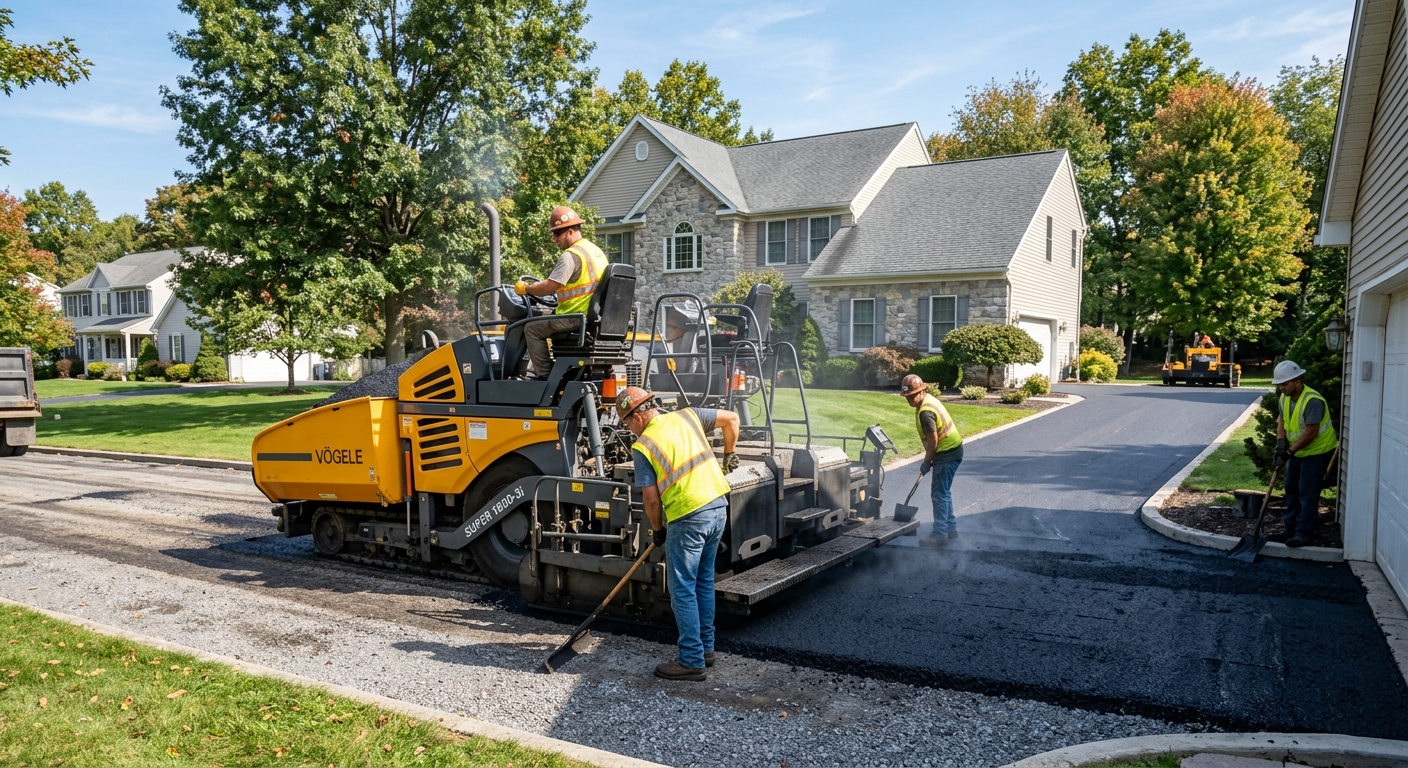
What a new driveway costs in Lower Makefield
Lower Makefield is a community where driveways are nearly universal, with 72.4% single-family homes and a high homeownership rate of 87.7% (U.S. Census Bureau, ACS 2024). Because a driveway is a structural investment, most owners face this project eventually. Most driveways here are large enough for two vehicles, typical of Bucks County suburbs.
Pricing depends less on surface material than you might think. The true cost difference between two bids is not about “asphalt vs. concrete” — it’s what happens below the surface. Our local ground is silty clay and glacial till, which hold water and are prone to freeze-thaw cycles. This means your base—stone thickness and drainage—matters as much as what you see on top. A low price may mean not enough stone or skipping excavation, which will cost more down the road.
Every quote you get includes material, hauling, and labor, but the lasting value is in the unseen prep. Ignore it and you might pay twice: once now, then again when the surface cracks or heaves in five years.
| Service |
Best for |
Lifespan |
Price range |
| Asphalt — full replacement with new base |
failed base, structural cracking |
20–30 yrs |
$4,400–$11,500 |
| Asphalt overlay / resurfacing |
sound base, surface cracking only |
8–15 yrs |
$1,900–$5,700 |
| Sealcoating — single application |
preventive maintenance on sound asphalt |
2–4 yrs |
$250–$900 |
| Concrete — new installation |
long service life, low maintenance |
30–50 yrs |
$6,300–$15,000 |
| Crack filling and patching |
isolated cracks under a quarter inch |
1–3 yrs |
$200–$800 |
| Gravel driveway |
rural, budget, long runs |
5–10 yrs with upkeep |
$900–$3,500 |
Estimates for a typical Lower Makefield driveway. Square footage and base condition drive these figures more than material choice.
Finding a legitimate paver in Bucks County
In Bucks County, verifying your driveway contractor isn’t just about protecting your money—it’s about avoiding headaches down the line. Paving is seasonal and capital-intensive, so the best contractors have their own equipment, a real shop address in the region, and they can name which Delaware Valley asphalt plant supplies their mix. If they hesitate or tell you they buy “from a guy,” walk away. Local quarries and plants keep haul costs down here, so it’s a question every decent paver expects.
Never rely on a business card or mobile number alone. Checklist: Pennsylvania requires Home Improvement Contractor registration for any contract over $500—always check at the attorney general's registry (hic.attorneygeneral.gov). For companies claiming employees, workers’ compensation is mandatory; confirm using WCAIS (wcais.pa.gov). Ask for references from driveways done at least three years ago—surface cracks often don't show right away. Anyone can make a new driveway look good for photos, but a driveway’s real test is time.
- Home Improvement Contractor registration—verify online
- Proof of workers’ compensation via WCAIS if they have employees
- Written contract for every job over $500
- Physical business address, not just a P.O. box or mobile number
- Company-owned paving and compacting equipment
- References for work done 3+ years ago, not just recent jobs
- Will name their asphalt supplier by location and plant
- No vague promises (“proper base” with no specs)
- Cleary describes stone depth and materials in writing
- Shows before/after photos of similar Bucks County driveways
- Payment schedule with deposit under one-third
- No pressure to sign on the spot, no “today only” pricing
Red flags: anyone dodging your questions about insurance, refusing to specify stone depth or asphalt supplier, or offering a one-line total is not someone you want working in your yard.
Permits and approvals for paving in Lower Makefield
For repaving an existing driveway in Lower Makefield—meaning you’re not expanding or changing the layout—most homeowners won’t need a building permit. The local townships in Bucks County, including Lower Makefield, administer their own permits and inspections, but strictly replacing asphalt tends to fly under the radar.
However, the driveway approach—where your drive meets the public roadway—isn’t handled by your township if the street is a state route. You’ll need a Highway Occupancy permit from PennDOT District 6 for any changes there. This catches a lot of people off-guard, as many assume it’s all township business.
Any new paved area or expansion is more likely to trigger stormwater review. Bucks County parcels, especially where impervious surface rules are enforced, require you to prove you’re not sending runoff onto a neighbor’s yard or right into the street. Even if no permit is formally required, it’s your legal responsibility not to create drainage problems.
Before signing, always verify that your contractor is HIC-registered at hic.attorneygeneral.gov and, if workers are present on the job, confirm coverage via the state's workers’ compensation portal (wcais.pa.gov). You have a three-day right to cancel any home improvement contract over $500 under Pennsylvania’s Home Improvement Consumer Protection Act.
Beyond replacement: layout changes
If you’re looking to widen your driveway, add a parking pad, run extension to a detached garage, or pave over an old gravel section, the project becomes more involved than a straight overlay or replacement. Any footprint change exposes undisturbed ground, which typically means digging a new stone base that matches—or, ideally, exceeds—the original for thickness and compaction.
Keep in mind that where old and new paving meet, the seam is always a future weak spot and may show cracks or heaving sooner than the rest of the driveway. With Bucks County stormwater rules and widespread lot line development, you can’t just pave wherever there’s grass; setbacks from property lines and total impervious area can limit what’s allowed. Your township and, for approaches on state roads, PennDOT District 6, will require review if you’re changing where or how your driveway meets the street.
Take layout changes seriously—sometimes just shifting a driveway a few feet or adding width for a second vehicle triggers more permitting and base work than most people expect. Assume you’ll be required to manage runoff and maintain setbacks, so always check with your township before work starts.
Lower Makefield's ground and what it means for paving
The soils in Lower Makefield—and much of lower Bucks—are a mix of glacial till and silty clay, especially as you get closer to the Delaware River. Clay-heavy soils hold water, freeze unevenly, and can heave during cold winters or after heavy rain. Glacial till is extremely variable: stones, silt, sand, and pockets that drain at different rates. Both mean a driveway built on minimum stone or without proper drainage will settle, crack, or even heave after a few harsh seasons.
Combine this with our regional frost depth of 30 inches and moderate freeze-thaw cycles, and it’s clear why the thickness and quality of your stone base matter more than somewhere built on sandy soils or shallow bedrock. The original Levittown-era tract homes in Falls and Bristol Townships often had thin or substandard bases, never designed to last 60+ years. If your old driveway dates back to the ’50s or ’60s, assume the base needs a full rebuild—not just a resurface.
A good Bucks County paver anticipates these soil conditions and plans for drainage with extra stone, weeping trenches, or grading away from your home. If you get two bids—one much cheaper than the other—the reason is usually buried right under your tires.
Overlay, patch or full replacement?
The biggest question when facing an aging driveway is whether patching, an overlay, or a full replacement is the right call. You can do a rough check yourself and spot most of what a good contractor will see. The key: what’s happening below the surface?
Look for alligator (block) cracking: if large areas have that scaly pattern, the base has likely failed completely. An overlay will hide this for a year or two—then the cracks will telegraph right back through. Isolated, straight cracks that are under a quarter inch wide just mean surface wear and can often be filled and sealed.
Birdbaths (depressions) that hold water, or spongy spots when you walk or park, point to subgrade movement or soft soil. Edge crumbling is classic in Bucks because many old driveways were poured right onto the clay with little or no edge support. Potholes signal water has reached the base.
Never accept an overlay where there’s clear base failure, and any contractor who quotes one without probing the base isn’t doing you a favor. If cost is driving you, ask to see photos of their last full excavation job—and ask if they know how much stone was under the old blacktop.
| What you see |
Likely cause |
Right fix |
Cost |
| Isolated cracks under 1/4 inch |
surface aging |
crack fill and seal |
$250–$900 |
| Alligator cracking over a wide area |
base failure |
full replacement |
$4,400–$11,500 |
| Depressions holding water |
subgrade movement |
excavate and rebuild that area |
$4,400–$7,000 |
| Crumbling edges |
no edge support |
edge repair, consider curbing |
$400–$1,500 |
| Potholes |
water into the base |
full-depth patch, then assess |
$250–$900 |
| Faded but sound surface |
oxidation only |
sealcoat |
$250–$900 |
What a real paving quote contains
Comparing two paving quotes in Lower Makefield isn’t just about the bottom line—it's about knowing what you’re actually getting. A real quote starts with the measured square footage, not a guess, and plainly states how deep they’ll excavate, what aggregate will go in (and how much), and how each layer will be compacted.
It should break out the asphalt courses and compacted depth, explain what’s being done for edge support, and describe grading and drainage—especially critical on clay and glacial till. Lawn restoration and cleanup should be included. Payment terms should be clear, with no more than a third up front, and a real (written) warranty should define what’s actually covered. Most warranties exclude cracking, so don’t assume otherwise.
If your quote is just one line with a total, you are missing all the facts you need to compare or hold anyone accountable. This is the single most common way Bucks County homeowners overpay for underbuilt, short-lived driveways.
| Line item |
What to look for |
Red flag if… |
| Area |
measured square footage stated |
eyeballed or absent |
| Excavation |
depth and disposal included |
'we'll pave over it' |
| Base |
aggregate type and depth in inches |
'proper base' |
| Compaction |
method, and done in lifts |
not mentioned |
| Asphalt |
courses and compacted depth |
'3 inches' unqualified |
| Drainage |
slope and water direction stated |
silent |
| Warranty |
what is covered and what is excluded |
verbal only |
| Payment |
modest deposit, balance on completion |
full cash up front |
Frequently asked questions — driveway paving in Lower Makefield
Does road salt damage driveways in Lower Makefield?
Road salt is a fact of life in Lower Makefield winters, but it affects asphalt and concrete differently. Rock salt can accelerate freeze-thaw cycles in concrete, causing surface pitting and spalling over time—especially on older slabs with surface wear. Asphalt stands up better, but frequent salting can dry out the surface binder, leading to faster oxidation and small cracks. If you have an asphalt drive, a sealcoat every few years (expect $250–$900 locally) will protect against salt and UV damage. For concrete, sealing is less common but still advisable if you want to slow surface wear. Ultimately, salt use is rarely what destroys a properly built drive in Bucks County—the underlying ground and drainage play a bigger role.
Should I repair or replace my Lower Makefield driveway?
The only way to answer this confidently is to look at the base condition, not just the surface. In Lower Makefield, with local soils of glacial till and silty clay, longer cracks, multiple potholes, and widespread alligator cracking almost always mean base failure. Overlaying or patching will be temporary at best. If you’re only seeing a few straight, narrow cracks and your driveway is less than 20 years old, crack filling and sealcoating can stretch life for a few years at a price of $250–$900. For driveways with real structural damage or aggressive settlement, you’re better off budgeting for a full replacement at $4,400–$11,500. Ask your contractor to show you the thickness of the old base before you decide—otherwise, you risk spending money twice.
When is the best time of year to pave in Lower Makefield?
The ideal months for paving in Lower Makefield are late April through early November. That’s when temperatures reliably stay above 50°F, giving asphalt enough time to compact and bond before the next cold snap rolls in. Asphalt plants generally close for the winter in Bucks County, so reputable contractors won’t push major projects past November. Surface repairs and sealcoating should be done only when the pavement and air are dry and warm—otherwise you’re risking poor adhesion and wasted money. A well-timed sealcoat, for example, in June or September, will last longer and look better for the typical $250–$900. Don’t trust anyone promising quality paving if there’s frost in the forecast or the ground is still cold.
How thick should asphalt be for a residential driveway in Lower Makefield?
For Lower Makefield’s glacial till and clay soils, a residential asphalt driveway should have at least 4 inches of compacted stone base—preferably more in areas near the Delaware River—and a minimum of 3 inches of asphalt, placed in two lifts for best longevity. Codes in Bucks County don’t dictate a thickness, but the climate and soil demand this much for a drive that’ll last 20+ years. Skimping on base or putting all asphalt down in one layer invites early cracking and rutting. Your total project cost for a properly built driveway here (including that thicker base) will typically fall in the $4,400–$11,500 range. Always ask for the planned stone depth in writing before you sign.
Can I cancel a paving contract I signed at my door?
Yes—you have the right to cancel any home improvement contract over $500 within three business days in Pennsylvania, including Lower Makefield. This is your protection under the Home Improvement Consumer Protection Act. The contractor must provide you with a written contract and clear notice explaining your cancellation rights. It’s illegal for them to waive your insurance deductible or pressure you to sign away this right. If you feel uneasy after signing, take your time and review the contract language; you don’t need to rush just because someone is “in the neighborhood.” Your deposit is refundable if you cancel within the allowed window, and you won’t owe any penalties—on a typical driveway repaving or sealcoat, this can be as much as $500–$2,000 depending on your deposit.
Is sealcoating a scam?
Sealcoating isn’t a scam, but it’s often oversold in Lower Makefield. Applied every few years, it can renew the look of asphalt and protect against oxidation, salt, and minor spills. But it won’t fix deep cracks or structural issues—won’t restore a failed driveway, and won’t make old asphalt new. For a relatively young drive in good shape, a single application—typical cost $250–$900—makes sense. If your contractor promises sealcoat will fill deep cracks or stop major cracks from growing, find another bidder. Sealcoating is cheap insurance if your surface is still solid, but as a fix for anything more than cosmetic wear, it’s money wasted.
What does sealcoating cost in Lower Makefield?
In Lower Makefield, a single sealcoating application for an average two-car driveway runs $250–$900 in 2026 prices. The wide range depends mostly on square footage, edge trimming, and whether cracks need to be cleaned and filled first. Be wary of quotes at the extreme low end—these often indicate diluted material or skipped prep, both of which mean less protection and a surface that wears off after just a season. Most driveways benefit from resealing every 2–4 years if the pavement is structurally sound. If you have deeper cracks or potholes, have those fixed before sealcoating, or the job will be short-lived at any price.
How much does driveway paving cost in Lower Makefield?
For a standard-size two-car asphalt driveway in Lower Makefield, fully excavated and rebuilt with a new stone base, expect a price between $4,400–$11,500, based on 2026 estimates. Overlaying an existing (but solid) base is cheaper, usually $1,900–$5,700. Concrete installation runs higher, typically $6,300–$15,000. The biggest price driver isn’t the material, but whether your soil needs extra stone and drainage—anything built on glacial till or silty clay will require more. Every quote should clearly state the planned excavation and stone depth; without those details, you have no leverage if the surface fails in a few years.
What causes driveway cracks in Lower Makefield?
In Lower Makefield, the main causes of driveway cracks are the freezing and thawing cycles acting on our silty clay and glacial till soils, water trapped beneath the pavement, and thin or poorly compacted stone bases. Asphalt dries out over time, especially on driveways facing south, which speeds up surface cracking. Concrete is less flexible and more prone to cracks if heavy vehicles are parked or drainage is poor. Sealcoating can slow but not prevent cracking ($250–$900). Most cracks here don’t start at the surface—they start when water or clay under the drive moves after heavy rain or in winter. That’s why repairs that ignore the base are just band-aids.