Shrewsbury paving prices by scope — 2026
In Shrewsbury, where 80.1% of homes are single-family and the homeownership rate is a very high 82.9% (U.S. Census Bureau, ACS 2024), most driveways are a long-term homeowner’s concern. What you pay for paving here depends less on the surface finish and more on what’s happening under the ground—which is not visible when you’re comparing estimates. South-central Pennsylvania has a pronounced freeze-thaw cycle and a base of local shale, which means that the stability and thickness of the base layer are crucial. Many postwar driveways, especially those original to their house, were built with thin or little base, and that’s why two driveways that look alike on top can have very different needs—and costs—below. The base, not the blacktop or concrete itself, drives most of the cost difference between quotes.
Below is a table of realistic prices for standard driveway projects in Shrewsbury in 2026. These cover typical single-family homes and are based on the need for proper subgrade and drainage correction where necessary.
| Service |
Best for |
Lifespan |
Price range |
| Asphalt — full replacement with new base |
failed base, structural cracking |
20–30 yrs |
$3,800–$9,700 |
| Asphalt overlay / resurfacing |
sound base, surface cracking only |
8–15 yrs |
$1,600–$4,900 |
| Sealcoating — single application |
preventive maintenance on sound asphalt |
2–4 yrs |
$225–$750 |
| Concrete — new installation |
long service life, low maintenance |
30–50 yrs |
$5,400–$13,000 |
| Crack filling and patching |
isolated cracks under a quarter inch |
1–3 yrs |
$200–$800 |
| Gravel driveway |
rural, budget, long runs |
5–10 yrs with upkeep |
$900–$3,500 |
Estimates for a typical Shrewsbury driveway. Square footage and base condition drive these figures more than material choice.
Choosing a paving company
Paving your driveway in Shrewsbury is a project that can easily run into the thousands, and it’s not something to hand over to a contractor who can’t prove their standing. Pennsylvania requires Home Improvement Contractor (HIC) registration for any contract over $500, and you can (and should) verify this at hic.attorneygeneral.gov—don’t just take the contractor’s word. Look for companies with a real local business address, not just a mobile number or a post office box. A business that runs its own crew and owns equipment, as opposed to renting or brokering out jobs, is more likely to be around if problems come up. Since local York County quarries and asphalt plants supply this market, a quality paving contractor will be able to name their supplier—if they can’t, they’re likely reselling jobs rather than paving themselves. Ask for references from jobs three or more years ago, not just last season; a fresh job always looks good, but a sound driveway is proven by time.
- Check HIC registration (hic.attorneygeneral.gov)
- Verify workers’ compensation in WCAIS (wcais.pa.gov)
- Physical business address in or near York County—no PO boxes
- Owned paving equipment, not just rental
- References from jobs done 3+ years ago, ideally in Shrewsbury
- Proof of insurance: general liability and workers’ comp
- Ability to name their asphalt and aggregate supplier
- Written, detailed estimate describing the full scope, including base preparation
- No pressure for cash payment or immediate decision
- Clarity on who handles permits or PennDOT approach applications
- Guarantee/warranty terms spelled out in writing
Red flags include unregistered contractors, those unwilling to give local references, a lack of physical address, or anyone vague about base thickness and material source. These all mean risk: you may end up with a thin, short-lived job that will cost more in the long run.
Why you can't pave in February
Paving in Shrewsbury is directly limited by climate: hot-mix asphalt simply cannot be properly installed in cold weather. Below about 40°F, the asphalt cools too quickly to be properly compacted, which results in a driveway full of pores and cracks that will fail after only a couple of winters. Even if you were able to haul in material, in south-central Pennsylvania, local asphalt plants shut down from late November through March, because they only batch enough for the demand and they can’t produce hot mix economically in low volumes or freezing temperatures. Concrete is also off the table: for a new driveway, it needs above-freezing temperatures for several days in order to cure and gain strength, and the winter design temperature here is just 12°F. The region’s pronounced freeze-thaw cycling is what does all the damage to a poorly installed or late-season driveway to begin with.
If you want the best balance of schedule and price, plan your paving project in the shoulder seasons—April through early June and September through October. This is when crews have the most flexibility, material supply is steady, and you won’t pay summer-peak prices. If a crew says they can pour or pave your driveway in late November here, ask yourself how many local references they have and what corners are being cut. Like most of York County, Shrewsbury’s paving window is real—not just a preference, but a requirement the climate imposes.
Driveway permits, approaches and stormwater rules
For most homes in Shrewsbury and the surrounding York County townships, repaving an existing driveway in the same footprint does not typically require a building permit—so you can save a call if you’re only resurfacing or replacing what’s already there. However, if you’re changing the approach, such as where the driveway meets a state road, you’ll need a Highway Occupancy Permit from PennDOT District 8. For local roads, townships handle the permitting, not the county, so don’t assume it’s the township every time.
Be aware—if you expand your impervious driveway surface, you may be subject to local stormwater management ordinances. Adding pavement can trigger requirements for runoff control, and regardless of permits, you are liable if your driveway sends water onto a neighbor’s property. Permits for new approaches or widenings can take time and may require grading plans or approvals.
When hiring a contractor, verify their Home Improvement Contractor (HIC) registration with the Pennsylvania Office of Attorney General (hic.attorneygeneral.gov) and check for valid workers’ compensation coverage through WCAIS (wcais.pa.gov). Never let a contractor work without proof of both—this is your protection if there’s an injury or dispute.
Widening, extending or adding a parking pad
If you’re thinking about widening your driveway for a second vehicle, extending it to reach a new garage, or swapping a gravel spur for asphalt, be prepared for more than just surface work. Any new footprint means building fresh base over undisturbed shale subgrade, not just topping existing stone. The seam between old and new will always be a weak link for water infiltration and future cracks, no matter how skilled the crew. Expanded driveways add impervious area, which may trigger local stormwater reviews and runoff controls under York County township rules.
Setback requirements also come into play—you can’t always pave right up to your property line, and new approaches (the driveway meeting the road) often mean new permitting. For a state road, PennDOT District 8 handles that permit; for a township road, your local township does. Factor in time for permitting and, if stormwater management is required, the possible extra engineering cost. If a contractor ignores these items or says you don’t need a permit on new work, consider it a clear warning sign.
Sealcoating: what it does and what it doesn't
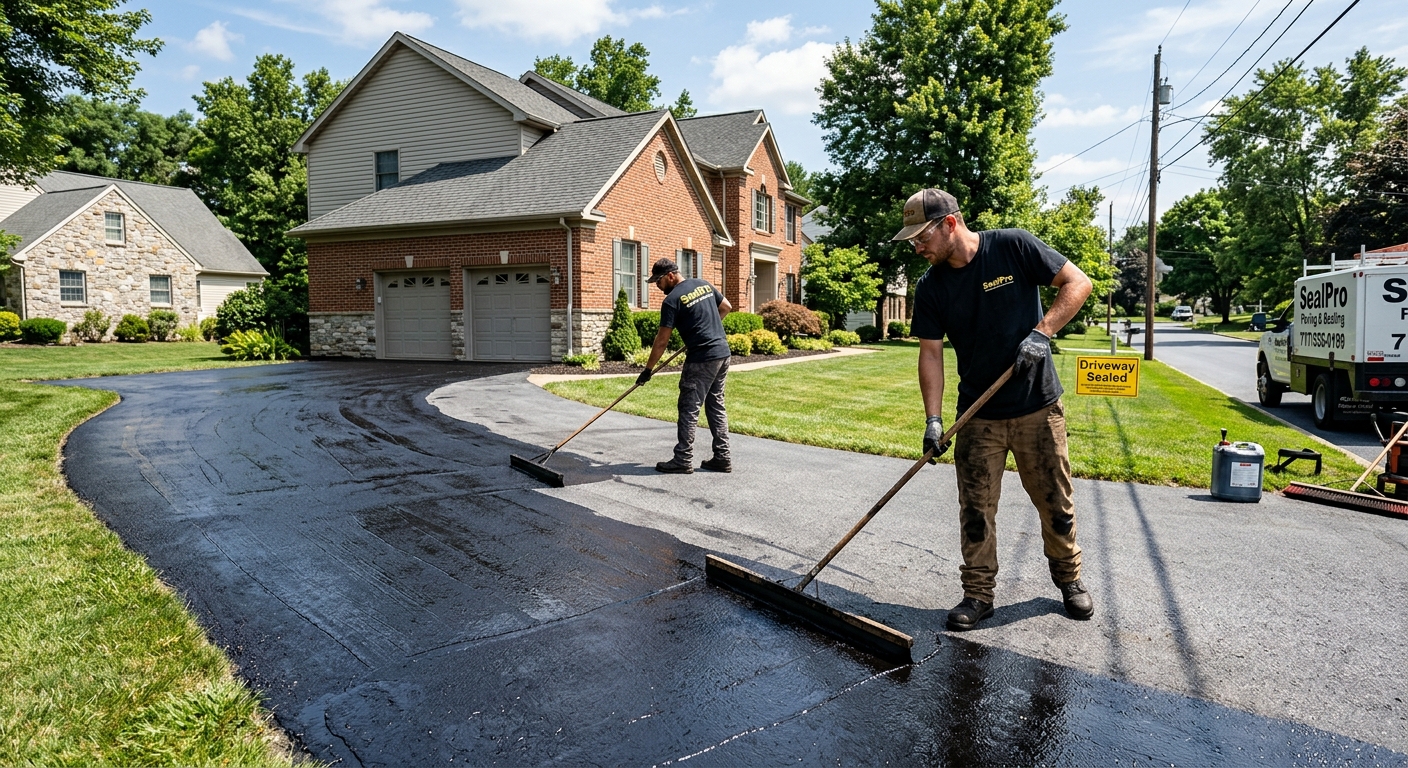
Sealcoating is often sold as a cure-all for aging driveways, but most of its benefits are surface-deep. Done properly and at the right interval, sealcoating protects the asphalt binder from oxidation caused by sunlight and minimizes damage from fuel and oil drips. It also darkens up a faded drive, improving appearance and curb appeal. What it does not do is add any structural strength or fix deeper problems; sealcoating won’t hide bad drainage, fix cracks, or make a failing base last longer.
What isn’t often mentioned: sealing too often, especially yearly, can actually shorten the life of your driveway. Too many coats build up into a brittle layer that cracks, peels, and holds water. With fresh asphalt, an early coating locks in solvents that need to escape—wait at least 6–12 months after paving before your first seal. Afterwards, a good interval in Shrewsbury is every 2–4 years, depending on traffic and sun exposure.
Crack filling is the crucial maintenance step between seal jobs. If cracks are not filled properly before sealing, water penetrates and undermines the base. Quality sealcoating is squeegeed or brushed for density, not just sprayed on. Expect to pay $225–$750 for a thorough single application in our area; anything cheaper likely means watered-down product or a quick spray-and-go, and it won’t last through a York County winter.
Shrewsbury's ground and what it means for paving
In Shrewsbury and across York County, the typical subgrade is local shale. This matters because shale’s drainage profile is very different from clay or sand—water moves through it more slowly, and any base laid on poor or uncorrected shale will be at risk for frost heaves. Our region’s frost depth is 30 inches, and the freeze-thaw cycle is pronounced, meaning water trapped below the driveway expands and contracts all winter, leading to cracks, dips, and base failure.
Many postwar neighborhoods here were built when driveway standards were minimal. If your home dates before 1980 (as 46.2% do locally, U.S. Census Bureau, ACS 2024), the original driveway probably wasn’t laid on a thick, engineered base, and that’s why so much work here is total replacement and not just resurfacing. A quality replacement in Shrewsbury depends on proper regrading and an adequate base—typically thicker than in a region with sand or gravel naturally present. Skipping this step may save you money upfront, but you’ll pay for it a few winters down the road.
Frequently asked questions — driveway paving in Shrewsbury
Should I repair or replace my Shrewsbury driveway?
If your driveway in Shrewsbury has only minor cracks less than a quarter inch wide and no widespread sinking or base failure, repairs and regular maintenance like crack filling and sealcoating can get you a few more years at a lower cost. Crack filling generally runs $200–$800 per visit and is enough to hold off major work if the base is still stable. But if you see large alligator cracking, widespread settling, or areas that stay soft after a rain, those are signs that the base is failing under our freeze-thaw cycles and York County’s shale subgrade. In those cases, it’s smarter to invest in a full replacement, which typically costs $3,800–$9,700 for asphalt with a new base. Simply resurfacing over a bad base is just putting off the inevitable, especially in this region.
How many freeze-thaw cycles does Shrewsbury get?
Shrewsbury sits in south-central Pennsylvania, where pronounced freeze-thaw cycles are the single biggest cause of driveway damage. While it varies from year to year, it’s not unusual to see 40–50 dramatic swings well above and below freezing each winter, thanks to our 12°F winter design temperature and ground frost depth of 30 inches. This means any water that sneaks under a poorly sealed or cracked driveway will expand and contract repeatedly. That’s why crack filling (typically $200–$800 a visit) is especially crucial here and why driveways not set on a properly prepped base tend to fall apart in only a few years.
Do I need a permit to repave a driveway in Shrewsbury?
In most of Shrewsbury and York County townships, repaving an existing driveway without changing its size or layout doesn’t require a building permit—so you’re spared a lot of red tape if you’re just resurfacing or replacing what’s already there. However, if you’re altering the approach where your drive meets a state or township road, a permit is usually required. For state roads, you’re looking at a PennDOT District 8 Highway Occupancy Permit. Keep in mind: expanding the paved area or altering impervious surface could trigger stormwater or zoning reviews by your township. While the paving itself may fall between permit cracks, always hire a contractor who knows the local rules and has HIC registration (any job over $500 must have a written contract under Pennsylvania law).
Can asphalt be laid in cold weather?
Asphalt paving in Shrewsbury and all of York County comes to a full stop in the winter. Hot-mix asphalt must be placed and compacted while it is still hot—from the plant to your drive—otherwise it cools too quickly and becomes porous, leading to quick failure when freeze-thaw hits. Our local asphalt plants shut down from late November to March thanks to low demand and low temperatures, with 12°F as the winter design temp. Any contractor saying they can pave outside of the April–October window should raise a red flag; a driveway poured in cold weather may not last a single winter, wasting $3,800–$9,700 on a full replacement.
Why does my driveway have depressions that hold water?
Depressions or “birdbaths” in your Shrewsbury driveway usually point to two issues: poor base preparation or repeated freezing and thawing on a marginal subgrade, which is common with York County’s shale. Our region’s 30-inch frost depth means water trapped under the surface expands again and again, weakening those spots until they depress or crack. Small depressions can be corrected with patching or resurfacing, which costs $1,600–$4,900, if the base below is still solid. But if you see more than a couple of dips or pooling after every rain, it’s probably time to talk about full replacement and drainage correction to prevent long-term failure.
What does an asphalt overlay cost in Shrewsbury?
If your existing driveway base is still sound—no deep cracks, soft spots, or major settling—an asphalt overlay or resurfacing is a cost-effective option in Shrewsbury. This involves milling or cleaning the old surface and laying new hot-mix asphalt on top. For an average single-family home, you can expect to pay between $1,600–$4,900. Remember, this only works if the foundation is in good shape. Our pronounced freeze-thaw cycle and that shale subgrade mean overlays on a failing base will not last long—sometimes as little as a single winter if drainage isn’t fixed at the same time.
What slope does a driveway need for drainage?
In Shrewsbury, driveways need enough slope to send water away from the house and off the pavement quickly—typically 2% (or about a quarter inch per foot) is the accepted minimum. This is especially critical because the local shale doesn’t drain as well as sand or gravel, so water tends to linger and exploit any weak spot during freeze-thaw cycles. Poor slope is a leading cause of cracks and base failure. When getting a new asphalt replacement (usually $3,800–$9,700), insist your contractor discusses slope and drainage—not just thickness and finish—so you don’t end up with puddles or a short-lived surface.
How much does a concrete driveway cost in Shrewsbury?
For homeowners wanting longevity with less frequent maintenance, a concrete driveway is an investment up front for long-term savings. In Shrewsbury, a typical installation will run between $5,400–$13,000 depending on square footage, layout, and how much base correction is required—older or poorly drained lots may need more. Concrete lasts 30–50 years here with basic cleaning and crack filling, though you still want to confirm rebar or fiber mesh is included to help combat our freeze-thaw cycles. The initial outlay is higher than asphalt, but for many in York County’s postwar subdivisions, replacing a failed blacktop with concrete is a once-in-a-lifetime project.
When can I seal a brand new asphalt driveway?
You should wait at least 6 to 12 months to seal a new asphalt driveway in Shrewsbury, giving it enough time to cure and let all the volatile compounds escape. Sealing too soon in our climate, where the freeze-thaw cycle is strong, traps those volatiles and makes the surface more prone to peeling and cracking. The first seal should be a quality squeegee or brush-on application, not a drive-by spray. Typical prices in Shrewsbury for a single proper sealcoat are $225–$750. After the first year, plan to reseal every 2–4 years—too frequent sealing does more harm than good, especially on the local shale.