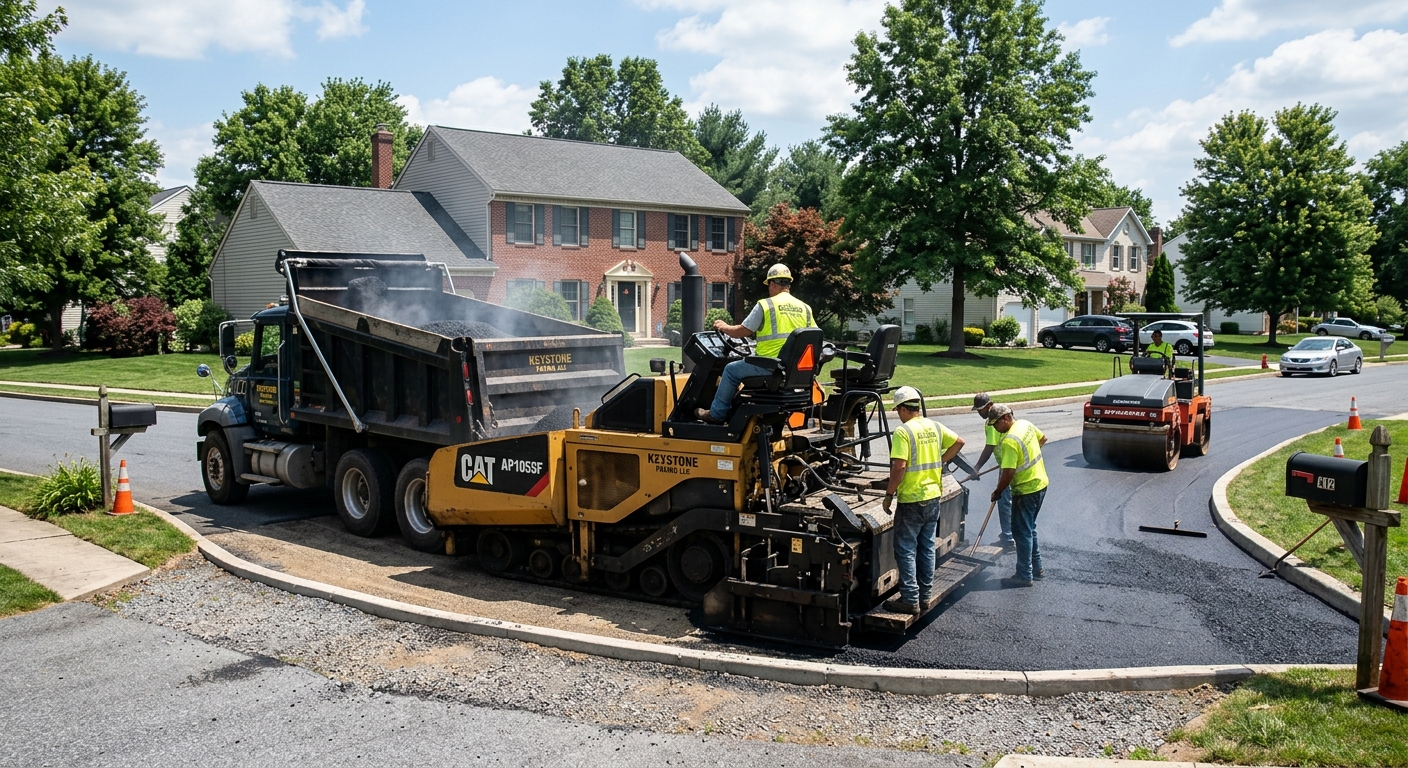
What a new driveway costs in Hanover
In Hanover, where 70.5% of homes are single-family houses and the homeownership rate is 81.5% (U.S. Census Bureau, ACS 2024), driveway paving is a pressing, tangible expense for most households. Pricing here is shaped by more than just what you see on the surface — most of what you pay for is below ground. This region's deep frost (36-inch depth) and regular freeze-thaw cycles are relentless on pavement. Combine that with Northampton County’s limestone karst subgrade, which demands careful grading and drainage, and it’s clear why costs can vary widely. If you get several quotes, nearly all the difference boils down to what happens below the surface: base prep, base depth, drainage handling, and compaction. Two driveways that look the same on day one can perform very differently after five winters.
Here's what typical driveway work costs around Hanover:
| Service |
Best for |
Lifespan |
Price range |
| Asphalt — full replacement with new base |
failed base, structural cracking |
20–30 yrs |
$3,700–$9,500 |
| Asphalt overlay / resurfacing |
sound base, surface cracking only |
8–15 yrs |
$1,600–$4,700 |
| Sealcoating — single application |
preventive maintenance on sound asphalt |
2–4 yrs |
$200–$750 |
| Concrete — new installation |
long service life, low maintenance |
30–50 yrs |
$5,300–$12,500 |
| Crack filling and patching |
isolated cracks under a quarter inch |
1–3 yrs |
$200–$800 |
| Gravel driveway |
rural, budget, long runs |
5–10 yrs with upkeep |
$900–$3,500 |
Estimates for a typical Hanover driveway. Square footage and base condition drive these figures more than material choice.
Drainage: the failure nobody plans for
Drainage is the single most important part of a driveway project in Hanover — yet it’s the step most likely to get skipped or skimped. This part of Northampton County faces harsh freeze-thaw swings, meaning any water that gets trapped below your driveway is going to freeze, expand, and heave the pavement. With the karst limestone subgrade we have here, water finds channels and voids, leading to settlement if not managed properly.
Your finished driveway should have a slope of at least 2% (about a quarter inch per foot) to shed water away from structures. Crowning works for wide drives by shedding water to both sides, while a cross-slope moves water to just one. If your driveway slopes toward your garage or house, that’s a recipe for water intrusion and frost-heave damage. In those cases, trench or channel drains at the base are a must. If you can’t sheet water to an open daylight spot, a dry well is a backup — but it’s not ideal in our high water table areas. Importantly, you can’t just dump water onto your neighbor's property; that's a liability regardless of what your permit says.
Poor drainage isn’t just a nuisance — it shortens the life of any paving job here, and it’s why sound grading and drainage planning should be non-negotiable in your contract.
What you need before paving in Hanover
Repaving an existing driveway in Hanover Township — if you’re not changing the footprint — usually does not require a building permit. In Palmer Township, for example, minor asphalt patching is commonly done without permits. But if you’re replacing or expanding your driveway, know that in Bethlehem, a zoning or building permit review normally applies. The often-missed step is the-driveway approach: where your drive meets the street. For state-maintained roads, you need an approach permit from PennDOT District 5-0, while township offices handle curb cuts on local roads.
Expanding impervious surface (making your driveway wider, for instance) can also trigger stormwater requirements. Even without permit stipulations, legally and practically, you can’t channel runoff to your neighbor’s property — that invites liability.
Who you hire matters. Any contract over $500 must be in writing under Pennsylvania’s Home Improvement Consumer Protection Act. Contractors must register with the Pennsylvania Office of Attorney General as Home Improvement Contractors — check them at hic.attorneygeneral.gov. Workers’ compensation insurance is mandatory for all employers and can be verified at WCAIS (wcais.pa.gov). These are non-negotiable. The contract has to state your three-business-day cancellation right and may not waive your homeowners insurance deductible. Don’t skip verification — protect yourself upfront.
Why you can't pave in February
In Hanover and greater Northampton County, the paving season is dictated by the weather, not personal schedules. The winter design temperature here drops to 4°F, and asphalt simply cannot be properly laid when ground or air temperatures are cold. Hot-mix asphalt needs both the air and subgrade to be above about 45°F to allow time for compaction before the mix cools. Below that, the asphalt seizes up before it’s sealed, leading to porous, crumbly pavement that won’t survive a few freeze-thaw cycles. For this reason, the local asphalt plants around Bethlehem and Easton close entirely in winter — you simply can’t get material between late November and late March.
Concrete is also not an option during a Hanover winter. It requires above-freezing temperatures for several days to cure. If someone offers to pave or pour for you in the dead of winter, it’s an immediate red flag for quality.
The best times to schedule work are in the shoulder seasons — April to early June and September to mid-November — when crews have availability and prices are often sharper. Peak summer is the busiest, and the vendors able to take your job right away during this period may be the ones you want to avoid. Plan ahead, and never rush into an off-season deal.
What to put in a Hanover paving contract
The most important protection you have as a buyer is a precise paving contract. In Hanover’s freeze-prone climate and with the county’s karst subgrade, you cannot afford shortcuts or ambiguity. Many homeowners focus on price, but the only way to get value and longevity is to focus on what’s actually being specified and built.
Every proposal should state numbers, not adjectives, for these steps: how deep they’re excavating; thickness and material of the new stone base; how they’ll compact it (mechanical compactor? vibratory roller?) and whether the base is built in lifts; the thickness of each asphalt layer as compacted (not just “laid,” because new hot mix can lose up to 25% of its thickness after rolling); the exact asphalt mix designation; and the treatment on the driveway edges, whether that’s an asphalt butt edge, concrete collar, or stone shoulder.
"We’ll put down three inches" is meaningless unless it says “three inches after compaction” and states whether that’s binder, surface, or both. In Northampton County's climate and soil, those details make the difference between 5 years and 25.
- Excavation depth (inches below finished grade)
- Aggregate base material and compacted thickness
- Base installed in lifts and compacted between lifts
- Binder course type and compacted depth
- Surface course type and compacted depth
- Asphalt mix designation (e.g., ID-2, ID-3)
- Edge treatment (butt edge, collar, or stone shoulder)
- Drainage slope and discharge location
- Joint details at garage or sidewalks
- Cleanup and restoration of disturbed areas
Comparing materials in northeastern Pennsylvania
In Hanover’s climate, driveway material choice needs to account for deep frost, high snow loads, and regular freeze-thaw cycles. Asphalt is the local default for good reason. It’s flexible, allowing it to flex and move as the limestone subgrade heaves slightly in winter. Minor settlement or movement won’t crack asphalt the way it will concrete, so it tends to last its full 20–30 years with routine sealcoating every few years.
Concrete lasts longer — often 30–50 years in theory — but that only plays out if you never use salt-based de-icers, which cause spalling and surface breakdown in our region. With public snow removal and the reality of icy driveways, salt use is hard to avoid, making surface flaking the usual end for concrete here. Concrete is also more expensive up front. If you want a concrete drive for looks or longevity, plan on extra care — and maybe some slip risks in icy times. Pavers give another durable option, but cost can rival or exceed concrete, and settling is possible if the base isn’t flawless. Gravel is still a legitimate option for long runs or rural lots, with great drainage and minimal frost impact, but ongoing maintenance is part of the deal.
| Option |
Installed cost |
Maintenance |
Freeze-thaw performance |
Lifespan |
| Asphalt — new install |
$3,700–$9,500 |
sealcoat every 3–4 yrs |
excellent, flexes |
20–30 yrs |
| Asphalt — overlay |
$1,600–$4,700 |
same |
good if base is sound |
+8–15 yrs |
| Concrete |
$5,300–$12,500 |
low, avoid de-icing salt |
fair, spalls with salt |
30–50 yrs |
| Pavers |
$8,400–$12,500 |
individual units replaceable |
good, settles gradually |
25–50 yrs |
| Gravel |
$900–$3,500 |
top-dress every 2–3 yrs |
excellent drainage |
indefinite with upkeep |
Comparing paving estimates in Hanover
When looking at driveway quotes in Hanover, first make sure you’re comparing apples to apples. Any quality estimate should specify the measured square footage (not just “approximate”), how deeply they’ll excavate, and the type and thickness of stone base. Compaction method should be clear — and whether the stone and asphalt are compacted in layers (“lifts”). The proposal should describe the binder and surface courses by compacted thickness and mix. Also check the drainage solution and whether edge treatments will hold the asphalt in place. Look for cleanup and turf restoration details, a payment schedule with a reasonable deposit, and a written warranty that spells out what's actually covered (most exclude the most common failures, like cracking).
The most common, and expensive, mistake is accepting a one-line bid with just a price. You can’t compare that to anything else — and it's how underbuilt driveways land you back in the market five years later.
| Line item |
What to look for |
Red flag if… |
| Area |
measured square footage stated |
eyeballed or absent |
| Excavation |
depth and disposal included |
'we'll pave over it' |
| Base |
aggregate type and depth in inches |
'proper base' |
| Compaction |
method, and done in lifts |
not mentioned |
| Asphalt |
courses and compacted depth |
'3 inches' unqualified |
| Drainage |
slope and water direction stated |
silent |
| Warranty |
what is covered and what is excluded |
verbal only |
| Payment |
modest deposit, balance on completion |
full cash up front |
Frequently asked questions — driveway paving in Hanover
Is gravel a cheaper option in Hanover?
Gravel is almost always the lowest-cost driveway type in Hanover, with typical installed costs between $900–$3,500. It's a fit for rural sites or long driveways where paving costs would balloon. Gravel handles our freeze-thaw conditions well, as it drains and flexes with the ground, preventing heaving or cracking. Just keep in mind, gravel comes with the need for regular maintenance — expect to top-dress and regrade every 2–3 years as ruts and low spots inevitably form. For many Hanover Township residents, especially on large lots, gravel is a sensible compromise between initial expense and function, but it does mean more upkeep than a solid asphalt or concrete surface.
How far ahead should I book a paver in Hanover?
In Hanover and the rest of Northampton County, you should start getting estimates two to four months before you want the work done. The paving season is short due to our climate — asphalt plants are typically closed from late November to late March. The most reputable crews are booked up fast, especially in April through July. For the best price and schedule flexibility, aim for the spring or fall shoulder seasons, when demand is lower. If you wait until early summer, you’ll be competing for time and may pay more, especially for work like a full asphalt replacement (which can run $3,700–$9,500). The earlier you book, the better the odds you get your top choice.
Asphalt or concrete for a Hanover driveway?
Both materials have pros and cons for Hanover’s climate. Asphalt is flexible, so it works well with Northampton County’s freeze-thaw cycling and shifting limestone subgrade — it won’t crack easily when the ground moves in winter. It's also less expensive up front, with new driveways typically costing $3,700–$9,500. Concrete is harder and can last longer, but it doesn’t tolerate ground movement and is vulnerable to de-icing salts, which cause surface spalling in our heavy-salting winters. If you want concrete, you’ll need to avoid salt and accept a higher initial price (typically $5,300–$12,500), along with careful upkeep. For most Hanover homes, asphalt is the pragmatic choice.
Does sealcoating fix cracks?
Sealcoating is not a crack repair — it’s a maintenance coat. In Hanover, with our temperature swings, minor cracking is common on aging asphalt. Sealcoating helps protect against UV and water infiltration, extending the life of sound pavement, but does not fill or stabilize cracks deeper than hairline. Visible cracks need to be cleaned and filled separately, using a hot or cold pour crack filler, before any sealcoat goes on. A typical sealcoating job here costs $200–$750. If your driveway has a lot of cracks wider than a quarter inch, sealcoating alone won’t help; it’s time to discuss patching or resurfacing options with a contractor.
Are door-to-door pavers a problem in Hanover?
Yes, fly-by-night pavers operating door-to-door are a recurring issue in Hanover Township and across Northampton County. Many offer “leftover asphalt” deals with no contract or specs and want cash up front. These jobs often lack any base prep or proper compaction, and the work fails quickly, so you’re left with no recourse. Any contract over $500 must be in writing per Pennsylvania’s Home Improvement Consumer Protection Act, and all contractors must be registered with the state. Always verify registration at hic.attorneygeneral.gov and never skip reference or insurance checks.
What does an asphalt overlay cost in Hanover?
An asphalt overlay, or resurfacing, is when new asphalt is applied over a base that’s still structurally sound but has surface cracks or fading. In Hanover, expect to pay between $1,600–$4,700 for a typical residential overlay. This can add 8–15 years of life if done before deep cracks and base failures set in. It’s not a fix for driveways with poor drainage or sunken spots — those need full replacement. An overlay is a great option for a moderately aged driveway if the underlying base passes inspection.
What is the difference between binder and surface course?
In a proper Hanover asphalt driveway, the binder course is the lower layer — thicker, made with larger aggregate, and provides structural strength. The surface course is finer, denser, and forms the smooth, finished top. Specs for this region typically call for 2–3 inches of compacted binder and 1–2 inches of compacted surface. Don’t be misled by a contractor who promises “three inches” without clarifying if that’s before or after compaction, or whether it’s total or just for one layer. Since a well-built asphalt driveway here runs $3,700–$9,500, it’s worth insisting on those distinctions in your contract.
How long should an asphalt driveway last in Hanover?
A properly built asphalt driveway in Hanover — over a stable, well-graded base — can be expected to last 20–30 years with routine maintenance. This involves sealcoating every 3–4 years and crack filling as soon as small splits appear. Our regular freeze-thaw cycles and deep frost mean shortcuts in base prep or drainage won’t last. Cheap jobs or “overlays on a failed base” tend to fail in under 10 years. Full replacement costs in this area run from $3,700–$9,500, but the longer service life is in the details, not just in the surface you see.
Do I need a permit to repave a driveway in Hanover?
For a simple repave of an existing driveway in its current size and location in Hanover Township, a building permit is typically not required. If you’re expanding or installing new driveway surface, then in neighboring Bethlehem, a zoning or building permit review is usually triggered. No matter what, replacing or modifying the driveway approach (where it meets the street) almost always requires a separate permit — from PennDOT District 5-0 for state roads, or from the township for local streets. Since costs for repaving typically run from $1,600–$4,700 for an overlay and up to $9,500 for a full rebuild, it’s wise to clarify permit needs up front to avoid headaches.