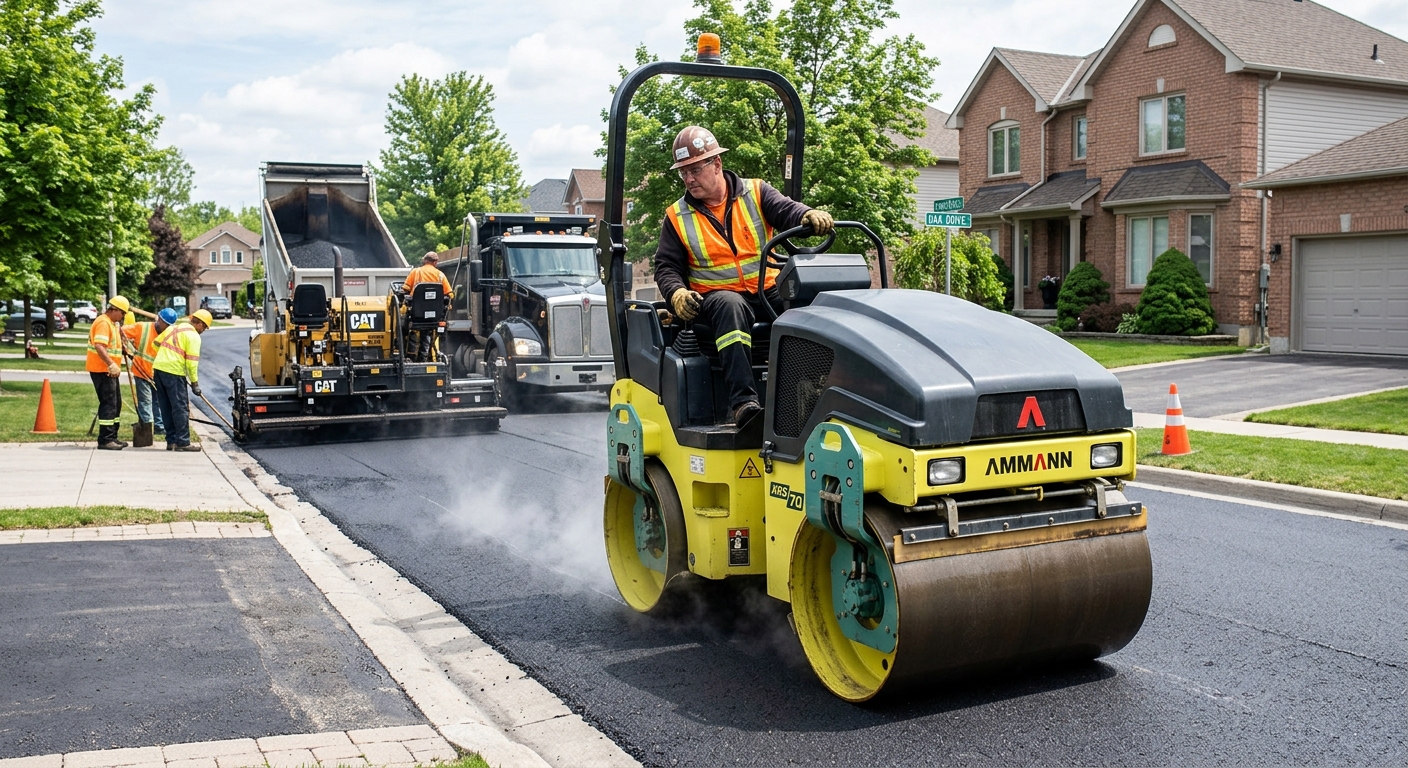
Bellevue paving prices by scope — 2026
Bellevue has a much lower rate of single-family homes (36.3%) and owner occupancy (41.3%) than is typical for an area with so many aging, postwar driveways (U.S. Census Bureau, ACS 2024). For those households maintaining detached driveways, paving cost is a significant, visible investment. Our tough southwestern Pennsylvania winters—lots of freeze-thaw cycles and subgrades heavy with clay and shale—mean the lifespan of your new driveway depends as much on what goes under the asphalt or concrete as on what you see at the surface.
Most price differences between bids in Bellevue come from what’s buried: the quality and thickness of the stone base, how well it’s compacted, and whether the installer deals correctly with our poor-draining native soils. A cheaper quote might mean less excavation, a thinner base, or skipping edge treatments—none of which are obvious to the homeowner until problems appear a few winters later.
| Service |
Best for |
Lifespan |
Price range |
| Asphalt — full replacement with new base |
failed base, structural cracking |
20–30 yrs |
$3,300–$8,500 |
| Asphalt overlay / resurfacing |
sound base, surface cracking only |
8–15 yrs |
$1,400–$4,200 |
| Sealcoating — single application |
preventive maintenance on sound asphalt |
2–4 yrs |
$200–$650 |
| Concrete — new installation |
long service life, low maintenance |
30–50 yrs |
$4,700–$11,500 |
| Crack filling and patching |
isolated cracks under a quarter inch |
1–3 yrs |
$200–$800 |
| Gravel driveway |
rural, budget, long runs |
5–10 yrs with upkeep |
$900–$3,500 |
Estimates for a typical Bellevue driveway. Square footage and base condition drive these figures more than material choice.
What you need before paving in Bellevue
In Bellevue, resurfacing or repaving a driveway that stays within the existing boundaries usually does not require a building permit. This can spare you an unnecessary step if you aren't changing the size or layout. However, if you are replacing the driveway approach—the section connecting to the public road—a permit is generally needed, but not through your local building office. For driveways entering state routes, the Pennsylvania Department of Transportation (PennDOT) District 11-0 issues the required Highway Occupancy Permit. Most homeowners do not realize this until they are told to pause their project. For driveways entirely on private property in neighboring Ross Township, no right-of-way permit is typically needed for resurfacing alone.
If your project expands the driveway or increases the impervious surface, be aware you may face stormwater management requirements, as diverting water onto a neighbor’s property creates a liability regardless of permits. Proper site grading and drainage are just as important as the surface material in Allegheny County’s hilly terrain.
For legal hiring, Pennsylvania requires Home Improvement Contractor (HIC) registration for any paving job over $500—check at hic.attorneygeneral.gov for current status. All employers must carry workers' compensation insurance, verifiable through WCAIS (wcais.pa.gov). Get these in writing before work starts to protect yourself under state law.
Bellevue's ground and what it means for paving
Bellevue sits on the same shale and clay subgrade that defines much of Allegheny County. Clay, notorious for holding water, expands and contracts with each freeze-thaw cycle. Shale, on the other hand, can shatter under site work if it isn't managed carefully. Between the two, you get soil that shifts—a setup for heaving, puddling, and edge failures if the base isn't deep enough or well compacted.
Our frost depth runs to 36 inches, and there are long heating seasons with frequent winter swings. This region’s heavy clay calls for a thicker aggregate driveway base than in lighter soils—an inch or two more stone can mean five or ten years of extra life. Homeowners should note: most driveways in Bellevue were built decades ago, and nearby postwar subdivisions like those in Penn Hills or McCandless rarely had a properly engineered base. Today, aging driveways in the borough are often ready for structural overlays, not just another layer of sealer.
If your driveway is alligator-cracked or settling by the street, the culprit is usually the subgrade and base, not the surface. Spending money to repair cracks alone or sealcoat such a driveway is often throwing good money after bad in these site conditions.
Reading a driveway proposal
When comparing paving quotes in Bellevue, the details matter. The measured square footage should be explicitly listed—no guessing. Excavation depth and how existing material will be disposed of makes a real price impact. The type and thickness of the stone base, not just a vague “proper base” note, should be detailed in inches. Ask how compaction will be done and insist on compacted lifts for both base and asphalt layers.
Drainage should be addressed head-on, including which way the water will run—sloping the wrong direction will ruin the best surface. Edges should be properly treated so the driveway doesn’t unravel. Cleanup and site restoration should be part of the contract, not an afterthought or “extra.” Your payment schedule should involve a modest deposit with the balance due at completion—not a lump sum up front. As for warranties, most paving contracts do exclude cracking in this climate. If the written warranty is missing or vague, ask for specifics before committing.
A one-line total price with no details can’t be compared to anything else. This is the number-one way homeowners get stuck with underbuilt driveways in Allegheny County.
| Line item |
What to look for |
Red flag if… |
| Area |
measured square footage stated |
eyeballed or absent |
| Excavation |
depth and disposal included |
'we'll pave over it' |
| Base |
aggregate type and depth in inches |
'proper base' |
| Compaction |
method, and done in lifts |
not mentioned |
| Asphalt |
courses and compacted depth |
'3 inches' unqualified |
| Drainage |
slope and water direction stated |
silent |
| Warranty |
what is covered and what is excluded |
verbal only |
| Payment |
modest deposit, balance on completion |
full cash up front |
Asphalt or concrete for a Bellevue driveway?
In Bellevue’s climate—where freeze-thaw cycles and low winter temperatures are harsh realities—material choice is not just about price. Asphalt is flexible. It survives our ground movement because it bends, not breaks, when the clay base pushes and shifts each winter. Concrete, while it can last decades longer ($4,700–$11,500 to install), is rigid. When our local roads and driveways are salted for safety, concrete suffers spalling and scaling—chunks break loose, the surface pits, and a beautiful driveway can look rough after just a few winters.
Asphalt costs less up front ($3,300–$8,500 for a full install), and if maintained carefully with crack filling and sealcoating, reaches 20–30 years of service. The main maintenance is routine resealing every few years. If there is an issue with the base, overlays ($1,400–$4,200) extend life but only if the base is sound—otherwise you’re delaying larger repairs.
Pavers offer individual unit replacement and great drainage but come at a premium. Gravel is best for rural settings or budget installations; it provides drainage but requires frequent upkeep.
The bottom line: unless you’re committed to never using salt or chemicals on your driveway, asphalt is the default in Bellevue and surrounding Allegheny County. Concrete is justified mainly where extreme longevity outweighs maintenance and up-front cost, and the owner is strict about winter treatment.
| Option |
Installed cost |
Maintenance |
Freeze-thaw performance |
Lifespan |
| Asphalt — new install |
$3,300–$8,500 |
sealcoat every 3–4 yrs |
excellent, flexes |
20–30 yrs |
| Asphalt — overlay |
$1,400–$4,200 |
same |
good if base is sound |
+8–15 yrs |
| Concrete |
$4,700–$11,500 |
low, avoid de-icing salt |
fair, spalls with salt |
30–50 yrs |
| Pavers |
$7,500–$11,500 |
individual units replaceable |
good, settles gradually |
25–50 yrs |
| Gravel |
$900–$3,500 |
top-dress every 2–3 yrs |
excellent drainage |
indefinite with upkeep |
How often should a Bellevue driveway be sealed?
Sealcoating in Bellevue is recommended maintenance—not a cure-all. What it really does is slow down oxidation of the asphalt binder and provide a protective layer against oil spills, gas drips, and minor water entry. It also revives the “like new” black look after a harsh winter. What sealcoating does not do is fix a failing base or meaningfully extend the life of an asphalt driveway that’s already structurally compromised.
Most homeowners are sold on yearly sealcoating, but that’s overkill here. Too-frequent applications create brittle buildup that cracks and peels, making things worse. The first coat should only be applied after a new driveway has cured—usually 90 days or more in a Pennsylvania summer. Realistically, 2–4 years between applications is right for most Bellevue homes, assuming the surface is sound.
Crack filling is actually the more critical maintenance item in our climate. Even the best sealcoat does nothing for major cracks. Proper, hot-pour crack filling prevents water from reaching the subgrade, which is what really ruins driveways in clay-heavy hillsides like ours.
Expect to pay $200–$650 for a credible sealcoating job. If you’re quoted lower than that for a typical single-car Bellevue drive, be suspicious—thin spray-on applications disappear after one or two rain cycles and offer little real protection.
When paving can actually be done in Bellevue
Paving in Bellevue is shaped as much by the calendar as by the ground. Hot-mix asphalt requires warm ambient and ground temperatures to be properly placed and compacted—generally 50°F or above. Below that, the mix loses workability, resulting in porous, short-lived pavement. This isn’t just a matter of preference: local asphalt plants shut down from late fall through early spring, so material simply doesn’t exist in the dead of winter. Our region’s winter design temperature is just 8°F, and freeze-thaw swings make late autumn paving unreliable.
Concrete comes with similar limits—the mix needs temperatures above freezing to set without risk of surface scaling or internal cracking. These are job-stopping constraints dictated by climate, not by crews or contractor schedules.
In practice, paving in Bellevue runs from April through October. Shoulder seasons (late spring and early fall) are less hectic, which can lead to shorter lead times and sometimes better pricing. The summer peak (June–August) sees crews fully booked and premium prices. If a crew is eager to pave asphalt in November, especially after the first hard frost or during plant closures, you’re likely to get a driveway that won’t last.
Frequently asked questions — driveway paving in Bellevue
What causes driveway cracks in Bellevue?
The main culprit for driveway cracking in Bellevue is freeze-thaw cycling combined with our local shale and clay soils. As water gets into small cracks, it freezes during cold nights—our region regularly gets deep freezes—and expands, widening cracks and eventually leading to alligatoring. The underlying clay holds water against the bottom of the pavement, which means the asphalt or concrete flexes or lifts each winter. This constant movement is much harder on a driveway here than in milder climates. If the base was never deep enough or wasn’t compacted right when the driveway was first built—as is common with Bellevue’s postwar homes—cracks show up even sooner. For repair, expect a professional crack filling and patching job to start at $200–$800 for a single-car drive in 2026.
What kind of soil is under Bellevue driveways?
Bellevue driveways are usually built over a mix of clay and shale, the same as most of Allegheny County’s hillsides. Clay holds moisture and expands with freezing, causing heaving and lifting, while shale can break apart if not compacted well. These soil types mean driveways here need a thicker, stone aggregate base and good drainage to minimize future movement. Thin or poorly compacted bases just won’t last on Bellevue ground. If you’re planning replacement, the soil conditions will often justify spending for a deeper base.
Can asphalt be laid in cold weather?
Not reliably—not in Bellevue. Hot-mix asphalt needs to be placed and compacted before it cools down, which can’t happen in cold conditions. Below about 50°F ambient and ground temperature, asphalt cools too quickly, resulting in a porous, short-lived surface. And in southwestern Pennsylvania, local asphalt plants close entirely each winter—so the material simply isn’t available. The official paving season here is April through October. If someone offers to pave asphalt in November or after the first frost in Bellevue, it’s a sign to look elsewhere, even if the price seems right ($3,300–$8,500 for a full replacement is what’s credible in 2026).
What is the difference between binder and surface course?
In Bellevue, a properly built asphalt driveway is laid in at least two layers. The binder course is the lower, thicker asphalt layer—made with larger aggregate for strength and flexibility. The surface course is the top layer, using smaller stones for a smoother, more attractive finish. The binder handles the bulk of the load from cars and trucks, while the surface course provides a weather-resistant, finished look. Both are important to withstand the clay and shale soils here. It’s not uncommon for budget jobs to skip this two-layer process, which saves money short-term but is a big mistake for long service life.
Can I cancel a paving contract I signed at my door?
Yes. Under the Pennsylvania Home Improvement Consumer Protection Act (HICPA), you have a 3 business-day right to cancel any contract signed in your home—including for driveway paving in Bellevue—if the contract is for more than $500. This applies whether you signed with a big company or a door-to-door crew. Written notice is required, and your contractor must provide you with the form. If they didn’t, that’s a red flag. Remember, you’re never obligated to go forward if you decide against the project within those days. For reference, a typical asphalt drive costs $3,300–$8,500—well above the $500 threshold for cancellation rights.
What is the difference between crack filling and sealcoating?
Crack filling and sealcoating both help maintain your driveway in Bellevue, but do very different jobs. Crack filling uses flexible, hot-pour material to seal individual cracks—this keeps water out and prevents freeze-thaw damage to the subgrade (especially critical with our clay soils). Sealcoating is a surface treatment that protects the asphalt binder from oxidation, sun, and fuel spills, but does not address cracks or structural problems. If your drive has more than a handful of visible cracks, crack filling should come first—sealcoating alone won’t stop water from getting underneath. Crack repair typically runs $200–$800, while a single sealcoat is $200–$650.
How much does a concrete driveway cost in Bellevue?
For a standard single-family Bellevue home, a new concrete driveway runs $4,700–$11,500 in 2026, with most jobs landing near the middle. This reflects our local prices with short haul distances from Pittsburgh-area suppliers. Concrete costs more than asphalt up front, but potentially lasts twice as long if maintained properly. The main downside in Bellevue and most Allegheny County sites is how badly concrete handles de-icing salt—spalling and surface scaling often appear after a few winters, unless you avoid all salt products. For owners seeking very low annual maintenance and a 30–50 year lifespan, concrete is the right choice—if you’re strict about winter care.
Can I pave over my existing driveway?
Sometimes. An asphalt overlay or resurfacing can be a cost-effective option if your existing driveway base is sound and cracks are limited to the surface. If there are deep cracks, soft spots, or major heaving—common on Bellevue’s postwar drives set on clay—the base is likely failing, and a full replacement is the smarter long-term move. Overlaying a bad base will bring problems back within a couple of years. Overlays in Bellevue typically cost $1,400–$4,200 versus $3,300–$8,500 for full replacement, but only make sense when the existing base is solid.
Why are paving quotes in Bellevue so different from each other?
Driveway quotes in Bellevue vary because most of what you’re paying for is invisible once the job is done: excavation depth, stone base material, compaction, and drainage all live below the surface. Contractors can quote low by skimping on these hidden essentials—using less base stone, thinner asphalt, or minimal site prep. Our clay and shale soils don’t forgive those shortcuts; the failures only become clear after a few hard winters. Always compare details on a written quote: price matters, but base depth and soil prep matter more. For a full asphalt replacement in Bellevue, expect $3,300–$8,500 in 2026. Anything far below that likely means corners are cut underground.