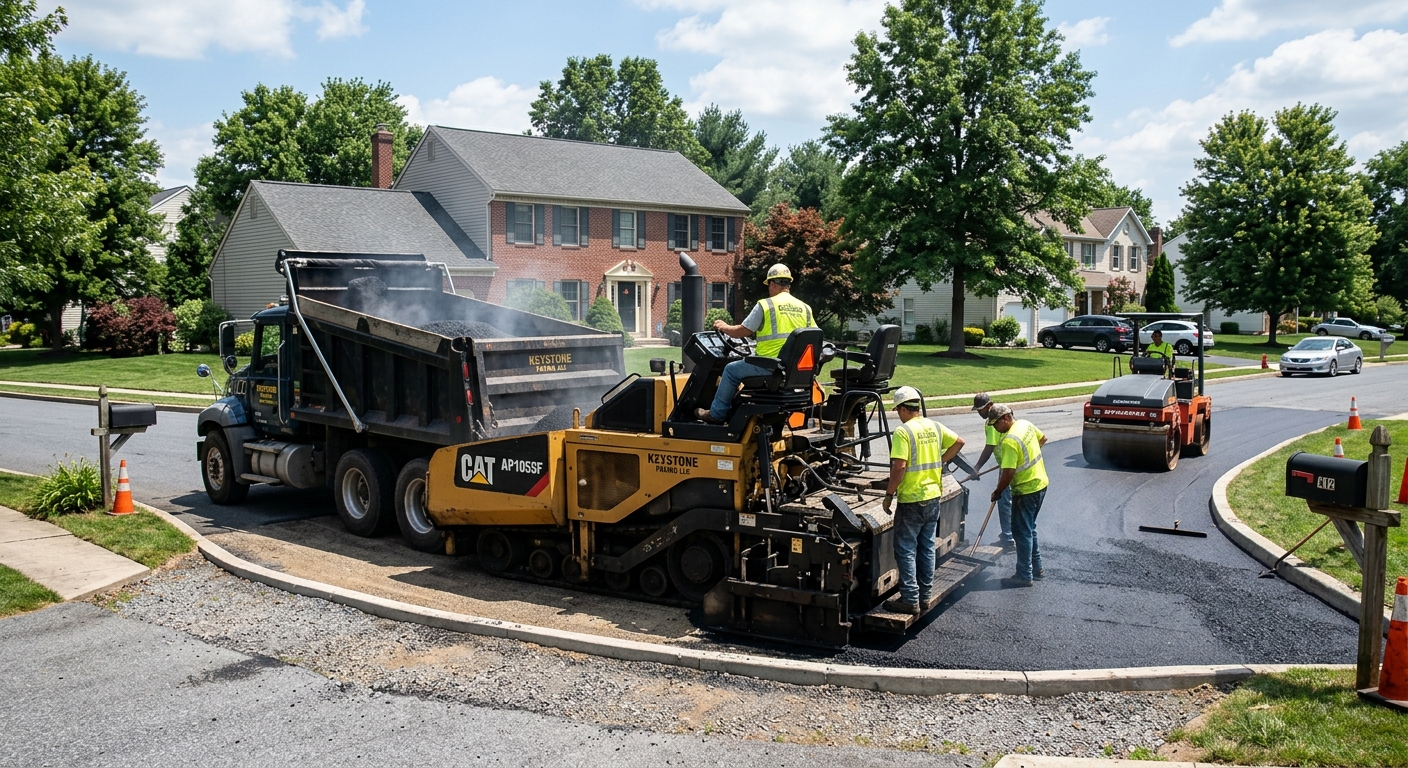
Driveway paving costs in Hanover — 2026
Hanover’s driveways are mainly found under single-family homes, which make up 47.4% of local housing. With a homeownership rate of 57.4%, most driveways here are cared for by the people who own them and plan to live with the results. Our winters in south-central Pennsylvania bring freeze-thaw cycles that are tough on pavement, especially when the surface coats thin and cracks let water into the base. Under almost every Hanover driveway is York County shale, which drains but can be unforgiving if not properly managed during installation.
Most differences in paving quotes come down to base preparation—the work you cannot see after the first layer goes down. Cutting corners under the surface is what leads to premature cracking, depressions, and edge failure. A higher upfront quote often means time spent excavating soft spots and trucking in the correct aggregate, not just stacking extra asphalt on a failing foundation. Old driveways, especially in postwar subdivisions, seldom meet today’s standards for base depth and compaction, so replacement often isn’t just about a new look, but correcting what’s beneath.
| Service |
Best for |
Lifespan |
Price range |
| Asphalt — full replacement with new base |
failed base, structural cracking |
20–30 yrs |
$3,400–$8,600 |
| Asphalt overlay / resurfacing |
sound base, surface cracking only |
8–15 yrs |
$1,450–$4,300 |
| Sealcoating — single application |
preventive maintenance on sound asphalt |
2–4 yrs |
$200–$650 |
| Concrete — new installation |
long service life, low maintenance |
30–50 yrs |
$4,800–$11,500 |
| Crack filling and patching |
isolated cracks under a quarter inch |
1–3 yrs |
$200–$800 |
| Gravel driveway |
rural, budget, long runs |
5–10 yrs with upkeep |
$900–$3,500 |
Estimates for a typical Hanover driveway. Square footage and base condition drive these figures more than material choice.
Hanover's ground and what it means for paving
In Hanover and York County, we pave over shale. Shale drains decently, but it’s unforgiving if not handled right—skip the correct base or get lazy with compaction, and the freeze-thaw cycles we see every winter will pry open cracks and create soft spots fast. Shale subgrade is a solid base if prepped properly, but it usually demands extra aggregate depth compared to softer, clay-rich soils you’ll find a county west or east. Practically, it means driveways here require more dollars spent on base prep and less on drainage tricks, though good grading to keep water moving off is still non-negotiable.
Frost penetrates down to 30 inches in south-central Pennsylvania; the goal is to build your driveway’s base well out of reach of heaving forces. Most postwar homes in York County—and that’s a large share in Hanover—had driveways put in before base construction was a standard concern. Many replacement jobs in our area start with tearing out sunken or cracked pavement, digging deeper, and importing the right stone to create a thick, stable platform. If you hear a high price for what seems like a simple driveway, it’s usually dollars going into correcting the hidden base, not for show. When a contractor wants to shortcut this step, Hanover’s winter will prove them wrong in a couple of years.
Overlay, patch or full replacement?
The decision to patch, overlay, or replace a Hanover driveway should start with what you see underfoot. Base condition is king here—if the stone and soil beneath aren’t sound, any money you put into surface work is temporary at best. Most honest contractors will take a core sample or at least dig a test hole to see what’s under there. If they don’t, that’s a sign they’re either guessing or hoping you don’t ask for more.
Here’s what you can check yourself: Alligator cracking—those tight, scaly cracks across wide patches—means the base has given out, and any overlay is just a band-aid over a broken bone. Isolated, straight cracks under a quarter inch wide are often just aging asphalt and can be sealed. Depressions or birdbaths that hold water signal the base moved or settled, needing excavation and rebuild in that area. Crumbling along the edge means whoever paved skipped putting in proper support there. Potholes mean water has gotten down to the base—patch them, but look for the cause.
Remember: overlays only work if the base is solid and dry. If the base is soft, patching or overlaying will fail inside two Hanover winters. No one can tell you truthfully which fix you need without seeing it for themselves.
| What you see |
Likely cause |
Right fix |
Cost |
| Isolated cracks under 1/4 inch |
surface aging |
crack fill and seal |
$200–$650 |
| Alligator cracking over a wide area |
base failure |
full replacement |
$3,400–$8,600 |
| Depressions holding water |
subgrade movement |
excavate and rebuild that area |
$3,400–$5,300 |
| Crumbling edges |
no edge support |
edge repair, consider curbing |
$400–$1,500 |
| Potholes |
water into the base |
full-depth patch, then assess |
$250–$900 |
| Faded but sound surface |
oxidation only |
sealcoat |
$200–$650 |
Choosing a paving company
In Hanover, you want a contractor who works out of a real address—not just a cell phone—and has jobs you can go look at that are several years old. Homeowners here have learned the hard way that some contractors rent equipment for the week, buy asphalt from whoever answers the phone, and disappear after the check clears. The best companies own their machinery and know exactly which York County quarry and asphalt plant they buy from. If they can’t name a local source, they’re either brokering the job or don’t actually do the work themselves.
Always verify their Home Improvement Contractor registration at the Pennsylvania Office of Attorney General site (hic.attorneygeneral.gov). Workers’ comp is mandatory in Pennsylvania for any employer; check their status in the WCAIS system (wcais.pa.gov) before they roll onto your property.
- Valid Home Improvement Contractor registration
- Current workers’ compensation insurance (verified via WCAIS)
- Physical business location, not just a mobile number
- Owned paving and grading equipment, not all rented
- References from driveways paved at least 3 years ago
- Ability to name their York County asphalt supplier
- Detailed written quote—no handshake deals over $500
- Insurance certificate sent directly from the carrier
- Proof they’re familiar with PennDOT and local township permitting
- No request for cash payments or waivers of your insurance deductible
- No attempt to rush you through the 3-day right of cancellation
Red flags: contractors who “have extra material,” ask for full payment upfront, won’t give a physical address, or pressure you to sign on the spot are not worth the risk—especially in York County, where a little vetting saves a lot of regret.
Permits and approvals for paving in Hanover
In most of Hanover, if you’re repaving your driveway in the existing footprint, a building permit is usually not required. That said, if you want to widen, relocate, or completely reconstruct a driveway, check with your local municipality first—York City requires a building permit for reconstruction, widening, or alterations. The surprise for many homeowners is that the driveway approach—where your driveway meets the road—requires a different kind of permit. If your driveway connects to a state road, you’ll apply to PennDOT District 8 for a Highway Occupancy Permit. For driveways off township roads, the township itself handles the approval.
With any new paving or widening that adds impervious surface, stormwater rules kick in. Expanding your driveway can trigger runoff requirements, and even if you have a permit, sending water onto a neighbor’s property opens you up to liability. It’s not just a code issue; in York County, it’s common courtesy and helps keep everyone out of court.
The Pennsylvania Home Improvement Contractor registry (hic.attorneygeneral.gov) is where you should verify registration for any contracts over $500. Workers’ compensation insurance is mandatory for paving contractors with employees, and you can confirm coverage at wcais.pa.gov before signing anything. Following these steps protects you if anything goes wrong—and helps shut out the fly-by-nights who skip these basics.
Sealcoating: what it does and what it doesn't
Sealcoating is often pitched as a cure-all, but in Hanover, it’s best understood as a maintenance step—not a magic fix. Here’s what it actually does: a proper sealcoat blocks oxygen, sunlight, and chemicals from reaching your asphalt binder. That slows down oxidation and protects against gas and oil stains, which are common with driveway traffic. A fresh sealcoat also revives the appearance, making old pavement look new again.
But sealcoating doesn’t add any real structural strength. It can’t fill cracks deeper than a hairline, and it does nothing for a base that’s already failing. If your driveway has significant cracks, depressions, or soft spots, sealcoating is just hiding the problem for another year or two—and you’ll usually see the damage return with a vengeance next freeze-thaw season.
More isn’t better: sealcoating too often builds up layers that peel, crack, and hold water. The first application should wait until new asphalt has cured—usually six months to a year, depending on temperature and weather. Our winters in York County mean one good seal every 2–4 years is about right. Anything more is usually a contractor trying to boost billable volume, not add value.
Crack filling matters more: sealing larger cracks (before you even think about coating) keeps water out of the base, which is what actually extends the pavement’s life. A proper sealcoat will be applied with squeegees and brooms—not just sprayed thin for show. Expect to pay $200–$650 for a single application. If someone offers a much lower price, odds are it’s watered down or sprayed thin and won’t last our Hanover winters.
Caring for a new Hanover driveway
If you want a Hanover driveway to last, the biggest bang for your buck is filling cracks before water seeps into the base. Crack sealing costs little and addresses the real villain: moisture that turns the base to mush during freeze-thaw cycles. Next up: keep your driveway edges supported. Unbacked edges crumble fast, so if you install new, consider compacted stone or curbs to shore them up. Third: keep water moving off the driveway—make sure downspouts, yard grading, and the drive itself steer runoff away to prevent puddles and future base washout.
Guard against point loads: don’t park dumpsters, jack stands, or heavy materials on one spot. On new asphalt, wait at least a week before parking, and avoid turning your wheels while stationary—Hanover summers can make hot mix soft until it fully cures. For salt: it’s rough on concrete, and can make freeze-thaw cycling worse on asphalt by encouraging early melts and refreezes. Alternatives like calcium magnesium acetate are easier on your pavement, but they do cost more per bag. In this climate, prevention and smart habits add years to your driveway, more than any product or routine can.
Frequently asked questions — driveway paving in Hanover
Are pavers worth the cost in south-central Pennsylvania?
Pavers can look fantastic and offer great curb appeal, but the answer really depends on your budget and expectations here in Hanover. While pavers offer flexibility for repairs and can last for decades if properly installed on a well-prepared base, they are substantially more expensive than either asphalt or concrete—often double or more. Most homeowners in Hanover choose asphalt for practicality; a full asphalt replacement runs $3,400–$8,600, while a similar area in pavers can easily reach five figures. Additionally, paver driveways need occasional re-levelling, especially with our freeze-thaw cycles, and weeds or shifting can be an issue without proper installation. In short, pavers might be “worth it” for full landscape projects or higher-end upgrades, but they’re not a must-have for homes in our typical price range or climate conditions.
Do I need a permit to repave a driveway in Hanover?
For most homeowners in Hanover, repaving an existing driveway in its same footprint does not require a building permit, saving you both money and paperwork. But if you’re changing the width, re-routing, or reconstructing in certain municipalities—like York City—you’ll need to check with your local office for permit requirements. The driveway approach, where your drive meets a state or township road, sometimes requires a separate permit: PennDOT District 8 handles state roads, with your township responsible for local driveways. Permits are rarely needed for straightforward resurfacing, but it’s always worth a quick check. For major replacements, plan for costs starting at $3,400–$8,600 to cover the project if a permit becomes necessary in your case.
Are door-to-door pavers a problem in Hanover?
Door-to-door pavers are a known risk in Hanover and greater York County. These crews often offer a “special price” because they claim to have extra asphalt from another job. While the occasional legitimate contractor may go door-to-door for business, the majority are unregistered, can’t name their plant supplier, and may provide no contract or warranty. The finished drive may look OK for a season but often starts to crack, ravel, or crumble well before its time—especially given our local freeze-thaw cycles and shale base. With prices around $3,400–$8,600 for a full replacement, legitimate work never comes at half price. Always verify registration at hic.attorneygeneral.gov, get jobsite references, and never pay in cash to someone at your door.
How deep should the aggregate base be here?
In Hanover, with our shale subgrade and 30-inch frost depth, the base under your driveway matters more than anywhere else. For asphalt, a minimum of 6–8 inches of compacted aggregate is standard, and many contractors will advise up to 10–12 inches if the underlying shale is soft or poorly draining. For concrete, you’ll want at least 4–6 inches of base, since concrete distributes loads better but still heaves if the base shifts. Anything less is cutting corners and will show quick signs of failure during our freeze-thaw cycles. A properly built base is why a full asphalt job here costs $3,400–$8,600—that depth costs more, but going cheap is just paying twice.
Is gravel a cheaper option in Hanover?
Gravel is often the most budget-friendly option for driveways in Hanover, especially on longer rural runs and where a finished look isn’t the priority. A new gravel driveway for an average Hanover property will run $900–$3,500 depending on length and base work—substantially less than asphalt, which starts at $3,400–$8,600. Gravel driveways need regular top-ups and grading, and dust or mud can be a concern, especially with our winter freeze-thaw cycles. Still, for large properties or those with long access lanes, gravel remains popular. Well-built gravel can handle our climate, provided you maintain grades and fill ruts before they deepen.
Why are my driveway edges crumbling?
In Hanover, edge crumbling on driveways happens for two main reasons: lack of support and water infiltration. Our local shale base poses a challenge—if the original paver didn’t compact the edges or extend the base wide enough past the surface course, the asphalt or concrete will fail as soon as weight shifts off the edge or water gets under it. This is common on driveways built before base standards improved in postwar neighborhoods. Heavy vehicles parking on the edges, repeated freeze-thaw, and no curbing all accelerate the problem. Fixing crumbled edges means patching the damaged area and, ideally, installing proper supports or curbing. Edge repair typically runs $400–$1,500 in Hanover, but the real fix is better base work and keeping water away.
What does an asphalt overlay cost in Hanover?
An asphalt overlay is more affordable than a full replacement if your base is in good condition. In Hanover, overlays run from $1,450–$4,300, with the typical job around $2,900 for a standard double-car drive. Remember, overlays are only a good choice when the base is sound and cracks are not due to foundation problems. If the base is soft, wet, or you see widespread alligator cracks, an overlay will only mask the problem for a few years (or less, given freeze-thaw cycles). The best way to save your investment is a base check first—overlays work in some cases, but not all, and a reputable Hanover contractor will tell you when it’s not the right move.
How far ahead should I book a paver in Hanover?
In Hanover, spring through early fall is prime paving season, and reputable contractors will book several weeks to months ahead, especially in neighborhoods with mostly single-family homes and frequent replacements. If you want a major job done—like a full removal and replacement—plan to book at least 2 to 3 months in advance for reputable crews, sometimes more if you want your choice of dates. A simple overlay or sealcoating ($1,450–$4,300 and $200–$650, respectively) can often be scheduled sooner, but expect delays after heavy rains or cold snaps. Rush jobs can end up with whoever is available, rather than the best. Booking early gives you time to vet contractors and make sure the job gets done right, not just quickly.
When can I seal a brand new asphalt driveway?
It’s tempting to seal a new driveway right away for looks, but in Hanover and the wider York County climate, new asphalt needs time to cure. You should wait at least 6 months—and ideally up to a full year—before applying the first sealcoat. This curing period allows the oils and volatiles in the asphalt to evaporate and the surface to harden, so the sealant sticks and doesn’t trap moisture. If sealed too soon, you risk peeling, uneven color, or even soft spots. Most driveways here are installed in summer or fall, so the first sealcoat should wait until the following season. When you do apply it, expect a price between $200–$650 for a proper job on a standard double-car drive. Trust the long game—waiting leads to a seal that actually protects, not just a quick shine.