What a new driveway costs in Pine
In Pine, where 83.9% of homes are owner-occupied and nearly three-quarters are single-family (U.S. Census Bureau, ACS 2024), driveways are a significant but necessary investment. With the local climate’s heavy freeze-thaw swings and common clay and shale subgrade, installing—or replacing—a driveway is not an interchangeable project. Prices here reflect not just what you see on the surface, but the work hidden underneath, especially in older neighborhoods with postwar and 1970s driveways now reaching the end of their useful life. It’s tempting to judge by appearance or headline price, but in Pine, most of the cost is buried: excavation, aggregate base, and compaction done right.
The price differences between contractors often stem from what happens before a single drop of asphalt is poured. If a quote is lower, it’s usually because of shortcuts on base depth or inadequate prep—not a genuine bargain. Hilltop clay and alley subgrades demand deeper bases and more attention than the national “average.” Ignore this, and even great-looking new blacktop will crack up in three winters.
| Service |
Best for |
Lifespan |
Price range |
| Asphalt — full replacement with new base |
failed base, structural cracking |
20–30 yrs |
$3,900–$9,900 |
| Asphalt overlay / resurfacing |
sound base, surface cracking only |
8–15 yrs |
$1,650–$5,000 |
| Sealcoating — single application |
preventive maintenance on sound asphalt |
2–4 yrs |
$225–$750 |
| Concrete — new installation |
long service life, low maintenance |
30–50 yrs |
$5,500–$13,000 |
| Crack filling and patching |
isolated cracks under a quarter inch |
1–3 yrs |
$200–$800 |
| Gravel driveway |
rural, budget, long runs |
5–10 yrs with upkeep |
$900–$3,500 |
Estimates for a typical Pine driveway. Square footage and base condition drive these figures more than material choice.
What you need before paving in Pine
For most homeowners in Pine, resurfacing or repaving an existing driveway right where it sits does not call for a building permit. There’s no Allegheny County- or state-level requirement for driveway work that doesn’t expand beyond the current footprint or touch the public right-of-way, so if you’re staying inside your own property, you usually save the trip to the permit office.
But there’s a catch: the driveway approach—where your pavement meets a township or state road—almost always requires a distinct permit. In Allegheny County, if your drive enters a state route, the proper authority is PennDOT District 11-0, who will issue a Highway Occupancy Permit. For work entirely within your property in Ross Township or similar municipalities, you typically do not need a separate permit, but always check with your local office if you plan to alter curbs or aprons.
Be aware of stormwater: expanding or redirecting any hard surface can cause runoff headaches, and in areas with Pine’s hilly terrain and clay soils, you are liable if water runoff damages a neighbor. Drainage correction is always your responsibility, whether or not a permit is required.
If hiring a contractor, Pennsylvania requires anyone handling jobs over $500 to be registered with the PA Office of Attorney General. You can verify this at hic.attorneygeneral.gov. Every legitimate contractor must also carry workers' compensation insurance—check records at WCAIS (wcais.pa.gov) for proof. Verifying these before you sign is worth your time.
When paving can actually be done in Pine
The paving season in Pine is governed by the weather and the asphalt plants, not by when you want the work done. Hot-mix asphalt, which is what belongs in driveways here, must be laid and compacted while it’s still above a certain temperature. In southwestern Pennsylvania, with an average winter design temperature of 8 °F and frequent freeze-thaw cycles, cold weather sets a hard stop: asphalt plants close for the season, usually from late November through March. If a crew says they can lay fresh hot-mix in January, either the material or the standard is not what you want.
Concrete paving is no easier in the cold. Concrete requires overnight lows to stay above freezing while it cures. In Pine’s climate, setting concrete in late fall or early spring without heated blankets or additives means your investment will likely chip or crack.
Practically, spring and early summer are when crews have open capacity, materials are fresh, and weather is workable. Peak summer, crews are booked out, and many contractors hold their prices a little firmer. In late fall, if you get a low-pressure sales pitch for a last-minute job, think twice. Local asphalt plants scattered around the Pittsburgh area keep haul distances short, but even that can’t overcome the basic rule: paving here stops for winter, period. Plan ahead and don’t rush work into an iffy weather window.
What's under the asphalt matters more than the asphalt
Most Pine driveways that fail early aren’t undone by the asphalt you see, but by what’s below it: the subgrade, the compacted crushed stone base, and every shortcut that was taken on either. In Allegheny County, clay and shale soils on hilly sites are unforgiving—water sits, freezes, and frost heaves crack even the nicest pavement when the base is too thin or loose. The assembly under every good driveway starts with the subgrade (the raw earth, graded for pitch and compacted), then a thick layer—usually 6 to 8 inches—of 2A or similar crushed aggregate, compacted in lifts, before asphalt comes anywhere near it.
Why care about the base? The freeze-thaw cycle is brutal here. Water in the clay or between the aggregate freezes, expands, and lifts sections of driveway up and down unevenly. That subtle movement cracks the surface above, and the cracks only get wider each winter. This is why the depths recommended in mild areas fall short—they aren’t built for southwestern Pennsylvania hills.
The biggest risk for Pine homeowners is paying for a driveway where shortcuts are hidden: not excavating soft spots, using too little or the wrong aggregate, skipping compaction between lifts, or laying new pavement over a failed base. None of this shows the next day, but by year three you’ll see cracks in the wheel paths, low spots, or alligator cracking. The only way to prevent that is to get excavation depth, aggregate type, and compaction tested and specified in writing. Don’t let anyone tell you “it’s standard.” For this climate, you want at least 6 inches of compacted aggregate base, tested for proper density, under at least 3 inches of compacted asphalt.
Numbers, not adjectives
In Pine, price alone won’t protect you from a bad driveway—only demanding real specs in your contract will. Too many driveway quotes say, “We’ll put down three inches,” with no clarity on whether that’s before or after compaction, or what’s actually under it. In our freeze-thaw climate, you need specifics, not promises. Undersized or poorly compacted stone, not enough asphalt, or a “one-pass” job will all crack up before the decade is out.
Good contracts distinguish between “as laid” and “as compacted” thickness—material compresses about 15–25% during rolling, so 3 inches placed is around 2.5 inches compacted. For our hilly, clay-heavy ground, you want more than the bare minimum. Pennsylvania isn’t Florida; depths here are driven by real winter and tough soils.
- Excavation depth (typically 8–12 in. below final grade)
- Type and depth of aggregate base (at least 6 in. of 2A or similar, compacted in lifts)
- Aggregate compaction method (vibratory plate/roller, checked per lift)
- Asphalt binder course thickness (minimum 2 in. compacted)
- Surface course thickness (1–1.5 in. compacted)
- Mix type or designation (e.g., ID-2 wearing, PG64-22 binder)
- Edge treatment (squared, supported, or backfilled with topsoil/seed)
- Drainage slope (minimum 2%, pitched away from buildings)
- Crack filling method (hot-pour rubberized, ASTM D6690 standard)
- Written warranty and documented compaction testing if available
Get all of these in writing. If a contractor laughs off your questions, keep shopping.
Sealcoating: what it does and what it doesn't
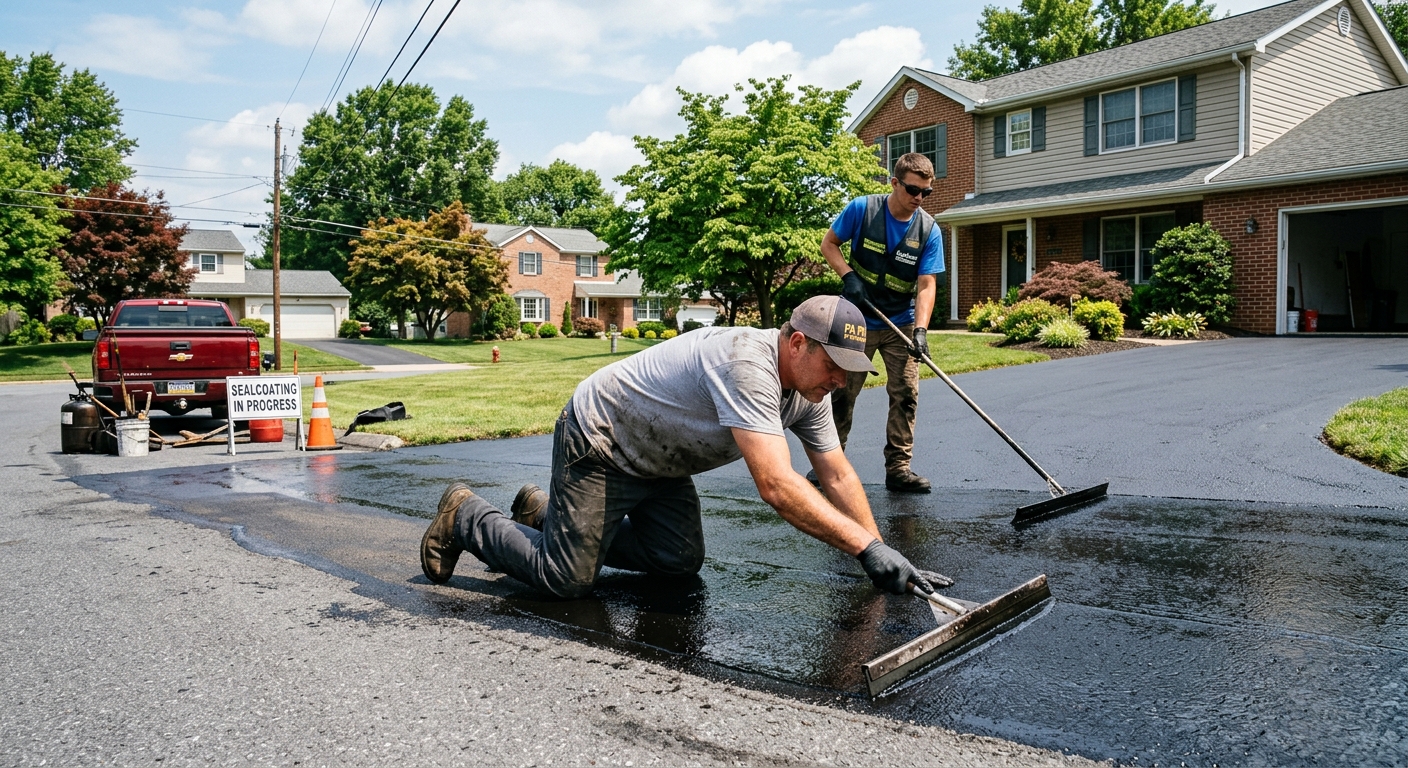
Sealcoating in Pine is preventive maintenance, not a cure-all. What sealcoat can do is shield your asphalt’s binder from oxidation, sunlight, and the occasional oil or fuel spill, and give a faded driveway a refreshed, uniform look. But it won’t add structural strength, won’t repair anything worse than hairline surface cracks, and will not make a failed base solid again. Expecting it to “fix” driveways with deep cracks or soft spots is just throwing money after a lost cause.
Done right, sealcoating every few years helps squeeze more life from a sound driveway, especially with our western Pennsylvania winters, but only if the base and main surface layers are still solid. Too-frequent applications, however, are just as bad as not enough—layered sealers will eventually peel, crack, or even trap moisture. For brand-new asphalt, it’s best to wait at least 9–12 months before sealing, letting the surface cure so volatiles don’t get locked in.
Crack filling is more critical than sealing for driveways in Pine. Hot rubberized filler, properly installed, keeps water out of the base—this matters much more than a cheap spray coat. Spot-filling cracks under a quarter inch and patching potholes can buy a few more winters before a major overhaul, usually for $200–$800. Beware any “deal” on sealcoating that seems suspiciously cheap: a $99 spray from a drum will usually be just watered-down sealer, barely thick enough to survive one season and sometimes just an old-fashioned scam.
For real value, expect to pay $225–$750 for a proper, hand-applied sealcoat every 2–4 years on a healthy Pine driveway.
The driveway scams that work in Pine
Paving, sadly, attracts out-of-town operators who know most of their customers won’t spot shortcuts or fraud until years later. The high density of contractors and easy material supply in the Allegheny County area makes it tempting for transient crews to roll through neighborhoods, offering “leftover asphalt from a job down the road,” claiming a discount for “today only” work, or pressing for cash up front with no paperwork. Unmarked trucks, out-of-area tags, and no written scope are all warning signs.
The quickest scam is a lowball verbal quote, done the same day, with a crew pressuring you to skip permits, pay in cash, and take the “deal” before they move on. For sealcoating, the typical fraud is a watery oil-based spray passed off as professional work—which will disappear with the first rain. These pitches show up in communities like Pine precisely because high homeownership and modest local policing make for easy pickings. Don’t fall for an “urgent” offer or let anyone start without a properly itemized, written contract.
Pennsylvania’s Home Improvement Consumer Protection Act exists for this reason: on any home job over $500, you have the right to a written contract and a three-business-day window to cancel—even if the crew is already parked outside. Never let anyone waive your deductible or pressure you into same-day work; both are red flags.
Take five minutes to check contractor registration at hic.attorneygeneral.gov, and workers’ comp at wcais.pa.gov. These simple steps shut out most scams before they start—and give you the leverage to say “no thanks” with confidence.
Frequently asked questions — driveway paving in Pine
Is gravel a cheaper option in Pine?
Yes, gravel remains the least expensive way to surface a driveway in Pine, especially for homeowners on longer rural lots or private drives. With a price range of $900–$3,500 depending on length and base prep, gravel is a fraction of the cost of full asphalt or concrete work. But local factors matter: Pine’s terrain is hilly, and the clay and shale subgrade can lead to ruts and drainage washouts if installation is rushed. Expect a bit more annual maintenance (grading and fresh gravel every few years) than with asphalt. Some households opt for gravel as a long-term surface; others use it as a stopgap until ready for a permanent option. It’s budget-friendly, but not maintenance-free—the freeze-thaw cycle causes settling and rutting, so be honest about whether annual upkeep is worth the savings for your property.
How far ahead should I book a paver in Pine?
In Pine, you should plan on booking a reputable paving contractor at least two to three months ahead, especially if you want work done during the main season (late spring to early fall). Peak summer dates fill up fastest, as demand is highest and local asphalt plants run full-tilt to supply projects around Allegheny County. Some contractors will squeeze in small jobs or sealcoating later, but for full replacement—especially for larger single-family driveways—it’s best to get on the schedule by March or April for summer work. Waiting until the last minute can mean paying more or getting pushed into the colder shoulder season, when material quality and install timelines are harder to guarantee. Quick-turn crews offering next-day jobs are usually worth steering clear of, regardless of price—good contractors stay booked. For planning, use the typical replacement cost in Pine: $3,900–$9,900 for a full asphalt driveway.
How long should an asphalt driveway last in Pine?
With proper installation over a well-prepared base, most asphalt driveways in Pine last 20 to 30 years. That life span assumes good aggregate depth and drainage to counter our region’s punishing freeze-thaw cycles and clay subgrade. Surface maintenance—like sealcoating every few years and timely crack repair—will help you get the high end of that range, but nothing substitutes for solid construction. Some older Pine driveways are now showing base failure after 30-plus winters—especially in homes built in the postwar booms. If you’re resurfacing over a still-sound base, expect 8 to 15 years, usually at a lower price ($1,650–$5,000), but once the base is compromised, full replacement is the only route to another two or three decades of service.
Does sealcoating fix cracks?
No, sealcoating does not fix cracks—it only coats the surface, hiding hairline gaps but leaving structural or deeper cracks untouched. Real crack repair in Pine’s climate means filling individual cracks (usually under a quarter inch wide) with hot-pour rubberized filler before any sealcoat is applied. This treatment, which costs $200–$800 depending on extent, is what keeps water and freeze-thaw cycles from eroding the base. Don’t trust a contractor who promises that a spray sealer will “take care of everything.” Sealcoating is for protection and color; real crack repair is a separate line item and makes the actual difference in extending driveway life in Pine’s challenging winters.
Are door-to-door pavers a problem in Pine?
Yes, door-to-door pavers still work Pine and the wider Allegheny County area. These crews drive unmarked trucks, offer “leftover” asphalt, and push urgent one-day-only deals. They rely on moving fast: exploiting the fact that defects show up only years later, not immediately. Pennsylvania law protects homeowners—any job over $500 requires a written contract and gives you a three business-day right to cancel, no matter what the crew says. Always check that any contractor is registered at hic.attorneygeneral.gov and carries valid workers’ comp insurance listed at wcais.pa.gov. If someone shows up offering you a full pave for under $3,900, walk away. The work is usually unpermitted, thin, and won’t last.
Do I need a permit to repave a driveway in Pine?
Typically, you do not need a building permit to repave an existing driveway in its current location in Pine—this is a significant cost and hassle saver for most homeowners. However, if you plan to change the driveway’s footprint, or especially if you’ll be altering the approach (the area connecting to the public road), then a permit from PennDOT District 11-0 may be required. For work entirely on private property and not impacting the public right of way, Ross Township (typical in Pine) usually does not require an additional permit. Always check with your local office if in doubt. No permit does not mean no responsibility—managing drainage properly is always on the homeowner. Full asphalt replacement here typically costs $3,900–$9,900.
Asphalt or concrete for a Pine driveway?
Both asphalt and concrete are good options for Pine, but each fits different priorities. Asphalt is less expensive to install—generally $3,900–$9,900 for a standard residential drive—and is more flexible in our freeze-thaw climate. It’s a bit more forgiving when the clay and shale subgrade shifts, and repairs are easy. Concrete has a higher upfront price ($5,500–$13,000) but lasts longer, typically 30–50 years with little maintenance. However, when Allegheny County soils settle or heave, concrete can crack permanently, where asphalt may flex. For smaller or steeper drives, asphalt is often the smarter local pick; if you want a long-term, low-maintenance surface and don’t mind the upfront cost, concrete is hard to beat.
What is the difference between binder and surface course?
In Pine, a typical asphalt driveway involves two distinct layers: the binder course and the surface (or wearing) course. The binder course is the first thick lift of asphalt, made with coarser aggregate for strength. It averages about 2 inches (compacted) and forms the structural heart of your drive. The surface course goes on top—about 1 to 1.5 inches thick (compacted)—using finer stone for a smoother, more attractive finish. Both layers are necessary for durability in the local freeze-thaw climate and to handle common clay and shale subgrades. Some cheap jobs skip the binder or under-compact the lifts, shortening your driveway’s life. In cost: a proper two-layer asphalt replacement falls between $3,900–$9,900 in Pine.
How much does driveway paving cost in Pine?
Driveway paving costs in Pine depend on the exact work needed and your existing base, but you can expect to pay $3,900–$9,900 for a full asphalt replacement with a new base, which is typical for older single-family homes. An overlay, if your existing base is sound and you just need a fresh wear surface, comes in lower—$1,650–$5,000. Concrete driveways are pricier, usually $5,500–$13,000. Maintenance jobs like sealcoating run $225–$750 and are a good value if your base is still solid. Most homeowners in Pine—where driveways carry the brunt of freeze-thaw damage—will want to invest in solid prep and base work; that’s where your money is best spent for the long run.