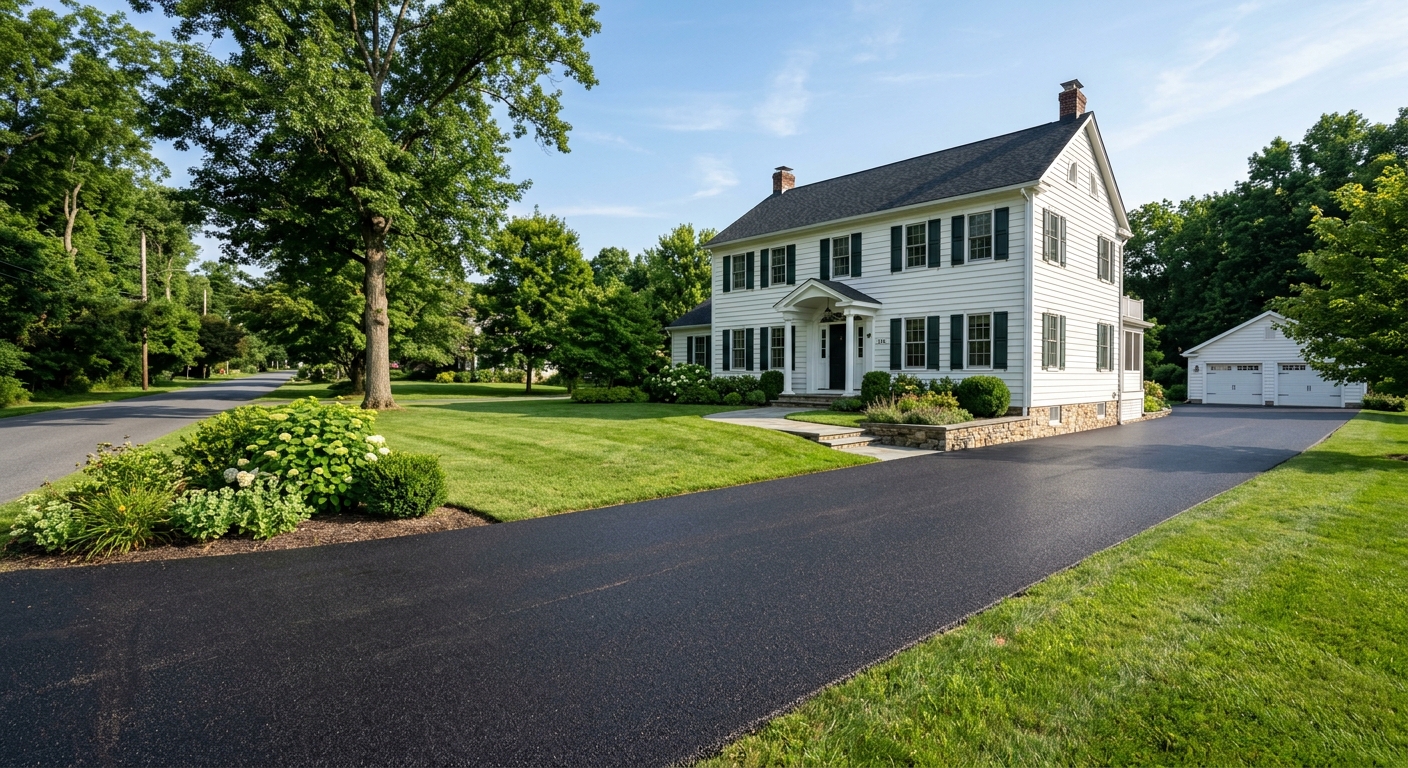
Uwchlan paving prices by scope — 2026
Uwchlan Township’s high single-family home rate (57.9%) and strong homeownership (73.1%) mean most residents are responsible for their own driveway upkeep and replacement, not a landlord or HOA. Here, the main driver of driveway cost is not just what you see above the surface—it's how deep and well-built the base under the driveway was, and whether that base is being repaired, replaced, or simply resurfaced. Southeastern Pennsylvania’s moderate freeze-thaw cycles and deep frost line (30 inches) demand thicker, well-drained bases. The limestone and dolomite soils common in the area make proper base construction critical. Between two quotes, the visible details—number of coats, finish, edge—often look similar. But the true difference is under the surface: excavation depth, aggregate, compaction, and drainage are where corners are cut, or value is delivered. This is why, for an Uwchlan driveway, the lowest bid is almost never the cheapest option in the long run. What you need most is a quote that details what will be done—and how deep they’ll go underfoot.
| Service |
Best for |
Lifespan |
Price range |
| Asphalt — full replacement with new base |
failed base, structural cracking |
20–30 yrs |
$4,100–$10,500 |
| Asphalt overlay / resurfacing |
sound base, surface cracking only |
8–15 yrs |
$1,750–$5,300 |
| Sealcoating — single application |
preventive maintenance on sound asphalt |
2–4 yrs |
$225–$800 |
| Concrete — new installation |
long service life, low maintenance |
30–50 yrs |
$5,900–$14,000 |
| Crack filling and patching |
isolated cracks under a quarter inch |
1–3 yrs |
$200–$800 |
| Gravel driveway |
rural, budget, long runs |
5–10 yrs with upkeep |
$900–$3,500 |
Estimates for a typical Uwchlan driveway. Square footage and base condition drive these figures more than material choice.
Driveway permits, approaches and stormwater rules
In much of Chester County, including Uwchlan, you usually won’t need a building permit when repaving a driveway that stays within its current footprint and is outside the public right-of-way. That saves you extra paperwork if you’re just resurfacing or replacing an existing drive in the same spot. Where homeowners trip up is at the driveway approach—the section where your driveway meets a public road. If your property connects to a state route, the approach permit must come from PennDOT Engineering District 6-0, not the local township office. If you live on a township-maintained street, check with Uwchlan Township for local requirements, as rules can vary from one jurisdiction to another.
Stormwater matters, too. Any expansion of impermeable surface—making your driveway wider or longer—can trigger runoff controls. Neighbors have recourse if you direct new runoff onto their land, even if your project is technically permitted. Water must be managed properly, often through added drainage, to prevent causing a problem downhill or next door.
When hiring a contractor, always verify their Pennsylvania Home Improvement Contractor (HIC) registration for any contract over $500, using the state’s official registry at hic.attorneygeneral.gov. By law, every legitimate paving contract must be in writing. Also, check for valid workers’ compensation insurance using the WCAIS system—this is mandatory for any employer on your property and will protect you from unexpected liability.
Numbers, not adjectives
Most driveway paving mistakes are born from vague promises like “three inches of asphalt”—but in Uwchlan, where our winters feature consistent freeze-thaw and a deep 30-inch frost line, these details are the difference between a driveway that lasts two years or twenty. Words like “thick,” “proper base,” or “well compacted” don’t mean a thing in this business without numbers. The compaction process shrinks loose material by 20–25%, so “three inches” could be three inches laid, but only two and a quarter inches after rolling. Insist on compacted thickness numbers in your quote, not just loose laydown numbers.
In this region, because of our recurrent winter freezing and settlement-prone subgrade, depth and base details matter more than finish or brand. Many Chester County homes—especially those built during the 1960s–1980s boom—were constructed when driveway standards were bare minimum. Repair or replacement work now has to compensate for old shortcuts or mistakes.
- Measured excavation and removal depth (in inches)
- Type and thickness of aggregate base, compacted
- Base compaction method and whether performed in lifts
- Type of asphalt mix (state mix designation, e.g. 9.5mm)
- Binder course depth and surface course depth, as compacted
- Temperature at paving, and timing of final roll
- Edge treatment — hand tamping, concrete band, or stone shoulder
- Drainage details — slope, direction, and outlets
- Cleanup and lawn restoration plans
- Warranty terms, including exclusions (e.g., cracks, settlement)
Local soil, drainage and driveway lifespan
In central Chester County, including Uwchlan, the subgrade is predominantly limestone and dolomite bedrock. While that sounds solid, these soils pose a risk for settlement and, over time, reflective cracking in paved driveways—meaning cracks that telegraph from weaknesses at the bottom, not just the surface. For asphalt driveways here to avoid early failure, the aggregate base needs to be deeper than in areas sitting on clay or sand: typically at least six to eight inches compacted stone, with select cases requiring even more.
Freeze-thaw cycles are another critical concern. Our region’s moderate winter swings and substantial 30-inch frost depth mean water trapped under or within the base will expand and contract repeatedly, stressing whatever sits above. Good drainage and thick, well-compacted stone are the only solution, especially as older driveways (many built during the 1960s–1980s housing push) often lack proper base depth. Simple overlays don't last where the original build was light or the soil moves each season. Most Uwchlan driveways at this age and soil type need full-depth replacement, not a cosmetic patch. A driveway built to minimal standard here is just a future repair bill waiting to happen.
What a real paving quote contains
You can compare two paving quotes only if both spell out details. For a driveway in Uwchlan, a proper quote will state the measured square footage—not guessed, but physically measured on site. It lists the planned excavation depth, includes debris disposal, specifies what type and exactly how much aggregate base goes in (in compacted inches), and clarifies how that base will be compacted and built up in lifts. Asphalt layers are separated into binder and surface courses, each with their own compacted thickness. The edge plan (whether the border is hand tamped, concreted, or stoned) and exactly how the drive will drain matter. A good quote also covers site cleanup, lawn restoration, the payment schedule (small deposit, rest on completion), and a written warranty—usually with explicit limitations, since most exclude cracks or settlement unless gross error is shown.
If you receive a one-line quote reading only "Pave driveway $X," with no breakdown, this is the most reliable route to overpaying for an underbuilt job. You must compare numbers, not just the bottom line.
| Line item |
What to look for |
Red flag if… |
| Area |
measured square footage stated |
eyeballed or absent |
| Excavation |
depth and disposal included |
'we'll pave over it' |
| Base |
aggregate type and depth in inches |
'proper base' |
| Compaction |
method, and done in lifts |
not mentioned |
| Asphalt |
courses and compacted depth |
'3 inches' unqualified |
| Drainage |
slope and water direction stated |
silent |
| Warranty |
what is covered and what is excluded |
verbal only |
| Payment |
modest deposit, balance on completion |
full cash up front |
Comparing materials in southeastern Pennsylvania
Neither asphalt nor concrete is perfect; each has trade-offs under Uwchlan’s local climate. Our region’s repeated freeze-thaw cycles give flexible, resilient materials an advantage. Asphalt does well precisely because it flexes with ground movement instead of cracking—at the cost of requiring more frequent maintenance like sealcoating, but at a much lower upfront price ($4,100–$10,500 for a full replacement). Concrete, by contrast, is rigid and can last decades—if it isn’t subjected to salt-based de-icers, which are unfortunately essential with southeastern Pennsylvania’s snow and ice. Spalling and scaling from salted winter roads is the number one killer of concrete driveways here, not cracks.
If you’re attentive and avoid salt, concrete ($5,900–$14,000) can be an asset, but this is a behavioral demand most owners do not keep. Pavers work if you want an upscale look, are comfortable with slightly higher cost, and don’t mind occasional re-setting of units after winter. Gravel remains a solid budget choice for longer rural runs or places with shifting ground.
| Option |
Installed cost |
Maintenance |
Freeze-thaw performance |
Lifespan |
| Asphalt — new install |
$4,100–$10,500 |
sealcoat every 3–4 yrs |
excellent, flexes |
20–30 yrs |
| Asphalt — overlay |
$1,750–$5,300 |
same |
good if base is sound |
+8–15 yrs |
| Concrete |
$5,900–$14,000 |
low, avoid de-icing salt |
fair, spalls with salt |
30–50 yrs |
| Pavers |
$9,400–$14,000 |
individual units replaceable |
good, settles gradually |
25–50 yrs |
| Gravel |
$900–$3,500 |
top-dress every 2–3 yrs |
excellent drainage |
indefinite with upkeep |
Drainage: the failure nobody plans for
Most driveway failures in Uwchlan trace to poor drainage, not thin materials. A driveway should always slope at least 2% (a quarter inch per foot) away from structures to ensure immediate runoff. Crowning—where the drive peaks in the middle and falls off each side—works for wider or rural drives, while a simple cross-slope is better in smaller suburban lots. If the grade can’t be changed, installing trench or channel drains at the garage entry or low points captures water before it invades the base or your house. All collected water must “daylight” properly to a lawn or discharge area—not a neighbor’s yard, where you could be liable for runoff damage. In some builds, dry wells or subsurface drains fix persistent puddling.
In Uwchlan, where limestone subgrade drains unevenly and frost depth runs 30 inches, ponded water beneath the asphalt or concrete spells disaster. Moisture works its way down, then freezes, heaving and breaking the surface. Heavy clay soils can make things worse by sealing in water, keeping it trapped until the next freeze-thaw cycle. If your property slopes toward the house or garage, never settle for a quick fix. Get the grading or drains built up front—a repair here saves the cost of an entire new driveway later.
Frequently asked questions — driveway paving in Uwchlan
How thick should asphalt be for a residential driveway in Uwchlan?
For a typical Uwchlan driveway, you want at least 3 inches of compacted asphalt—meaning an initial laydown thickness of about 4 inches, rolled and compacted to 3. Two-layer construction is best: a 2-inch base (binder) course and a 1- to 1.5-inch surface (wearing) course. This is on top of 6–8 inches of compacted crushed stone, which is especially critical with Chester County’s limestone and freeze-thaw cycles. Some driveways from the 1960s and 1970s were built thinner, which is why they now need full-depth replacement at typical costs of $4,100–$10,500. Where heavier vehicles are parked, go 4 inches compacted. Always ask your contractor for measurements specified as “compacted thickness,” not loose or “after rolling,” and have them write it into the contract.
Are there stormwater rules on paving in Uwchlan?
Yes—while most repaves or overlays don’t need a full building permit if you aren’t changing the footprint, expanding the impervious area (widening or lengthening) can trigger stormwater runoff requirements. Uwchlan’s local rules are shaped by Chester County’s standards, meaning you need to manage runoff so you don’t create problems for neighbors or roadways. Draining water directly onto another property can lead to legal liability, even with a permit. If your driveway connects to a state road, PennDOT also has regulations about drive approaches and drainage. Make sure your paving contractor understands these responsibilities, as correction costs or fines can far exceed the upfront budget, even for a modest overlay at $1,750–$5,300.
Should I repair or replace my Uwchlan driveway?
It depends on your base and the driveway’s age. If you have isolated surface cracks under a quarter-inch wide, chip-and-fill patching ($200–$800) or a simple sealcoat can buy you another few years. But for Uwchlan’s typical single-family driveways, especially those built before the 1980s, base failure is common: alligator cracking, sinking sections, or standing water after rain. Surface repairs here are money down the drain—a fresh overlay won’t last. In these cases, full-depth replacement (with a rebuilt base and improved drainage) gives you 20–30 years of service and pays off in the long run. Always have a contractor check base depth and drainage before making your decision. Don’t pay for a “band-aid” if your drive is fundamentally failing from below.
How much does it cost to widen a driveway?
In Uwchlan, widening a driveway typically costs a little more per square foot than a simple overlay or replacement, due to excavation, base preparation, and tie-in work. For asphalt, expect anywhere between $4,100–$10,500 for a full replacement, with widening adding to this range based on the total size increase. If you are just adding a small “bump-out” or parking pad, minor work might be in the lower end of that range, but doubling the width pushes it higher. Always check for permit and stormwater rules before starting—expanding width can trigger extra requirements not needed for in-place resurfacing.
What does sealcoating cost in Uwchlan?
For a standard single-family driveway in Uwchlan, expect to pay $225–$800 for a single sealcoating application, with the typical job falling around $475. Pricing depends on driveway size and prep work needed—if there’s heavy moss, deep cleaning, or more crack filling, it’ll be toward the upper end of the band. Sealcoating is preventative maintenance for sound asphalt and does not fix structural cracks. Because so many local homes are of similar size and age, most fall near the median price. Avoid lowball offers; sub-par materials or too-thin applications do not last, especially with Uwchlan’s freeze-thaw cycles.
What causes driveway cracks in Uwchlan?
Cracking is usually caused by a combination of water, freeze-thaw, and weak base construction—problems made worse by Chester County’s limestone and varying subgrade depth. Water works its way beneath the surface; then, as the temperature drops, it freezes, expanding and lifting the pavement. Old driveways in Uwchlan—often built thin in the 1960s–80s—are especially prone to “alligator” cracking, settlement cracks, and reflective cracks. Surface sealing helps, but once the underlying base shifts or fails, these cracks appear season after season. Proper drainage and base depth, built to today’s standard, are the only lasting solution. If you see widespread or recurring cracks, it points to base issues that patching can’t resolve. A full-depth replacement (typical cost $4,100–$10,500) may be warranted.
How many freeze-thaw cycles does Uwchlan get?
Southeastern Pennsylvania—including Uwchlan—experiences moderate freeze-thaw cycling each winter, usually 25–45 cycles per year. This means that water trapped in and below your driveway will freeze, expand, and thaw repeatedly for several months each season. The local 30-inch frost depth shows how deeply the ground can freeze, putting driveways at risk for heaving if water isn’t drained properly. These cycles are why Chester County asphalt driveways need deeper, well-compacted bases compared to milder climates, and why surface cracks often appear in spring. For longevity, invest in a base and asphalt thickness suitable for these local conditions, with typical new installs running $4,100–$10,500.
Can asphalt be laid in cold weather?
Asphalt can technically be laid in cooler temperatures, but performance suffers below 45°F. In Uwchlan, paving season typically runs from late March through early November for best results. Late fall paving risks poor bonding and compaction, which lead to early cracking as soon as winter sets in. Fresh asphalt needs time above freezing to cure and develop strength. If cold weather installation is unavoidable, demand thicker lifts, quicker rolling, and use of hot mix (not cold patch) made at a local batch plant. But it’s better to wait for a proper window than risk redoing the work at $4,100–$10,500 just a few years later.
Is sealcoating a scam?
Sealcoating is not a scam if your driveway is in otherwise sound condition and hasn’t started breaking up or cracking widely. In Uwchlan, where surface weathering and oxidation happen steadily with sunshine and winter salts, a quality sealcoat ($225–$800) every 2–4 years can extend asphalt life by protecting against UV, water, and slow chemical breakdown. But sealcoating can’t fix deep cracks, settlement, or base failure, and it isn’t a substitute for replacement when the structure is gone. Where you get scammed is with shoddy application—too-thin, watered down, or unnecessary upsells. Always hire a contractor experienced in local conditions and check references. Done for the right reasons and at the right time, sealcoating saves money long-term.