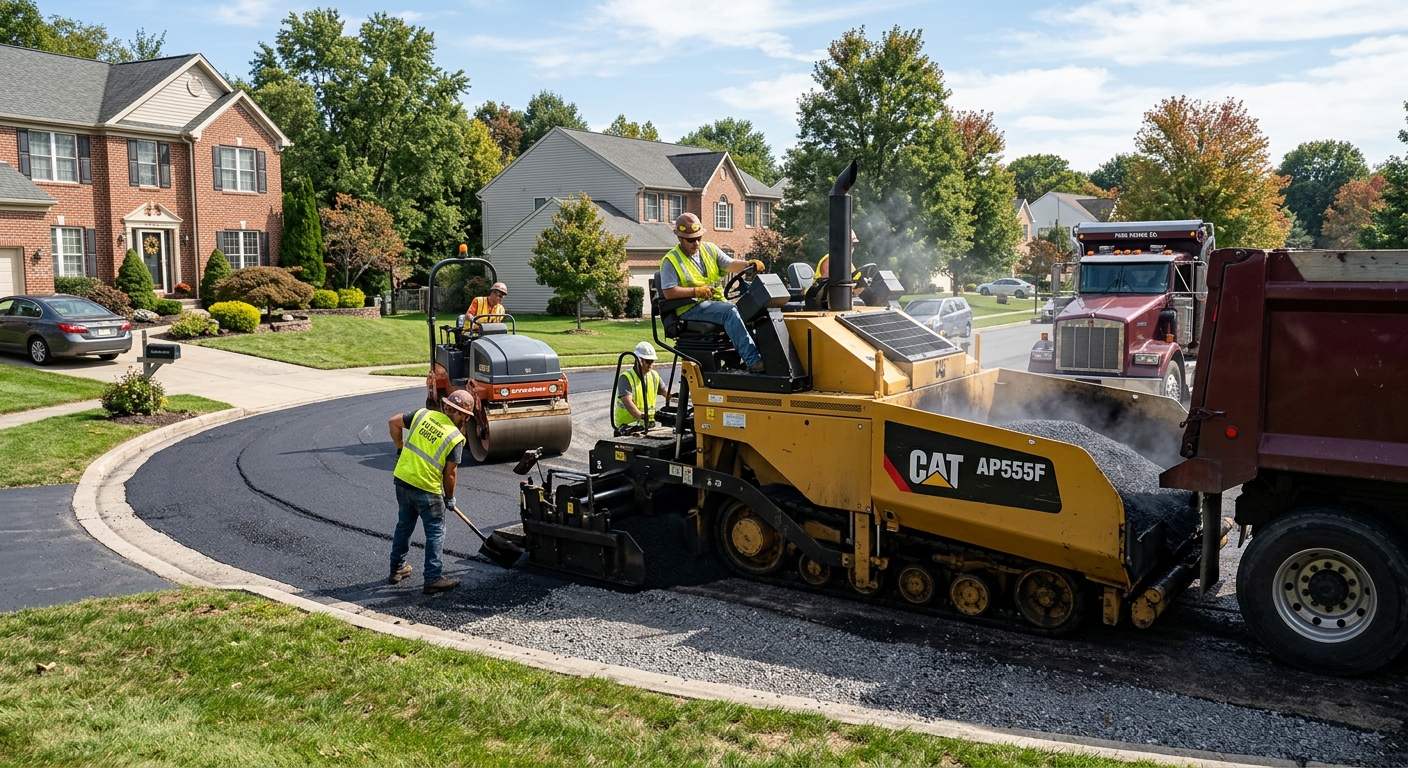
What a new driveway costs in Elizabethtown
In Elizabethtown, driveway paving is an investment tied closely to the kind of home you own. About 39.8% of homes here are single-family (U.S. Census Bureau, ACS 2024), and at a 53.6% homeownership rate, it’s mostly owner-occupiers footing the bill for replacement or repair—not property managers or renters. The region’s pronounced freeze-thaw cycle plays a huge role in long-term costs. Local limestone and clay soils (especially in neighboring East Hempfield Township) mean that base prep is where most of your money actually goes, not the visible surface. When comparing quotes, remember: the difference is buried where you’ll never see it. Cutting corners on base depth or prep won’t show for a year or two, but once winter’s repeated freezing lifts a thin base, the repairs begin. This makes it crucial to compare more than just the top number—ask what’s happening under the surface and how thick the base and top layers will be. Below, typical price ranges in Elizabethtown in 2026:
| Service |
Best for |
Lifespan |
Price range |
| Asphalt — full replacement with new base |
failed base, structural cracking |
20–30 yrs |
$3,400–$8,700 |
| Asphalt overlay / resurfacing |
sound base, surface cracking only |
8–15 yrs |
$1,450–$4,300 |
| Sealcoating — single application |
preventive maintenance on sound asphalt |
2–4 yrs |
$200–$650 |
| Concrete — new installation |
long service life, low maintenance |
30–50 yrs |
$4,800–$11,500 |
| Crack filling and patching |
isolated cracks under a quarter inch |
1–3 yrs |
$200–$800 |
| Gravel driveway |
rural, budget, long runs |
5–10 yrs with upkeep |
$900–$3,500 |
Estimates for a typical Elizabethtown driveway. Square footage and base condition drive these figures more than material choice.
The driveway scams that work in Elizabethtown
Paving scams are surprisingly effective in Elizabethtown and across Lancaster County, in large part because driveways are easy to spot from the road, and our moderate suburban density provides plenty of soft targets. Here, crews show up unannounced touting “leftover material from a job down the road,” pushing for today-only pricing. Unmarked pickup trucks with unfamiliar or out-of-area plates are a red flag. Another common tactic is demanding cash up front, or offering a cheap verbal quote with no written details. Some will skip materials entirely—spraying a thin coat of oil-based liquid that looks rich for an afternoon but offers no actual sealing. The defects—washout, raveling, base collapse—usually don’t show for a couple seasons, by which time these outfits are long gone to the next county.
The laws are designed here for exactly these risks. Under the Home Improvement Consumer Protection Act (HICPA), every job over $500 in Pennsylvania has to come with a written contract and a three business-day right to cancel. Never let anyone start work or cut a deal with just a handshake. If they balk at paperwork, that’s the warning you need. No reputable contractor in Elizabethtown will ask you to waive your cancellation right. Always request their Home Improvement Contractor registration number (check at hic.attorneygeneral.gov), verify they carry workers’ compensation (via WCAIS at wcais.pa.gov), and take down plate numbers.
Before you sign, do these checks: confirm HIC registration online, call the number on their card, check for local references, and don’t ever pay cash up front. If something feels hurried or vague, walk away—Elizabethtown has enough legitimate contractors that you do not need to gamble.
Drainage: the failure nobody plans for
Most driveway failures in Elizabethtown are caused by water—paving is only as durable as the drainage underneath it. Proper grading isn’t about looks; it’s protection from the area’s tough freeze-thaw cycles. Every driveway needs at least a 2% slope away from buildings to carry off rain and snowmelt. A crowned profile (high in the center, falling to each side) or straight cross-slope both work, but if your drive slopes back toward your garage or foundation, trouble is ahead. In such cases, trench or channel drains may need to be installed where grade correction isn’t possible.
Local clay-heavy soils hold water against the base, compounding problems in freeze-thaw months—ponded water seeps in, and with our 30-inch frost depth, that water expands and heaves the entire base. Limestone subgrades in areas like East Hempfield need extra-thick aggregate bases and more focus on underdrain systems to avoid settlement and water channeling issues.
Even with a perfect pitch, water has to go somewhere. “Daylighting”—directing water to the lawn or a swale—is ideal, but sometimes dry wells are needed if you can’t send it off-site. Remember, you can’t simply redirect runoff onto a neighbor’s property. It’s a liability, whether or not a permit is involved, and in close-set Elizabethtown blocks, that leads to disputes fast. Plan the drainage, not just the paving, or you’ll be paying for both.
What you need before paving in Elizabethtown
In most of Lancaster County’s townships, including Elizabethtown, you do not need a building permit just to resurface or repave a private driveway in its existing footprint—no wasted calls or paperwork if you’re not changing layout or size. But where your driveway meets the public road (the “approach”), permits are required. Inside Lancaster city, that means going through the City of Lancaster Bureau of Engineering. If your property abuts a state-maintained route, approach permits are actually handled by PennDOT District 8-0, not your local city or township office.
If you plan to widen or relocate your driveway, adding to the area of hard (impervious) surface often triggers stormwater requirements. Local rules may require you to manage new runoff onsite—either with swales or dry wells—regardless of how your neighbor handled it a generation ago. And it isn’t just about following permit rules: even if allowed, you carry liability if paving diverts water onto another property.
Verify that your contractor is properly registered for home improvement work over $500—find their Home Improvement Contractor (HIC) registration (hic.attorneygeneral.gov). Confirm they carry mandatory workers’ compensation insurance at WCAIS (wcais.pa.gov). Saving a few hundred now by skipping these steps is never worth the risk later.
Which surface survives Elizabethtown winters
In Elizabethtown, the numbers make the decision: southern Pennsylvania’s harsh freeze-thaw cycle and about 30 inches of frost depth favor surface materials that can take seasonal movement. Asphalt is flexible, designed to rise and fall just a little as the ground churns beneath it. After two decades working right here, I can tell you this is why most residential driveways are blacktop—not concrete. When the winter deep-freezes set in, water that’s worked its way down expands, pushing rigid surfaces. Asphalt just flexes.
Concrete, on the other hand, can last decades longer—sometimes 50 years if installed perfectly—but it’s unforgiving. Around Elizabethtown, surface spalling and scaling from road salt is the real killer, not so much cracks. Our winter road salt use is constant, and you have to be disciplined not to use salt on concrete if you want it to last. Most people say they’ll avoid it, but few keep at it when the driveway is icy. If you’re set on concrete, you’re paying more up front for a longer shot, but only if you do the upkeep. Pavers can work, especially on high-end properties, as each unit settles individually, but the cost is highest. Gravel is an honest option further out—especially for longer, rural drives with built-in drainage.
| Option |
Installed cost |
Maintenance |
Freeze-thaw performance |
Lifespan |
| Asphalt — new install |
$3,400–$8,700 |
sealcoat every 3–4 yrs |
excellent, flexes |
20–30 yrs |
| Asphalt — overlay |
$1,450–$4,300 |
same |
good if base is sound |
+8–15 yrs |
| Concrete |
$4,800–$11,500 |
low, avoid de-icing salt |
fair, spalls with salt |
30–50 yrs |
| Pavers |
$7,700–$11,500 |
individual units replaceable |
good, settles gradually |
25–50 yrs |
| Gravel |
$900–$3,500 |
top-dress every 2–3 yrs |
excellent drainage |
indefinite with upkeep |
Diagnosing a failing Elizabethtown driveway
Most driveways fail from the bottom up, but it isn’t always easy to see the signs if you haven’t dealt with paving before. In Elizabethtown, the test is simple and you can do it yourself. If you’re seeing alligator or “chicken wire” cracking across broad areas, that’s a failed base underneath—no overlay or topping will fix it, and patching is a waste of good money. Isolated linear cracks mean the surface is getting old, but the structure is still intact. Depressions (birdbaths) are a sign of subgrade movement, while crumbling at the edges means there was never enough support put in. Potholes mean water has already made it to the base and needs a full-depth patch—otherwise, trouble will spread.
If a contractor quotes you an overlay or top-coat without probing for base soundness (with a core, a probe bar, or even a shovel at the edge), they haven’t actually inspected it. Every honest repair decision starts with base condition, not just what’s visible. Below is what you can expect to spend, depending on what you see on your own driveway:
| What you see |
Likely cause |
Right fix |
Cost |
| Isolated cracks under 1/4 inch |
surface aging |
crack fill and seal |
$200–$650 |
| Alligator cracking over a wide area |
base failure |
full replacement |
$3,400–$8,700 |
| Depressions holding water |
subgrade movement |
excavate and rebuild that area |
$3,400–$5,300 |
| Crumbling edges |
no edge support |
edge repair, consider curbing |
$400–$1,500 |
| Potholes |
water into the base |
full-depth patch, then assess |
$250–$900 |
| Faded but sound surface |
oxidation only |
sealcoat |
$200–$650 |
Elizabethtown's ground and what it means for paving
The soil beneath your driveway in Elizabethtown isn’t just a footnote—it dictates how long your paving will last. In nearby East Hempfield Township, limestone karst is widespread, and that means you need a thicker aggregate base with special attention paid to drainage. Limestone karst is infamous for sudden settlement and hidden water channels below, posing unique risks if an installer cuts corners on base prep. On the other side, areas with heavier clay soils hold water close to the surface. This spells trouble under repeated 30-inch frost conditions—waterlogged clay expands heavily during freeze-thaw swings, leading to heaving, rutting, and premature failure if paving isn’t designed around it.
Many Elizabethtown homes, like those in Lancaster city, predate 1940 and were built in eras before strict standards for base depth or stormwater design. Driveways in these older neighborhoods are often narrow, shared, or wedged into tight lots, and the original base may be little more than compacted dirt or cinders. That’s why replacement projects here so often require rebuilding from the ground up, not just a new surface. If your drive shows wave-like movement or chronic puddling, the subgrade and drainage are as much the cause as the pavement you see.
Frequently asked questions — driveway paving in Elizabethtown
Do I need an approach permit where my driveway meets the road?
Yes—if you are building, widening, or moving the part of your driveway that connects to a public street in Elizabethtown, you will almost always need an approach permit. In Lancaster city, this comes from the City of Lancaster Bureau of Engineering, and on state highways, from PennDOT District 8-0. This is true even if you don’t need a general building permit for the rest of your driveway. Why? The connection to public right-of-way affects curb cuts, drainage, and even pedestrian safety. If you’re just resurfacing your existing private driveway in most Lancaster County townships, you likely won’t need a permit, but changing where or how you access the street does trigger extra red tape, and you’ll want proof before breaking ground. Approach permits can prevent headaches down the road, especially if you ever sell.
Does sealcoating fix cracks?
Sealcoating is good preventive maintenance for driveways in Elizabethtown, but it won’t repair cracks—not even the fine ones. A single application ($200–$650) protects the surface from oxidation and water intrusion, slowing aging and keeping the drive looking fresh. But any cracks wider than a hairline will “telegraph” right through the coating. They have to be properly cleaned and filled first, using hot or cold rubberized crack filler, or they’ll stay open beneath the sealer and keep growing. Sealcoating is most effective on a surface that’s still structurally sound. If your driveway is riddled with alligator cracks or deep damage, sealcoating is throwing money away. For minor, isolated cracks and surface wear, though, it’s worth doing every few years.
What are the signs of a failing driveway base?
You can spot base failure on a driveway in Elizabethtown by looking for alligator or “grid” cracking that spans wide areas, persistent depressions that hold water long after a rain, or new potholes reopening time and again. These symptoms show up more quickly here because freeze-thaw action pushes and pulls the layers each winter. If the edges are crumbling away or the whole surface has started to wave or buckle, the supportive aggregate below has lost strength or washed away. Surface cracks or light raveling can be handled with simple crack fill ($200–$650), but consistent structural issues mean the base is the real problem—a patch or an overlay won’t last. The only real fix at that point is a full-depth replacement, rebuilding the base from scratch.
How long does a driveway installation take?
Most new driveway installations in Elizabethtown—whether asphalt or concrete—take just 1 to 3 days on site, plus a few days of curing or cooling before you can park on them. The actual work moves quickly if the weather allows, especially when local limestone quarries and asphalt plants are just a short haul away in Lancaster County. The biggest variable is prep: if your old base needs to be removed and rebuilt (common with driveways in older neighborhoods), allow extra time for excavation, inspection, and regrading. Concrete demands the longest cure (up to a week for light traffic), while asphalt can usually be driven on in 24–48 hours. Scheduling is busiest late spring through fall, so early booking saves waiting weeks for a good crew.
How much does driveway paving cost in Elizabethtown?
For a typical single-family home in Elizabethtown, a new asphalt driveway with full base replacement ranges from $3,400–$8,700, with most folks falling around $5,300. An asphalt overlay (where the existing base is sound) drops that to $1,450–$4,300. Concrete runs a bit pricier, from $4,800–$11,500, mainly because of material and the depth needed to survive our freeze-thaw cycles. Maintenance jobs like sealcoating are much less ($200–$650 per application). The biggest cost factor is what’s hiding in your base, not just square footage or material—so be wary of low quotes that skip excavation or drainage.
Asphalt or concrete for a Elizabethtown driveway?
In Elizabethtown, most homeowners opt for asphalt because it flexes with ground movement, handles the area's freeze-thaw cycle, and costs less up front ($3,400–$8,700 installed) than concrete. Asphalt is easier to repair and can be resealed every few years, which keeps it looking new. Concrete lasts longer if you avoid de-icing salts, but it's more than a cosmetic difference—using road salt on concrete will spall and scale the surface, especially here where winter salting is a given. Concrete’s longer life ($4,800–$11,500) only pays off if you commit to diligent care. There’s no single “best” option, but for flexibility and recovery from winter movement, asphalt’s the local favorite for good reason.
Does road salt damage driveways in Elizabethtown?
Yes, especially on concrete. Elizabethtown and the rest of Lancaster County use plenty of road salt in winter—fine for asphalt, destructive for concrete if used regularly. Salt causes the surface of concrete to spall and flake, sometimes within just a few years, by drawing water into the pores and freezing within them. Asphalt driveways are more forgiving: they resist salt, only aging a little faster if not sealed. If you want concrete but can’t commit to sand or non-chloride deicers, be prepared for cosmetic damage well before the end of concrete’s theoretical 30–50 year lifespan. A properly maintained asphalt drive with regular sealcoating ($200–$650 each time) is generally more forgiving in salt-heavy Elizabethtown winters.
How much does it cost to widen a driveway?
If you’re widening a driveway in Elizabethtown—say, to fit a second car or ease parking—you can expect costs close to new paving per square foot. Full excavation, new base prep, and tie-ins push the typical project into the $3,400–$8,700 range for asphalt (just the added width, not the whole drive). If your job involves cutting a new approach to the road or curb, add permit costs and possibly an inspector’s visit from the City of Lancaster Bureau of Engineering if you’re inside city limits. If you only need a few feet and the edge base is solid, you might get by at the low end of the range. Concrete is higher—$4,800–$11,500 for similar work—with matching existing color and finish a challenge on older drives.
How thick should asphalt be for a residential driveway in Elizabethtown?
For Elizabethtown’s climate and soil, you want at least 3 inches of asphalt over an 8–10 inch compacted crushed stone base—more if your ground is clay (which holds water) or limestone karst (which can channel water beneath the drive). Cheap jobs skimp on thickness, which shows up as rapid cracking and base collapse after a couple winters of freeze-thaw. The bottom layer matters just as much as the surface: if a bid comes in much lower than the average ($3,400–$8,700), ask how deep both the base and the asphalt will be, and how compaction will be done. Code minimums are not enough for the long haul here—cutting corners is a false economy in this part of Pennsylvania.