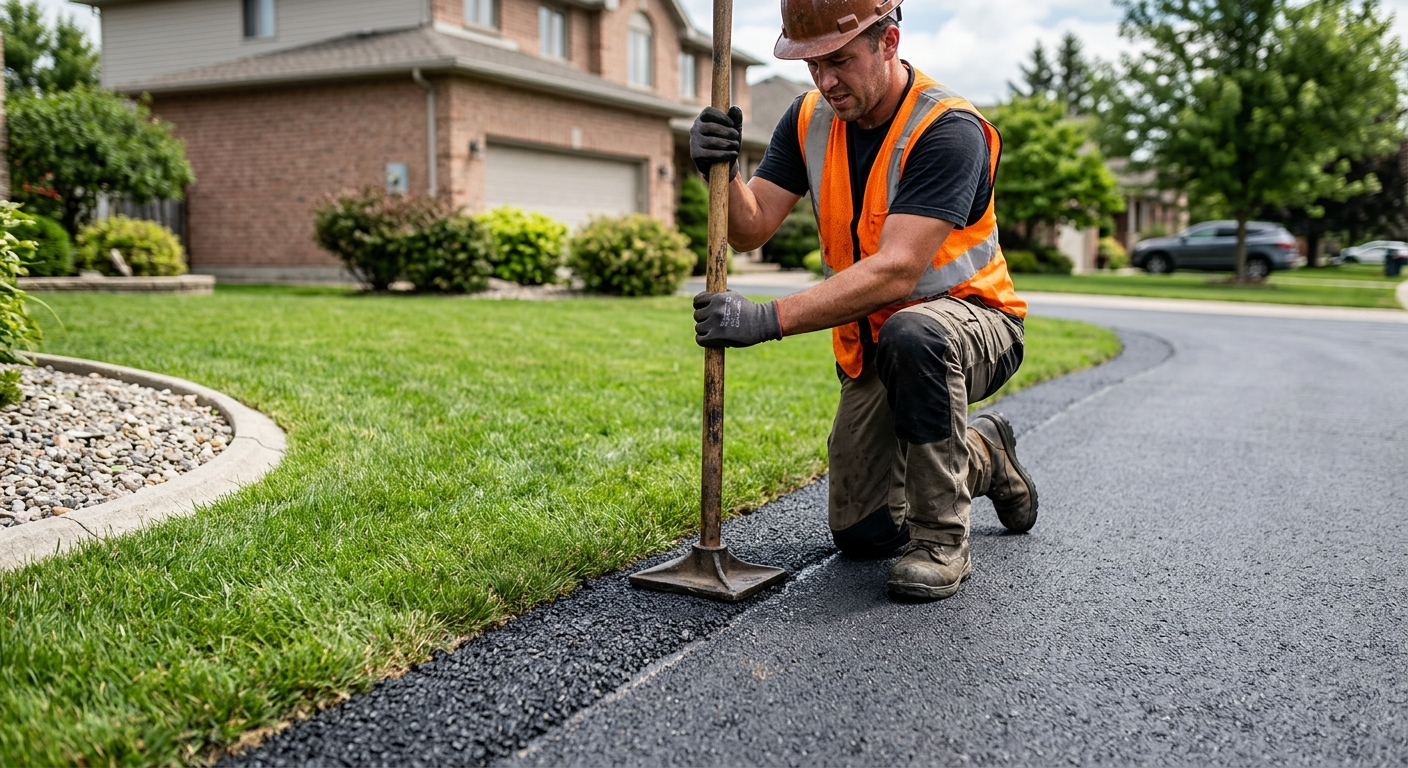
What a new driveway costs in Ross
Ross Township is a community where 65.6% of homes are single-family and the homeownership rate stands at 76.0% (U.S. Census Bureau, ACS 2024). Most homeowners here eventually face driveway repair or replacement—an expense that doesn't just touch the surface. With our region’s heavy freeze-thaw cycles, driveways in Ross get hit hard, and underlying clay and shale demand solid base preparation. Those headline prices you get from contractors don’t tell the real story, since most of the cost—and risk—lies below ground, out of sight. One quote may look much cheaper than another, but if the base isn't done right, it won't hold up past a few western Pennsylvania winters. Long-term value depends far more on what’s under the asphalt than the flair on top.
Here's what you should expect for common driveway services in Ross:
| Service |
Best for |
Lifespan |
Price range |
| Asphalt — full replacement with new base |
failed base, structural cracking |
20–30 yrs |
$3,600–$9,200 |
| Asphalt overlay / resurfacing |
sound base, surface cracking only |
8–15 yrs |
$1,550–$4,600 |
| Sealcoating — single application |
preventive maintenance on sound asphalt |
2–4 yrs |
$200–$700 |
| Concrete — new installation |
long service life, low maintenance |
30–50 yrs |
$5,100–$12,500 |
| Crack filling and patching |
isolated cracks under a quarter inch |
1–3 yrs |
$200–$800 |
| Gravel driveway |
rural, budget, long runs |
5–10 yrs with upkeep |
$900–$3,500 |
Estimates for a typical Ross driveway. Square footage and base condition drive these figures more than material choice.
What's under the asphalt matters more than the asphalt
The health of a driveway in Ross is decided long before a roller ever touches asphalt. Construction starts with the subgrade—the raw earth, which around here is usually dense clay mixed with shale. On top of that goes the aggregate base, spread and compacted in layers. Only then does the paving crew lay and compact hot-mix asphalt. Each layer supports the one above. If the base is thin or loosely compacted, the best asphalt on earth won’t save your driveway from early failure.
Ross gets the full brunt of southwestern Pennsylvania winters: freezing, thawing, and freezing again. Water trapped in our clay-heavy subgrade expands as it freezes, lifting portions of the driveway—a process called frost heave. Once the base shifts, cracks form. Inadequate drainage and base depth mean you’re paying for a job that won’t last half as long as it should.
Here’s where a too-low quote usually cuts corners: skipping or skimping on base excavation, laying new asphalt directly on a failing base, thin base layers, minimal compaction, or skipping compaction testing altogether. You won’t notice anything wrong when the paving crew leaves. But in year three, the cracks and ruts show up, and there’s no cheap fix once that happens.
For Ross driveways over clay, insist in writing on at least 6–8 inches of compacted crushed limestone (2A modified) base, compacted in lifts—not in one thick layer. Make sure the contract calls out compaction, aggregate type, and thickness. And don’t be shy about asking for compaction tests—any reputable paving crew in Allegheny County can provide them.
How to vet a paving contractor in Ross
In Ross, it's not enough that a paving contractor says they’re licensed—you need to check for yourself. Pennsylvania requires Home Improvement Contractor (HIC) registration for any job over $500; you can verify this at hic.attorneygeneral.gov. For your protection, confirm that workers’ compensation coverage is active for all employees through WCAIS (wcais.pa.gov). A contractor with a verifiable, local business address—not just a mobile phone number in a different area code—shows roots in the community and accountability. Prefer companies that own their equipment; continual rentals are a sign of a fly-by-night outfit. Ask for references from at least three years ago, since a faulty Ross driveway looks fine the first season but rarely makes it past a third harsh winter if corners were cut. Finally, because the Pittsburgh market has plenty of suppliers, any professional working in Ross should be able to name which local asphalt plant or quarry they use. If they can't, you may be talking to a broker—or worse.
- Check HIC registration at hic.attorneygeneral.gov
- Verify workers’ comp status at wcais.pa.gov
- Require a local business address, not just a cell or PO box
- Ask what plant or quarry supplies their asphalt and stone
- Request references from jobs at least three years old in Ross or North Hills
- Confirm ownership (not rental) of paving and compaction equipment
- Get proof of insurance, not just a copy of policy cover
- Ask for a detailed, written contract covering base depth, asphalt thickness, and material
- Clarify who pulls any needed approach permits or arranges inspections
- Expect a fixed address on contracts and invoices
- Be wary of cash-only payment terms
- Watch for honest discussion of subgrade and drainage corrections
Red flags: out-of-town plates, pressure for same-day decisions, refusal to supply permits or insurance, or an inability to specify their material source—these point to risky contractors and a driveway that won’t survive Ross’s climate.
Grading and water management on a Ross driveway
Water is behind the lion’s share of driveway troubles in Ross Township. Grading isn’t a cosmetic touch—it sets up the whole lifespan of your pavement. Every driveway here needs a minimum slope of at least 2% (a quarter inch per foot) away from the house and garage. Some jobs get a crowned shape, shedding water to both sides, while short or steep driveways are often given a steady cross-slope. If your driveway slopes toward your garage—or worse, toward your house—surface water will pool at the base of the slab, often seeping into basements or garages.
Where regrading isn’t practical, a trench drain or channel drain across the driveway near the garage can intercept and direct that water safely. In Ross’s heavy-clay soils, surface water that isn't drained completely will soak into the base and stay there, especially as clay holds onto moisture. This gets worse in the freeze-thaw cycles we see every winter: water in the base freezes, swells, and heaves the surface. A few winters of that, and even the best-laid asphalt starts to break up.
For stormwater, aim to daylight the drain line wherever possible, letting water exit onto your own property and dissipate safely. Dry wells are a last resort for tight lots but require regular maintenance. And remember—redirecting driveway runoff toward a neighbor’s property isn’t just a bad idea; it’s a liability, even if no permit is required for the work.
How often should a Ross driveway be sealed?
Sealcoating extends the cosmetic life of an asphalt driveway in Ross and helps the surface resist sun, oil, and fuel damage. It forms a thin barrier that slows down oxidation of the asphalt binder and makes future cleaning and snow removal easier. But it’s not a miracle fix: sealcoating doesn’t add strength or cure underlying base problems. If your driveway is suffering from alligator cracking or sinking, a coat of sealer only hides issues until the next freeze-thaw cycle peels it off.
Too many Ross homeowners are sold on yearly sealcoating, but that schedule ends up hurting more than it helps. Frequent coats trap moisture, cause flaking, and leave driveways looking patchy. New asphalt must cure for at least six months—ideally a full summer—before any sealer goes on, or trapped solvents will speed up surface failure. After that, sealing every two to four years is reasonable in our climate. Cheaper jobs often mean the contractor sprays a thin coat that’s mostly water. A proper service at the going rate of $200–$700 includes broom cleaning, full drying, and two coats applied by squeegee, not just a quick spray.
Crack filling is the more important maintenance step. It prevents water infiltration and freeze-thaw damage, which shortens the life of your driveway far more than surface oxidation. Done right with a hot rubberized material, it lasts years; done poorly, it’s wasted money. If a sealcoating price sounds too good for Ross, you’re likely paying for watered-down material and a five-minute job.
Driveway permits, approaches and stormwater rules
In Ross Township, most private driveway resurfacing or replacement performed entirely within your property lines doesn’t require a separate right-of-way or building permit. That saves homeowners a call to the office—and a good bit of paperwork. But there’s an important catch: if your driveway connects to a state route, even if you’re just rebuilding the apron, you need a Highway Occupancy Permit from PennDOT District 11-0. That’s often handled by the contractor, but it’s your responsibility to make sure it’s pulled before work on the approach begins; don’t assume your paving crew has done it by default.
Stormwater isn’t just a line in the permit checklist—expanding a driveway or paving a gravel area creates more runoff. Pushing water onto public rights-of-way or a neighbor’s lot can cause enforcement headaches and real liability. Reputable contractors in Ross should address these issues in writing, offering drainage solutions as part of their quote, not as a surprise after completion.
Always get a written contract for driveway paving jobs over $500, as required under Pennsylvania’s Home Improvement Consumer Protection Act (HICPA). Confirm the contractor’s registration at hic.attorneygeneral.gov, and verify workers’ compensation status using WCAIS (wcais.pa.gov) before anyone sets foot on your property.
Why you can't pave in February
Paving season in Ross, and all of Allegheny County, is dictated by more than just comfort—it’s a matter of physics. Hot-mix asphalt requires both the material and the ground to be warm enough to mix, spread, and compact before it stiffens. Below about 50°F, the mix cools too fast and can’t be properly compacted, leaving you with a porous, brittle driveway. With a winter design temperature of just 8 °F and over 5,600 heating degree days, you simply cannot pave a quality driveway here between late fall and spring. Local asphalt plants shut down when temperatures drop, so even if someone claims they have spare asphalt in January, it’s not the fresh material you want under your tires.
Concrete has similar limitations: if ambient temperatures are below freezing—even just overnight—it can’t cure correctly. Ross’s heavy freeze-thaw cycles and clay soil mean late fall and early winter paving doesn't just risk rough work; it guarantees early failure. Spring and fall are ideal for scheduling, with the summer rush booked far ahead. If you get a quote to pave after Thanksgiving or before early April, or if a crew offers to “squeeze you in” in February, they're either desperate or skipping crucial quality steps. Local supply and plant schedules support this reality—no reputable Ross contractor will claim otherwise.
Frequently asked questions — driveway paving in Ross
What does sealcoating cost in Ross?
Sealcoating a typical residential driveway in Ross usually falls in the $200–$700 range, depending on size, preparation, and whether cracks are filled and the surface is cleaned beforehand. This covers a professional two-coat squeegee application, not just a quick sprayed-on layer. The wide range is due mostly to square footage—driveways here can run from small postwar pads to doublewide suburban entries. Be wary of offers well below this window; they almost always shortcut prep or water down the material. In Ross, with our frequent freeze-thaw cycles, correct surface preparation and crack filling are more important than how shiny the driveway looks on day one.
Do I need an approach permit where my driveway meets the road?
In Ross, if your driveway approach meets a state road, a Highway Occupancy Permit is required from PennDOT District 11-0 before any paving or reconstruction takes place, even if you aren’t changing the actual width. On local municipal roads, approach work may be less regulated but it’s always smart to check. For work entirely inside your property line—like resurfacing your driveway itself—you typically don’t need a municipal permit. Permitting at the approach is strictly enforced by PennDOT, and you should make sure your paving contract clearly states who is responsible for obtaining it. Not following the rules can mean expensive do-overs if a new apron is ripped up for non-compliance, making a little paperwork worth it compared to even a small repair, which can run $200–$800.
What causes concrete to spall or flake in Ross?
Spalling—where chunks or flakes break off a concrete driveway surface—is a common Ross problem, especially in our heavy freeze-thaw climate. The main causes are insufficient air entrainment during mixing, too much water in the mix, poor finishing practices, or sprinkling de-icing salts in the first winter before the slab has fully cured. Spalling exposes the aggregate, making the surface rough and prone to further deterioration every time the temperature swings. Using a reputable contractor with experience in Ross’s conditions, and following their advice about curing, will help your driveway last 30–50 years, which matches the $5,100–$12,500 cost range for new concrete installations in the area. Careful spec and post-pour care make all the difference in our environment.
Does road salt damage driveways in Ross?
Yes, road salt accelerates wear on both asphalt and concrete driveways in Ross. State and local plows use salt heavily in Allegheny County winters. For asphalt, repeated salt exposure can harden and dry out the top surface, leading to more rapid cracking and faster oxidation. Concrete is vulnerable to flaking, pitting, and even surface crumbling—especially if it was poured with insufficient air entrainment. The salt itself isn’t the only concern; it pulls in extra moisture, which then infiltrates cracks and the base. Once water freezes in those spaces during our harsh winters, small problems quickly turn into spalling and cracking. Driveway repairs or partial section replacements here usually cost $200–$800, so sweeping or rinsing off salt whenever possible is time well spent.
When is the best time of year to pave in Ross?
The absolute best time to pave in Ross is late spring through early fall—typically late April to early October. Local asphalt plants operate on this window, and the ground temperatures are reliably above the minimums needed for quality compaction and curing. Pushing the schedule late into fall or starting too early in spring risks problems with compaction or concrete curing. Attempting to pave in cold months simply results in short-lived work, so reputable contractors won't offer January or February slots. If you time your project for the shoulder season, you might get better availability and slightly more competitive pricing—full asphalt replacement, for example, generally falls between $3,600–$9,200 in Ross depending on size and base work. Always confirm your timeline with the plant and contractor before signing.
What does an asphalt overlay cost in Ross?
An asphalt overlay, which goes over a sound existing base, typically costs $1,550–$4,600 for a standard Ross driveway. It’s less expensive than a full replacement because the excavation and installation of a new aggregate base aren’t required. Overlays are a good solution if the underlying structure is still solid but the surface shows widespread cracks or looks tired. Just keep in mind, overlays don’t fix drainage or base-level issues—a failing or poorly graded base means any overlay will be a band-aid, not a cure. When comparing overlay quotes in Ross, make sure the scope includes milling raised edges and cleaning thoroughly; skipping these steps is a common way less-reputable outfits cut cost but leave you with premature failure.
What is the difference between binder and surface course?
In the Ross area, a standard asphalt driveway is built in two layers, each serving a different purpose. The binder course is the thicker, coarser layer laid directly over the aggregate base. It provides the structural strength and absorbs the major stresses—think of it as the backbone. The surface course, or wearing course, is a finer-mix asphalt layer that takes direct contact from your tires and the elements, providing a smoother look and feel. Failing to include both means the driveway won’t last through western Pennsylvania winters. For a complete replacement, which costs $3,600–$9,200 here, your contract should specify thickness and material for both courses—not just “asphalt,” which leaves too much room for shortcuts.
Does sealcoating fix cracks?
No—sealcoating doesn’t fill or repair cracks in any meaningful way. The thin layer of sealant is too fluid to bridge or reinforce gaps, especially those wider than a hairline. Sealcoating is about protecting intact asphalt from UV, moisture, and fuel spills. In Ross, our frequent freeze-thaw cycles make crack filling with a rubberized hot material far more important than sealing. Cracks left untreated let water in, and the next freeze can widen them rapidly. If your driveway has numerous cracks, have them properly cleaned and filled before sealcoating, which often brings the full maintenance call to $200–$800. Otherwise, sealing alone just masks the problem for a season or two at best.
Are pavers worth the cost in southwestern Pennsylvania?
Pavers offer an upscale appearance and excellent repairability, but for most Ross homeowners they aren’t the best value given our local climate and soil. Installation typically comes at a premium—often well above the $5,100–$12,500 range for concrete, especially when accounting for base preparation over heavy clay. Freeze-thaw cycles here can lead to settling and heaving unless the base is excavated even deeper and properly drained, which raises costs further. If you value looks over low maintenance, and budget isn’t the top concern, pavers may work. But for the majority of single-family homes in Ross, asphalt or concrete provide a more predictable return in terms of lifespan and upkeep. Before deciding, ask for references to see how neighboring paver jobs have fared after a few Pennsylvania winters.