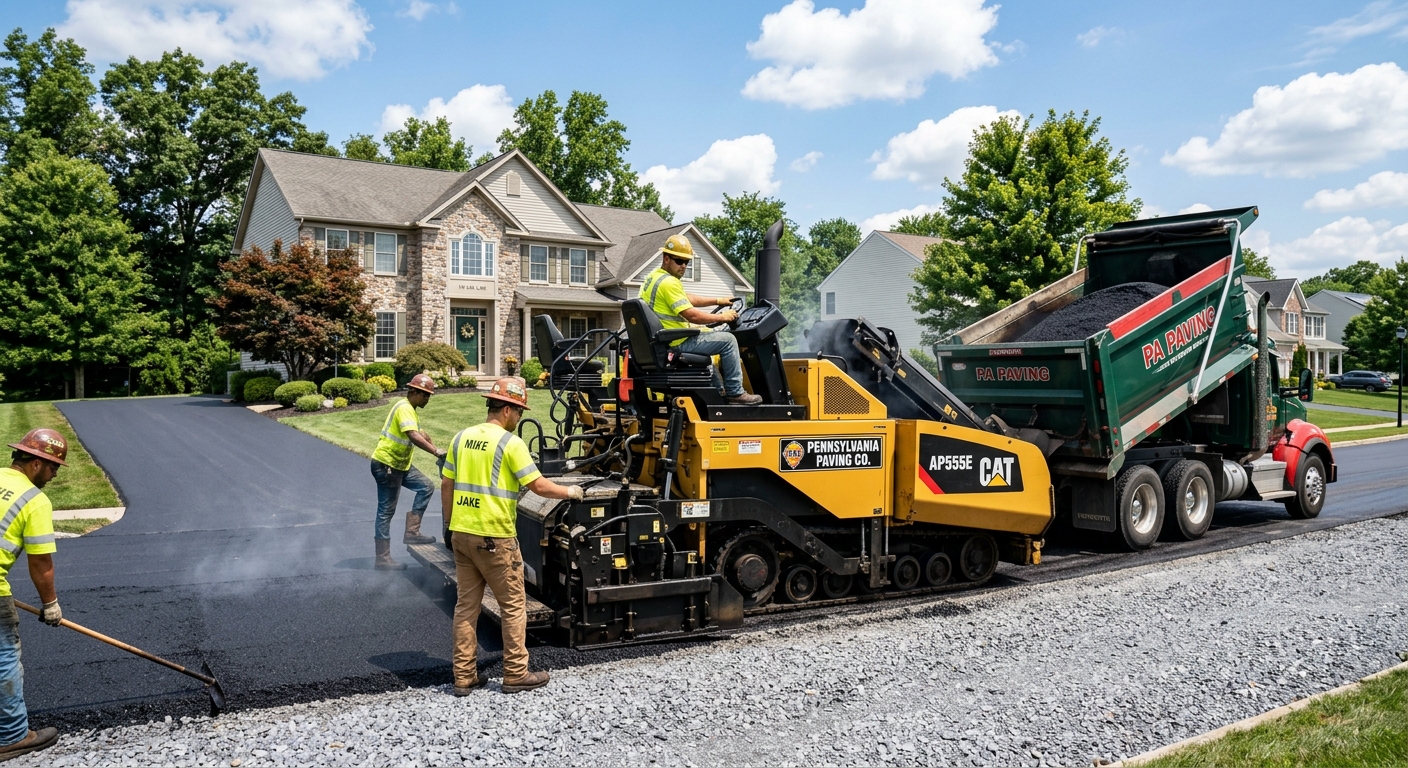
What a new driveway costs in Elizabeth
Elizabeth's driveways are almost all for single-family homes—87.0% according to the latest figures (U.S. Census Bureau, ACS 2024)—and with an 87.2% homeownership rate, most local residents are footing their own repair bills. A new driveway here is a real investment and not just a quick fix, especially with our heavy freeze-thaw cycles every winter and the clay-and-shale subgrade found across Allegheny County hillsides. That subgrade requires extra base prep if you want a driveway that lasts.
In Elizabeth, what you pay for a driveway project often comes down to what happens under the surface. The finished product—new blacktop or concrete—might look similar, but most of the price difference hides under the pavement in the depth and quality of the base, the compaction, and drainage work. It’s nearly impossible to judge these from the curb. Cheap quotes often skip proper base prep, which might not show until after another winter or two, once frost heaves start to crack the surface or the center settles.
Here’s what to expect for various paving options around Elizabeth:
| Service |
Best for |
Lifespan |
Price range |
| Asphalt — full replacement with new base |
failed base, structural cracking |
20–30 yrs |
$3,400–$8,900 |
| Asphalt overlay / resurfacing |
sound base, surface cracking only |
8–15 yrs |
$1,500–$4,400 |
| Sealcoating — single application |
preventive maintenance on sound asphalt |
2–4 yrs |
$200–$700 |
| Concrete — new installation |
long service life, low maintenance |
30–50 yrs |
$4,900–$12,000 |
| Crack filling and patching |
isolated cracks under a quarter inch |
1–3 yrs |
$200–$800 |
| Gravel driveway |
rural, budget, long runs |
5–10 yrs with upkeep |
$900–$3,500 |
Estimates for a typical Elizabeth driveway. Square footage and base condition drive these figures more than material choice.
The driveway scams that work in Elizabeth
Driveway paving attracts out-of-area and fly-by-night crews year after year in Elizabeth, especially because so many homes here have visible driveways from the road. The most common scam starts with someone knocking on your door offering a “special deal” with leftover asphalt from a job “just down the street.” You’ll also hear pitches about today-only or cash discounts; see trucks with no markings, sometimes with plates from counties that aren’t even in this state; and get pressure for cash up front. Verbal quotes offering a “thick coat” or “premium sealant” (usually a thin oil of dubious quality) are another favorite. None of this work is likely to last past next winter—if it even survives the first rainfall.
Allegheny County is part of a saturated contractor market, so it’s no accident scammers target Elizabeth and its neighbors. With lots of legitimate outfits, verifying the real thing takes a couple of minutes—but skipping it attracts fast-talking crews who are gone by morning.
Pennsylvania law is on your side: for any paving project over $500, you’re legally owed a written contract under the Home Improvement Consumer Protection Act (HICPA), and you have a three-business-day right of cancellation if you change your mind. If someone won’t give you a paper contract or tries to talk you out of your cancellation rights, that’s the only red flag you need.
It takes five minutes: Check the contractor’s HIC registration at hic.attorneygeneral.gov, verify workers’ compensation coverage at wcais.pa.gov, and ask for local references from jobs done years ago. If anything is missing, keep your wallet closed.
Driveway permits, approaches and stormwater rules
For most homes in Elizabeth, resurfacing or replacing your driveway in place usually does not require a building permit, as long as the work stays entirely within your property and existing footprint. That saves you a step—and a fee—if you are just removing and repaving what’s already there. But the approach, where your driveway ties into a public road, can be another story. In all of Allegheny County, if your driveway meets a state road, a Highway Occupancy Permit is required through PennDOT District 11-0, which surprises a lot of homeowners.
Stormwater is a separate concern. Expanding your driveway, or changing drainage, can trigger new requirements on runoff. Dropping more impervious surface without managing water could send stormwater onto your neighbor’s property, and that creates liability even if the township never steps in. Good contractors know to grade driveways to shed water safely, but you should always double-check the plan if you’re increasing the paved area.
Always verify anyone working over $500 on your driveway is registered with the Pennsylvania Office of Attorney General via HIC registration (hic.attorneygeneral.gov). If the company brings any employees, state law requires them to carry workers’ compensation coverage—check this easily at wcais.pa.gov. These two checks help you steer clear of liability and bad jobs alike.
Finding a legitimate paver in Allegheny County
With so many contractors and quarries in the Pittsburgh area, picking an asphalt paver in Allegheny County isn’t about luck—it’s about working the checklist. Every reputable driveway contractor should have a verifiable, local business address (not just a cell phone), own or lease their paving equipment (rather than renting each job), and have no problem providing references from at least three years back. New work always looks good; old work tells the real story.
Your local supplier matters, too. Because Allegheny County’s contractors benefit from multiple nearby asphalt plants, it’s a basic question: “Which plant do you buy from?” If your bidder can’t answer, they’re likely brokering the job, not paving it themselves.
- Registered with the Pennsylvania Home Improvement Contractor registry (HIC)
- Verifiable business address in Allegheny County
- References from work at least three years old
- Owned or regularly operated paving equipment
- Insured, with workers’ compensation if employing a crew
- Can name their local asphalt plant or aggregate supplier
- Written estimates with scope and specs
- No pressure for cash or full prepayment
- Payment schedule clearly stated
- No refusal of your right to cancel under HICPA
- Uses contract forms that match Pennsylvania requirements
- No claims of leftover material “from a job nearby”
Red flags: giving only a cell number; no listed company name; insists on a verbal agreement; won’t write down specifics; pushes for all cash up front; or tells you not to worry about permits and insurance. One “yes” to these should be an automatic pass.
Changing the footprint of a Elizabeth driveway
Expanding or changing your driveway’s shape—say, to add a second parking pad, widen for two vehicles, or run out to a detached garage—means more than just extra asphalt. In Elizabeth, every new area needs to be excavated down and built back up from the subgrade, which is often shale and clay in Allegheny County. That means proper base and compaction over ground that’s never had a driveway before.
Be aware, the new seam where old and new paving meet is always a weak spot. Even with good joint prep, these seams tend to show first signs of wear, especially after a few freeze-thaw seasons.
If you’re increasing your driveway’s size, you might run into local or county rules about impervious surface limits and setbacks—meaning how close you can pave to your property line. No quote should move ahead until you’ve looked at the approach permit if you’re adding a new connection to a road, or the stormwater plan if you’re creating new runoff areas. Contractors claiming “no permit needed” for driveway extensions are always worth fact-checking.
What a real paving quote contains
A real paving quote for an Elizabeth driveway should read more like a recipe than a sticker price. Look for exact measured square footage—the actual area, not a rough guess. Excavation (and disposal of what’s hauled away) should be spelled out. You want to see the base described by type and depth—like “6 inches of limestone, compacted in lifts”—and with heavy clay subgrade around here, that depth matters. Compaction should state the method (roller or plate), and whether it’s done in multiple layers.
The proposal should describe each asphalt course separately (base and surface), stating the compacted depth. You should see grading (how water will run off), edge treatment (how the edges of the driveway are finished), and a plan for cleaning up lawn edges when done. The payment schedule should be modest up front, the balance at completion. And ask about the warranty—most paving jobs exclude cracks from coverage, which surprises many people.
A one-line quote with just a total price and no details can’t be compared to any other bid, and this is the fastest way to overpay for a short-lived job. Get it in writing—down to the last inch.
| Line item |
What to look for |
Red flag if… |
| Area |
measured square footage stated |
eyeballed or absent |
| Excavation |
depth and disposal included |
'we'll pave over it' |
| Base |
aggregate type and depth in inches |
'proper base' |
| Compaction |
method, and done in lifts |
not mentioned |
| Asphalt |
courses and compacted depth |
'3 inches' unqualified |
| Drainage |
slope and water direction stated |
silent |
| Warranty |
what is covered and what is excluded |
verbal only |
| Payment |
modest deposit, balance on completion |
full cash up front |
Drainage: the failure nobody plans for
Water is the single biggest reason driveways in Elizabeth fail early. It’s not just about the surface material—proper grading and drainage is what keeps the job from falling apart after a few winters. Allegheny County’s freeze-thaw climate means any water trapped under or within the driveway will freeze, expand, and start heaving the base layers. Heavy clay soils in our region hold onto water and don’t drain freely, which is a bad combination for driveway longevity if ignored.
The minimum slope for effective surface runoff is about two percent—just enough for water to flow away from the house and garage. Depending on your property’s shape, this may require crowning the driveway (higher in the middle) or building in a cross-slope to direct water sideways. Steep hillsides or driveways that point right at your garage often need trench drains at the bottom; otherwise, water finds its way into your foundation or your neighbor’s yard.
Sometimes grade can’t be changed, especially if you’re boxed in by existing features. In those cases, a channel drain piped to daylight (where water exits safely) or a dry well is the only answer. But beware: sending runoff onto someone else’s parcel is always a liability regardless of permits—the water will find the path of least resistance, and it tends not to care about survey pins.
Frequently asked questions — driveway paving in Elizabeth
Should I repair or replace my Elizabeth driveway?
In Elizabeth, deciding between repair and replacement comes down to how deeply the problems run. Isolated cracks under a quarter inch wide or small potholes can usually be repaired for $200–$800, extending the life of a sound driveway. But if you’re seeing large, interconnected cracks, sunken areas, or the driveway is shifting—especially on our common clay and shale subgrades—it probably means the base has failed. In those cases, a full replacement with a new base ($3,400–$8,900) is the only long-term fix that will handle another 20–30 winters. Many Elizabeth neighborhoods have driveways over 40 years old, so if you’re dealing with widespread problems, it’s not usually worth putting repair money into a bad foundation.
When is the best time of year to pave in Elizabeth?
The best time for driveway paving in Elizabeth is mid-April through September, when daytime temperatures reliably stay above 50°F. Pennsylvania’s cool spring nights and early falls make it risky to pave too early or late—the base and asphalt need enough warmth to set up properly. Contractor schedules fill fast once the weather turns, so it’s wise to book early for summer work. If you’re quoted for a job in March or late October, ask how the crew plans to handle overnight frost. Rushed cold-weather jobs are one reason some driveways in Elizabeth develop cracks and surface irregularities before they reach even the lower end of their life expectancy. A standard asphalt replacement, for example, should give you 20+ years if paved in good weather ($3,400–$8,900).
Do I need a permit to repave a driveway in Elizabeth?
If you’re just resurfacing or replacing your driveway in its current footprint, a separate building permit is not typically required in Elizabeth. This holds for much of Allegheny County unless you plan to expand the area or change the curb or sidewalk. However, if your driveway connects to a state road, you’ll need a Highway Occupancy Permit from PennDOT District 11-0. Always ask your contractor which authority handles approach permits for your street—they should know based on address and roadway type. Remember, proper documentation protects you if problems turn up later. Typical paving replacements in Elizabeth fall within $3,400–$8,900, but don’t let any contractor skip local protocol for the sake of a fast start.
What does sealcoating cost in Elizabeth?
The going rate for a single application of premium sealcoating in Elizabeth runs $200–$700 per driveway, depending on size and how many edges need hand-brushing. Most single-family homeowners will pay closer to the middle of that range. Avoid crews offering “cheap” spray-and-go jobs from unmarked trucks; these thin coats rarely last a season, and you’ll get far better value from a legitimate company. Proper prep and application can add years between repaving jobs—most local driveways should be sealcoated every 2–4 years for best performance, especially with all the freeze-thaw cycles we get.
Does road salt damage driveways in Elizabeth?
Yes, road salt—the kind spread on Elizabeth streets—can accelerate wear on both asphalt and concrete driveways. Salt increases freeze-thaw cycles by pulling moisture in, which can cause the surface to crack or spall over repeated winters. Fresh asphalt should not be salted in its first season, while older surfaces benefit from timely sealcoating ($200–$700) to limit salt penetration. For those using concrete, sealing cuts down on salt scaling but doesn’t make the surface impervious. If your driveway fronts a busy salted road, be extra diligent about drainage and annual maintenance, since runoff will add to the problem.
How often should I sealcoat my driveway in Elizabeth?
In Elizabeth, it’s best to sealcoat an asphalt driveway every 2–4 years, depending on sun exposure, plowing, and how much salt or sand winds up on the surface over winter. Our local climate, with plenty of freeze-thaw and summer UV, is tough on asphalt binders, so regular sealing keeps water and oxidation at bay. Standard single-application jobs run $200–$700—most homes land around the average. Going too often isn’t helpful, but letting it go too long means cracks will start to form, and those open the door for deeper water damage.
What does compaction in lifts mean?
Compaction in lifts means building the driveway base (and sometimes the asphalt itself) in layers—typically 2–4 inches at a time—and compacting each layer separately before placing the next. In Elizabeth, with our clay and shale subgrade, this process is crucial to prevent settlement and “alligator cracking” after a few winters. One thick, uncompacted dump of gravel or asphalt might look fine on paving day, but it’ll settle unevenly and crack as soon as the freeze-thaw cycles start. Full asphalt replacement jobs here ($3,400–$8,900) should always specify compaction in lifts, both for the base and the blacktop.
What causes driveway cracks in Elizabeth?
The two biggest causes of driveway cracking in Elizabeth are water infiltration and our relentless freeze-thaw cycles. Water seeps into even hairline cracks; when temperatures drop, the water freezes, expands, and forces the pavement apart. Clay and shale below the base don’t help—when saturated, they hold water up against the driveway, speeding up the damage. Other factors include improper base preparation, lack of compaction, and salt use in winter. That’s why a proper replacement here runs $3,400–$8,900 and isn’t something to skimp on if you’re seeing widespread cracking.
How much does it cost to widen a driveway?
Widening a driveway in Elizabeth often costs a little more per square foot than basic overlay or replacement, since new base must be installed over undisturbed ground and there is extra labor tying new paving to old. For a typical double-width extension or additional pad, expect a range of $3,400–$8,900 for full-depth asphalt, depending on how many feet you’re adding and access to the site. If you’re converting a long gravel section, gravel installation typically runs $900–$3,500. Always double-check impervious-surface and setback rules if expanding, and get a clear written quote breaking out all costs before work begins.