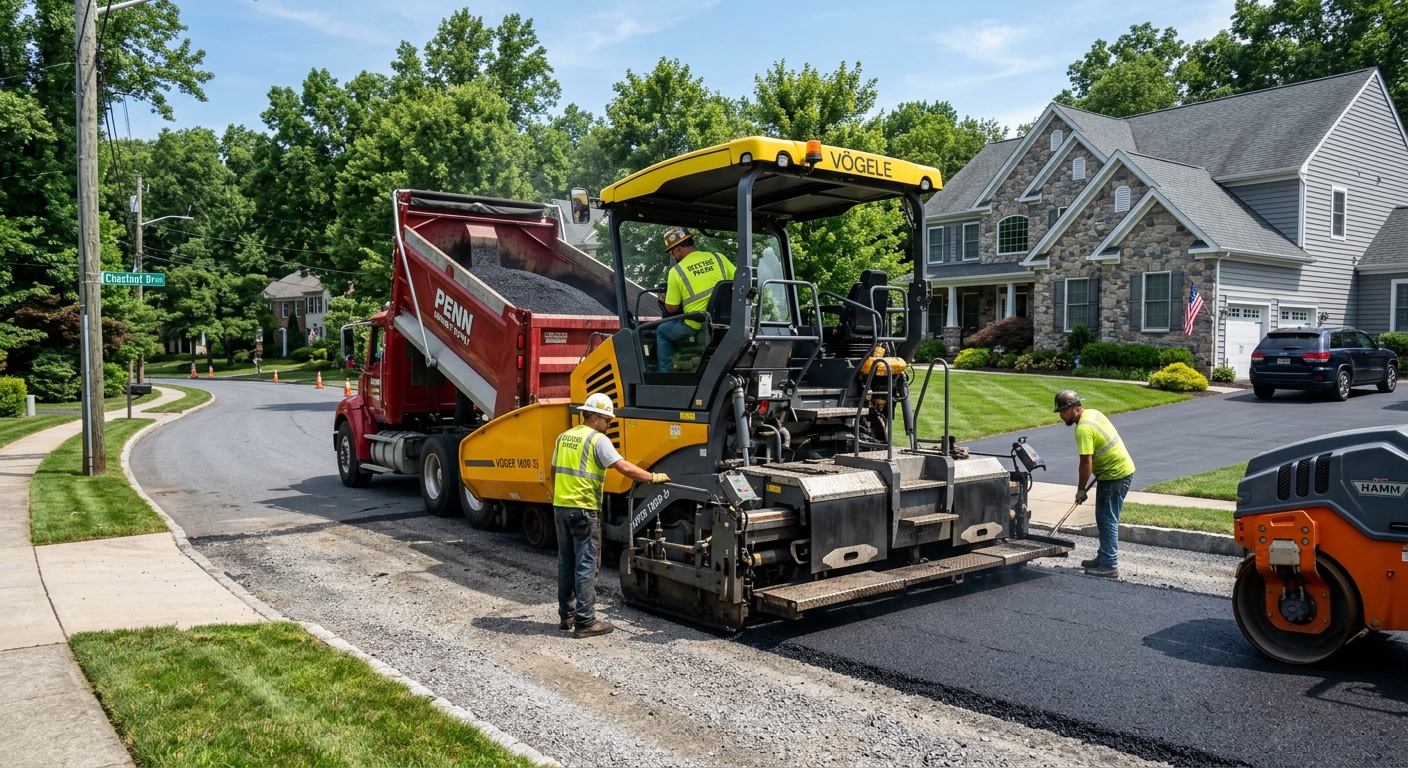
Driveway paving costs in Bethel Park — 2026
In Bethel Park, driveway paving is a reality for most homeowners—almost 75% of homes here are single-family, and the homeownership rate sits above 78% (U.S. Census Bureau, ACS 2024). This means driveway upkeep or replacement is both likely and a meaningful expense. Given our southwestern Pennsylvania climate—with harsh freeze-thaw cycles, up to a 36-inch frost depth, and a clay/shale subgrade—what goes under the driveway matters at least as much as the asphalt or concrete you see. It's that base work, unseen once the job is done, that drives most of the price difference between two quotes. In older subdivisions, you might be dealing with a base put down decades ago without modern drainage or compaction standards, and patching over it is rarely a bargain.
| Service |
Best for |
Lifespan |
Price range |
| Asphalt — full replacement with new base |
failed base, structural cracking |
20–30 yrs |
$3,800–$9,700 |
| Asphalt overlay / resurfacing |
sound base, surface cracking only |
8–15 yrs |
$1,600–$4,800 |
| Sealcoating — single application |
preventive maintenance on sound asphalt |
2–4 yrs |
$225–$750 |
| Concrete — new installation |
long service life, low maintenance |
30–50 yrs |
$5,400–$13,000 |
| Crack filling and patching |
isolated cracks under a quarter inch |
1–3 yrs |
$200–$800 |
| Gravel driveway |
rural, budget, long runs |
5–10 yrs with upkeep |
$900–$3,500 |
Estimates for a typical Bethel Park driveway. Square footage and base condition drive these figures more than material choice.
Door-knocking crews and leftover material
Paving is ripe for scams, especially in areas like Bethel Park that blend busy streets with older homes. The typical frauds aren’t just stories—they show up every season. The pitch often sounds like, “We have leftover asphalt from a job down the road and can offer a big discount if you say yes today.” Suspicious signs include an unmarked truck with out-of-state plates, a crew that wants cash up front, only offers a verbal estimate, or claims oil-based spray is “professional sealcoating.” None of these are how legitimate contractors operate. With multiple asphalt plants and high contractor density in Allegheny County, real professionals have no interest in door-to-door rush jobs. Scam crews know that driveway defects can take a year or more to show up. By then, they’re long gone and untraceable.
Pennsylvania’s Home Improvement Consumer Protection Act is written for situations like this. Any contract over $500 must be written, and you have a three business-day right of cancellation—no questions asked. Never pay in full before work is done, get everything in writing, and don’t be pressured by “today-only” deals. Waiving an insurance deductible is illegal. Use your rights: take your time, read the contract, and if anything feels wrong, you can cancel within that window.
Five-minute sanity checks: verify HIC registration at hic.attorneygeneral.gov, check workers' comp coverage through WCAIS (wcais.pa.gov), ask for proof of local paving jobs, and demand a written contract. These steps run off nearly every scammer before they set foot on your property.
Changing the footprint of a Bethel Park driveway
Not every driveway project is simply tearing out and replacing what’s already there. Expanding for a second car, adding a turnaround, or paving where only gravel existed calls for more planning and excavation. Any time you’re widening into your yard or extending toward a garage, you’re working on undisturbed ground and building a brand-new base. The seam where old meets new will always be more vulnerable to frost and shifting, especially on the hilly, clay-heavy subgrade in Bethel Park. It matters, too, because seamless joins are nearly impossible when dealing with old and new materials.
Local rules often limit how close you can pave to property lines, and increasing your amount of pavement—what’s called impervious surface—may require approval to manage stormwater runoff. Discharging rainwater directly across a sidewalk, or onto a neighbor’s lot, can create headaches regardless of permits. If your project connects a new driveway approach to a state road, you’ll need a Highway Occupancy Permit from PennDOT District 11-0. For residential streets, municipal staff in Bethel Park usually handle the right-of-way, especially if you’re changing a curb or apron.
Caring for a new Bethel Park driveway
The biggest enemy of any driveway in Bethel Park is water—and the freeze-thaw cycles that come with our winters. Your first and most effective care step is filling cracks before water can reach the base layer. Once below, water freezes, expands, and heaves the driveway until you’re facing full replacement. Back up the edges of asphalt with soil or stone to keep them from breaking off where cars roll over. Never let runoff pool on the driveway or flow toward the house; make sure drainage moves water away. Don’t park dumpsters or put jack stands on the surface for long periods—those point loads create permanent marks and cracks.
New asphalt needs time to cure. Wait at least 72 hours before parking, and longer before turning wheels while stationary to avoid scuffing. For de-icing in winter, rock salt will damage concrete driveways—opt for calcium chloride or sand instead. With asphalt, salt is less of a chemical concern, but rapid melting can increase freeze-thaw cycles, which leads to cracks. Alternatives are pricier but extend the life of both surfaces. In our climate, these small disciplines can add years to a driveway’s life.
Why driveways behave differently in Bethel Park
Much of Bethel Park sits over a mix of clay and shale, which is not forgiving to driveways. Clay holds water, causing it to freeze and expand—leading to heaves, cracks, and settling under vehicle weight or from years of winter cycles. Shale drains better but creates its own challenges when it shifts or fractures beneath the surface. These subgrade realities mean that base thickness and compaction are critical. With a frost depth of 36 inches and heavy freeze-thaw periods, skimping on these steps is false economy; driveway failures here usually start from below.
The region’s housing saw rapid buildout in the three decades after World War II, especially in nearby subdivisions like Penn Hills and McCandless. Many driveways laid during that era were paved thinly over whatever was there—sometimes with minimal base or drainage planning. If your Bethel Park home dates to that era, odds are you have an aging driveway that may need a full overlay or replacement, not just another layer of sealcoat. In nearby counties with different soils, a minimalist approach may get by for longer, but not here. Our conditions are tougher on pavement from the start.
Permits and approvals for paving in Bethel Park
If you’re repaving a driveway in Bethel Park and not changing the width or routing, you usually don’t need a building permit. Most replacement or resurfacing work is handled as routine home maintenance. Altering the driveway’s approach—where your driveway meets the street—is another matter. If your driveway connects to a state-maintained road, you must secure a Highway Occupancy Permit from PennDOT District 11-0. For local residential roads, contact Bethel Park’s municipal office to check if you’ll need a right-of-way or curb-cut permit, especially if you’re changing the apron or sidewalk.
Stormwater is always part of the equation. Expanding your driveway or adding new pavement increases impervious surface. That can trigger municipal stormwater review, even if no formal permit is needed. Discharging water onto a neighbor’s property can create future legal issues, regardless of permit status, so always address drainage up front.
When hiring a contractor, verify they hold a Home Improvement Contractor (HIC) registration with the Pennsylvania Office of Attorney General—check at hic.attorneygeneral.gov. Confirm workers' compensation insurance through WCAIS (wcais.pa.gov), even for smaller firms. These protections are for you as much as for the crew, and any reputable Bethel Park contractor will readily show proof.
The honest case for and against sealcoating
There’s no shortage of opinions about sealcoating in Bethel Park, but most come from people selling it. Here’s what sealcoating genuinely does: it shields the asphalt binder from oxidation, resists stains from leaked fuel or oil, and refreshes faded surfaces to look nearly new. That’s genuinely useful when your pavement is sound and you want it to last. However, sealcoating alone does not fix deep cracks, prevent all water intrusion, or add any real structural strength. If your base is failing or you’re seeing widespread cracks, no amount of sealcoating will stop the progress—you’re due for a real fix, not a cosmetic coat.
The part you rarely hear: oversealing, or sealing new asphalt too soon, does more harm than good. Sealcoating too often traps oils and moisture, leading to peeling and surface cracks. Wait at least a year after new paving; then, a seal every two to four years is plenty. The first line of real pavement defense is crack filling and patching. These keep water out of the base—the true enemy in Bethel Park’s climate. A proper sealcoat is free of heavy solvents, rolls on thick, and dries without traffic for a full 24 hours. Those $99 spray jobs, promising a “deal” far below $225–$750, are usually diluted with oil and gone after one winter. Sometimes not sealing at all for a few years buys you more time than cheap jobs that peel right off.
Frequently asked questions — driveway paving in Bethel Park
Are pavers worth the cost in southwestern Pennsylvania?
Pavers can deliver a unique, upscale look, but they’re typically a high-cost option—much more than asphalt or concrete. In Bethel Park, where freeze-thaw cycles and clay/shale subgrade are tough on hardscape, pavers require meticulous base work and ongoing maintenance to prevent shifting and weed growth between joints. For the same footprint, a new concrete driveway costs $5,400–$13,000, while a properly installed paver drive usually runs double or more. Unless you’re aiming for a specific aesthetic or high resale value, the ongoing upkeep and higher initial expense aren’t practical for most owners here. Asphalt or concrete will handle the climate and budget better in most Bethel Park neighborhoods.
What kind of soil is under Bethel Park driveways?
Bethel Park driveways generally rest on a mix of clay and shale, which sets it apart from other parts of Allegheny County. Clay retains water, leading to heaving when it freezes in winter, while shale can fracture and shift. This means your driveway base needs to be thicker and better compacted than in places with sandy or loamy soil. Many driveways built during the postwar boom were laid over these less-forgiving soils—if you don’t address this when resurfacing or replacing, you’ll see new cracks within a few winters. That’s why costs for a full replacement, including a new base, start at $3,800–$9,700.
Is gravel a cheaper option in Bethel Park?
Gravel is the most budget-friendly driveway surface, especially for longer or rural runs common in some pockets around Bethel Park. You’re looking at $900–$3,500 depending on length and preparation. Gravel’s big drawback here is maintenance: plowing scatters it, it shifts on a clay base, and frequent regrading or top-offs are required thanks to hills and stormwater. Still, if you’re after a short-term fix or dealing with access roads, gravel is hard to beat on price but expect a five- to ten-year lifespan and regular upkeep.
Can asphalt be laid in cold weather?
In Bethel Park, the paving season mostly runs from mid-spring through early fall. Asphalt needs to be hot when applied, and cold ground or air causes it to cool before it can be compacted. Once temperatures drop below about 50°F, a new overlay or replacement loses both workability and long-term durability. Contractors who lay asphalt too late in the year may offer a tempting deal, but you’re risking early cracking—making even a $1,600–$4,800 overlay a poor investment. For best results locally, wait until weather and ground temps are reliably warm.
Can I cancel a paving contract I signed at my door?
Yes. In Pennsylvania, the Home Improvement Consumer Protection Act gives you a three business-day right of cancellation for any contract signed at your home costing over $500—no explanations required. This is specifically aimed at door-to-door sales, which are common in Bethel Park and all over Allegheny County. The contractor must provide you with written notice of this right in your contract. If you change your mind, send written notice (email, letter, or even a signed form) within that window. This protects you from urgent, high-pressure offers. Even for a full replacement job up to $9,700, you’re legally covered.
What is the difference between crack filling and sealcoating?
Crack filling and sealcoating serve different roles, especially important under Bethel Park’s freeze-thaw patterns. Crack filling targets individual cracks, preventing water from reaching the base layer and causing major frost heaving—the biggest single factor in driveway lifespan here. Costs for thorough crack repair are typically $200–$800. Sealcoating, meanwhile, applies a thin layer to the whole surface. It defends against oxidation and renews appearance, but won’t block water if cracks are left open. For most homes, crack filling should be the first maintenance priority, with sealcoating only added after your surface is fully sealed.
What causes concrete to spall or flake in Bethel Park?
Concrete spalling in Bethel Park is mainly due to our combination of heavy freeze-thaw cycles, salt use in winter, and the clay-based soil underneath. When water gets into surface pores or small cracks, it freezes and expands, popping off the top layer. Using salt accelerates this, attacks the binder, and makes scaling worse. Proper curing, minimal use of deicers, and keeping the surface sealed can help. Even so, a new concrete drive here (costing $5,400–$13,000) should be installed with air entrainment and thick enough to resist these cycles—cut corners now, see flaking sooner.
How deep should the aggregate base be here?
For Bethel Park, the typical aggregate base should be deeper than in many flatter or sandier regions—largely because of the clay and shale subgrade, plus our 36-inch frost depth. The rule of thumb is at least 8 to 12 inches of compacted stone under asphalt, and 6 to 8 inches under concrete, but some older homes may need even more if water doesn’t drain. Skimping on this is the main reason new driveways fail fast. Full replacement with proper base is why your cost is usually $3,800–$9,700. Never accept a bid that can’t explain base preparation in detail.
What does sealcoating cost in Bethel Park?
A properly applied sealcoat in Bethel Park costs $225–$750 per application, depending on driveway size and prep needed. This covers the full clean, edge work, and a thick, brush- or squeegee-applied product—not a cheap, quick spray. If you see a price much below this, it’s likely a diluted oil mixture sprayed on thin, which may last one season (or less) and could even harm the underlying asphalt. Because sealcoating doesn’t fix structural issues, investing in crack filling first—usually $200–$800—is generally money better spent for most Bethel Park driveways, especially older ones.