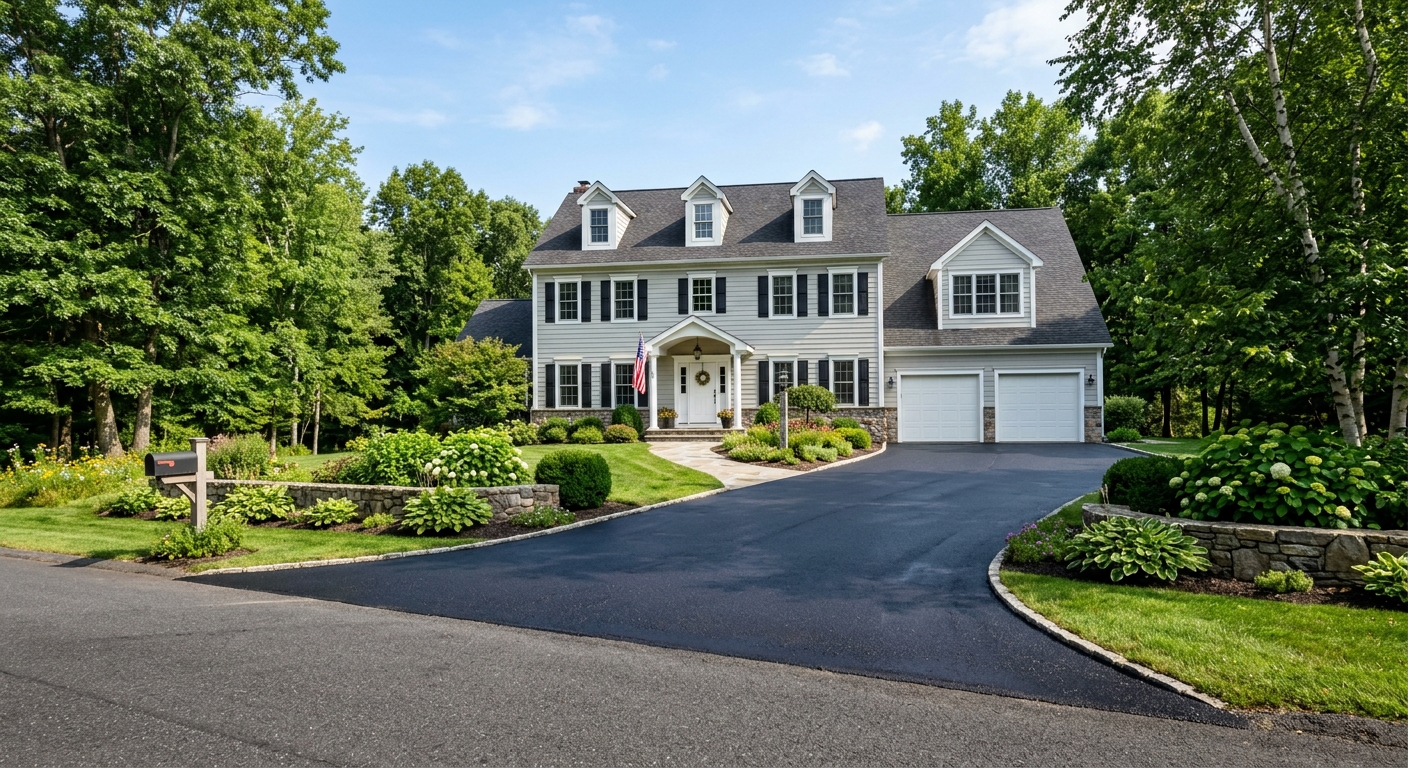
Driveway paving costs in Georges — 2026
In Georges, the decision to pave or replace a driveway is shaped by the township’s strong homeownership—over 80% of homes are owner-occupied (U.S. Census Bureau, ACS 2024)—and by the dominance of single-family properties. Most driveways are significant investments aimed at increasing curb appeal and utility, not just patch jobs. But in this part of Fayette County, the hilly terrain and underlying shale and clay soils turn driveway work into a game of what you can’t see. Harsh freeze-thaw cycles mean a poorly built base won’t last, no matter how good the top looks on day one.
Most of the price difference between two quotes in Georges comes down to what’s buried—aggregate depth, subgrade prep, real compaction. Two driveways poured on the same street, even the same asphalt mix, can have wildly different lifespans purely because of hidden details. Asphalt and aggregate costs are steady thanks to local Monongahela Valley supply, and travel costs are relatively controlled. What you pay for is how well the layers under the surface are handled, and that work separates a true investment from a short-term patch.
| Service |
Best for |
Lifespan |
Price range |
| Asphalt — full replacement with new base |
failed base, structural cracking |
20–30 yrs |
$3,500–$9,000 |
| Asphalt overlay / resurfacing |
sound base, surface cracking only |
8–15 yrs |
$1,500–$4,500 |
| Sealcoating — single application |
preventive maintenance on sound asphalt |
2–4 yrs |
$200–$700 |
| Concrete — new installation |
long service life, low maintenance |
30–50 yrs |
$5,000–$12,000 |
| Crack filling and patching |
isolated cracks under a quarter inch |
1–3 yrs |
$200–$800 |
| Gravel driveway |
rural, budget, long runs |
5–10 yrs with upkeep |
$900–$3,500 |
Estimates for a typical Georges driveway. Square footage and base condition drive these figures more than material choice.
Getting thirty years out of a driveway
The life of a driveway in Georges is determined less by what’s poured than by how you care for it—especially in the region’s heavy freeze-thaw climate. The number one factor is sealing cracks before water gets through to the base. Once the base takes on water, freeze-thaw cycles lift and ruin the structure from beneath, and there’s no cheap fix. Keeping drive edges supported—by backfilling or with hard edging—prevents raveling and break-off. Always keep surface drainage moving so water doesn’t pool or direct runoff toward your house or your neighbor’s lot.
Weight is another killer: avoid parking RVs, dumpsters, or using jack stands on the apron. If you have new asphalt, allow a solid 7–14 days (weather dependent) before parking; hold off on sharp turns while stationary even longer, or you’ll end up with permanent scarring.
De-icing is tricky here. Salt attacks concrete, causing spalls and surface crumbling, so it’s best to avoid rock salt entirely on concrete. Safer alternatives—calcium magnesium acetate or small amounts of sand—cost more up front, but protect the surface. On asphalt, salt won’t attack chemically, but it melts snow and causes refreeze at night, which pumps damaging water into any crack. If you must use salt, sweep it off as soon as practical.
Comparing materials in southwestern Pennsylvania
Choosing between asphalt and concrete in Georges isn’t just about the upfront cost. With the region’s freeze-thaw extremes and clay-heavy soils, each has strengths and traps. Asphalt is flexible and absorbs ground movement, which means it can ride out a harsh Pennsylvania winter by flexing a fraction, not cracking. It’s less expensive—see $3,500–$9,000 for full replacement—but needs sealcoating every few years and won’t tolerate a weak base.
Concrete, meanwhile, can last decades—30 to 50 years isn’t uncommon, if it survives—but the real risk here is de-icing. Salt eats at the surface, causing chipping and scaling that turns a pristine white apron into an eyesore in just a couple winters. In Georges, where plowing and salting are facts of life, you’d have to swear off salt-based de-icers entirely to get top lifespan from concrete. Few homeowners actually do. If you can commit, concrete delivers low maintenance and rarely needs patching.
Pavers suit specialty looks or repairs—high price, but you can replace sections without patchwork. They settle slowly, not crack. Gravel remains viable for rural or secondary driveways, or where budget and length matter most. With our shale subgrade and steep grades, well prepped gravel drains well and lasts if topped off regularly.
| Option |
Installed cost |
Maintenance |
Freeze-thaw performance |
Lifespan |
| Asphalt — new install |
$3,500–$9,000 |
sealcoat every 3–4 yrs |
excellent, flexes |
20–30 yrs |
| Asphalt — overlay |
$1,500–$4,500 |
same |
good if base is sound |
+8–15 yrs |
| Concrete |
$5,000–$12,000 |
low, avoid de-icing salt |
fair, spalls with salt |
30–50 yrs |
| Pavers |
$8,000–$12,000 |
individual units replaceable |
good, settles gradually |
25–50 yrs |
| Gravel |
$900–$3,500 |
top-dress every 2–3 yrs |
excellent drainage |
indefinite with upkeep |
What you need before paving in Georges
For most driveway paving projects in Georges, a building permit isn’t required if you are just resurfacing or replacing within the existing footprint—so you save yourself the runaround. However, if you’re changing the access point or widening where your driveway meets a state route, you’ll need a permit from PennDOT Engineering District 12‑0, not from the township or borough. Many homeowners miss this, but work at your driveway approach is state-regulated, and skipping that permit creates headaches selling or when an inspector comes by.
Expanding or adding new hard surface can also trigger stormwater requirements. Redirecting runoff onto a neighbor’s property, regardless of what’s permitted, sets up legal problems. Good drainage design is critical—not just for passing code, but for keeping peace with neighbors and preventing base failures down the line in Georges’ hilly terrain.
To protect yourself, only hire contractors registered with the Pennsylvania Office of Attorney General—verify their Home Improvement Contractor number at hic.attorneygeneral.gov. Every contractor employing workers is required to carry workers’ compensation insurance, checked against the WCAIS database (wcais.pa.gov). Insist on seeing both, because these are your only protection if a worker is injured or something goes wrong.
What to put in a Georges paving contract
If you want your driveway to last in Georges, stop qualifying bids by price alone. Everything that wins you longevity is on the written spec, not the sign in the yard. Demand that your quote specify, in inches, the excavation and removal depth, new aggregate base thickness, type of base—ideally 2A modified stone—how and whether compaction happens in lifts, and the actual “as compacted” depth for both asphalt binder and top course. If a quote promises “three inches,” ask: is that before or after compaction? In this trade, three inches loose often means two-and-change after the roller runs through. In our region’s freeze-thaw climate and with shale base, skimping on depths or compaction is the first corner cut, and you won’t know until ruts show by year four.
Your contract should address: mix design (such as PennDOT ID-2 wearing for surface), drainage slope, edge restraint, and curing recommendations. These details are not overkill—they provide leverage if you have to call somebody back. Freeze-thaw and steep grades in Fayette County mean you need real structure underneath, not just blacktop on the surface.
- Total excavation/removal depth in inches
- Aggregate base depth (minimum 6–8 inches for clay/shale soils)
- Specified aggregate type (2A modified stone or better)
- Compaction in lifts, with lift thicknesses stated
- Asphalt binder course depth (compacted)
- Asphalt wearing course depth (compacted)
- Specific asphalt mix designation (e.g., PennDOT ID-2)
- Drainage slope away from house and neighbor’s property
- Edge restraint type (hard edging or compacted backfill)
- Recommended curing or use restrictions before regular traffic
Why you can't pave in February
Paving season in Georges is locked to the weather, not just convenience. Hot-mix asphalt needs to be installed and compacted above a certain temperature—if the surface or air is too cold, the mix can’t compact before it hardens and you’re left with a porous, failure-prone drive. For our region, with winter design lows around 8 °F, asphalt plants in the Monongahela Valley shut down from late November through late March, and material simply isn’t available even if someone promises a deal. Laying concrete when the ground is below freezing leads to surface scaling and weak spots—concrete must cure above 40 °F for days, or the surface is toast before the first winter is out.
The best time to pave in Georges is late April through October. Early spring and late fall (shoulder months) are good if the weather holds and the plant’s open, and many crews have more availability then. Summer is peak season—prices rise and reputable contractors are booked out. If someone is offering to pave in February or after a hard freeze, question their standards, because the work will not last. Scheduling against this window is reality here.
What's under the asphalt matters more than the asphalt
Every driveway in Georges that lasts has one thing in common: attention to what’s under the surface. Here’s the basic assembly, Fayette County-style: first, a properly graded subgrade—often clay and shale over Monongahela hillsides—goes down, shaped for drainage. On top of that is a thick, compacted aggregate base (at least 6–8 inches, more on a hillside), which spreads vehicle weight and drains moisture away from asphalt. Only then does the asphalt layer—the part you see—get placed and compacted. Each layer transfers stress to the one below, and any weak point leads to ruts, cracks or base pumping in under five years.
The region’s freeze-thaw cycles are brutal: water trapped in the subgrade freezes and expands, “heaving” the slab or asphalt upward, then dropping it back down every thaw. This uneven lift literally tears the driveway from the underside, causing waves, cracks, and joint failure. Base depth and drainage therefore matter more here than in any state with a shallow frost line.
This is precisely where cheap quotes save money—by skimping on excavation, laying thin or untested base, doing a “skin patch” over failed material, or skipping compaction. None of these shortcuts show until the first or second winter, when soft spots appear and repairs become your problem. If your contract doesn’t specify base depth (in inches), exact aggregate type, and confirmation that compaction was done in lifts—not just a quick pass at the end—you’re at the mercy of what your crew did when you weren’t watching. And unfortunately, Fayette County’s steep ground and local clays won’t forgive shortcuts.
Frequently asked questions — driveway paving in Georges
Do I need a permit to repave a driveway in Georges?
In Georges, if you’re just resurfacing or replacing your driveway within its current footprint, you typically do not need a building permit—the local townships generally don’t require one for these projects. But if your project affects the driveway approach, where it connects to a public (especially state) road, you almost always need a permit from PennDOT Engineering District 12‑0. Many homeowners are surprised by this, but this requirement is set at the state level, and ignoring it can cause delays when you sell or get township inspections. If you’re planning to widen or move your driveway, or add a second entrance, always check with both your local office and PennDOT before scheduling work. It’s better to confirm up front than pay more in corrections later.
Is gravel a cheaper option in Georges?
Gravel remains a practical and budget-friendly choice in rural sections of Georges, especially for long driveways where paving costs would be prohibitive. Installation typically costs between $900–$3,500—less than a third of the price for a comparable asphalt drive. Georges, with its hilly, clay and shale soils, is actually a reasonable place for gravel provided the subgrade is properly shaped and the surface is crowned for drainage. You’ll need to plan for semi-regular top-dressing (every 2–3 years) and re-grading after major storms. Gravel is noisier and less tidy, but it handles steep approaches and PennDOT-permitted entrances cheaper than any solid material. If dust or tracking bothers you, there are low-cost chipseal or dust-control upgrades, but those push up lifetime cost. For high-traffic or tight neighborhoods, asphalt or concrete make more sense, but gravel is hard to beat for budget and longevity in our area.
How much does driveway paving cost in Georges?
Paving costs in Georges reflect local materials, travel, and this region’s tough subgrade conditions. A standard asphalt driveway replacement with a new base costs $3,500–$9,000 for most homes, and you can expect a typical job to land near $5,500 unless you’re going extra wide or extra long. Asphalt overlay to freshen a solid base is less, usually $1,500–$4,500. If you choose concrete, expect $5,000–$12,000, with materials and finish options as the main variables. Travel surcharges are common for rural addresses, but local Monongahela Valley aggregate helps keep material supply steady. The biggest cost factors are access (steep or hard-to-reach sites run higher) and what’s required for the base—more excavation and stone means more up front but much lower risk of early failure.
What does compaction in lifts mean?
“Compaction in lifts” is industry talk for installing your driveway base and asphalt in several thin layers—usually three to four inches thick—compacting each layer fully before the next is laid. In Georges, with its heavy clay and shale soils, this technique is crucial. Laying the base in one thick lift and only running the roller at the end leaves air pockets and soft spots, especially on hilly drives. Those weak spots won’t show until the ground freezes and thaws, but that’s when you see ruts and cracking. By compacting in lifts, each layer becomes solid before the next is added, building a base that resists both heavy vehicles and water infiltration. If your paving crew skips this step, you’re not getting the service you’re paying for—even on a $3,500–$9,000 job.
How long should an asphalt driveway last in Georges?
A properly built asphalt driveway in Georges should last 20–30 years under normal conditions. This assumes a solid subgrade, a full aggregate base (at least 6–8 inches thick), and a surface properly sloped for drainage. Annual sealing and timely crack filling extend life at little ongoing cost—figure $200–$700 every few years for sealcoating. Neglecting maintenance, allowing heavy trucks or dumpsters to sit, or skimping on initial compaction can chop a decade off your drive’s lifespan, especially with Fayette County’s severe freeze-thaw swings. Remember, cheap jobs almost always skimp on the base—which you won’t realize until too late. With reasonable care and contract specs, thirty years is realistic in this region.
Is an overlay worth it or should I start over?
Asphalt overlays or resurfacing, priced from $1,500–$4,500 in Georges, are worthwhile if your existing base is still solid—meaning only surface cracks or minor pitting, with no deep depressions or widespread alligator cracking. If the base is soft or heavily cracked (pushes underfoot, waves, or shows rutting), resurfacing is a bad investment; problems will reappear within a few freeze-thaw cycles. In those cases, only a full replacement—removing the old drive, fixing underlying base, rebuilding from the bottom up—will provide a durable fix, and costs more up front ($3,500–$9,000) but saves money and hassle long-term. A reputable contractor will properly core or test your existing base before recommending which way to go.
How long before I can drive on a new asphalt driveway?
In Georges, after new asphalt is placed, wait at least 24–48 hours before driving a light car on it, and a full 7–14 days before parking regularly—especially in warmer months when fresh asphalt remains pliable longer. This window allows the binder to set and the surface to cool evenly through its full depth. The heavier the vehicle, the longer you should wait; don’t park RVs or large pickups early. Turning your wheels sharply while stationary will cause scarring in fresh asphalt, so keep turns gradual for the first month. Contractors will give you a specific recommendation based on outdoor temps; follow it closely, because this cure time is non-negotiable if you want your $3,500–$9,000 investment to last.
What is the difference between crack filling and sealcoating?
Crack filling and sealcoating are both asphalt maintenance tasks but serve different jobs—and both matter for Georges’ freeze-thaw climate. Crack filling uses flexible rubber or asphalt compounds to fill and seal individual cracks (usually under a quarter-inch wide), stopping water from reaching the base where freeze cycles can cause heaving and breakdown. It’s targeted, and should be repeated as new cracks appear—costing $200–$800 for a typical driveway. Sealcoating, by contrast, is a thin surface coating brushed or sprayed over the entire drive. It protects against UV, slows minor surface wear, and keeps the drive darker and neater, but does not stop water or serious cracks. Both are cheap insurance, and best applied in combination for driveways you want to last a full 20–30 years in Georges.
Does road salt damage driveways in Georges?
Road salt is a fact of winter life in Georges and the rest of Fayette County—but it affects driveway surfaces differently. On concrete, salt is the biggest enemy: it draws moisture into the slab, then cycles between freezing and thawing to cause surface scaling, spalling, and ultimately crumbling. Even high-strength concrete cannot escape this process over repeated winters. That’s why most contractors here advise against using salt-based de-icers on concrete. Asphalt tolerates salt chemically, but it’s the freeze-thaw water cycling that does the real harm—salt-melted snow seeps into even hairline cracks, freezes at night, and pops out chunks by spring. Preventing damage means keeping up with crack sealing ($200–$800) and redirecting water before it gets below the surface. Alternatives like sand work but offer less melt power, so it’s a compromise every Georges homeowner should plan for.