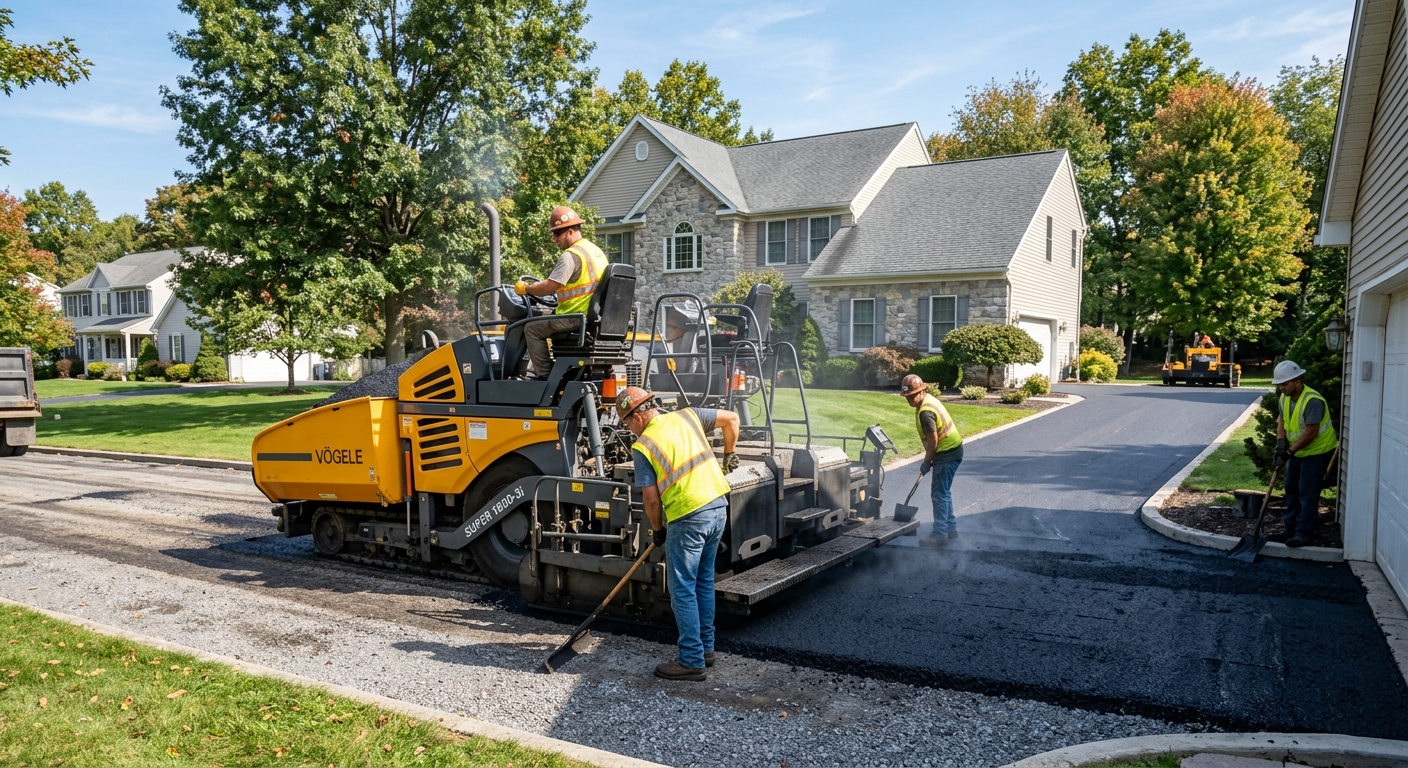
What a new driveway costs in West Caln
West Caln’s homeowners — over 88% of households here own their homes and nearly 80% live in single-family houses (U.S. Census Bureau, ACS 2024) — are prime candidates for driveway paving projects. Whether replacing asphalt, resurfacing an aging drive, or making the jump to concrete, driveway work is a real investment in these larger-lot neighborhoods. In southeastern Pennsylvania, our freeze-thaw cycles and soils over limestone and dolomite mean you are always paying not just for what you see at the surface, but mostly for what’s under it.
The most expensive part of any driveway quote comes from base preparation: excavation, adding new aggregate, compacting in lifts, and managing water so frost doesn’t destroy your investment. Two bids that look similar at first glance may be miles apart below ground. Shortcuts here don’t show up until a few winters later, when cracks and settlement reveal what was missed.
| Service |
Best for |
Lifespan |
Price range |
| Asphalt — full replacement with new base |
failed base, structural cracking |
20–30 yrs |
$3,800–$9,900 |
| Asphalt overlay / resurfacing |
sound base, surface cracking only |
8–15 yrs |
$1,650–$4,900 |
| Sealcoating — single application |
preventive maintenance on sound asphalt |
2–4 yrs |
$225–$750 |
| Concrete — new installation |
long service life, low maintenance |
30–50 yrs |
$5,500–$13,000 |
| Crack filling and patching |
isolated cracks under a quarter inch |
1–3 yrs |
$200–$800 |
| Gravel driveway |
rural, budget, long runs |
5–10 yrs with upkeep |
$900–$3,500 |
Estimates for a typical West Caln driveway. Square footage and base condition drive these figures more than material choice.
Base preparation: the part you pay for and never see
The life of your driveway in West Caln depends overwhelmingly on what’s under the pavement, not what you see when the crew pulls away. Here’s the structure: at the bottom sits the native soil (the subgrade). Over that, a compacted aggregate base — usually crushed stone from one of the quarries near Downingtown or Coatesville — distributes load and drains water. The asphalt sits on top of that.
Chester County’s soils, especially over limestone and dolomite, need special attention. Water in these soils expands as it freezes. That freeze-thaw action can lift the driveway (“frost heave”), cause settlement, and crack the surface from below. If the contractor skimps on excavation or base depth, or lays thin, poorly compacted stone, all those problems get locked in. Once asphalt goes on, you won’t see it for years — but when the first big winter comes, you’ll be calling to ask why the drive is sinking or cracking.
The biggest place a cheap quote undercuts quality is here: not enough excavation (maybe just removing old asphalt instead of digging out soft spots), skipping new stone, thin lift thicknesses, or failing to test compaction after each layer. You must get in writing:
- Excavation depth (inches below finished grade, usually at least 8–12" in this region, more on soft spots)
- Aggregate base type (2A modified or similar, not recycled debris)
- Aggregate base depth (at least 6", more is often needed on West Caln’s soils and for driveways seeing heavy vehicles)
- Compaction in 3–4" lifts, using proper plate or roller equipment
If those specs aren’t in the contract, you are counting on luck and weather. With freeze-thaw cycles and our local ground, most of what you pay for is never seen — but always shows up in driveway life.
How paving fraud actually operates
There is a reason paving scams are so common in Chester County: driveway projects are highly visible, but their biggest flaws are invisible for years. Operators show up in an unmarked truck, claim to have “leftover asphalt from a job down the road,” and pitch a one-day “cash only” deal. The work is done fast, the base is ignored, and beyond the blacktop itself, you have no idea what went under it.
Common pitches include: today-only deals, an unmarked vehicle with out-of-state plates, aggressive cash-upfront demands, a handshake quote without any detailed written scope, and a “sealcoating” that’s nothing but a thin oil spray. In a suburban market like Chester County, where driveways are long and neighbors are a bit more distant, these fraudsters know there’s less word-of-mouth. By the time defects show up, they’re long gone.
Pennsylvania law protects you. For any home improvement over $500, you must receive a written contract and have a clear, three-business-day right to cancel under the Home Improvement Consumer Protection Act. If a contractor tries to do business on a handshake or cannot provide a registered HIC number, walk away.
Five-minute checks stop nearly every paving scam: Confirm HIC registration at hic.attorneygeneral.gov, ask for proof of workers' comp at wcais.pa.gov, and refuse cash-only, driveway-approach deals without a written contract.
What you need before paving in West Caln
If you’re simply resurfacing or repaving a driveway in its footprint on your property in West Caln, most townships in Chester County do not require a permit — that saves you a step. However, any changes to the driveway’s connection to the public road, or any new construction within the right-of-way, triggers driveway approach permit requirements. For driveways accessing state roads, this means a Highway Occupancy Permit from PennDOT’s Engineering District 6-0.
Be cautious when increasing the paved area, widening a drive, or regrading. Adding impervious surface can trigger stormwater regulations and runoff management requirements. Even without official permits, sending runoff onto a neighbor’s property makes you liable for any damage.
Before hiring, confirm your paving contractor is registered for home improvement work using the Pennsylvania Office of Attorney General’s HIC registry (hic.attorneygeneral.gov). Workers’ compensation coverage is also mandatory for all employers in Pennsylvania; verify on the WCAIS system (wcais.pa.gov). For jobs over $500, a written contract and a three-business-day right of cancellation are required and protect you from fraud.
How to vet a paving contractor in West Caln
In West Caln, vetting a paving contractor means more than asking for a recent reference and a phone number. Start with their HIC registration at hic.attorneygeneral.gov and workers' compensation verification via WCAIS. A legitimate paving company in Chester County will have a fixed local address (not just a mobile number), own their equipment, and use nearby aggregate plants in Downingtown or Coatesville — with such proximity, there’s no excuse for not knowing local suppliers.
Ask for references from projects done three or more years ago, not just last season. Surface defects often don’t show for the first freeze-thaw cycles. Reliable contractors can tell you what plant supplies their asphalt — if they’re vague, they may be just brokers, not true installers.
- Verify HIC registration (hic.attorneygeneral.gov)
- Check workers’ compensation at WCAIS (wcais.pa.gov)
- Ask for a physical business address
- Ensure they own/operate their paving equipment
- Request supplier information (quarry/asphalt plant).
- References at least three years old
- Photos of past work after multiple winters
- Proof of insurance (not just worker’s comp)
- License plate check — avoid out-of-area vehicles
- Scope of work must be detailed, written, and include base specs
- Never pay cash up front or agree to a “leftover materials” deal
Red flags: a PO box only, all communication by a burner cell, no written scope, vague on materials, or refuses to name subcontractors or suppliers.
What to put in a West Caln paving contract
In driveways, a numberless contract is worthless. For West Caln’s soil and climate, you need clear construction specs — and in writing, not just on a handshake. Without them, you are buying thickness “as the eye sees it,” and that eye cannot see what goes below the surface.
Demand the contract spell out exactly how much excavation will be performed, the depth and type of aggregate base, and that the stone will be compacted in layers (lifts) — not all dumped at once. Specify that all depths are “as compacted”: loose stone or freshly laid asphalt will settle dramatically. For asphalt, require separate depths for binder and surface courses (typically 2–3" binder, 1–1.5" surface compacted), the mix number, and edge treatment (tapered edge or retaining forms).
Because southeastern Pennsylvania sees moderate freeze-thaw cycles and sits on uneven soils, our driveways need deeper bases and denser compaction than a milder region. Without these, subgrade movement will break up the surface years too soon.
- Excavation depth (inches below finished grade)
- Aggregate base type (e.g., 2A modified crushed stone)
- Aggregate base depth, measured as compacted
- Compaction method, in lifts
- Asphalt binder course depth (inches compacted)
- Surface course depth (inches compacted)
- Specified asphalt mix designation
- Edge treatment (taper, vertical, or border restraint)
- Stormwater/drainage handling plan
- Cleanup, reseeding, or repair clauses
Never accept “We’ll put down three inches” unless that means three inches after compaction — and specified for both binder and surface courses.
The honest case for and against sealcoating
Sealcoating a driveway in West Caln can be real maintenance value, or it can be a waste — it depends on the driveway’s age and condition. A proper sealcoat shields the asphalt binder from UV light, weather, and chemical spills, and it definitely enhances curb appeal by making the surface look new. It does not add any structural strength or fix existing cracks, nor will it prevent major failure if the base is already compromised.
Most importantly, high-frequency sealing — annually or even every other year — causes as many problems as it solves. Multiple layers build up, become brittle, and start to peel or crack. Brand new asphalt shouldn’t be sealed for at least 6–12 months; doing it too soon “locks in” solvents, causing soft or sticky pavement. A realistic interval in West Caln is every 3–4 years, assuming the surface is still in good shape.
If you have cracks, deal with those first: hot-rubber crack filling does more to extend driveway life here than any amount of cosmetic sealing. Likewise, beware of “sealcoat” jobs pitched at the low end — <$300 for a two-car drive — these are usually thin, spray-on oil-based dressings that won’t last a season and can do more harm than good. Professional applications with squeegee or brush, at $225–$750, deliver much better results. Ask what’s being used and how it’s applied.
Frequently asked questions — driveway paving in West Caln
Is gravel a cheaper option in West Caln?
Gravel is often the lowest up-front cost for driveways here, especially on rural lots with longer runs. The typical price for a new gravel drive in West Caln is $900–$3,500, making it much less expensive than asphalt or concrete. However, you need to budget for ongoing maintenance—gravel requires periodic grading, topping up, and weed control. With West Caln’s freeze-thaw and rainfall, gravel can rut and wash out more quickly than in flat, arid places. If you don’t mind the extra work and some mud in wetter months, gravel works well and drains naturally, but don’t expect a maintenance-free surface.
Why are my driveway edges crumbling?
Edge failure is a top complaint in West Caln, especially on older asphalt driveways. There are two main causes: insufficient base beneath the edge (a common shortcut), and traffic driving close to or off the edge, which the asphalt cannot support without side support. On curvy or narrow drives, this happens all the time. Water from rain or snowmelt gets into these unprotected edges, seeps underneath, and accelerates freeze-thaw breakdown. If you’re resurfacing or replacing, specify that your new driveway gets at least 6–12" of base extending past the surface on each side, and consider concrete edge restraint. Professional repair—expect $200–$800 for patching—can help, but the best solution is good base and edge installation from the start.
Do I need a permit to repave a driveway in West Caln?
If you’re just resurfacing or replacing an existing driveway inside your property lines in West Caln, you typically don’t need a permit—most Chester County townships allow this work to proceed without one. But if you’re changing the driveway’s connection to the road, expanding onto public right-of-way, or modifying the approach, you will need a driveway permit. For driveways connecting to state roads, that means applying to PennDOT’s Engineering District 6-0. Always check with your township office before major changes. Regardless of permit status, your contractor must be HIC registered and insured. Typical repaving runs from $1,650–$4,900 for an asphalt overlay.
Does road salt damage driveways in West Caln?
West Caln driveways do face salt exposure every winter, especially if you’re near a township road. Asphalt is more resilient to salt than concrete, but even blacktop can degrade over time if salt and melting/freezing water repeatedly enter the surface and edges. For concrete, salt does more visible damage—scaling, surface flakes, and deeper cracks. The best defense for either is sealing: on asphalt, a periodic sealcoat every few years ($225–$750), and for concrete, a penetrating sealer. Both clay soils and limestone subgrades in Chester County hold water, making the combination of salt and freeze-thaw especially rough here.
What is the difference between binder and surface course?
In West Caln, a quality asphalt driveway is usually built in two layers: the binder course and the surface course. The binder is the thicker, stronger base layer—it has larger aggregate and provides most of the structural strength. The surface course is a finer mix for a smoother, denser, more weather-resistant top. Contracts should specify both depths “as compacted” (not as laid)—for instance, a 2.5" binder plus 1.5" surface is common here. Skipping the binder, or thinning the surface course to save money, shortens driveway life and makes it more prone to cracks. You typically see this clear split in jobs at the high end of the $3,800–$9,900 price range.
How much does it cost to widen a driveway?
Widening a driveway in West Caln isn’t just extra blacktop—it means excavating the new area, matching base depth, and tying the new section to the old. For a typical two-car drive widened by a few feet for extra parking or easier turning, count on $1,650–$4,900 (asphalt overlay to full-depth replacement). If your project crosses into the public right-of-way, expect to pay for a township or state permit as well—PennDOT if you're on a state road. More substantial or complex widening, especially with concrete, can hit $5,500–$13,000. Always confirm drainage is properly managed to avoid future problems.
When is the best time of year to pave in West Caln?
In West Caln, paving season realistically runs from late April through October. Asphalt needs daytime temps solidly in the 50s or above for proper compaction and bonding—try it late in the fall or too early in spring, and you’ll get poor results. Rainy spells stall work, too, since subgrade moisture can cause long-term issues. Scheduling at the season’s peak can mean higher prices, but you avoid the risks and poor surface finish of cold-weather paving. Even so, don’t rush sealcoating: new asphalt should cure at least 6–12 months before your first seal at $225–$750.
Is sealcoating a scam?
Proper sealcoating is not a scam in West Caln, but there are scammy practices. Done right, it’s preventive maintenance that keeps UV and fluids from breaking down your asphalt, and it improves the look. What is a scam? A cut-rate, $150 “seal” sold by a door-to-door crew using thin, oily spray—this does nothing for longevity and creates peeling and streaking. Legitimate sealcoating should be professionally brushed or squeegeed, with adequate prep (crack filling first), and priced in the $225–$750 band. Too-frequent sealing can harm your drive. If your surface is failing or the base is shot, sealcoating is a waste. It’s a maintenance tool, not a fix.
Asphalt or concrete for a West Caln driveway?
Both materials have their place in West Caln. Asphalt is often chosen for its lower up-front cost ($3,800–$9,900 for new), easier repairs, and better performance in our freeze-thaw cycles and on sloped drives. Concrete costs more ($5,500–$13,000), but if installed with proper base and control joints, offers a longer lifespan (30–50 years) and lower day-to-day maintenance. Concrete is less forgiving to salt and needs sealing to avoid surface scaling. For larger or curved driveways, asphalt is typically more cost-effective. For a long-term, crisp look and less frequent upkeep, concrete wins—if you don’t mind the initial investment.